
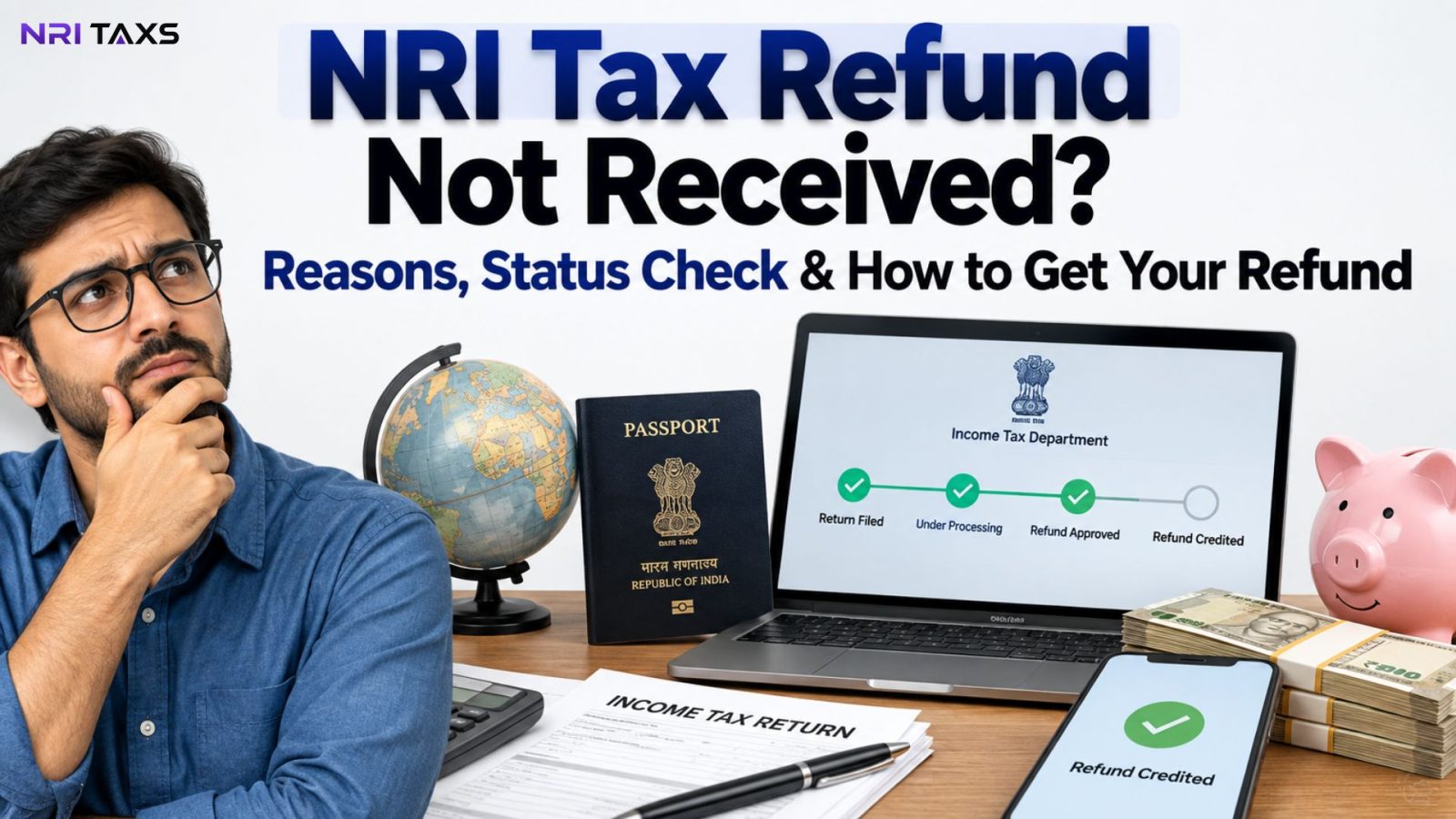
You filed your ITR, expected a tax refund, but the money still hasn’t reached your bank account? For NRIs, a delayed refund can happen because of an unprocessed ITR, incorrect or invalidated bank details, TDS mismatches, outstanding tax demands, or other issues with the return. If your NRI tax refund is not received, the first step is to check the exact refund status and identify what is holding up the payment. This guide explains the common reasons for refund delays, how to check your refund status online, and what you can do to get the refund processed.
Key Takeaways
- ✔ An NRI tax refund can be delayed due to ITR processing, bank validation issues, incorrect bank details, TDS mismatches, or outstanding tax demands.
- ✔ Before taking any action, check the exact refund status on the Income Tax e-Filing portal.
- ✔ If the refund has failed, verify your bank account, IFSC, PAN details, and account validation status.
- ✔ Check Form 26AS and AIS to ensure the TDS claimed in the ITR matches the tax department’s records.
- ✔ If an old tax demand exists, your refund may be adjusted against that outstanding demand.
- ✔ A refund failure may require a refund reissue request, rectification, or response to an outstanding demand, depending on the reason.
- ✔ If the refund remains stuck despite correcting these issues, professional NRI tax assistance can help identify the exact issue and take the appropriate action.
Why Is NRI Tax Refund Not Received?
- Refund Is Still Processing:- Your ITR may simply be within the normal processing window. CPC verifies income, TDS, and deductions before issuing any refund, so a few weeks’ wait is expected and not automatically a problem.
- ITR Has Not Been Processed Yet:- No refund is released until your return is fully processed and Section 143(1) intimation is issued. If e-verification wasn’t completed, processing itself hasn’t even started.
- Bank Account Is Not Validated:- Refunds only credit to a pre-validated bank account on the e-filing portal. Many NRIs skip this step or validate an account that’s since gone inactive, silently blocking the payout. This is often tied to an outdated KYC status that was never updated from resident to NRI, which stops the bank-side verification from matching.
- Refund Failed Due to Bank Details:- A wrong account number, closed account, outdated IFSC, or a bank merger can cause the refund to bounce back after issuance, even when everything else on your return was correct.
- Outstanding Tax Demand:- Under Section 245, the department can adjust your refund against an old unpaid demand from a previous year, releasing only the balance or nothing without always notifying you clearly.
- ITR Information Does Not Match:- If the income or deductions reported in your ITR don’t align with your Form 26AS or AIS, the return gets flagged for reconciliation, which pauses the refund until it’s resolved. This mismatch shows up often when NRIs skip filing altogether after a sale, which is also why filing an ITR after selling property in India is treated as mandatory, not optional, for anyone expecting a TDS refund.
- TDS Details Are Missing or Incorrect:- If a bank, tenant, or buyer deducted your TDS but reported it wrongly, the credit won’t reflect in your Form 26AS, and the department won’t release a refund it can’t verify. This is an especially common gap on NRO fixed deposit interest, where the wrong TDS rate or reporting error can hold up the entire refund.
- ITR Was Defective or Requires Correction:- A return flagged as defective under Section 139(9) needs correction within the given window. Until you respond, it isn’t treated as validly filed, and no refund can move.
- Refund Was Adjusted Against Previous Tax Demand:- Even a small, disputed, or already-paid old demand can silently eat into this year’s refund. Checking your outstanding demand list catches this before it surprises you.
How to Check NRI Tax Refund Status Online
Check Refund Status on the Income Tax e-Filing Portal
Step 1: Log in to the e-filing portal at incometax.gov.in using your PAN as the user ID and your registered password, then navigate to your personal dashboard to begin the refund check.
Step 2: Go to “e-File” and then “Income Tax Returns,” and select “View Filed Returns” to see every return you’ve submitted, along with its current processing stage for the relevant assessment year.
Step 3: Click on the specific assessment year’s return to open detailed status information, including whether it has been e-verified, processed, or is still pending action from the department’s side.
Step 4: Look for the refund status field, which shows outcomes like “Refund Issued,” “Refund Failed,” “Processed with Refund Due,” or “No Demand No Refund,” depending on where your case stands.
Step 5: If it shows “Refund Failed,” open “Services” and select “Refund Reissue Request” to correct your bank details and resubmit, rather than waiting indefinitely for it to resolve on its own.
Check Refund Status Through the Refund Banker/NSDL Route
Step 1: Visit the TIN-NSDL refund status page, a separate government-run tracker that shows the actual RBI/bank-side movement of your refund once it leaves the tax department’s system.
Step 2: Enter your PAN and select the correct assessment year from the dropdown, making sure it matches the exact year you’re trying to check the refund for.
Step 3: Submit the captcha and view the result, which typically shows a status like “Refund Sent to Bank,” “Refund Paid,” or a specific failure reason if applicable.
Step 4: If it shows “Sent to Bank” but nothing has landed, allow one to three working days, since a short gap between RBI release and bank credit is completely normal.
Step 5: If a cheque was issued instead of a direct credit, use the tracking reference shown to follow it through India Post’s Speed Post tracker for delivery status.
What to Do If Your NRI Tax Refund Is Delayed
- Verify Your Bank Account Details: Double-check the account number, IFSC, and account type entered on the portal against your actual passbook or bank statement, since even one incorrect digit silently blocks every future refund attempt.
- Check PAN and Bank Account Linking/Validation: Confirm your PAN is mapped in your bank’s records and that the account shows as “Validated,” not just “Added,” under Profile → My Bank Account on the e-filing portal.
- Check Your ITR Processing Status: Open your filed return and confirm it shows “Processed,” not just “Verified.” An e-verified but unprocessed return means CPC hasn’t finished its review yet, so no refund is triggered.
- Check for Outstanding Tax Demand: Review “Pending Actions” for any old demand, even a small or disputed one, since the department can legally adjust or withhold this year’s refund against it under Section 245.
- Verify TDS and Form 26AS/AIS Details: Cross-check every TDS entry claimed in your ITR against Form 26AS and AIS. A missing or misreported entry means the department can’t verify the credit you’re claiming.
- Respond to Any Income Tax Department Communication: Check your registered email and the portal’s “e-Proceedings” section for notices. An unanswered notice, even a minor one, can indefinitely freeze your refund until resolved.
NRI Tax Refund Failed — How to Fix It
- Incorrect bank details: Go to Profile → My Bank Account, remove the wrong entry, add the correct account number and IFSC, revalidate it, and then file a fresh refund reissue request.
- Account validation issue: Confirm your PAN is seeded in the bank’s own records, not just added on the portal. If validation keeps failing, visit your bank branch to update PAN-KYC directly, then retry.
- Closed/inactive account: Add an active NRO or NRE account you currently operate, pre-validate it fresh on the portal, and submit a refund reissue request pointing to this new account.
- Name/PAN mismatch: If your bank records show a different name format than your PAN (initials vs. full name), get your bank to correct it first pre-validation will keep failing until names match exactly.
- Refund reissue: Once your bank details and validation are fixed, use Services → Refund Reissue Request on the portal, select the relevant assessment year, and submit with your corrected, validated account.
- Corrected ITR, where applicable: If the failure stems from wrong income, TDS, or bank details entered in the original return itself, file a rectification under Section 154 rather than just requesting reissue.
How Long Does an NRI Income Tax Refund Take?
| Stage | Typical Timeline |
| E-verification to processing (143(1)) | 2 to 6 weeks |
| Processing to refund issuance (no scrutiny) | 4 to 8 weeks from filing |
| Returns with capital gains/foreign assets/large refunds | 8 to 16 weeks, sometimes longer |
| Refund Sent to Bank → credited | 1 to 3 working days |
| After a corrected reissue request | 1 to 4 weeks |
These are typical ranges, not guarantees, NRI returns with capital gains from property or mutual funds, foreign asset reporting, or DTAA claims usually take longer because they trigger deeper system-level verification before release. If your refund involves a property sale, running the numbers through a capital gains tax calculator for property sales beforehand helps you spot a mismatch early instead of waiting for the department to flag it.
Can NRIs Get a Tax Refund in India?
Yes. NRIs are fully entitled to claim a refund whenever TDS deducted on Indian income rent, interest, capital gains, or property sale proceeds exceeds their actual final tax liability. This is extremely common for NRIs, since TDS is often deducted at flat, higher default rates rather than on the real gain, especially without a lower-deduction certificate. Refunds are claimed by filing an ITR and reconciling the TDS credit reflected in Form 26AS or AIS the same principle that applies when TDS is withheld on mutual fund redemptions after becoming an NRI and the excess needs to be claimed back.
NRI Tax Refund Not Received After ITR Processing — What Next?
- Check refund status: Open the e-filing portal and confirm the exact status shown issued, failed, or still under review before assuming anything is genuinely wrong with your refund.
- Check bank validation: Confirm the linked account still shows “Validated,” since a status can silently change to invalid if KYC lapses or the account becomes dormant after filing.
- Check refund failure: If status shows “Refund Failed,” identify the exact reason listed on the portal rather than guessing, since the fix differs for each specific failure type.
- Check outstanding demand: Review pending demands under “Response to Outstanding Demand,” since an old, unresolved demand can quietly reduce or fully offset the refund you were expecting.
- Check communication from Income Tax Department: Scan your registered email and portal notices for any unanswered query, since ignored communication is one of the most common causes of frozen refunds.
- Take appropriate rectification/refund-reissue action where applicable: Once the exact cause is identified, file the matching action reissue request, rectification, or demand response instead of simply waiting longer.

When Should an NRI Get Professional Help for a Tax Refund?
If your refund has been stuck for several months despite validated bank details, involves a disputed old demand, a TDS mismatch you can’t explain, or a return with capital gains and foreign asset reporting, it’s worth getting expert eyes on it rather than guessing further. This is especially true if you’re also claiming DTAA relief on investment income through your Indian return, since treaty claims add another layer the department checks before releasing funds. NRITaxs.com’s team regularly resolves exactly these stuck-refund cases for NRIs reviewing your specific ITR, Form 26AS, and demand history to identify the real blocker and file the correct fix.
Conclusion
Most NRI refund delays trace back to a handful of fixable issues: an unvalidated bank account, a wrong IFSC, a TDS mismatch, or an old demand sitting quietly against your PAN. Checking your exact status first, rather than assuming the worst, saves weeks. Once you know the real reason, the fix is usually a straightforward reissue request, a rectification, or a quick portal correction, not a long, uncertain wait.
Disclaimer
The content published on NriTaxs is intended for informational purposes only and does not constitute legal, tax, or financial advice. Readers are encouraged to consult qualified professionals before making any decisions based on the information provided.








Related Articles