
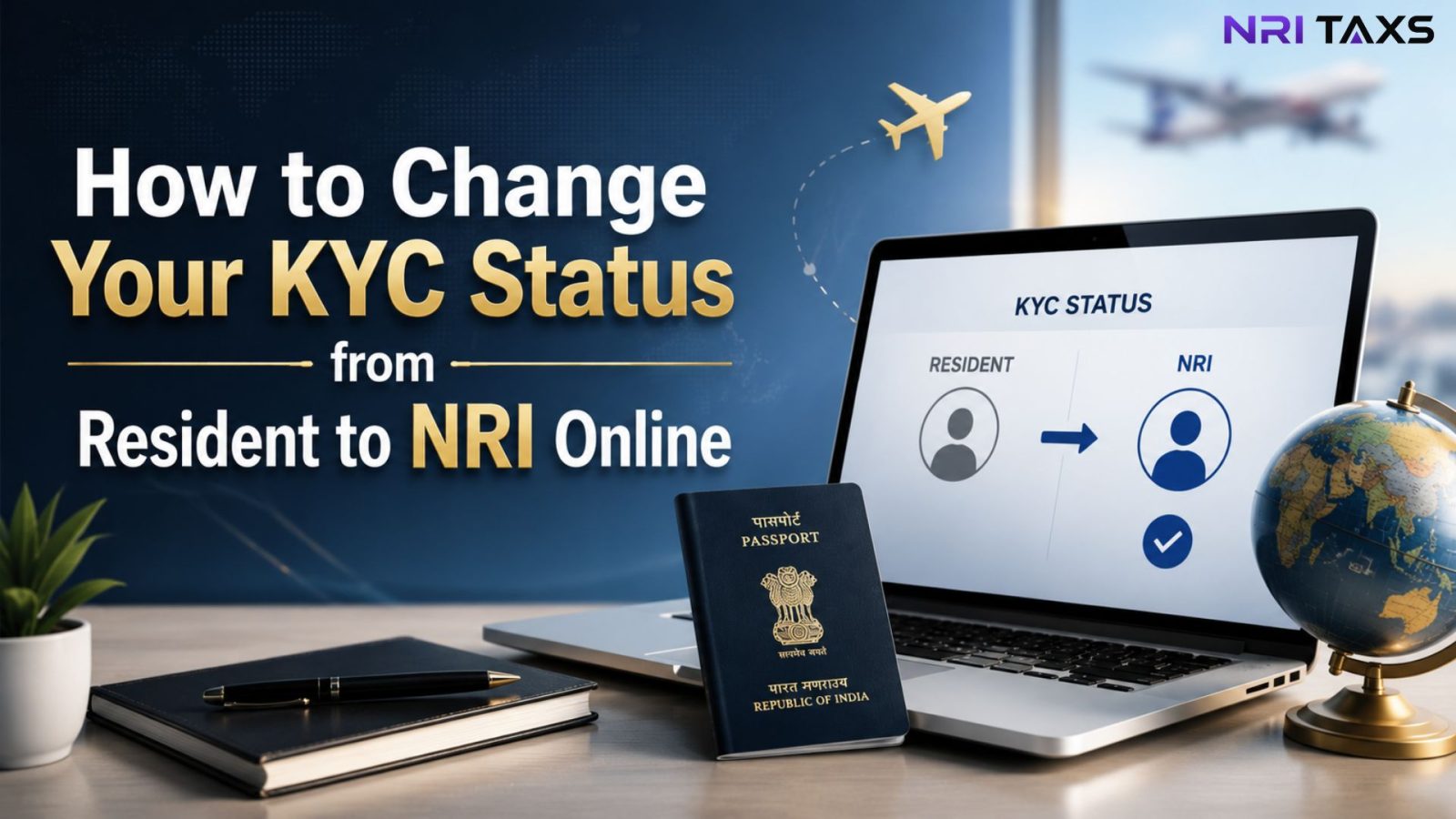
Your bank account says you’re an NRI. Your KYC still says you’re a resident.
It may seem like a small mismatch, but it can create unexpected problems when you try to manage your finances in India. Banks may ask you to complete fresh KYC, mutual fund transactions could be delayed, and stock brokers or other financial institutions may restrict certain services until your records are updated.
Many NRIs assume that updating their PAN details or converting a resident savings account into an NRO account automatically changes their KYC status. Unfortunately, that’s not how the process works. In most cases, banks, KYC Registration Agencies (KRAs), mutual fund houses, brokers, and insurance companies maintain their own KYC records, which must be updated separately after your residential status changes.
The good news is that many institutions now allow NRIs to complete this process online. However, the exact steps, required documents, and verification process vary depending on the organisation you’re dealing with.
In this guide, you’ll learn how to change your KYC status from Resident to NRI online, which documents you’ll need, where to update your records, common reasons KYC requests get rejected, and practical tips to complete the process smoothly.
? Quick Answer
To change your KYC status to NRI, gather your passport, visa/residence permit, overseas address proof, PAN, and FATCA/CRS declaration. Then submit an NRI KYC update request through your bank, KRA (such as CAMS or KFintech), or your broker’s official online portal or registered email. Once your documents are successfully verified, most requests are processed within 3–10 working days.
What Does Changing Your KYC Status to NRI Mean?
Your KYC (Know Your Customer) status tells every regulated financial institution in India your bank, mutual fund houses, and brokers how to treat your account under RBI and SEBI rules. When you move abroad and become a Non-Resident Indian under FEMA, your accounts are legally required to be re-classified as NRI accounts. This is different from your income tax residential status; you can update your KYC to NRI status even before your tax residency officially changes, since the two are governed by separate rules.
Who Should Update Their KYC Status?
A Resident to NRI KYC update applies to a wide range of people, not just salaried professionals relocating for work:
- Employees moving abroad on work visas or intra-company transfers.
- Students who move overseas for long-term courses and cross the NRI threshold.
- Business owners setting up or relocating operations outside India.
- OCI holders living outside India, where applicable to their accounts.
- Returning NRIs whose status changes again once they move back.
Why Is It Important to Update Your KYC Status?
Skipping this step doesn’t just create paperwork problems later it can actively disrupt your finances:
- Bank compliance: RBI requires resident accounts to be converted once you become an NRI; continuing to operate a resident savings account after that point is a FEMA violation.
- FEMA compliance: Investments and repatriation rules differ for residents and NRIs, and incorrect KYC status can flag transactions for scrutiny.
- Mutual fund transactions: Fund houses can block new purchases, SIPs, and redemptions if your KYC doesn’t reflect your current status.
- Demat account: Holding a resident demat account as an NRI isn’t compliant, and your broker may restrict trading until it’s converted.
- Smooth tax filing: Mismatched KYC and residential status records can complicate ITR filing and AIS/TIS reconciliation.
- Avoid account restrictions: Outdated KYC is one of the most common reasons NRI accounts get frozen or flagged for re-verification.
Documents Required to Change Your KYC Status to NRI
The exact list can vary slightly by bank or KRA, but these NRI KYC documents cover almost every request:
| Document | Notes |
| Passport | Must be valid; all relevant pages included |
| Visa / Residence Permit | Proof of your legal right to reside in the country you’ve moved to |
| Overseas Address Proof | Utility bill, bank statement, or rental agreement from your country of residence |
| PAN Card | Details must exactly match your passport and other KYC records |
| Recent Photograph | Passport-size, as per the institution’s format |
| Cancelled Cheque | Required by some banks/brokers for NRE/NRO account linkage |
| FATCA/CRS Declaration | Mandatory for mutual funds and demat; declares your tax residency abroad |
? Quick Tip
Before submitting your KYC update request, ensure that your name, date of birth, and passport details exactly match your PAN records. Even minor mismatches can delay verification and lead to rejection.
How to Change Your KYC Status from Resident to NRI Online (Step-by-Step)
Here’s how to change your KYC status from Resident to NRI online, across most banks, KRAs, and brokers:
Step 1: Update Your Bank Account to NRO/NRE (If Required)
Before or alongside your KYC update, convert your resident savings account to an NRO account, and open an NRE account if you plan to remit foreign income to India.
Step 2: Collect Required Documents
Gather your passport, visa/residence permit, overseas address proof, PAN, photograph, and FATCA/CRS declaration the full set of NRI KYC documents listed above.
Step 3: Update PAN & Contact Details (If Needed)
If your PAN records still show your old Indian address, citizenship, or contact details, update them before submitting your KYC request. Mismatches between your PAN records and KYC documents are one of the most common reasons for verification delays or rejection. If you’ve recently acquired foreign citizenship or OCI status, follow our detailed guide on how to update citizenship status in your PAN card before proceeding.
Step 4: Submit KYC Request
Submit your NRI KYC online through your bank’s NRI service portal, or through a KRA like CAMS or KFintech for mutual funds, or through your broker’s platform for demat accounts. Most institutions also accept scanned documents by registered email. Always submit your request through the institution’s official portal, registered email, or designated NRI relationship manager. Avoid sharing KYC documents through unofficial channels, as incomplete or incorrectly submitted requests can delay verification.
Step 5: Complete Verification
Some institutions require in-person verification (IPV) or notarization/attestation of documents by the Indian Embassy, a Notary Public, or an overseas branch of a scheduled Indian bank if you’re not submitting in person.
Step 6: Track Request
Track your CKYC NRI update status using your PAN on the CVL KRA portal, or check directly with your bank or broker for confirmation once processed.

How to Update NRI KYC for Different Financial Services
Bank Accounts
Contact your bank’s NRI services desk to convert your resident savings account and submit the Re-KYC/customer information update form along with your documents, either online, by email, or at a branch.
Mutual Funds (KRA/AMC)
Since KYC records are shared across a central database, updating your KYC once with any KRA (CAMS or KFintech) or AMC updates your status across all mutual fund houses where you hold investments.
Demat & Trading Accounts
Inform your broker that your status has changed, submit updated KYC documents, and your existing resident demat holdings will typically be transferred into a new non-resident (NRO non-PIS) demat and trading account. If you’re unsure about the conversion process or opening a new NRI investment account, read our complete guide on How to Open aNRI Demat Account.
Insurance Policies
Insurers usually require a separate NRI KYC update to continue premium payments from an NRE/NRO account and to ensure claims processing isn’t delayed due to a residency status mismatch.
Common Reasons Why NRI KYC Requests Get Rejected
A KYC update for NRIs gets rejected more often than people expect, usually for avoidable reasons:
- Passport mismatch — name or details don’t match other KYC records.
- PAN mismatch — outdated address or contact details on file..
- Address mismatch — overseas proof doesn’t match the address declared in the form.
- Expired passport — submitted documents are no longer valid.
- Missing FATCA declaration — required for mutual funds and demat, often overlooked.
- Unsigned forms — a surprisingly common and entirely avoidable rejection reason.
- Signature mismatch — The signature on your KYC form doesn’t match your existing records.
- Photograph doesn’t meet requirements — Blurred, outdated, or incorrect passport-size photographs may not be accepted.
- Documents not properly attested — Where required, failure to submit self-attested or duly attested documents can delay or reject your KYC request.
Contact Us
How Long Does an NRI KYC Update Take?
Processing time may vary depending on document verification, attestation requirements, and the financial institution.
| Service | Estimated Time |
| Bank | 3–10 Working Days |
| Mutual Funds | 5–10 Working Days |
| Demat | 3–7 Working Days |
Common Mistakes NRIs Should Avoid
- Delaying the KYC update after becoming an NRI, which risks blocked transactions and FEMA non-compliance.
- Submitting self-attested documents when the institution requires embassy or notarized attestation..
- Forgetting to update KYC across every fund house or broker separately when it isn’t centrally linked.
- Using an Indian address as the primary address after relocating abroad.
- Ignoring the FATCA/CRS declaration, especially for US and Canada-based NRIs.
- Not converting the linked bank account to NRO/NRE before updating mutual fund or demat KYC.
Conclusion
Now that you know how to change your KYC status from Resident to NRI online, the smartest move is to start the process as soon as your move abroad is confirmed rather than waiting until an SIP gets paused or a trade gets blocked. Keep your documents attested and consistent across PAN, passport, and address proof, and most updates clear within 3–10 working days.
Disclaimer
The content published on NriTaxs is intended for informational purposes only and does not constitute legal, tax, or financial advice. Readers are encouraged to consult qualified professionals before making any decisions based on the information provided.







Related Articles