
Missing the deadline to elect S Corporation status does not always mean your business has lost the opportunity. A Late S Corp Election may still be possible under certain IRS relief provisions, allowing eligible businesses to request S Corporation status retroactively by filing Form 2553. However, approval depends on meeting specific eligibility requirements, demonstrating reasonable cause for the delay, and following the correct filing procedure. Whether you recently formed an LLC or intended to elect S Corporation status for an earlier tax year, understanding the late-election rules can help you determine your next steps.
This guide explains who qualifies for late election relief, what counts as reasonable cause, and how to file Form 2553 step by step. It also covers the documents you need and what to do if the IRS denies your request.
Quick Answer
Yes, you can file Form 2553 late. If you meet the rules in Revenue Procedure 2013-30, the IRS can treat your S corporation election as effective on the date you intended. You must file within 3 years and 75 days of that date, show reasonable cause, and write “Filed Pursuant to Rev. Proc. 2013-30” at the top of the form.
What Is a Late S Corporation Election?
A late S corporation election is a Form 2553 filed after the normal deadline. That deadline is no more than 2 months and 15 days after the start of the tax year the election should take effect, or any time during the year before. If you miss it, the election generally starts only from the following tax year. For the year you missed, a corporation is taxed as a C corporation, and an LLC under its default rules. A late election asks the IRS to excuse the delay and make S status effective on your original date. The IRS offers this relief through Revenue Procedure 2013-30, but only when specific conditions are met.
Why Does Late-Election Relief Matter?
- Lower self-employment tax: Owners can reduce payroll taxes, and an S corporation can be worth it when profits are high. A missed election delays savings.
- Correct filings: Without relief, the IRS may reject your Form 1120-S because no valid election exists. Relief aligns your returns with S corporation treatment.
- Avoid double tax risk: If your business is taxed as a C corporation, profits may face corporate tax first and shareholder tax again on dividends.
- Protect your records: Payroll and K-1s may already follow S corporation rules. Relief fixes the mismatch before penalties, amended returns, and confusion grows.
What Is the Deadline to File Form 2553?
General Filing Deadline
Form 2553 is due no more than 2 months and 15 days after the first day of the tax year when you want S status to begin. You can also file at any time during the tax year before. A calendar-year business that wants S status for 2027 can file now and up to March 15, 2027. For field-by-field help, see this guide on how to elect S corporation status with Form 2553.
Deadline for Newly Formed Corporations
A new corporation’s first tax year starts on the earliest date it has shareholders, acquires assets, or begins doing business. The 2 months and 15 days count starts from that date, not from the day you registered with the state.
Deadline for Existing Corporations Changing Their Tax Status
An existing business, such as a C corporation or an LLC taxed as a sole proprietorship or partnership, normally starts S status on the first day of its tax year. For a calendar-year business, that means filing by March 15. If you miss it, the election usually applies from the next tax year unless you receive relief.
Example of a Missed Election Deadline
Priya’s Studio Inc. began doing business on April 10, 2026, and planned to be an S corporation from day one. Her deadline was June 25, 2026 (2 months and 15 days later). She filed Form 2553 on August 5, 2026, so it was late. Because her intended effective date was April 10, 2026, she can ask for relief until about June 24, 2029, which is 3 years and 75 days later.
Who Qualifies for Late Election Relief?
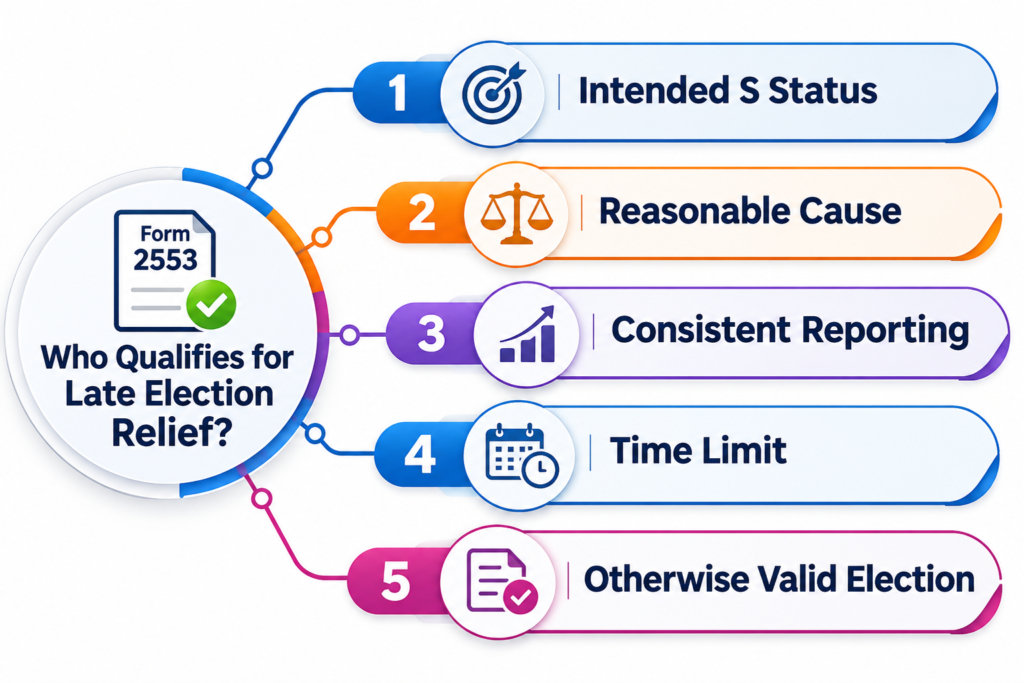
The IRS uses five practical tests. Each one needs a clear answer before you file.
- Intended S status. You intended to be an S corporation from the effective date, you are an eligible entity, and the only reason you failed to qualify was the late election.
- Reasonable cause. You must have reasonable cause for filing late and show you acted diligently to fix the mistake once you discovered it. A written statement under penalties of perjury explains this.
- Consistent reporting. The business and every shareholder must have reported income consistently with S corporation status for the intended year and all later years, including Form 1120-S and each shareholder’s return.
- Time limit. You must request relief within 3 years and 75 days of the intended effective date. A rare exception covers certain corporations with no IRS objection after their first Form 1120-S.
- Otherwise valid election. The business must be a domestic corporation or eligible LLC with eligible shareholders and one class of stock, and every shareholder must sign Form 2553. Invalid elections need different relief.
IRS Requirements Under Revenue Procedure 2013-30
Revenue Procedure 2013-30 combines several older IRS relief rules into one process. To use it, your Form 2553 must carry the note “Filed Pursuant to Rev. Proc. 2013-30” in the top margin of page 1. You must attach a reasonable cause statement, and each shareholder must provide a signed statement about consistent income reporting. If you do not qualify, the IRS generally requires a private letter ruling instead.
What Is a Reasonable Cause for a Late S Corp Election?
The tax code does not define reasonable cause, so the IRS looks at the facts. In practice, the bar is fairly low when your explanation is honest, specific, and supported by records. Because you sign under penalties of perjury, write only what is true.
Common Reasons for Missing the Deadline
Typical reasons include confusion about when the tax year began, a late business start, an ownership change near the deadline, or a form that was prepared but never sent.
Accountant or Tax Preparer Errors
Many late elections happen because a CPA or preparer forgot to file the form, gave wrong advice, or assumed forming an LLC automatically created S status. Keep emails or engagement letters that show what you relied on.
Misunderstanding of IRS Filing Requirements
Some owners believe filing Form 1120-S, paying payroll as an S corporation, or registering with the state is enough. It is not. Form 2553 must be filed with the IRS and accepted.
Administrative or Documentation Mistakes
Lost mail, a missing shareholder signature, a wrong fax number, or an unsent form can all explain a late filing. Fax confirmations, mailing receipts, and unsigned drafts help prove what happened.
Importance of Explaining the Circumstances and Corrective Actions
Your statement should cover two things: why the election was late, and what you did once you found the problem. A short example:
“The corporation intended to be an S corporation effective April 10, 2026. Our former preparer did not file Form 2553 by the deadline. We discovered the error on August 1, 2026, and filed this election within one week. All shareholders reported income consistent with S corporation status.”
How to Request S Corporation Late Election Relief
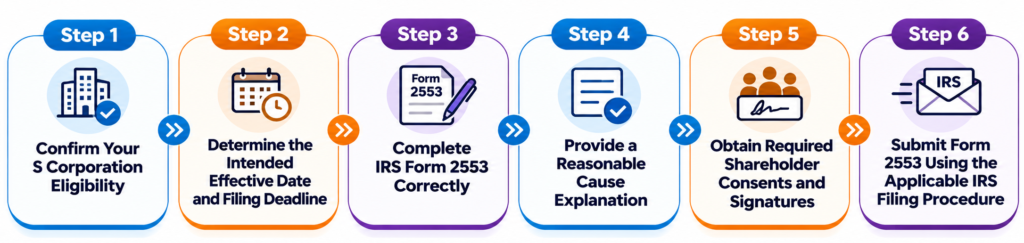
Step 1: Confirm Your S Corporation Eligibility
Check that you are a domestic corporation or an eligible LLC, with no more than 100 shareholders, only eligible shareholders, and one class of stock. Confirm you intended S status from the start. Nonresident alien owners cannot hold S stock.
Step 2: Determine the Intended Effective Date and Filing Deadline
Choose the date you wanted S status to begin, usually January 1 or your first day in business. Then count 2 months and 15 days from that date, and check whether you are still within 3 years and 75 days.
Step 3: Complete IRS Form 2553 Correctly
Complete Part I with the entity name, EIN, tax year, and intended effective date. List every shareholder, ownership share, and consent signature. Write “Filed Pursuant to Rev. Proc. 2013-30” in the top margin of page 1. Use the current form revision.
Step 4: Provide a Reasonable Cause Explanation
Attach a statement explaining why Form 2553 was late and how you fixed the mistake once you found it. Include dates and actions taken. Sign it under penalties of perjury, and keep it factual and consistent with your records.
Step 5: Obtain Required Shareholder Consents and Signatures
Get consent signatures from all shareholders, including spouses with community property interests where applicable. Each shareholder who held stock during the relief period must sign a statement that they reported income consistently with S status. Missing signatures invalidate the request.
Step 6: Submit Form 2553 Using the Applicable IRS Filing Procedure
If you have not filed Form 1120-S, attach Form 2553 to it, or mail or fax it separately to your IRS service center. If the IRS sent an invalid-election notice, send both to that center. Online filing is unavailable.
Step 7: Keep Submission Records and Review the IRS Response
Keep copies of everything, plus mailing proof or fax confirmation. The IRS usually responds within about 60 days, often with Notice CP261. Check the effective date in the acceptance letter.
What Documents Are Needed for Late S Corp Election Relief?
| Document | Why It Is Needed |
| Completed Form 2553 | The election itself, marked “Filed Pursuant to Rev. Proc. 2013-30” |
| Reasonable cause statement | Explains the late filing and your corrective action, signed under penalties of perjury |
| Shareholder consent signatures | Every required shareholder must consent to the election |
| Shareholder reporting statements | Confirm each shareholder reported income consistently with S status |
| EIN confirmation letter | Matches the entity name and EIN on Form 2553 |
| Formation documents and stock records | Show ownership, shareholder eligibility, and one class of stock |
| Filed Forms 1120-S and K-1s (if any) | Prove consistent S corporation reporting |
| Proof of reasonable cause | Emails, preparer letters, or mail and fax records that support your explanation |
Rev. Proc. 2013-30 Relief vs. Private Letter Ruling
| Factor | Rev. Proc. 2013-30 | Private Letter Ruling |
| Who it is for | Businesses that meet all the revenue procedure tests | Businesses that do not qualify under the revenue procedure |
| Time limit | Within 3 years and 75 days (limited exception) | No fixed window, but facts must support relief |
| IRS fee | No user fee | User fee set by the IRS annually |
| Process | File Form 2553 with statements | Formal written ruling request |
| Speed and cost | Generally faster and cheaper | Slower and usually needs professional help |
What Happens If the IRS Denies Your Late S Corporation Election?
Common Reasons for Denial
Most denials come from missing shareholder signatures, no reasonable cause statement, requests outside the 3 years and 75 days window, inconsistent income reporting, an ineligible shareholder, or a missing “Rev. Proc. 2013-30” notation.
How to Review the IRS Decision
Read the IRS notice carefully and note the exact reason given. Compare it with your submitted copy of Form 2553 and attachments. If the notice is unclear, call the number on it, or ask a tax professional to review it.
Possible Corrective Actions
If the problem is a missing signature or statement and you are still within the time limit, you may be able to refile a corrected request. If you do not qualify under Rev. Proc. 2013-30, the IRS generally expects a private letter ruling. For some invalid elections caused by an ineligible shareholder, other IRS relief may be available.
Future S Corporation Election Options
If relief is not possible, you can still elect S status going forward. File Form 2553 on time for the next tax year, either during the current year or by the 15th day of the third month of the new year.
When to Seek Professional Tax Assistance
Get help if the IRS denied your request, a shareholder was ineligible, you are near the 3 years and 75 days limit, or returns were filed inconsistently. A small mistake here can affect several tax years.

Conclusion
A missed Form 2553 deadline does not have to mean lost S corporation status. If you intended to be an S corporation, had reasonable cause, reported income consistently, and act within 3 years and 75 days, Revenue Procedure 2013-30 can fix the problem without a ruling fee. Gather your signatures and records, write a clear reasonable cause statement, and file using the correct IRS procedure. If anything looks complicated, ask a tax professional before you file.
Disclaimer
The content published on NriTaxs is intended for informational purposes only and does not constitute legal, tax, or financial advice. Readers are encouraged to consult qualified professionals before making any decisions based on the information provided.





Related Articles