

Holding Indian mutual funds while living in the US? You may face unexpected US tax rules even if you have already paid tax in India. Many Indian mutual funds fall under PFIC rules, which can trigger complex tax calculations, interest charges, and IRS Form 8621 filing requirements. This guide explains who must file, how PFIC taxation works, and how to report your investments correctly.
Are Indian Mutual Funds Taxable in the USA?
Yes, Indian mutual funds may be subject to US tax and reporting requirements if you are a US citizen or tax resident. The IRS generally taxes US citizens and resident aliens on their worldwide income, including applicable foreign investment income. Many Indian mutual funds may qualify as Passive Foreign Investment Companies (PFICs), which follow special US tax rules. Depending on your investments and transactions, you may need to file IRS Form 8621. Paying tax in India does not automatically eliminate your US tax obligations. However, eligible taxpayers may qualify for foreign tax credits to reduce double taxation.
What Is a PFIC and How PFIC Taxation Works
PFIC stands for Passive Foreign Investment Company. It is a non-US company or fund that earns mostly passive income, such as interest, dividends or capital gains, or holds mostly assets that produce such income. Mutual funds that invest in stocks, bonds, and other income-generating assets may qualify as PFICs under US tax rules. The IRS created PFIC rules to stop US taxpayers from deferring tax by investing through foreign funds.
Why it matters:
- Higher tax: Gains are taxed at the highest ordinary rate, not the lower long-term capital gains rate most US investors expect.
- Interest charge: The IRS adds interest, as if you had owed the tax every year since you bought the fund.
- Annual paperwork: You may need one Form 8621 for every PFIC, every year, even when you earned nothing from it.
- Open audit window: A missing form can keep your tax return open for IRS review, with no normal time limit.
What Is IRS Form 8621?
IRS Form 8621 is the information return US taxpayers use to report ownership of a PFIC. It shows the fund, your holding, any payouts, any gain on sale and the tax method you choose. You attach it to your yearly tax return, and you generally file a separate form for each PFIC. The form lets the IRS work out the extra tax and interest charge that apply to PFIC investments.
Who Needs to File Form 8621?
- US citizens, green card holders and resident aliens who own Indian mutual fund units, directly or through another entity.
- Anyone who received a distribution, sold or redeemed units, or made a QEF or mark-to-market election during the tax year.
- Holders whose total PFIC value is above 25,000atyearend(50,000 for joint filers), even if nothing was sold.
- Investors who also report these funds on FBAR or Form 8938. Those filings are separate and do not replace Form 8621.
Why the IRS Treats Your Indian Mutual Fund Differently
US mutual funds follow US rules, but Indian funds do not. Here are five reasons the IRS treats them as PFICs. If you recently moved abroad, our guide on what happens to your Indian mutual funds after becoming an NRI covers the Indian side of the story.
- Pooled structure: Indian funds pool investor money and earn passive income, which matches the PFIC definition in US tax law.
- Not a US fund: US mutual funds pass income to investors under a special regime, but foreign funds do not qualify for it.
- Deferral risk: Indian funds can grow for years without payouts, so the IRS fears US investors could delay tax for decades.
- All fund types count: Equity, debt, hybrid, index and ELSS funds are generally PFICs because each is a foreign pooled investment.
- No US-style statements: Indian fund houses do not usually issue PFIC annual statements, so tax-saving elections are hard to use.
How Are Indian Mutual Funds Taxed in the USA?
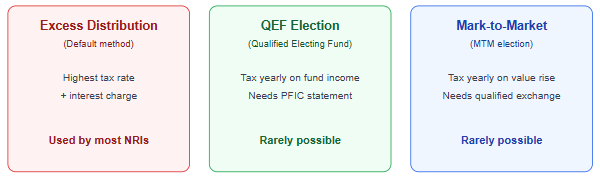
PFIC tax depends on the method you use. Most NRIs end up with the first one because the other two need conditions Indian funds rarely meet.
- Default excess distribution method: If you do nothing, the IRS spreads gains and large payouts over each year you held the fund. Each year is taxed at that year’s highest rate, and an interest charge is added on top.
- QEF election: Under a Qualified Electing Fund election, you pay tax each year on your share of the fund’s income and gains. It needs an annual statement from the fund, which Indian fund houses rarely provide, so it is seldom practical.
- Mark-to-market election: You pay tax every year on the rise in the fund’s value, taxed as ordinary income. It needs shares traded on a qualified exchange, so it rarely works for open-ended Indian mutual funds.
- Tax in both countries: India taxes your redemption gains and deducts tax at source. The US also taxes the same gain under PFIC rules, because US persons are taxed on worldwide income, so both countries may tax one redemption.
- Foreign tax credit: Tax paid in India may be claimed as a credit on Form 1116, subject to US limits. It reduces double taxation but does not remove PFIC rules. See how NRIs can avoid double taxation on an Indian sale for how credits work.
How to Report Indian Mutual Funds on US Tax Return

Follow these six steps each year. Doing them in order saves time and avoids mistakes.
Step 1: Identify all Indian mutual fund holdings
List every Indian mutual fund you hold, including folios linked to NRE and NRO accounts, SIPs, ELSS funds and joint holdings. Check statements from fund houses and platforms like CAMS or KFintech. Note the fund name, folio number and country of registration. Even a small, forgotten folio can leave your reporting incomplete.
Step 2: Collect purchase dates, cost basis, distributions, and redemption details
For each fund, gather purchase dates, units bought, cost in rupees, dividends or IDCW received and any redemption details. Convert amounts into US dollars using the exchange rate for each date. You also need the year-end value. Your Indian capital gains calculation helps you cross-check the numbers.
Step 3: Determine whether the investments qualify as PFICs
Check each fund against the PFIC definition. Almost every Indian mutual fund, whether equity, debt, hybrid, index or ELSS, is treated as a PFIC. Direct shares and bank deposits are different. Also confirm that you are a US person, such as a citizen, green card holder or resident alien.
Step 4: Evaluate the applicable PFIC tax regime and elections
Decide how each PFIC will be taxed. The default is the excess distribution method. A QEF election needs an annual statement from the fund, and a mark-to-market election needs a qualified exchange. Because Indian funds rarely meet these conditions, most holders end up under the default method. Ask a CPA before choosing.
Step 5: Complete Form 8621 where required
Fill one Form 8621 for each PFIC. Enter the fund name, address, your shares, year-end value, payouts, and any gain or loss on sale. Select the tax method used. If you hold five funds, you will usually complete five forms. Check whether the small holdings exemption applies to you.
Step 6: Include the relevant amounts and forms with the federal tax return
Attach every Form 8621 to your Form 1040 when you file. If you do not have to file a tax return, send the forms to the IRS separately. Also check whether FBAR and Form 8938 apply, and claim any foreign tax credit on Form 1116.
Documents Required for PFIC Reporting
| Document | Why You Need It |
| Consolidated Account Statement (CAS) | Shows all your Indian mutual fund holdings, units and year-end values in one place |
| Purchase and redemption statements | Give purchase dates, units and amounts needed for cost basis and gain calculations |
| Capital gains statement from the fund house | Confirms gains and losses on redemptions for the financial year |
| TDS details or Form 16A | Proves Indian tax deducted, which supports a foreign tax credit claim |
| Dividend or IDCW statements | Show payouts received, which are reported as distributions on Form 8621 |
| PFIC Annual Information Statement (if available) | Required only if you plan to make a QEF election |
| NRE / NRO bank statements | Show where redemption proceeds and payouts were credited |
| USD exchange rate records | Needed to convert rupee amounts into dollars for each transaction date |
| Previous years’ Form 8621 and tax returns | Show the tax method used earlier and keep reporting consistent |
Mismatched records are a common cause of delays, so make sure your folios and bank accounts show the correct status. This is easier if you update your KYC status from resident to NRI with your fund house and bank.
What Happens If You Do Not File Form 8621?
- Open audit window: The IRS can keep your return open for review until the missing form is filed, so old years stay exposed with no normal three-year time limit.
- Higher tax: Without proper reporting, the IRS may apply the default PFIC method, with the highest tax rate and interest charges instead of lighter options.
- Penalties: You may face accuracy-related penalties on the extra tax, and separate penalties can apply for related forms like FBAR and Form 8938.
- Extra cost: Fixing missed years means amended returns, CPA fees that are often charged per form, and time spent collecting old statements.
- Data matching: India shares account data with the IRS under FATCA, so unreported funds can lead to notices or compliance checks later.
Can NRIs Avoid PFIC Tax on Indian Mutual Funds?
Yes, but only through planning. The best fix is to redeem Indian mutual funds before you become a US tax resident. After that, many NRIs choose direct stocks, bank deposits or US-listed funds instead. Elections like QEF or mark-to-market can lower tax in some cases, but Indian funds rarely support them. Selling later triggers PFIC tax, so speak to a CPA first.

Common Mistakes NRIs Make With Indian Mutual Funds
- Assuming Indian filing is enough. The US needs its own reporting, even when no tax is due.
- Filing only when selling. Form 8621 may also be due for holdings above the threshold, even with no sale.
- Skipping small funds. One form is needed per fund, so five small SIP folios can mean five forms.
- Trusting account labels. The IRS looks at what you own, not whether the account is NRE or NRO.
- Using wrong rates or cost. Incorrect exchange rates or cost basis create wrong gains and mismatched Form 8621 entries.
Final Thoughts
Indian mutual funds are easy to buy but costly to report from the US. PFIC rules mean higher tax, interest charges and one Form 8621 per fund. The good news is that the rules are manageable once you know them. Keep clean records, report every year, and plan any redemption with a CPA. Acting early, especially before moving to the US, can save you thousands and a lot of stress.
Disclaimer
The content published on NriTaxs is intended for informational purposes only and does not constitute legal, tax, or financial advice. Readers are encouraged to consult qualified professionals before making any decisions based on the information provided.










Related Articles