
Starting a business in the USA means choosing a legal and tax structure early. A C corporation is one of the most common choices for startups, investors, and fast-growing companies. It protects owners from personal liability, can raise money by selling stock, and pays tax at a flat federal rate. But it also comes with double taxation and strict paperwork. In this guide, you will learn what a C corporation is, who runs it, how it works, how it is taxed, which forms it files, and how it compares with an S corporation and an LLC. Everything is explained simply.
Quick Answer
A C corporation is a separate legal entity owned by shareholders that pays its own federal income tax at a flat 21% rate. Owners usually have limited liability. Profits paid as dividends are taxed again on shareholders’ personal returns, which is called double taxation. The company files Form 1120 every year.
What Is a C Corporation?
A C corporation is a separate legal entity formed under state law that is taxed on its own as a business. It is owned by shareholders, managed by a board of directors, and run by officers. Because it is separate from its owners, shareholders are usually not personally responsible for company debts. A C corporation pays federal income tax on its profits and can issue different classes of stock. There is no limit on shareholders, and foreign owners are allowed.
Who Owns and Manages a C Corporation?
- Shareholders:- Shareholders own the company through stock, vote on major decisions, elect directors, and receive dividends.
- Board of Directors:- The board sets strategy, appoints officers, approves major decisions, and supervises management for the shareholders.
- Corporate Officers:- Officers like the CEO, CFO, and secretary run daily operations and carry out board decisions.
How Does a C Corporation Work?
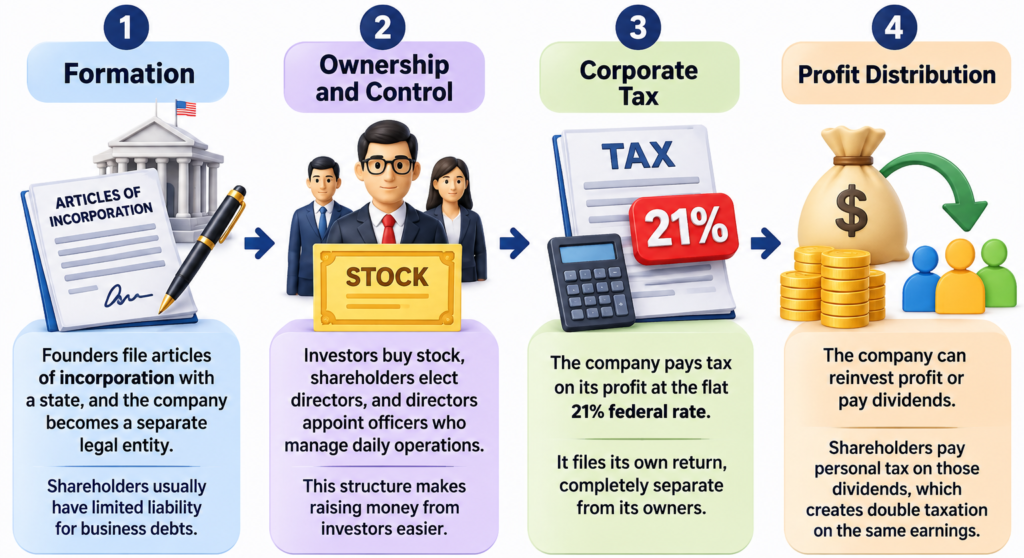
- Formation: Founders file articles of incorporation with a state, and the company becomes a separate legal entity. Shareholders usually have limited liability for business debts.
- Ownership and control: Investors buy stock, shareholders elect directors, and directors appoint officers who manage daily operations. This structure makes raising money from investors easier.
- Corporate tax: The company pays tax on its profit at the flat 21% federal rate. It files its own return, completely separate from its owners.
- Profit distribution: The company can reinvest profit or pay dividends. Shareholders pay personal tax on those dividends, which creates double taxation on the same earnings.
What Are the Benefits and Drawbacks of C Corps?
| Benefits | Drawbacks |
| Limited personal liability for shareholders | Double taxation on profits paid as dividends |
| Flat 21% federal corporate tax rate | More paperwork and strict record-keeping |
| Unlimited shareholders, including foreign owners | Higher setup and yearly compliance costs |
| Easy to raise money by issuing stock | Business losses cannot be passed to owners |
| Can offer multiple stock classes and employee stock options | Owners have less direct control than in a small LLC |
| Possible tax exclusion on gains from qualified small business stock | New 1% floor on charitable deductions from 2026 |
| Company continues even if an owner leaves | Extra state taxes, such as franchise tax, may apply |
If double taxation worries you, an S corporation passes profit to owners and avoids tax at the company level, but it has stricter ownership rules.
What Are the Tax Rules for a C Corporation?
- Federal tax rate: A flat 21% on taxable income, with no lower brackets.
- Double taxation: The company pays tax first, then shareholders pay tax on dividends they receive.
- Annual return: Form 1120 is due April 15 for calendar-year companies. Form 7004 gives six more months to file, but not to pay.
- Estimated tax: Quarterly payments are due if the company expects to owe $500 or more.
- Deductions: Salaries, rent, business expenses, depreciation, and most interest are deductible.
- Charitable gifts: From 2026, only the amount above 1% of taxable income is deductible, with a 10% cap.
- Losses: Net operating losses carry forward without expiry but offset only 80% of future taxable income.
- Extra taxes: Excess retained earnings may face the accumulated earnings tax.
- State taxes: Most states charge corporate income tax or franchise tax, and rates vary by state.
- QSBS: Owners of qualified small business stock may exclude part of the gain when they sell. The 2025 tax law expanded this benefit.
The way tax rules change by structure is easier to see in our guide on how small businesses are taxed in the USA.
What Tax Forms Does a C Corporation Need to File?
| Form | Purpose | Usual Due Date |
| Form 1120 – U.S. Corporation Income Tax Return | Reports income, deductions, and corporate tax owed | April 15 (calendar-year company) |
| Form 941 – Employer’s Quarterly Federal Tax Return | Reports wages paid, income tax withheld, and Social Security and Medicare taxes | April 30, July 31, October 31, January 31 |
| Form 940 – Federal Unemployment Tax Return | Reports yearly federal unemployment (FUTA) tax | January 31 |
| Form W-2 and Form 1099 | W-2 reports employee pay. 1099-NEC reports contractor pay, and 1099-DIV reports dividends | January 31 for recipients |
| Other Applicable Tax Filings | Form 7004 (extension), Form 5472 (25% foreign-owned companies), and state and local returns | Varies |
What Are the Requirements for a C Corporation?
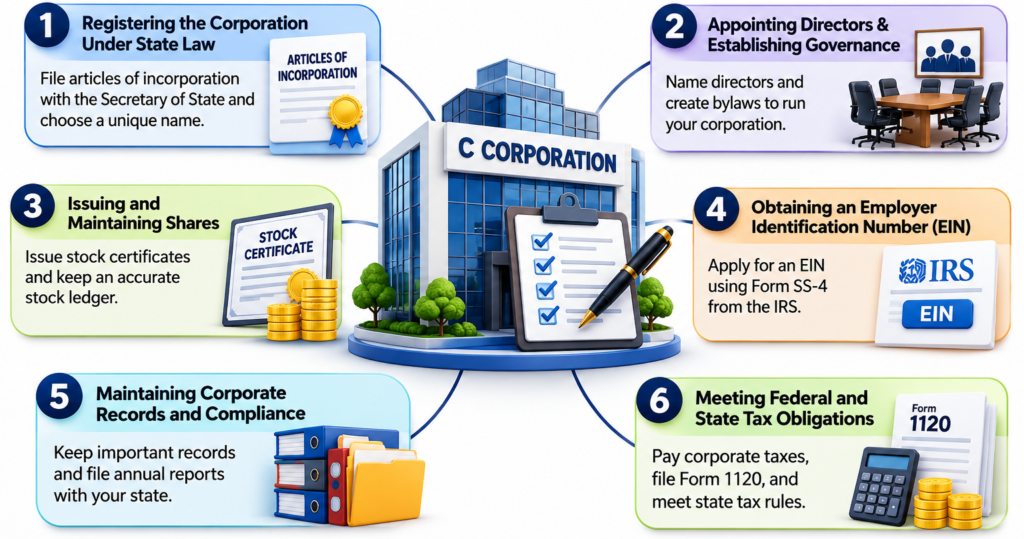
1. Registering the Corporation Under State Law
File articles of incorporation with the Secretary of State in your chosen state, such as Delaware or your home state. Choose a unique name that includes Inc., Corp., or Corporation, and pay the filing fee.
2. Appointing Directors and Establishing Corporate Governance
Name the initial directors and write bylaws that explain how the company is run. Hold an organizational meeting to adopt bylaws, appoint officers, approve key decisions in writing, and record everything in the minutes.
3. Issuing and Maintaining Shares
Issue stock certificates or digital shares to founders and investors in exchange for money or property. Keep an accurate stock ledger showing each shareholder’s name, number of shares, and issue date, so ownership is always clear.
4. Obtaining an Employer Identification Number (EIN)
Apply for an Employer Identification Number from the IRS using Form SS-4. You need an EIN to open a business bank account, hire employees, and file taxes. Foreign owners can apply by fax or phone.
5. Maintaining Corporate Records and Compliance
Keep minutes of annual shareholder and director meetings, bylaws, stock records, and financial statements. File annual reports with your state and keep a registered agent, so important legal notices always reach you without any delay.
6. Meeting Federal and State Tax Obligations
Pay corporate income tax, file Form 1120 every year, and deposit payroll taxes on time. Make quarterly estimated tax payments, and meet all your state income tax, sales tax, and franchise tax obligations as well.
How Is a C Corporation Taxed?
A C corporation is taxed twice: once on company profit and again on dividends. Here is a simple example with $200,000 of profit, assuming a 15% qualified dividend rate.
| Step | Amount |
| Corporate profit | $200,000 |
| Corporate tax at 21% | $42,000 |
| Profit left to pay as dividends | $158,000 |
| Shareholder tax on dividends at 15% | $23,700 |
| Total tax paid | $65,700 (about 32.9%) |
- High-income shareholders may also owe the 3.8% net investment income tax on dividends.
- Profit kept in the company is not taxed again until it is paid out.
- Reasonable salaries paid to owner-employees are deductible, which lowers corporate profit.
- Owners who want one level of tax may prefer an S corporation, and you can compare costs in our guide on whether an S corporation is worth it.
C Corporation vs. S Corporation vs. LLC
| Feature | C Corporation | S Corporation | LLC |
| Federal tax treatment | Taxed as a separate entity | Pass-through | Pass-through by default; can elect corporate tax |
| Tax rate | Flat 21% at company level | Owners pay at personal rates | Owners pay at personal rates |
| Double taxation | Yes | No | No, unless it elects C corp tax |
| Who can own it | Anyone, including foreign owners | Up to 100 US citizens or residents | Anyone |
| Stock classes | Multiple classes allowed | One class only | Flexible ownership terms |
| Main tax return | Form 1120 | Form 1120-S | Schedule C, Form 1065, or as elected |
| Self-employment tax | Not on dividends | Only on owner salary | Usually on all profit |
| Best for | Startups and investor-backed growth | Small profitable businesses | Simple, flexible small businesses |
For a deeper look at two of these options, read our comparison of S corp vs LLC taxes.
Conclusion
A C corporation is a strong choice for businesses that want to raise money, issue stock, and grow without owner limits. Its flat 21% tax rate, limited liability, and flexible ownership make it attractive, but double taxation and strict compliance are real costs. Before choosing this structure, compare it with an S corporation and an LLC, think about your long-term goals, and check your state rules. If you are unsure, speak with a qualified tax professional so your company starts with the right structure and stays compliant.
Disclaimer
The content published on NriTaxs is intended for informational purposes only and does not constitute legal, tax, or financial advice. Readers are encouraged to consult qualified professionals before making any decisions based on the information provided.







Related Articles