
Many LLC owners ask the same question every tax season: can I owe 0% federal income tax on LLC profits? The short answer is yes, in some cases. But it happens only through legal deductions, credits and smart planning, never through loopholes. By default, an LLC does not pay income tax itself. Its profit passes to your personal return, where deductions, the standard deduction and retirement contributions can reduce taxable income to nothing. This guide explains how LLC profits are taxed, 10 legal strategies, covers non-resident owner rules, and shows a simple 2026 example.
Key Takeaways
- ✔ An LLC does not pay federal income tax by default. Profits generally pass through to the owner’s personal tax return, where deductions determine the final taxable income.
- ✔ A 0% federal income tax result is possible when taxable income falls to $0. The 2026 standard deduction ($16,100 for single filers), business expenses, retirement contributions, health insurance and QBI deduction can help.
- ✔ Zero income tax does not mean zero tax. Self-employment tax (15.3%), state taxes and filing obligations may still apply. For example, $36,000 in profit could result in $0 federal income tax but approximately $5,087 in self-employment tax.
- ✔ Only genuine, documented, ordinary and necessary business expenses are deductible. Personal expenses cannot be claimed as business deductions.
- ✔ A nonresident owner of a US LLC generally does not owe US federal income tax on foreign-source income that is not effectively connected with a US trade or business. However, Form 5472 with a pro forma Form 1120 may still be required annually. The penalty for non-compliance is $25,000.
- ✔ Electing S corporation status can help reduce self-employment taxes in certain situations, but it does not eliminate income tax. Owners must receive reasonable compensation for their work.
- ✔ For 2026, Section 179 allows up to $2,560,000 in qualifying equipment expensing, and the QBI deduction has been made permanent.
Can You Pay 0% Federal Income Tax on LLC Profits?
Yes, it is possible, but it is not automatic and not guaranteed. A 0% federal income tax result simply means your taxable income falls to $0 after all legal deductions. It does not mean your profit is zero, and it does not mean you owe no other taxes.
For example, a single filer gets a $16,100 standard deduction for 2026 before any business deduction is counted. Add business expenses, retirement contributions, health insurance and the QBI deduction, and low to moderate profits can end up with no federal income tax. Larger profits are much harder to bring down to zero. Self-employment tax, state tax and payroll tax usually still apply.
How Are LLC Profits Taxed in the USA?
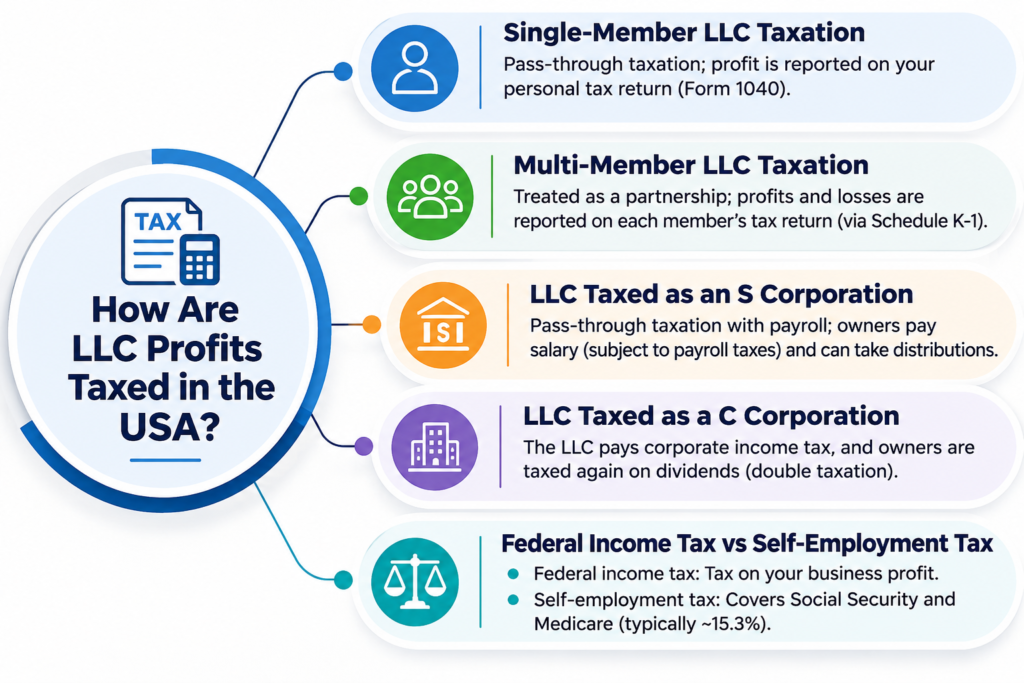
The IRS does not have a separate tax category for an LLC. How your LLC is taxed depends on how many owners it has and which tax classification it uses.
Single-Member LLC Taxation
A single-member LLC is a “disregarded entity” by default. You report all income and expenses on Schedule C of your personal Form 1040. The profit is taxed at your personal income tax rates, and you also pay self-employment tax on it. To see how this compares with other business types, read our guide on how small businesses are taxed in the USA.
Multi-Member LLC Taxation
A multi-member LLC is taxed as a partnership by default. The LLC files Form 1065 and gives each member a Schedule K-1. Each member reports their share of profit on a personal return and pays tax on it, even if the cash was not withdrawn.
LLC Taxed as an S Corporation
An LLC can elect S corporation status by filing Form 2553. The business files Form 1120-S, and profit still passes through to owners. Owners who work in the business must take a reasonable salary, which is subject to payroll tax. Remaining profit can be taken as distributions, which are not subject to self-employment tax.
LLC Taxed as a C Corporation
An LLC can also elect to be taxed as a C corporation. The company files Form 1120 and pays a flat 21% federal corporate tax. If profits are later paid out as dividends, owners pay tax again on them. This is often called double taxation.
Federal Income Tax vs Self-Employment Tax
These are two different taxes, and this is where many LLC owners get confused. You can reach $0 federal income tax and still owe self-employment tax.
| Federal Income Tax | Self-Employment Tax | |
| What it pays for | General government spending | Social Security and Medicare |
| Rate | 10% to 37%, based on tax brackets | 15.3% (12.4% Social Security up to $184,500 in 2026, plus 2.9% Medicare) |
| Calculated on | Taxable income after deductions | 92.35% of net self-employment earnings |
| Reduced by standard deduction and QBI? | Yes | No |
| Where reported | Form 1040 | Schedule SE |
10 Legal Strategies to Reduce Federal Income Tax on LLC Profits
1. Claim All Eligible Business Tax Deductions
Every ordinary and necessary business expense lowers your profit. Common examples are software, advertising, professional fees, insurance, rent, supplies and contractor payments. Keep receipts and bank records for each one. If you are unsure what to collect, see the documents needed to file LLC taxes.
2. Deduct Eligible Home Office Expenses
If you use part of your home regularly and only for business, you can deduct it. The simplified method allows $5 per square foot, up to 300 square feet, which is a maximum of $1,500. The regular method uses actual expenses such as rent, utilities and insurance in proportion to the space used.
3. Use Section 179 and Bonus Depreciation
Instead of deducting equipment slowly over many years, you can often deduct it in the year you buy it. For 2026, the Section 179 limit is $2,560,000, and it phases out once total qualifying purchases pass $4,090,000. Bonus depreciation can cover purchases above that. The equipment must be used for business and placed in service by December 31.
4. Contribute to a Tax-Advantaged Retirement Plan
Retirement contributions are one of the strongest ways to cut taxable income. In 2026, a Solo 401(k) allows an employee deferral of up to $24,500, plus an employer contribution of up to 25% of net self-employment income, with a combined cap of $72,000 for those under 50. A SEP IRA also allows up to 25% of compensation, with the same $72,000 cap. Check plan setup deadlines before year-end.
5. Claim Eligible Health Insurance Deductions
Self-employed owners can usually deduct health, dental and long-term care insurance premiums for themselves, their spouse and dependents. The deduction cannot be more than your net business profit, and you cannot claim it for months when you could join an employer-subsidized plan. If you have a high-deductible plan, HSA contributions are also deductible: up to $4,400 for self-only and $8,750 for family coverage in 2026.
6. Use Tax-Loss Deductions Where Applicable
If your business has a loss, it can offset other income on your return, subject to basis, at-risk and excess business loss limits. Unused losses can be carried forward to future years. Owners with more than one activity should also know how reporting works. Read more on running multiple businesses under one LLC, since a loss in one business can offset profit in another.
7. Consider the Qualified Business Income (QBI) Deduction
Owners of pass-through LLCs can often deduct up to 20% of their qualified business income. This deduction is now permanent. For 2026, full access applies when taxable income is at or below $201,750 (single) or $403,500 (married filing jointly). Above those levels, limits based on wages paid and the type of business can reduce the deduction.
8. Track and Deduct Eligible Vehicle and Travel Expenses
You can deduct business driving using either actual costs or the standard mileage rate. The 2026 rate was 72.5 cents per mile from January to June and rose to 76 cents per mile from July 1. Keep a mileage log with date, purpose and miles driven. Business travel costs are deductible, while business meals are generally limited to 50%.
9. Review Your LLC Tax Classification
The right classification can change your tax bill. An S corporation election may reduce self-employment tax once profits are high enough, but it adds payroll, a required salary and extra filings. A comparison of S corp vs LLC taxes will help you decide whether it fits your profit level.
10. Plan Business Income and Expenses Before Year-End
Most small LLCs use cash-basis accounting, so timing matters. Before December 31, you can pay bills, buy equipment, fund retirement plans and delay invoicing to next year where it makes sense. Also check that your estimated tax payments are on track so you avoid underpayment penalties.
How to Make Zero Federal Tax on USA LLC Profit as a Non-Resident (Step by Step)
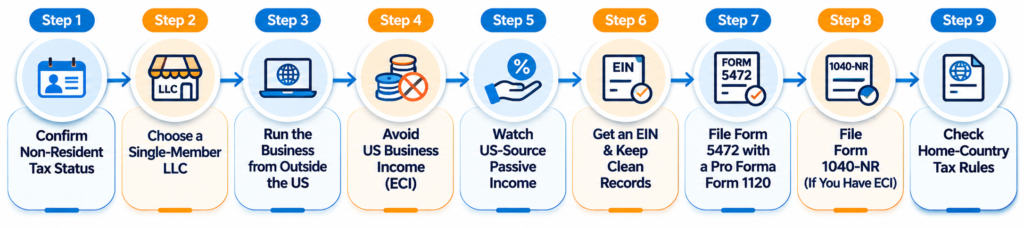
A non-resident alien (NRA) who owns a US LLC is taxed differently from a US resident. The main idea is that US federal income tax generally applies only to income connected to a US business or to certain US-source income. Follow these steps:
- Confirm you are a non-resident for US tax. You are generally a non-resident if you do not hold a green card and do not meet the substantial presence test.
- Choose a single-member LLC if possible. It is treated as a disregarded entity. A multi-member LLC is taxed as a partnership and has extra filing and withholding rules.
- Run the business from outside the US. If you provide services while physically outside the US and have no US office or employees, the income is generally foreign-source and not taxed in the US.
- Avoid income “effectively connected” with a US trade or business (ECI). ECI is taxed at graduated rates, and non-residents generally cannot use the standard deduction (limited treaty exceptions apply).
- Watch US-source passive income. Items such as US dividends, interest and royalties can face 30% withholding, which a tax treaty may reduce.
- Get an EIN and keep clean records. Use a separate business bank account and keep invoices, contracts and proof of where work was performed.
- File Form 5472 with a pro forma Form 1120 every year. This is required for a foreign-owned single-member LLC even with no income. The penalty for missing it is $25,000. It is due April 15, with an extension to October 15 using Form 7004.
- File Form 1040-NR if you have ECI. This is needed to report and pay tax on any US-connected income.
- Check your home-country tax rules. Zero US federal tax does not mean zero tax overall. India, for example, can tax residents on global income.
Can an LLC Owner Have Zero Federal Income Tax but Still Owe Other Taxes?
Yes. Zero federal income tax does not remove other tax duties. You may still owe self-employment tax at 15.3%, state income tax, state LLC fees or franchise tax, payroll taxes if you have employees, and sales tax. You may also still need to file a return. See our guide on whether an LLC needs to file taxes with no income.
Example: How an LLC Owner Can Reduce Federal Taxable Income
Here is a simple 2026 example for a single filer with one single-member LLC and no other income. The figures are for illustration only.
| Item | Amount |
| Business revenue | $70,000 |
| Business expenses (software, home office, mileage, equipment, etc.) | −$34,000 |
| Net profit | $36,000 |
| Half of self-employment tax deduction | −$2,543 |
| Self-employed health insurance deduction | −$4,000 |
| Solo 401(k) employee contribution | −$13,500 |
| Adjusted gross income | $15,957 |
| Standard deduction (single, 2026) | −$16,100 |
| Taxable income | $0 |
| Federal income tax | $0 |
| Self-employment tax still owed (15.3% × 92.35% × $36,000) | $5,087 |
As you can see, income tax reaches $0, but self-employment tax of about $5,087 remains. State tax is not included.
When Should You Hire a Professional for LLC Tax Preparation?
- Multiple business owners: Partnership filings, K-1s and profit-sharing rules are easy to get wrong without expert help.
- High business income: Larger profits need planning around QBI limits, S corp savings and estimated tax payments.
- S Corporation election: Salary levels, payroll filings and Form 1120-S need to be set up correctly from the start.
- Business losses and complex deductions: Loss limits, depreciation and large equipment purchases require careful tracking and correct reporting.
- IRS notices or unfiled tax returns: Late filings and notices carry penalties, and a professional can respond and bring you back into compliance.
Conclusion
Paying 0% federal income tax on LLC profits is possible, but only when real expenses, the standard deduction and smart planning bring taxable income down to zero. It is not a trick, and it rarely removes every tax. Self-employment tax, state tax and filing duties often remain. Start by tracking expenses, use retirement plans and the QBI deduction, and review your LLC classification each year. If you are a non-resident owner, file Form 5472 on time. When your situation gets complex, get professional help.
Disclaimer
The content published on NriTaxs is intended for informational purposes only and does not constitute legal, tax, or financial advice. Readers are encouraged to consult qualified professionals before making any decisions based on the information provided.





Related Articles