
Filing LLC taxes in the U.S. can get complicated when you don’t know which documents to prepare. Missing a single financial record, overlooking a tax form, or confusing personal and business expenses can delay your return and create unnecessary stress. The documents you need also depend on how your LLC is taxed, whether you have employees, and whether your business operates in multiple states. So, what documents do you need to file your LLC taxes? This guide covers the essential paperwork for single-member LLCs, multi-member LLCs, and LLCs taxed as S or C corporations, along with state tax records and practical tips to help you prepare for tax season with confidence.
Key Takeaways
- ✔ Your LLC’s tax type decides your IRS form, deadline, and document list.
- ✔ Single-member LLCs use Schedule C. Multi-member LLCs and S corporations get Schedule K-1s. C corporations file Form 1120.
- ✔ Always keep your EIN letter, income records, expense proof, bank statements, and payroll records.
- ✔ 2026 update: the 1099-NEC and 1099-MISC threshold is now $2,000, and most U.S. LLCs no longer file BOI reports.
- ✔ Foreign-owned LLCs may need Form 5472, and a missed filing can cost $25,000.
Understand How Your LLC Is Taxed Before Gathering Documents
Before collecting any documents, you need to know how your LLC is taxed. The IRS does not tax an “LLC” as such; your tax type decides your form, your deadline, and your paperwork.
- Single-member LLC: By default, the IRS treats it as a disregarded entity. You report business income and expenses on Schedule C with your personal Form 1040, and you pay self-employment tax too.
- Multi-member LLC: By default, the IRS taxes it as a partnership. The LLC files Form 1065, gives each member a Schedule K-1, and members report their share of profit on personal returns.
- LLC taxed as S Corporation: An LLC can elect S corporation status using Form 2553. It files Form 1120-S, pays owner-employees a reasonable salary through payroll, and passes remaining profit to owners through Schedule K-1.
- LLC taxed as C Corporation: An LLC can elect C corporation status using Form 8832. It files Form 1120 and pays corporate tax itself, while shareholders may pay tax again on any dividends they receive.
What Documents Do You Need to File LLC Taxes?
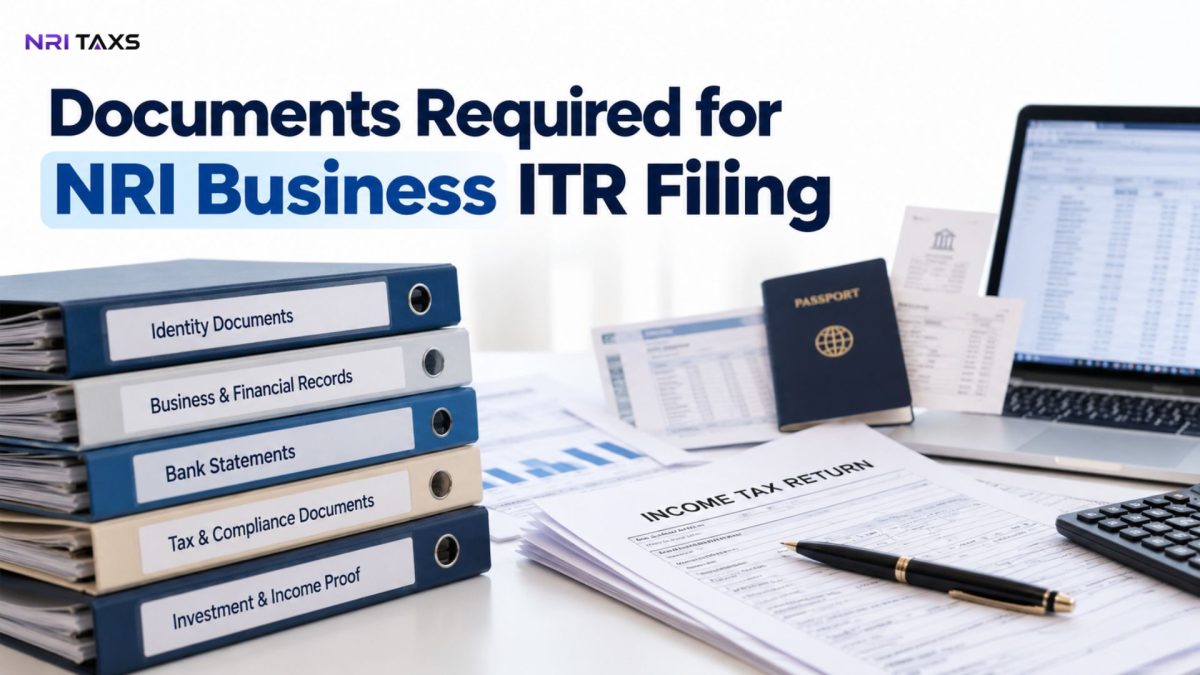
Before filing your LLC taxes, gather the financial records, income statements, expense receipts, and tax forms relevant to your business. The exact documents depend on your LLC’s tax classification, ownership structure, and business activities. Use the checklists below to prepare.
Documents Required for a Single-Member LLC
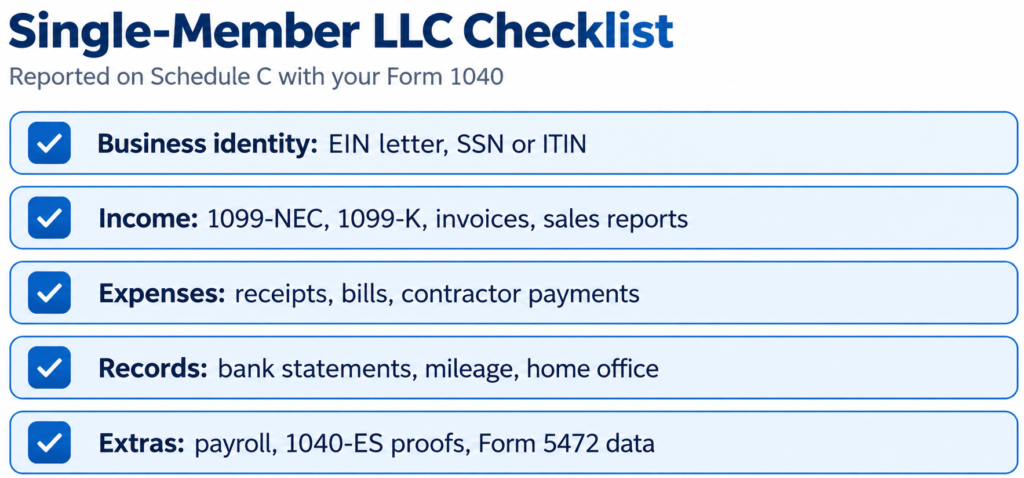
- Business identity and tax information: EIN confirmation letter (CP 575), articles of organization, your SSN or ITIN, and your last filed tax return for easy comparison.
- Income documents: Forms 1099-NEC, 1099-K, and 1099-MISC, client invoices, sales reports, and payment-app or merchant statements.
- Expense documents: Receipts, vendor bills, software subscriptions, rent, advertising costs, and records of payments made to contractors.
- Financial and deduction records: Business bank and credit card statements, a mileage log, home office details, asset purchase records, and proof of health insurance or retirement contributions.
- Additional documents, where applicable:
- Payroll reports, if you have employees
- Proof of estimated tax payments (Form 1040-ES)
- State registration and sales tax records
- Records of money moved between you and the LLC if the owner is a foreign person, because Form 5472 may apply.
Documents Required for a Multi-Member LLC
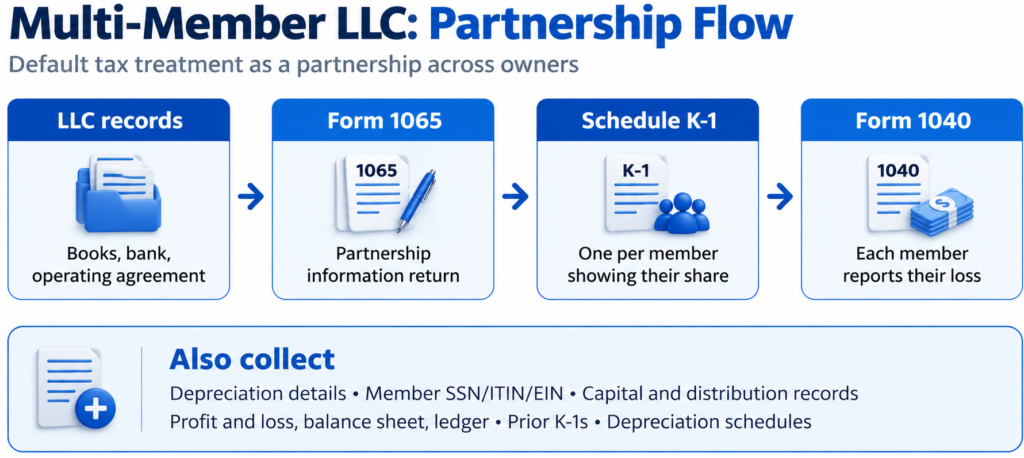
- Business and ownership documents: EIN letter, signed operating agreement, member list with ownership percentages, each member’s SSN, ITIN, or EIN and address, and last year’s Form 1065.
- Income and expense documents: Forms 1099, sales and invoice records, receipts, vendor bills, rent, and payments to contractors.
- Partnership financial records: Profit and loss statement, balance sheet, general ledger, bank reconciliations, loan statements, and member capital contributions and distributions.
- Tax-specific documents: Prior-year Schedule K-1s, depreciation schedules, guaranteed payment records, and member health insurance details.
- Additional documents, if relevant:
- Form 8832 or other tax elections
- Records of any change in ownership during the year
- Asset sale or purchase documents
- State filings and composite or withholding tax records
Documents Required for an LLC Taxed as an S Corporation
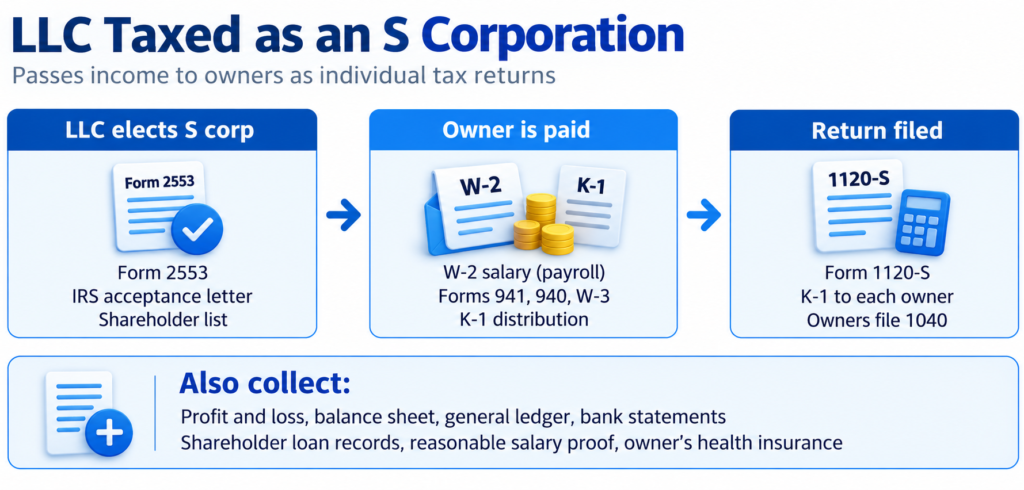
- Election and ownership documents: Form 2553, the IRS acceptance letter, EIN letter, operating agreement, and a list of shareholders with their ownership percentages.
- Income and expense documents: Sales records, invoices, Forms 1099, receipts, vendor bills, and proof of business expenses paid during the year.
- Business financial documents: Profit and loss statement, balance sheet, general ledger, bank and credit card statements, loan records, and a list of business assets.
- Payroll and shareholder documents: Payroll reports, Forms W-2 and W-3, Forms 941 and 940, shareholder distribution records, and proof that owners are paid a reasonable salary.
- Additional tax documents:
- Shareholder basis records
- Prior-year Form 1120-S and Schedule K-1s
- State S corporation filings
- Fringe benefit and health insurance records for owners who hold more than 2% of the shares
Documents Required for an LLC Taxed as a C Corporation
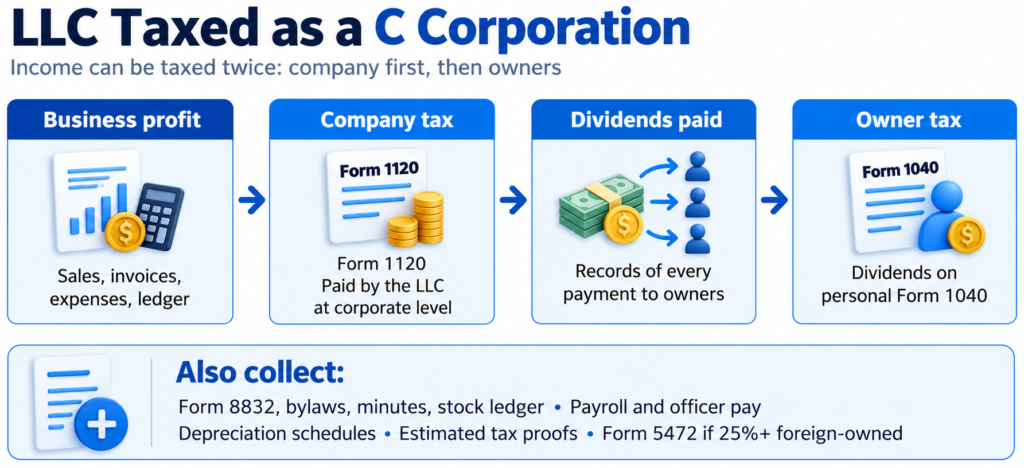
- Business and corporate records: Form 8832, EIN letter, articles of organization, bylaws or operating agreement, board meeting minutes, and a stock or ownership ledger.
- Income and expense documents: Sales records, invoices, Forms 1099, receipts, vendor bills, and proof of all business expenses for the year.
- Financial statements and asset records: Profit and loss statement, balance sheet, general ledger, bank statements, depreciation schedules, and records of assets bought or sold.
- Payroll and ownership documents: Payroll reports, Forms W-2 and 941, officer pay records, dividend payment records, and a list of shareholders.
- Additional tax documents:
- Prior-year Form 1120
- Proof of estimated tax payments
- Net operating loss records
- State corporate returns
- Form 5472, if the LLC is 25% or more foreign-owned and has reportable transactions
State and Local Tax Documents Many LLCs Miss
Federal forms get most of the attention, but state and local paperwork is where many LLCs slip. Rules differ by state, so check your state tax website each year. These are the documents owners forget most often.
| Document | Why it matters | Example |
| State annual report or franchise tax filing | Keeps your LLC in good standing with the state | California charges an $800 annual LLC tax; Delaware charges an annual LLC tax due June 1; Texas franchise reports are due May 15 |
| State income or pass-through return | Reports LLC income to the state | California LLCs file Form 568 |
| Sales tax permit and returns | Required if you sell taxable goods or services | Keep monthly or quarterly sales tax returns |
| State payroll and unemployment registration | Needed before you pay employees | State withholding and unemployment account numbers |
| Local business license and city or county tax receipts | Proves you may legally operate in your area | Annual license renewal and gross receipts tax records |
| State 1099 filings | Some states have lower limits than the federal $2,000 threshold | Illinois and New Jersey use a $1,000 threshold |
| Pass-through entity tax (PTET) election records | Some states let LLCs pay tax at the entity level | Election forms and payment proofs |
Tips to Stay Organized Year-Round
- Separate business and personal money. Open a separate business bank account and credit card. Keep every business payment in that account, so income and expenses stay clean and you never have to separate personal spending.
- Scan receipts quickly. Scan receipts and invoices on the same day. Save them in cloud folders named by year and month, so you can find any document in seconds during the busy tax season.
- Review your books monthly. Review your books every month. Match your bank statements with your records, fix missing entries, and mark unclear payments early, so year-end cleanup usually takes hours instead of many weeks.
- Use a tax calendar. Track all due dates on a shared calendar. Add reminders for estimated taxes, payroll deposits, state reports, and extension deadlines, so that no important date arrives as a sudden surprise.
- Build one tax folder. Keep a yearly tax folder. Store your EIN letter, operating agreement, filed returns, bank records, and elections together, and share the folder with your CPA before they ask for anything.
Should You Use an Accountant or Tax Software?
Both options can work. The right choice depends on how complex your LLC is.
- Tax software: Tax software works well for simple single-member LLCs with clear income and few deductions. It is affordable and fast, but it cannot give personal advice on entity choice, payroll setup, state rules, or complex deductions.
- An accountant or CPA: A CPA helps when you have partners, employees, multiple states, or an S corporation. They review your records, find missed deductions, answer your questions, and represent you if the IRS sends you a notice later.
- Professional tax preparation: Professional preparation suits busy owners who want accuracy and peace of mind. A dedicated team handles forms, deadlines, state filings, and elections, while you focus on running the business instead of learning complex tax rules.
How Nritaxs CPA LLC Can Help
- LLC tax return preparation: NriTaxS CPA LLC prepares Schedule C, Form 1065, Form 1120-S, and Form 1120 returns for your LLC type, and checks that every income and expense is reported correctly before filing.
- Foreign-owned LLC compliance: We also handle Form 5472 with the pro forma Form 1120 for foreign-owned LLCs, including NRI owners, so required reporting is filed correctly and costly IRS late-filing penalties are avoided.
- Document checklist and review: We give you a clear, simple checklist for your LLC type, review your bank statements, 1099s, and expense records, and point out any missing papers early, before deadlines create pressure.
- Tax planning: Our team reviews deductions, entity choice, estimated taxes, and S corporation salary planning, so your LLC pays only what it legally owes and you keep more of your hard-earned profit.
- State filings and year-round support: We help with state returns, annual reports, and tax notices, and we answer your questions throughout the year, so you have steady support instead of one rushed meeting every spring.

Conclusion
Filing LLC taxes becomes easier when you know what to collect and when to collect it. Start by confirming your tax type, then gather identity papers, income records, expense proof, financial statements, and any payroll or ownership documents your LLC needs. Remember the 2026 updates, including the higher $2,000 threshold for 1099-NEC and 1099-MISC and the end of BOI reporting for most U.S. companies. Keep your records organized all year. If your LLC has partners, payroll, foreign owners, or several states, speak with an expert early and file with confidence.
Disclaimer
The content published on NriTaxs is intended for informational purposes only and does not constitute legal, tax, or financial advice. Readers are encouraged to consult qualified professionals before making any decisions based on the information provided.





Related Articles