
Did you work abroad for a few years and then move back to India? Or are you an NRI who once lived in India as a resident? If yes, an old foreign bank account, a few shares or some RSUs from an overseas employer may still be missing from your Indian tax return. This is a common mistake, and most people never notice it. But the tax department now receives account details from many countries, so such gaps can surface at any time. The good news is that FAST-DS 2026 gives you a one-time, fixed-cost way to fix the past. The window closes on 31 December 2026, and time is running short. This guide explains everything you need to know.
What Is FAST-DS 2026?
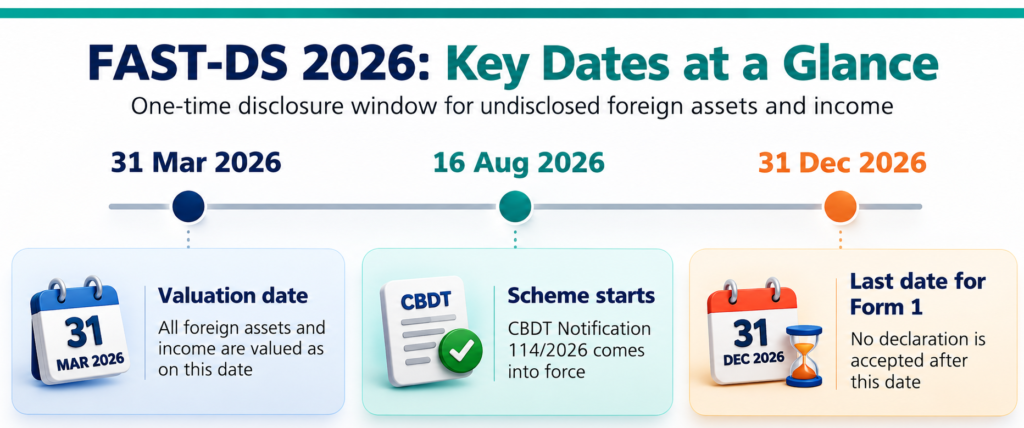
FAST-DS stands for Foreign Assets of Small Taxpayers Disclosure Scheme, 2026. It was introduced through the Finance Act, 2026 and started on 16 August 2026. It lets eligible taxpayers declare foreign income or assets that were never reported or taxed in India. You pay a fixed amount, and once the process is complete, you get protection from further tax, penalty and prosecution under the Black Money Act, 2015 for the declared items. All values are taken as on 31 March 2026. It is a one-time window, not a permanent facility.
Can NRIs Apply for FAST-DS 2026?
Yes, many NRIs can apply, but your current status alone does not decide it. You can use FAST-DS 2026 if you were an Indian resident in the year the income was earned or the asset was bought. If you have always been a non-resident, the scheme generally does not apply to you. Check your status carefully for each relevant year.
- NRIs Who Were Previously Indian Residents:- Yes, you may qualify. If you were an Indian resident when the foreign income was earned or the asset was bought, you can declare it.
- Returning NRIs Who Have Become Indian Residents:- This is the main target group. Old foreign accounts, shares or policies need reporting after return. If missed, FAST-DS helps. Check your residential status first.
- RNOR Taxpayers and FAST-DS Eligibility:- RNORs can apply too, if they were Indian residents in the relevant earlier year. Many returning NRIs are RNOR, so test eligibility year by year.
Which Foreign Assets and Income Can NRIs Disclose?
Foreign Bank Accounts and Savings
Old salary, student and savings accounts abroad can be declared. For bank accounts, the rules generally look at total deposits made, not just the balance on 31 March 2026. Returned home with an RFC account? Read our RFC account guide.
Foreign Property and Real Estate
A house, flat or plot abroad can be declared if it falls within the value limits. Its value is worked out as on 31 March 2026 using the prescribed method and currency conversion rules. Keep deeds and payment proofs ready.
Foreign Shares, ESOPs and RSUs
Shares of foreign companies, ESOPs and RSUs from an overseas employer are covered. Many employees miss these because the employer already cut taxes abroad. If you are an H1B returnee, see our tax guide for H1B holders returning to India.
Foreign Income Not Reported in Indian ITR
Interest, dividends, rent or salary earned abroad never shown in your Indian return can be declared. This falls under Category A, where the total value of undisclosed assets and income must stay within ₹1 crore, valued on 31 March 2026.
Assets Acquired From Explained Sources but Omitted From ITR
Suppose you paid tax on the money, or earned it abroad as a non-resident, but forgot to show the asset in your return. This is Category B. The asset limit is ₹5 crore and the flat fee is ₹1 lakh.
FAST-DS 2026 Tax, Penalty and Fee Structure
| Particulars | Category A | Category B | If you do not declare |
| What it covers | Foreign assets or income never reported and never taxed in India | Assets bought from income earned abroad as a non-resident, or from income already taxed in India, but not shown in the return | Foreign assets and income stay undisclosed under the Black Money Act |
| Value limit (as on 31 March 2026) | Up to ₹1 crore | Up to ₹5 crore | No limit |
| Tax | 30% of the declared value | Nil | 30% tax |
| Penalty / additional amount | Equal to the tax (another 30%) | Nil | Penalty up to 300% of the tax, plus ₹10 lakh for not reporting in the return |
| Total you pay | 60% of the declared value | Flat fee of ₹1 lakh | Can go far above the asset value |
| Prosecution | Immunity after valid declaration, payment and full process | Immunity after valid declaration, payment and full process | Possible |
Remember, ₹1 crore and ₹5 crore are eligibility limits, not tax-free amounts. If your total value is above the limit for your category, the scheme is not available for that portion.
How to File FAST-DS Form 1 Online: Step-by-Step Process
Step 1: Check Your Eligibility
First, confirm whether you were an Indian resident in the year the income was earned or the asset was bought. Then check the value limits: ₹1 crore for Category A and ₹5 crore for Category B. Also make sure no Black Money Act assessment is already complete for that year.
Step 2: Collect Foreign Asset Documents
Make a list of every foreign account, share, ESOP, policy and property. Note when each was acquired, how it was funded and whether it appeared in earlier returns. Keep bank statements, broker reports, employer grant letters and tax papers ready. Work out each value as on 31 March 2026 using the scheme’s valuation and currency conversion rules, not today’s price.
Step 3: Log In to the Income Tax E-Filing Portal
Visit the Income Tax e-filing portal and log in with your PAN and password. Make sure your PAN is active, your mobile number and email are updated, and your residential status is correct in your profile. This avoids problems later. Keep your e-verification option ready, such as an OTP or a bank-linked EVC. Do this early to avoid last-minute rush.
Step 4: Select FAST-DS Form 1
After login, go to e-File, then Income Tax Forms, then File Income Tax Forms, and choose Other Acts. Select the Foreign Assets of Small Taxpayers Disclosure Scheme, 2026 (Form 1). Pick the right category and enter your personal details, asset details, source of funds and values carefully. Wrong details can lead to a wrong payable amount, so double-check each entry.
Step 5: Submit the Declaration
Upload the supporting documents and the valuation report, where required. Check every figure once more, then submit and verify Form 1 electronically. Remember, Form 1 must be filed on or before 31 December 2026. Submitting the form alone does not give immunity. You must also complete the payment and the remaining steps. Save the acknowledgement receipt for your own records.
Step 6: Review Form 2 Issued by the Tax Department
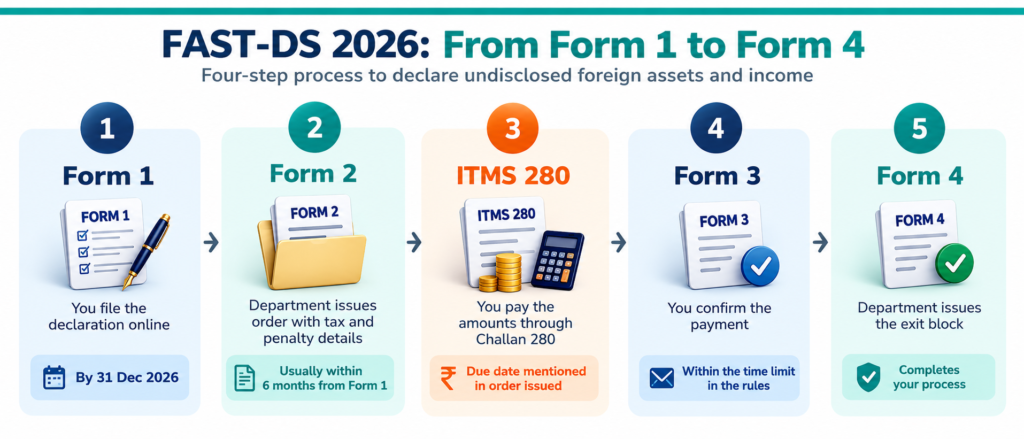
After your declaration, the Income Tax Department issues Form 2, an order stating the amount you must pay. This usually comes within one month from the end of the month in which you filed Form 1. Read the amount, category and asset details carefully. If anything looks wrong, speak to a qualified tax expert before you pay anything at all.
Step 7: Pay the Amount Through Challan ITNS 289
Pay the amount shown in Form 2 using challan ITNS 289 on the e-filing portal. Choose the correct minor head, because a wrong choice cannot be corrected or refunded. AY 2026-27 comes pre-filled. After paying, file Form 3 to inform the department about your payment. Finally, the department issues Form 4 as your certificate. Keep all your challan receipts safely.
Documents NRIs Should Prepare Before Applying for FAST-DS
Good preparation saves time and avoids mistakes. Keep these papers ready before you open Form 1:
- PAN card, passport and OCI or visa details to prove your residential status.
- Travel records or passport stamps for each relevant financial year.
- Foreign bank statements since the account was opened, showing all deposits.
- Broker statements and ESOP or RSU grant, vesting and sale records.
- Foreign payslips, Form W-2 or equivalent income proofs.
- Property purchase deed, loan statements and payment proofs.
- Foreign insurance or pension policy statements.
- Earlier Indian ITRs, Schedule FA copies and your AIS.
- Foreign tax returns and tax payment receipts.
- Proof of source of funds for each asset.
- Valuation report, where required, and exchange rate records.
What Is the Last Date to Apply for FAST-DS 2026?
The last date to file Form 1 under FAST-DS 2026 is 31 December 2026. The window opened on 16 August 2026, and no declaration will be accepted after the deadline. About two months remain from today. Since Form 2, payment and later steps follow your filing, do not wait for the last week of December. Start collecting your documents now.
What Happens After You Submit a FAST-DS Declaration?
- Form 2 is issued: The department reviews your Form 1 and issues Form 2 with the amount payable. This normally happens within one month from the end of the month of filing. Check the category, value and amount carefully.
- You pay through ITNS 289: You must pay the amount through challan ITNS 289 within the time allowed. Late or wrong payment can create problems for your declaration, and a wrong minor head cannot be corrected or refunded at all.
- You file Form 3: After paying, you file Form 3 to inform the department about the payment, along with proof. This confirms to the authorities that you have completed your part of the process, so do not skip it.
- Form 4 is issued: Once the payment is verified, the department issues Form 4, a certificate confirming your declaration and payment. Keep it safe, as it is your final official proof of compliance for any future queries or notices.
- You get immunity: On a valid declaration and full completion of the process, you get immunity from further tax, penalty and prosecution under the Black Money Act for the declared items. Form 1 alone does not give this.
What If You Have Already Received an Income Tax Notice About Foreign Assets?
Do not ignore it, and do not rush to file Form 1 either. Whether you can still use FAST-DS depends on the type of notice and the stage of the case. Cases where a Black Money Act assessment is already complete for that year, and proceeds-of-crime cases, are excluded, and other pending proceedings may also affect eligibility. First, check that the notice is genuine, as fake income tax notices circulate on WhatsApp. Then read it carefully, note the reply date and get an expert to check your options.
Not sure whether your notice allows a FAST-DS declaration? Do not guess. A wrong step can cost you immunity or push you past the deadline. The expert team at Nritaxs reviews your notice, checks your residential status and tells you the safest route, quickly and in plain language.

How Nritaxs Can Help When You Receive an Income Tax Notice About Foreign Assets
- Notice review: We read your notice, identify the section and the foreign asset involved, and explain your risk and reply deadline simply.
- Eligibility check: We test your residential status year by year and confirm whether FAST-DS 2026 applies to you, and under which category.
- Valuation and documents: We prepare your asset list, valuation as on 31 March 2026 and supporting papers, so your declaration is fully accurate.
- Filing and reply: We file Form 1, track Form 2, handle ITNS 289 payment and Forms 3 and 4, and draft department replies.
Need help before the deadline? Talk to Nritaxs tax experts at +91 88588 88885.
Conclusion
FAST-DS 2026 is a rare chance to clear old foreign-asset gaps at a fixed cost, without the fear of heavy penalty or prosecution. If you are an NRI, RNOR or returning NRI with unreported accounts, shares, ESOPs or property, check your eligibility now. Confirm your residential status, value your assets as on 31 March 2026 and file Form 1 before 31 December 2026. Early action gives you enough time to fix any errors. For expert help, connect with Nritaxs today.
Disclaimer
The content published on NriTaxs is intended for informational purposes only and does not constitute legal, tax, or financial advice. Readers are encouraged to consult qualified professionals before making any decisions based on the information provided.






Related Articles