
Understanding NRI business ITR filing charges in India is essential for NRIs earning business income in India. These charges refer to the professional fees paid to a Chartered Accountant (CA) or tax consultant for preparing and filing an Income Tax Return (ITR). The cost varies depending on your business structure, income sources, turnover, accounting complexity, and tax compliance requirements. Simple returns may cost less, while complex business returns involving multiple income sources or tax audits may require additional fees. In this guide, we cover estimated filing charges, additional costs, required documents, and professional tax filing services to help you make an informed decision.
Quick Answer
NRI business ITR filing charges are quote-based, not fixed. The fee depends on your business type, number of transactions, other income, and whether tax audit, foreign tax credit, or notice work is needed. Filing on the government e-filing portal is free. You pay only for professional help. NRIs with business income must file ITR-3. Always get a written quote that lists what is included.
How Much Do NRI Business ITR Filing Services Cost in India?
Average Cost of NRI Business ITR Filing
There is no single “average” price. Providers charge based on the amount of work, not a flat government rate. A basic return with only interest or rent is cheaper. A business return needs income calculation, expense review, and bank reconciliation, so it costs more. The final quote depends on four things: how many transactions you have, how good your records are, how many income sources you have, and whether audit or treaty work is needed. Two NRIs with the same turnover can get different quotes if their records are very different.
Before you choose, compare what each quote includes. A low fee that excludes notice support, TDS reconciliation, or e-verification can cost you more later.
NRI Business ITR Filing Fees: An Overview
This table shows how professional services are usually grouped and what changes the fee.
| Type of Service | Services Included | Factors Affecting Fees | Additional Charges, If Applicable |
| Basic ITR filing | Return for interest, rent, or capital gains; tax computation; e-filing | Number of income sources, residential status | Revised or belated return work |
| Business income reporting (ITR-3) | Profit calculation, expense review, ITR-3 preparation, e-verification | Transaction volume, record quality, business type | Bookkeeping, financial statements |
| Tax audit assistance | Audit by a practising CA and audit report | Turnover, number of ledgers, complexity | Usually charged separately from ITR filing |
| Tax notice assistance | Reply to notices, defective return response, demand or refund issues | Type of notice, documents needed | Often a separate engagement |
| Cross-border tax consultation | Foreign income review, foreign tax credit, DTAA review | Country of residence, type of foreign income | Form 67 and extra documents |
Ask every provider for a written scope. It should say which of these services are inside the quote and which cost extra.
NRI Business ITR Filing Charges by Business Type
Your business structure decides how your income is reported and how much work is involved. This is why fees change from one NRI to another. If you are new to the process, our guide on how NRIs can file ITR for business income in India explains each step in detail.
NRI Sole Proprietorship ITR Filing Charges
A sole proprietorship has no separate legal identity. Your business income is added to your own return and taxed at individual slab rates. The preparer must calculate revenue, allowable expenses, and net profit. You file this in ITR-3. Fees depend on the number of invoices and expense entries, and on how well your bank statements match your books.
NRI Freelancer and Consultant ITR Filing Charges
Freelancers and consultants report professional income in ITR-3. The work gets harder when income comes from both Indian and overseas clients. Each receipt needs to be matched with bank credits and invoices. Cross-border income may need extra checks, such as whether it is taxable in India and whether foreign tax credit applies. This can add to the fee.
NRI Partnership Firm Tax Filing Charges
A partnership firm files its own return. The NRI partner files a separate personal return that shows the partner’s own income from the firm, such as remuneration and interest. Share of profit from the firm is handled under separate rules. If you need both the firm’s return and your personal return, providers usually quote them separately. This guide focuses on the personal return of an NRI business owner.
NRI Director and Business Owner Tax Filing Charges
NRI directors report director’s fees and any salary from an Indian company in their personal return. Dividend income is also reported. Tax is generally deducted at source on dividends paid to non-residents, and a tax treaty may reduce the rate if you qualify. A company files its own return separately. Your professional fee for personal filing depends on how many income types you have and whether treaty claims are needed.
What Factors Affect NRI Business ITR Filing Charges?
Type of ITR Form Required
NRIs with business or professional income file ITR-3. The simple ITR-4 for presumptive taxation is not available to non-residents. This matters for cost, because presumptive filing is simpler and cheaper. NRIs must prepare a full profit and loss calculation instead.
Number of Income Sources
Each extra income source adds work. These include:
- Business and professional income
- Salary or director’s remuneration
- Rental income
- Capital gains
- Interest, dividends, and foreign income
Business Turnover and Accounting Complexity
More transactions mean more time spent on checking. If your records are complete and organised, the work is faster. If bank statements, invoices, and expense bills are missing, the preparer must rebuild the accounts first. This is usually charged extra.
Tax Audit Requirements
A tax audit under Section 44AB is needed when business turnover or professional receipts cross the prescribed limits. Limits can differ based on cash transactions, so check them for your case. Audit fees are normally separate from ITR filing fees. Read more in our guide on tax audit for NRI business.
For AY 2026-27, the tax audit report was due on 30 September 2026, and the ITR deadline for audit cases is 31 October 2026.
Late Filing and Previous-Year Returns
Missing deadlines increases both cost and risk. For AY 2026-27, the original due date for non-audit business returns (ITR-3) was 31 August 2026. A belated return can still be filed up to 31 December 2026, with a late fee under Section 234F and interest under Section 234A. After that, an updated return (ITR-U) can be filed with additional tax. Providers often charge more for old or late returns, because they must rebuild records and check what is still allowed.
Cross-Border Tax Complexity
Your residential status decides what income is taxable in India. If you also earn income abroad, the preparer must check foreign tax credit and tax treaty (DTAA) rules. This needs extra documents and time, so the fee is usually higher than for a purely Indian business.
Additional Charges You May Need to Pay
The filing fee is only one part of the cost. These extra services are often billed separately.
Tax Audit Fees
If an audit applies, a practising CA must audit your accounts and give a report. This is a separate service from filing. Fees depend on turnover, number of ledgers, and how complete the books are. Failing to get a required audit can attract a penalty under Section 271B, so do not skip it to save money.
Accounting and Bookkeeping Charges
If you do not keep proper books, the provider must organise transactions, prepare a profit and loss statement, and match income and expenses. Incomplete records mean more hours, and more cost.
Income Tax Notice Assistance Fees
Basic filing does not usually cover notices. Replying to a defective return notice, a demand notice, or a refund query is generally a separate engagement. Ask if post-filing support is included before you pay.
TDS Reconciliation and Refund Assistance
The provider should match TDS credits with Form 26AS and AIS. If more tax was deducted than you owe, you can claim a refund. This is common for NRIs, as explained in our guide on TDS on NRI business income and refund process. Refund work outside the original scope can cost extra.
Foreign Income and Tax Treaty Consultation
If you want to claim foreign tax credit or a treaty benefit, the provider must review your foreign income and tax paid abroad. This usually involves Form 67 and supporting documents. Complex cases cost more.
GST Reconciliation and Other Compliance Services
If your business is registered under GST, your GST returns should match your income in the ITR. A mismatch can lead to questions later. GST filing is usually a separate service, so check what is included in your quote.
Government Fees vs Professional Fees
Filing a return on the income tax portal is free. You pay professional fees for the preparer’s time and expertise. You also may pay amounts to the government that are not a service fee at all:
- Tax payable: the actual income tax you owe.
- Late fee (Section 234F): up to ₹5,000 for late filing.
- Interest (Sections 234A, 234B, 234C): for late filing and short advance tax.
- Penalties: for example, for missing a required tax audit.
A good quote lists professional fees separately from these amounts.
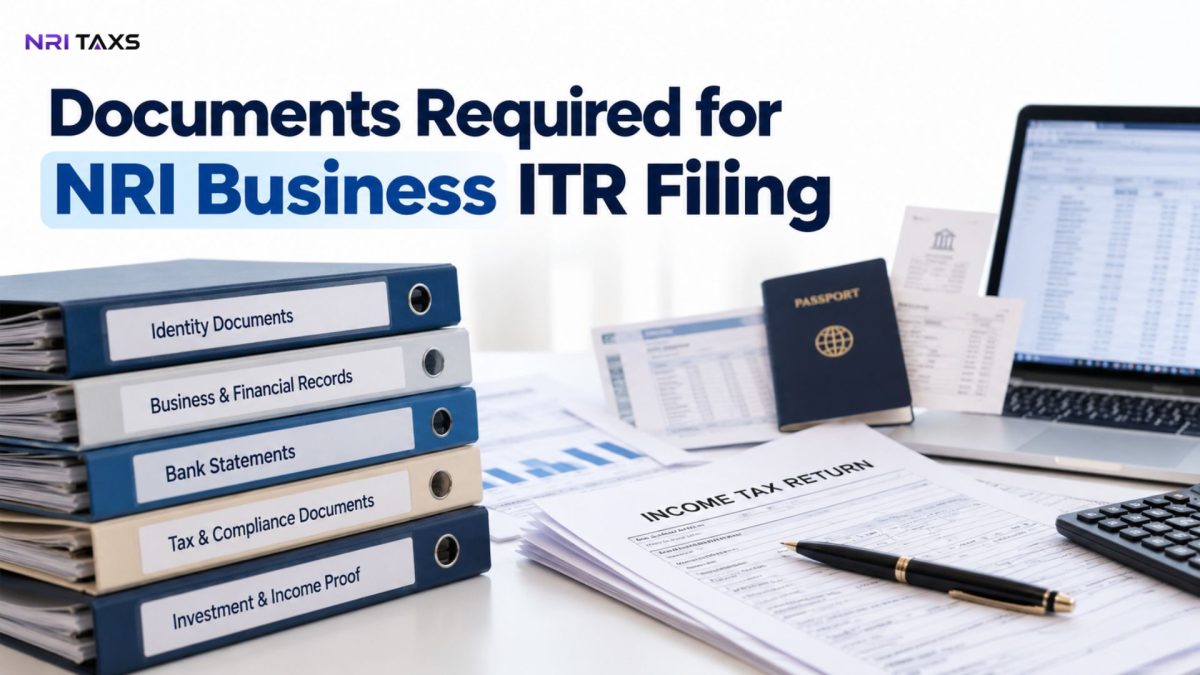
Documents Required for NRI Business ITR Filing
Sharing documents early helps your provider give an accurate quote and avoids delays. Our full checklist of documents for NRI business ITR filing has more detail. Here is a short summary.
Personal Documents
- PAN details and Indian bank account details
- Passport and details of days spent in India (for residential status)
- Previous income tax returns, if available
Business Income Documents
- Sales and purchase invoices
- Business bank statements
- Income and expense records, profit and loss statement, and balance sheet, where applicable
- GST returns, where relevant
Tax Payment Documents
- Form 26AS and Annual Information Statement (AIS)
- TDS certificates
- Advance tax and self-assessment tax payment details
Additional Documents for NRIs
- Foreign income details and foreign tax payment records
- Tax Residency Certificate, if you claim a treaty benefit
- Documents about business ownership and activity in India
Can NRIs File Business ITR Online Without a CA?
When DIY Filing May Be Suitable
You may manage on your own if your tax affairs are simple, your records are well kept, you know that ITR-3 applies, and you can complete the filing and e-verification yourself.
When Professional Assistance May Be Beneficial
Get help if you have multiple income sources, complex profit calculations, foreign income, a tax audit requirement, past filing errors, or an income tax notice.
DIY Filing vs Professional ITR Filing
| Factor | DIY Filing | Professional Filing |
| Service cost | No professional fee | Fee based on scope |
| Time and effort | High, you do everything | Low, you share documents |
| Tax calculation | You calculate and organise records | Done by the preparer |
| Complex cases | Hard without tax knowledge | Audit, DTAA, and foreign income support |
| Accuracy responsibility | Fully yours | Shared, but you still sign off on the return |
| Extra services | Need to find separately | Notice, TDS, and audit support, often at extra cost |
How to Choose the Right NRI Business ITR Filing Service
- Check NRI experience. Ask if they handle non-resident cases, residential status rules, and business income.
- Compare inclusions, not only price. Check if audit, notice support, and TDS reconciliation are included, and ask for the total expected cost.
- Verify qualifications. Confirm who prepares your return and who signs the audit report, if one is needed.
- Review privacy and support. Your documents contain bank and PAN details. Ask how they are stored and whether support continues after filing.
How to Get Your NRI Business ITR Filed in India
- Share your business and income details. Tell the provider your business type, income sources, and residential status.
- Confirm the ITR form. For NRI business income, this is ITR-3.
- Submit the required documents. Collect and share your financial and tax records.
- Review the tax computation and fees. Confirm your tax liability, scope of work, and professional charges before approving.
- File and e-verify. Submit the return and complete e-verification within the time allowed. A return is not complete without verification.
Conclusion
NRI business ITR filing charges depend on your business structure, income sources, accounting complexity, and extra compliance such as tax audit, notices, or foreign tax credit. There is no one price that fits every NRI. Do not choose a provider on price alone. Compare what each quote includes, and keep government fees and professional fees separate in your mind. If you want a clear quote for your business return, contact NRITaxs with your business details and we will guide you on the right filing approach.
Disclaimer
The content published on NriTaxs is intended for informational purposes only and does not constitute legal, tax, or financial advice. Readers are encouraged to consult qualified professionals before making any decisions based on the information provided.









Related Articles