

Many NRIs in the USA, UK, Canada and the UAE ask whether they can run a business in India while living overseas. The answer is yes in most cases, but registering a company is only the first step. You also need to follow FEMA rules for money coming in and going out, Indian tax rules for your income, GST, and yearly filings. This guide explains how Can an NRI Run a Business in India From Abroad? the structures available, FEMA conditions, tax and ITR rules, bank accounts, and compliance for 2026.
Quick Answer
Yes. An NRI can own, invest in and manage an eligible Indian business from abroad. The structure you choose decides your FEMA conditions, tax treatment and whether profits can be sent back. A private limited company or LLP is usually the cleanest route. An NRI with business income files ITR-3, and the business needs its own compliance such as GST and annual filings.
Can an NRI Run a Business in India From Abroad?
Yes. Owning a business, investing in one and running it day to day are three different things under the law. What you can do depends on the sector, the structure and your residential status.
An NRI can usually:
- Hold shares in an Indian private limited company.
- Invest in an eligible LLP, partnership firm or proprietary concern, subject to conditions.
- Manage the business remotely through employees, managers or authorised representatives.
- Receive eligible income such as dividends or remuneration.
Important: Being allowed to invest does not mean every activity is allowed. Real estate business, agriculture, plantation and print media face special restrictions.
Which Business Structure Is Best for an NRI?
Private Limited Company
A private limited company is a separate legal entity with limited liability for shareholders. Foreign investment is allowed in most sectors under the automatic route, subject to sector caps. It also suits future funding. You need at least one director who is resident in India (see Section 4).
Limited Liability Partnership (LLP)
An LLP also has a separate legal identity and limited liability. Foreign investment is allowed under the automatic route only in sectors where 100% FDI is permitted automatically and no FDI-linked conditions apply. An LLP needs at least one designated partner who is resident in India. It often suits consulting and service businesses.
Partnership Firm and Sole Proprietorship
An eligible NRI or OCI cardholder may invest in a partnership firm or proprietary concern on a non-repatriation basis. This means the investment and its proceeds cannot be freely sent abroad. Agriculture, plantation, real estate business and print media are not allowed. A proprietorship also has no separate legal identity, so you carry unlimited personal liability.
FEMA Rules for NRIs Running a Business in India
The Foreign Exchange Management Act, 1999 (FEMA) controls how money moves between India and abroad. Follow these five steps before you invest.
- Check the sector: Foreign investment may be under the automatic route, need government approval, or be prohibited.
- Choose the basis: Investment can be on a repatriation or non-repatriation basis. This decides whether money can go back abroad.
- Send funds through banking channels: Use proper inward remittance, and keep the proof.
- Report on time: When a company issues shares to you, it must usually report on the RBI FIRMS portal (Form FC-GPR) within 30 days. It must also file an annual return on foreign liabilities and assets.
- Keep records: Remittance advice, share certificates, board resolutions and valuation papers are needed later for transfers and repatriation.
Note that FEMA residential status and income tax residential status are different tests. Do not treat them as the same.
Can an NRI Be a Shareholder, Director or Manager?
- Shareholder: Yes, where foreign investment is permitted. The company must follow pricing and reporting rules.
- Director: Yes, but every Indian company must have at least one director who stayed in India for 182 days or more in the financial year. If you are the only founder, you will need a resident co-director.
- Remote manager: Yes. You can take decisions through board meetings by video, digital approvals and a local team. The company still has to keep Indian books, filings and tax compliance in order.
How Is NRI Business Income Taxed in India?
A non-resident is taxed in India on income received here, income that arises here, and income deemed to arise here. Foreign income is generally not taxed in India for an NRI.
Your status matters, so confirm it first. An Indian citizen with Indian income above ₹15 lakh who spends 120 days or more in India in a year (and 365 days or more in the previous four years) may be treated as a resident but not ordinarily resident (RNOR). Read our guide on NRI residential status rules before you plan your India visits.
Tax by Type of Income
| Income | How it is generally taxed |
|---|---|
| Proprietorship profit | Added to your own income and taxed at your slab rates. |
| Partnership or LLP share and remuneration | The firm or LLP is taxed on its profit. Your share of profit is generally exempt, but remuneration and interest are taxed in your hands. |
| Company profit | Taxed in the company. You are taxed separately on salary or fees you receive. |
| Dividend | TDS is generally 20% plus surcharge and cess. A lower DTAA rate may apply if you give the required documents. |
If you live in the USA or UAE, your treaty rate and foreign tax credit can change the final tax. Our DTAA guide for NRIs explains how to claim relief and avoid paying twice.
Business expenses such as staff salary, rent, professional fees and depreciation are allowed if they are genuine and supported by invoices. Personal expenses cannot be claimed.
Which ITR Form Should an NRI Use for Business Income?
An NRI with business or professional income generally files ITR-3. An NRI with only salary, rent, capital gains or interest files ITR-2. ITR-4 is not available to non-residents.
Presumptive taxation under Sections 44AD and 44ADA is meant for resident taxpayers, so an NRI generally cannot use it. Business income is computed under regular provisions with books of account. Our step-by-step guide to filing ITR for NRI business income shows each stage of the return.
The business entity files its own return. A firm or LLP files ITR-5 and a company files ITR-6. This is separate from your personal return.
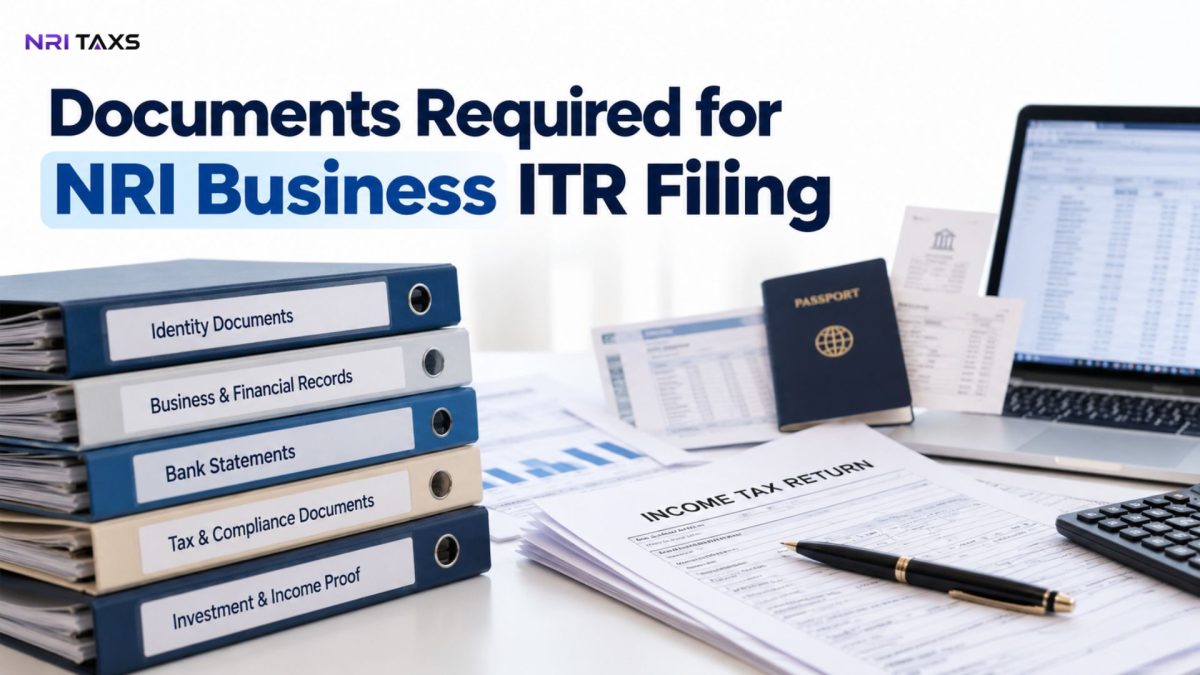
Documents usually needed: PAN, passport, Indian bank statements, profit and loss account, balance sheet, Form 26AS and AIS, TDS certificates, dividend or remuneration details, and foreign tax paid proof if you claim credit.
Note: This section covers the return for FY 2025-26 (AY 2026-27). For income from 1 April 2026, the Income-tax Act, 2025 applies, so section numbers and form names may change.
TDS on NRI Business Income and Refunds
Tax is deducted at source on many payments to an NRI, such as interest, dividends and professional fees. The rate is often higher than your final tax. TDS does not close your tax obligation. You still need to file a return, match your TDS with Form 26AS and AIS, and claim the balance as a refund. Our guide on how NRIs claim excess TDS refund covers the process and common delays.
NRE, NRO or SNRR: Which Account for Business Money?
- NRE account: For funds remitted from abroad. Indian business receipts generally cannot be credited here.
- NRO account: The usual account for income earned in India, including dividends and business receipts.
- SNRR account: For a person resident outside India with a genuine business interest in India, for eligible rupee transactions.
Repatriation rules differ by income type. Dividends from a repatriable investment can generally be sent abroad after tax. Balances in an NRO account can be remitted up to USD 1 million per financial year after paying tax, with a Chartered Accountant certificate. Investments made on a non-repatriation basis cannot be freely sent abroad. Banks ask for tax documents before a remittance, now under Forms 145 and 146 (earlier Forms 15CA and 15CB). Read our Form 145 and 146 guide for NRIs before you transfer money.
GST and Annual Compliance
Running the business from abroad does not remove Indian filings.
- GST: Registration is generally required above ₹40 lakh turnover for goods or ₹20 lakh for services in most states. Some activities need registration at any turnover.
- Company or LLP: Annual financial statements, annual returns, income tax return and foreign investment reporting.
- Tax audit: Generally applies if business turnover crosses ₹1 crore (₹10 crore if cash transactions stay within 5%). See our tax audit guide for NRI business to check if it applies to you.
- Books: Hire a local accountant to keep invoices, bank reconciliation and statutory records current.
Example: NRI in California With an Indian IT Company
Rahul lives in California and owns 60% of an Indian private limited company that has a resident co-director. The company reports his investment on the FIRMS portal and files its own ITR-6 and GST returns. Rahul receives a dividend with TDS and a small director fee. He files ITR-3 in India, claims the DTAA rate and foreign tax credit, and reports the Indian income in his US return. India compliance does not replace US reporting, so he checks both sides.
Common Mistakes NRIs Should Avoid
- Choosing a structure without checking FEMA: A proprietorship may block repatriation.
- No resident director or designated partner: The company or LLP cannot be set up properly.
- Using NRE for business receipts: Business income generally goes to NRO.
- Filing the wrong ITR form: ITR-4 is not for non-residents.
- Ignoring TDS reconciliation: You lose refunds when Form 26AS and AIS do not match your return.
- Sending money abroad without documents: Remittance can be delayed or refused.
Conclusion
An NRI can run a business in India from abroad, but the right result depends on the structure, FEMA basis, tax status and filings. Choose the structure first, report investment correctly, file the right ITR, and keep GST and annual compliance on schedule. A little planning avoids blocked remittances and notices later.
Disclaimer
The content published on NriTaxs is intended for informational purposes only and does not constitute legal, tax, or financial advice. Readers are encouraged to consult qualified professionals before making any decisions based on the information provided.








Related Articles