

Yes, you can continue your existing SIPs even after moving abroad. Becoming an NRI doesn’t mean you have to stop investing in Indian mutual funds. However, before your next SIP instalment, you should update your NRI status, KYC details, FATCA declaration, and bank account with the mutual fund house. These updates help ensure your investments continue without any interruptions or compliance issues.
Many NRIs worry that their SIPs will stop automatically after leaving India, but that’s not usually the case. As long as you complete the required formalities and follow the applicable rules, your SIPs can continue smoothly. However, some fund houses may have additional requirements, especially for investors living in countries like the USA and Canada.
In this guide, we’ll explain everything you need to know from eligibility and required documents to taxation, FEMA rules, and the step-by-step process to continue your SIPs after moving abroad.
Key Takeaways
- ✓ NRIs can continue their existing SIPs after moving abroad, provided they update their residential status, KYC, PAN details, and bank account.
- ✓ SIPs do not stop automatically after becoming an NRI, but failing to update records may lead to KYC, FEMA, or transaction-related issues.
- ✓ Existing SIPs and new SIP investments have different compliance requirements, including NRI KYC and FATCA declarations for new investments.
- ✓ NRIs should link their SIPs to an NRE or NRO account based on their repatriation and investment requirements.
- ✓ SIP redemptions are subject to Indian tax rules, while DTAA benefits may help eligible NRIs reduce double taxation.
Do Existing SIPs Stop Automatically?
No, this is the most common misconception. SIPs do not stop automatically when you become an NRI. They continue running until you either pause them yourself, the AMC flags a KYC mismatch, or your linked bank account gets frozen for FEMA non-compliance (which typically happens only after your bank is notified of your NRI status through other channels, such as a new NRE account opening). In practice, many NRIs discover the mismatch only when a SIP payment bounces or an AMC support email asks for updated KYC documents.
FEMA Rules Every NRI Should Know
The Foreign Exchange Management Act (FEMA) governs how NRIs can hold and operate financial accounts and investments in India, and mutual funds fall squarely under it. The core FEMA mutual fund rules that matter here are straightforward:
- NRIs cannot continue operating a regular resident savings account; it must be redesignated as an NRO account, or funds should route through an NRE account for repatriable investments.
- Mutual fund investments made by NRIs must be funded through an NRE or NRO account, not a resident account, once your status changes.
- Repatriation of SIP proceeds is generally allowed through NRE-linked investments, subject to RBI limits; NRO-linked investments have more restricted repatriation rules.
- Non-disclosure of your changed residential status to your bank and AMC is itself a compliance lapse, independent of whether your SIP continues to run.
How to Continue Existing SIPs After Moving Abroad?
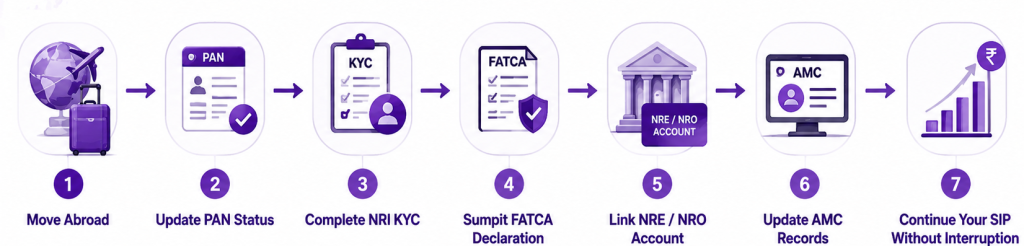
If you want to keep your SIPs running smoothly and stay fully compliant, here’s the step-by-step process AMCs and banks expect you to follow.
Step 1: Update Your Residential Status
Inform your bank that you have become an NRI under the Income Tax Act (this generally happens once you’ve spent under 182 days in India in a financial year, subject to the exact residency test that applies to you). Your bank will guide you through converting your existing account.
Step 2: Update PAN Records
Your PAN itself doesn’t change, but your residential status and communication address linked to PAN need updating. Mismatched PAN records are one of the most common reasons AMC folios get flagged for review.
Step 3: Complete NRI KYC
Every AMC you hold folios with requires a fresh NRI KYC mutual fund process this typically involves submitting your passport copy, overseas address proof, PIS (Portfolio Investment Scheme) permission if applicable, and an in-person or video KYC verification.
Step 4: Submit a FATCA Declaration
If you’re now tax-resident in the USA or another FATCA-participating country, you must submit a FATCA/CRS self-certification to each AMC. This is a mandatory step under FATCA mutual funds India regulations, and AMCs will not process further transactions without it.
Step 5: Link Your NRE or NRO Account
Your SIP debit mandate needs to be re-linked to your NRE or NRO account instead of your old resident savings account. NRE account SIP contributions are typically used when you want proceeds to be fully repatriable; NRO account SIP setups work better for India-sourced funds you don’t plan to move abroad immediately.
Step 6: Update AMC Records
Once your bank, PAN, and KYC updates are in place, formally notify each AMC (or use their online NRI status-update form) so your folios reflect your new residential status. This closes the loop and keeps your mutual fund SIP for NRI fully compliant going forward.
Updating six different records across banks and AMCs can get confusing fast, reach out if you’d like help getting it done correctly the first time.
Which Bank Account Should NRIs Use for SIPs?
| Account Type | Best For | Repatriation |
| NRE Account | Investing foreign earnings; fully repatriable SIP proceeds | Fully repatriable |
| NRO Account | Managing India-sourced income (rent, dividends) used to fund SIPs | Restricted, subject to RBI limits and CA certification |
Can NRIs Start New SIPs After Moving Abroad?
Yes, in most cases — but it’s worth separating this from continuing an existing SIP after becoming NRI, because the two situations aren’t identical.
Existing SIP: Was set up while you were a resident, and simply needs your bank, KYC, and PAN details updated to stay compliant. The AMC already has a folio and history for you.
Fresh SIP: Requires you to go through full NRI onboarding from scratch NRI KYC, FATCA declaration, and PIS approval where applicable before the AMC will accept your first instalment. Some AMCs also restrict which schemes are open to NRIs from certain countries (more on this below).
Which Countries Face Mutual Fund Restrictions?
Not every AMC treats every NRI the same way, and this is one of the most overlooked parts of SIP after moving abroad.
- USA and Canada: Several Indian AMCs restrict or outright avoid onboarding NRIs based in the US and Canada, or limit them to a small list of approved schemes. This isn’t an Indian government restriction, it’s a business decision by individual fund houses.
Why USA and Canada specifically? The reason comes down to compliance cost, not legality:
- FATCA: US-resident investors trigger FATCA reporting obligations that many smaller AMCs find too operationally expensive to support.
- SEC-adjacent securities regulations: Some Indian mutual fund schemes could be construed as “securities offerings” under US law if marketed to US residents, so AMCs restrict access to sidestep SEC-related exposure entirely.
Every AMC differs here; some fund houses accept US and Canada NRIs without issue, others accept them only for specific schemes, and a few decline new NRI folios from these countries altogether. Before starting a fresh SIP, it’s worth checking directly with the specific AMC rather than assuming a blanket rule applies across the industry.
Taxation of SIPs for NRIs
Tax rates for NRI mutual fund investment are largely the same as for resident investors, but the collection method is different and that difference matters.
Equity Funds
- STCG (units held under 12 months): taxed at 20%
- LTCG (units held over 12 months): taxed at 12.5% on gains above the ₹1.25 lakh annual exemption
Debt Funds
- Debt fund units bought on or after 1 April 2023 are taxed entirely at your applicable income tax slab rate, with no LTCG benefit and no indexation, regardless of how long you hold them.
Capital Gains and TDS
Here’s the part that catches most NRIs off guard: unlike resident investors, NRIs face TDS deducted at source on every redemption, not just at year-end tax filing. AMCs are required to withhold tax at the applicable rate before crediting your redemption proceeds, which means your actual payout is already net of tax even before you file a return.
SIP Redemptions Follow FIFO
Each SIP instalment is treated as a separate purchase for holding-period purposes, calculated on a First-In-First-Out basis. If you redeem a SIP that ran for 12 months, only your earliest instalments qualify for LTCG treatment; the most recent ones are still classified as STCG.
DTAA Relief
If TDS deducted in India exceeds your actual tax liability, or if you’re also taxed on the same income in your country of residence, the Double Taxation Avoidance Agreement (DTAA) between India and your resident country lets you claim credit or relief but only if you file your Indian tax return and claim it correctly.

Common Mistakes NRIs Make While Continuing SIPs
- Not updating residential status at all — continuing to run SIPs through a resident account long after becoming an NRI, which is a FEMA violation even if the SIP keeps working.
- Assuming the AMC will notice automatically — AMCs have no way of knowing you’ve moved abroad unless you tell them directly.
- Skipping the FATCA declaration — this alone can freeze folio transactions for US and Canada-based NRIs.
- Redeeming SIPs without accounting for TDS — many NRIs are surprised by how much smaller their payout is compared to a resident investor’s, simply because of at-source withholding.
- Not claiming DTAA relief — leaving excess TDS unclaimed because they never file an Indian return.
- Ignoring the 12-month FIFO rule — assuming an entire SIP qualifies for LTCG the moment the SIP itself turns a year old, when each instalment is judged separately.
Documents Required to Continue Existing SIPs as an NRI
The exact document requirements may vary slightly between mutual fund houses, but most AMCs typically ask for the following:
| Document | Purpose |
| Valid passport copy | Identity and citizenship verification for NRI KYC |
| Overseas address proof | Updates your registered address with the AMC |
| PAN card | Mandatory for all mutual fund transactions in India |
| NRE/NRO bank account details | Required for re-linking your SIP mandate |
| FATCA/CRS self-declaration | Mandatory for US, Canada, and other FATCA-participating residents |
| PIS permission letter (if applicable) | Required for certain repatriable equity investments under RBI’s Portfolio Investment Scheme |
Conclusion
To sum up: can NRIs continue existing SIPs after moving abroad, yes without interruption, as long as you complete the compliance steps on your side. Your NRI SIP won’t stop on its own, but staying invisible to your bank and AMC creates FEMA risk and, eventually, transaction freezes. Update your status, complete your NRI KYC, submit your FATCA declaration, and re-link your account and your SIP keeps building wealth exactly as it was before you left.
Disclaimer
The content published on NriTaxs is intended for informational purposes only and does not constitute legal, tax, or financial advice. Readers are encouraged to consult qualified professionals before making any decisions based on the information provided.










Related Articles