

You built a life in the US, now your plans are changing, and you are thinking about going back to India. Before you hand over your green card, there is one question you must answer: what will it cost you in taxes? The green card surrender tax implications for Indians are often misunderstood. Many people assume that once they leave the US and move to India, their US tax duties end. That is not true. As long as you hold a green card, the IRS treats you as a US tax resident, even if you live in India. And if you surrender a green card that you held for a long time, a special set of rules called the US exit tax for green card holders may apply. This guide explains everything in simple language: who must pay the exit tax, how it is calculated, how Form 8854 for green card surrender works, and what you should do before you file Form I-407. All figures are updated for 2026.
Key Takeaways
- ✔ Giving up your green card is a legal step with USCIS, but your tax exit is completed only through the IRS.
- ✔ The exit tax applies only if you are a long-term resident (green card held in at least 8 of the last 15 tax years) and a covered expatriate.
- ✔ You become a covered expatriate if you fail any one of three tests: net worth, tax liability, or five-year tax compliance.
- ✔ Form 8854 is mandatory for every long-term resident who surrenders a green card, even if no exit tax is due.
- ✔ Planning before you surrender is the best way to avoid a costly surprise.
What Does Green Card Surrender Mean?
Surrendering a green card means you voluntarily give up your lawful permanent resident (LPR) status. This is done by filing Form I-407 (Record of Abandonment of Lawful Permanent Resident Status) with US immigration authorities.
Here is the important part for tax purposes. Your green card does not end just because you moved abroad, stayed outside the US for a long time, or let the card expire. For US tax, your residency generally ends on the earliest of these dates:
- The date you voluntarily abandon your green card by filing Form I-407.
- The date of a final administrative or judicial order ending your residency.
- The date you start to be treated as a resident of another country under a tax treaty (for example, using the India-US tie-breaker rules). This also needs a separate Form 8833 filing.
Green Card Surrender Tax Implications for Indians: The Big Picture
For Indians, the tax impact of surrender usually falls into three buckets:
- US exit tax: A one-time tax that may apply if you are a long-term resident and a covered expatriate.
- US reporting: Form 8854 must be filed with your final US return, and your past five years of US tax filings must be clean.
- Indian tax after you return: Once you become a resident in India, your worldwide income may become taxable in India.
If you are an H-1B or green card professional who is planning your move back, our guide on financial and tax planning for H1B holders returning to India is a useful starting point, because the order in which you sell assets, close accounts and relocate can change your tax bill.
Who Is a Long-Term Resident?
The exit tax rules apply to green card holders only if they are long-term residents. You are a long-term resident if you were a lawful permanent resident in at least 8 of the last 15 tax years ending with the year you give up your green card.
A tax year counts even if you held the green card for only part of that year. For example, if you received your green card in November 2018 and surrendered it in February 2026, you held it during tax years 2018 to 2026. That is 9 tax years, so you are already a long-term resident.
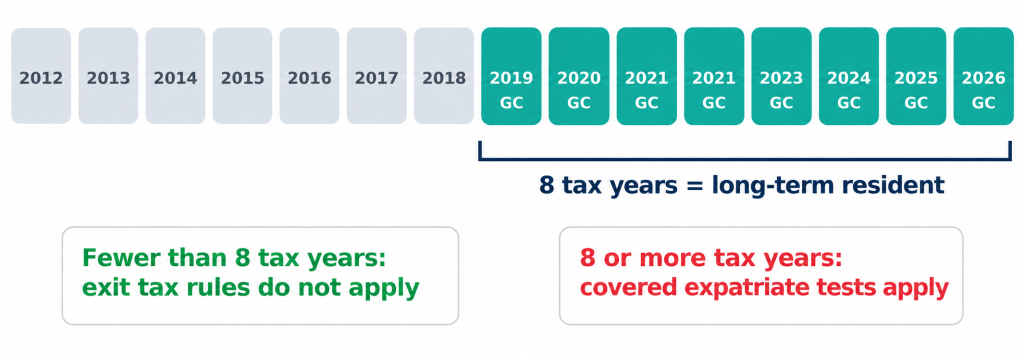
But the best part is, If you give up your green card before you complete 8 tax years of status, the exit tax rules generally do not apply to you, no matter how much you earn or own. Still, count your years carefully, because a partial year counts as a full year.
US Exit Tax for Green Card Holders: Are You a Covered Expatriate?
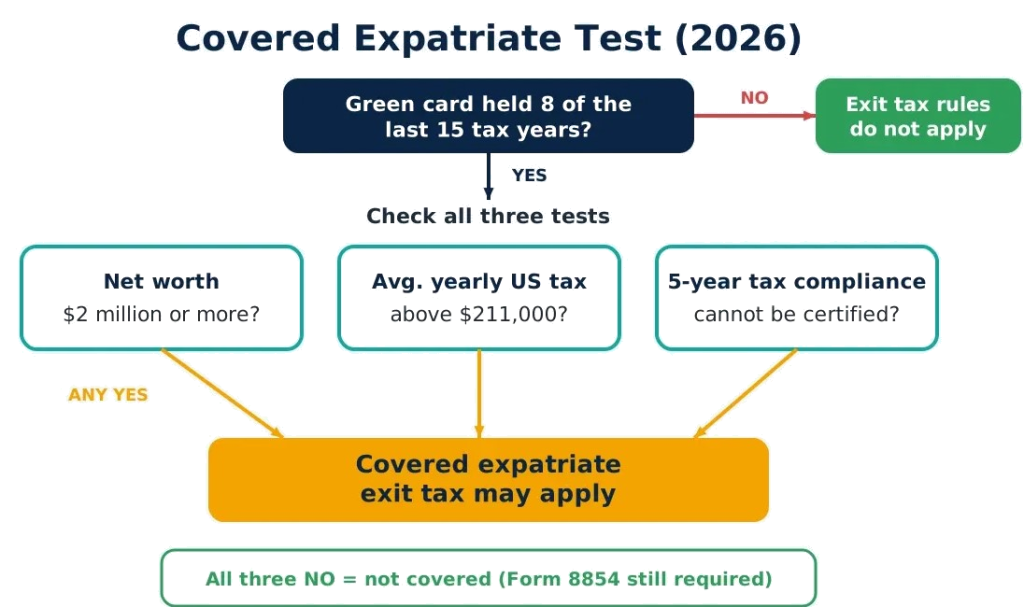
Being a long-term resident alone does not mean you will pay the exit tax. The tax applies only if you are a covered expatriate. You are covered if you meet any one of these three tests:
| Test | 2026 Threshold | What It Means in Simple Words |
| Net Worth Test | $2,000,000 or more | Your worldwide assets minus your debts, measured on your expatriation date. This limit is not adjusted for inflation. |
| Tax Liability Test | More than $211,000 | Your average annual US net income tax liability for the 5 tax years before the year you surrender. |
| Compliance Test | Cannot certify | You cannot certify under penalties of perjury on Form 8854 that you filed all required US tax returns and paid all tax due for the last 5 years. |
The compliance test is the most common trap
Many Indians are surprised by this one. You can have a modest net worth and a small tax bill, and still become a covered expatriate if you cannot certify five years of full tax compliance. A common reason is missing foreign account reporting such as FBAR or Form 8938 for Indian bank accounts, fixed deposits or mutual funds. If you have received a tax notice about overseas holdings, read our guide on the foreign asset disclosure notice for NRIs to understand how disclosure gaps arise and how to respond. If you have missed US filings, speak to a US tax professional before you surrender, because the certification is signed under penalty of perjury.
Does your net worth include Indian assets?
Yes. The $2 million test counts your worldwide assets, including your house or land in India, NRE and NRO balances, fixed deposits, shares, mutual funds, gold, business interests and retirement balances. Your spouse’s assets are tested separately, so ownership structure matters, and any planning must be done well before your expatriation date.
How Is the US Exit Tax Calculated?
If you are a covered expatriate, the IRS treats your assets as if you sold everything the day before your expatriation date. This is called the mark-to-market rule. You pay tax on the gain, but only above a yearly exclusion amount. For 2026, the exclusion is $910,000.
Simple illustration (not tax advice):
- Priya has held a green card since 2015 and plans to move to India in 2026.
- Her net worth is $2.3 million, so she is a covered expatriate.
- Her unrealised gain on US shares and other assets is $1.4 million.
- Taxable gain = $1,400,000 minus $910,000 = $490,000.
- At a 20% long-term capital gains rate, the federal tax would be about $98,000. Other taxes may also apply.
Special rules for retirement and deferred income
Not everything is taxed by the deemed-sale rule. Some items are handled differently:
- Tax-deferred accounts such as IRAs are generally treated as fully withdrawn the day before expatriation, with no exclusion available.
- Employer plans and deferred compensation are usually taxed when you receive the payments, often with 30% withholding, unless you make the required election.
- Trust interests follow their own rules.
If you also hold Indian provident fund or other Indian retirement balances, check how they are treated in India before you cash them out. Our article on whether PF withdrawal is taxable for NRIs explains the Indian side so you can plan both countries together.
Can you delay paying the exit tax?
In some cases you can elect to defer the tax on certain assets until they are actually sold, but you must provide security and agree to the IRS terms. This election is made on Form 8854 and cannot be reversed, so get professional advice first.
Gifts to family in the US
If you are a covered expatriate, a US citizen or resident who later receives a large gift or inheritance from you may have to pay a transfer tax at the top rate of 40% on the amount above the annual exclusion. Keep this in mind while planning your estate for children or parents in the US.
Form 8854 for Green Card Surrender: What It Is and How to File
Form 8854 (Initial and Annual Expatriation Statement) is the key IRS form for anyone who gives up a green card after being a long-term resident. It is required even if you do not owe any exit tax.
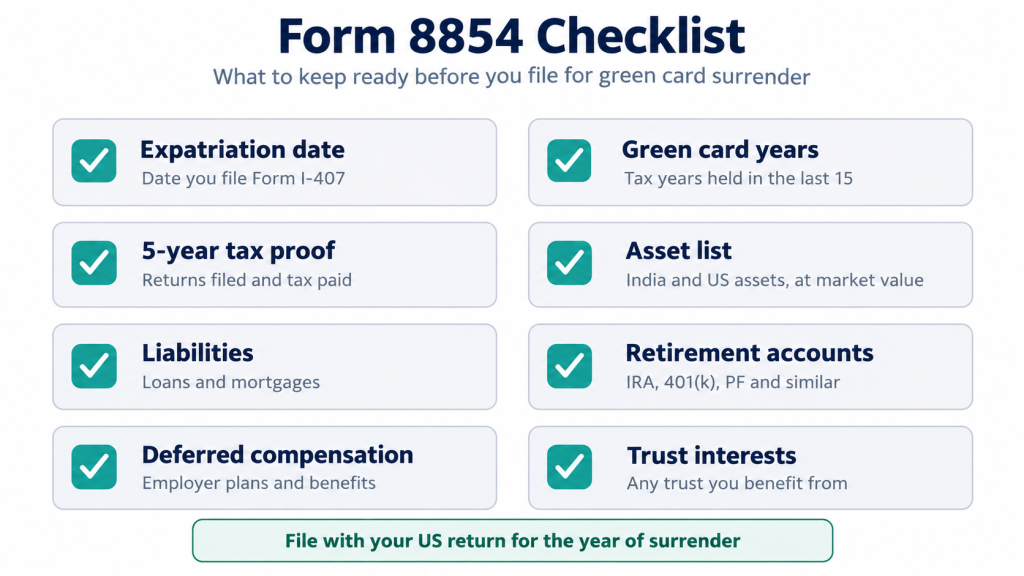
Form 8854 does three things:
- It tells the IRS that you have expatriated and gives your expatriation date.
- It certifies your five-year US tax compliance.
- It reports your assets, liabilities and net worth, so the IRS can decide if you are a covered expatriate.
When and how to file
- File Form 8854 with your US income tax return for the year that includes your expatriation date. The deadline is the same as that return, including extensions.
- If you are not required to file an income tax return, you must still send the form to the IRS by the due date.
- A copy of the form must also be sent to the separate IRS address given in the instructions.
- Covered expatriates may need to file the form again in later years if they have deferred tax items, deferred compensation or trust interests.
What if you do not file Form 8854?
The cost of skipping this form is high:
- A penalty of $10,000 may apply for late or missing filing.
- Without the form, you cannot certify five-year compliance, so you may be treated as a covered expatriate.
- The IRS may not treat you as having left the US tax system at all.
Step-by-Step: How to Surrender Your Green Card the Right Way
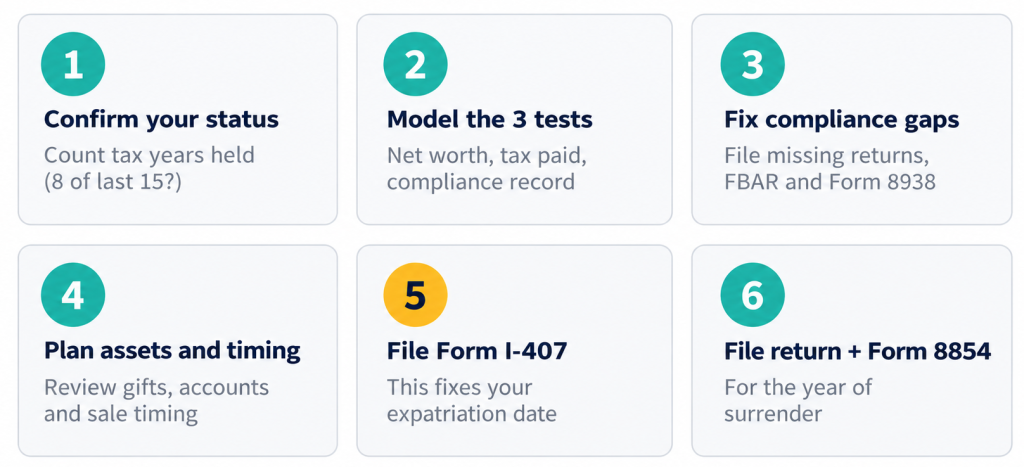
- Confirm your status. Count how many tax years you held your green card. Fewer than 8 tax years means you are not a long-term resident.
- Model the three tests. Estimate your net worth, five-year average tax and compliance record as of your planned expatriation date.
- Fix compliance gaps. File any missing US returns, FBARs and Form 8938 before you surrender.
- Plan your assets and timing. Review gifts, ownership, retirement accounts and sale timing with a US tax professional.
- File Form I-407. Do this only after the earlier steps. Your expatriation date is fixed by this filing.
- File your final US return and Form 8854. Attach the form to the return for the year of surrender, and keep proof of filing.
Tax Rules in India After Green Card Surrender
Surrendering the green card ends your US tax residency, but your Indian tax position depends on how long you stay in India. If you become a resident in India, your global income, including income earned abroad, may become taxable in India. Depending on your travel history, you may qualify as a Resident but Not Ordinarily Resident (RNOR) for a few years, which can limit tax on foreign income during that time.
The India-US tax treaty (DTAA) helps avoid double tax on the same income, but only if you claim it correctly in both countries. For your India filings after you return, see our guide on how NRIs can file taxes in India for FY 2025-26, which covers income reporting and ITR basics.
What Happens to Your Travel Status? Getting an OCI Card
After you give up your green card, you may want long-term access to India. Many Indian-origin people apply for or keep an Overseas Citizen of India (OCI) card, which allows visa-free travel and stay in India. If you already hold an OCI card and need a copy, here is a step-by-step guide to download your e-OCI card online.
Note that OCI is a travel and residency document, not Indian citizenship, and it has no effect on your US exit tax position.

Common Mistakes to Avoid
- Assuming that moving to India ends US tax duties. Only formal surrender (or a treaty-based position) ends your US tax residency.
- Ignoring Indian assets in the net worth test. Real estate, FDs and provident funds all count.
- Skipping Form 8854. This can turn a no-tax situation into covered expatriate status.
- Missing FBAR and Form 8938 filings. These gaps can make you fail the compliance test even if you are not wealthy.
- Surrendering first and planning later. Your net worth and expatriation date are fixed once you file Form I-407.
- Selling assets without a plan. Selling or gifting just before surrender can create unexpected tax in the US or India.
Conclusion
The green card surrender tax implications for Indians depend on three things: how long you held your green card, how much you own, and whether your US tax history is fully compliant. If you are a long-term resident, the US exit tax for green card holders can create a large, one-time tax bill, and Form 8854 for green card surrender is the document that decides it. The smartest approach is simple: count your years, check the three covered expatriate tests, fix any missing filings, and plan your timing before you file Form I-407. A short consultation with a US-licensed CPA or tax attorney before you surrender can save you far more than it costs.
Disclaimer
The content published on NriTaxs is intended for informational purposes only and does not constitute legal, tax, or financial advice. Readers are encouraged to consult qualified professionals before making any decisions based on the information provided.










Related Articles