

Selling property in India as an NRI or resident can bring significant profits—but it also comes with a crucial responsibility: understanding your capital gains tax liability before closing the deal. Many sellers focus only on the sale price, ignoring the tax implications that can substantially impact their final returns.
A Capital Gains Tax Calculator on Sale of Property (2026) helps you estimate your tax bill in advance, giving you clarity on how much you’ll actually take home after taxes. Whether you’re selling residential property, land, or inherited assets, calculating your capital gains correctly ensures better financial planning and avoids last-minute surprises.
In this guide, you’ll learn how capital gains tax works on property sales, how to calculate it accurately using updated 2026 ru
What Is Capital Gains Tax on Property?
When you sell a property whether it’s your home, a rental, or an investment — the IRS treats your profit as taxable income. This profit is called a capital gain, and the tax you owe on it is the capital gains tax.
Capital gains are calculated as the difference between the selling price of the property and its original purchase price, along with certain allowable costs such as improvements and transaction expenses. Depending on how long you hold the property, the gain may be classified as short-term or long-term, which directly affects the tax rate applicable. Understanding how capital gains tax works is essential because it helps you estimate your actual profit after tax and plan your sale more efficiently.
Types of Capital Gains for NRIs
- Short-Term Capital Gains – STCG
A profit is considered a Short-Term Capital Gain (STCG) if an immovable property, such as a house, building, or land, is sold within 24 months of its acquisition. The calculation for STCG is straightforward. It is the sale price minus the cost of acquisition, the cost of any improvements made to the property, and the expenses incurred exclusively for the sale (like brokerage or legal fees).
- Long-Term Capital Gains – LTCG
If the same immovable property is sold after being held for more than 24 months, the resulting profit is classified as a Long-Term Capital Gain (LTCG). The calculation for LTCG is different from STCG because it allows for a benefit called “indexation.” This adjustment accounts for the effect of inflation on the property’s cost over the holding period, which generally reduces the taxable gain.
How To Calculate Capital Gains Tax On Sale Of Property?
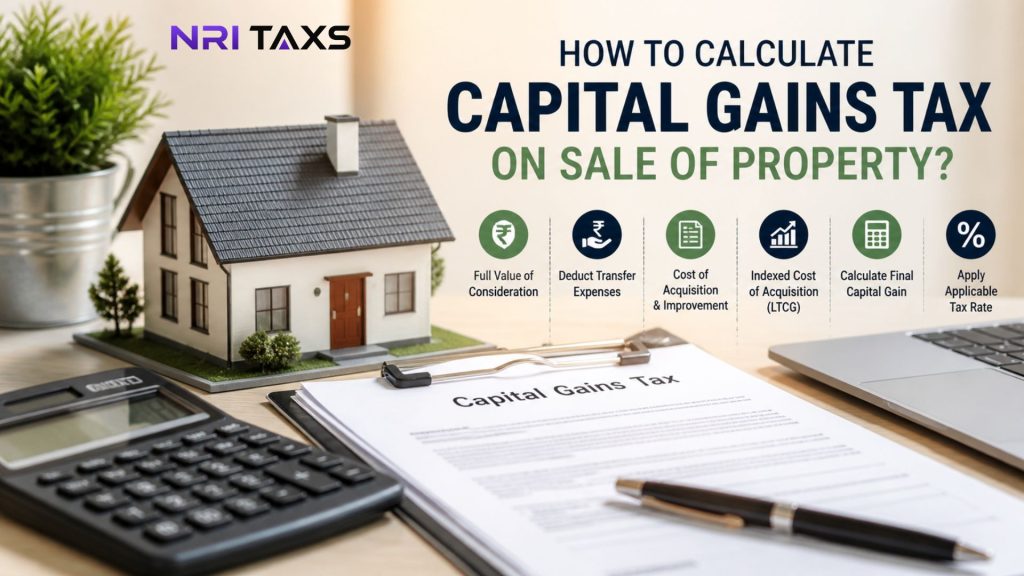
Calculating the capital gains tax involves a systematic process. Following these steps helps ensure accuracy and provides a clear picture of the final tax amount. This process is the foundation of any reliable Capital Gains Tax Calculator for NRIs in India.
Step 1: Determine the Full Value of Consideration
The first step is to identify the full sale price of the property. This is the total amount received or to be received by the seller in exchange for the property. It serves as the starting point for our calculation.
Step 2: Deduct Transfer Expenses
From the full sale price, we subtract any expenses incurred directly in connection with the sale. These can include brokerage or commission fees paid to a real estate agent, stamp duty, legal fees, and other related charges. The resulting figure is known as the “net consideration.
Step 3: Find the Cost of Acquisition and Improvement
Next, we need the original purchase price of the property, which is called the cost of acquisition. We also need to account for any capital expenditure made to add to or improve the property. This is known as the cost of improvement. Simple repair or maintenance costs are not included here.
Step 4: Calculate the Indexed Cost of Acquisition – For LTCG
For Long-Term Capital Gains, we adjust the cost of acquisition and improvement for inflation. This is done using the Cost Inflation Index (CII) notified by the government. The formula is:
Indexed Cost = Original Cost × (CII of the year of sale / CII of the year of purchase)
This step increases the cost base, thereby reducing the taxable profit. The indexation benefit is not available for STCG.
Step 5: Compute the Final Capital Gain
The final capital gain is calculated by subtracting the costs from the net consideration.
- For STCG: Net Consideration – (Cost of Acquisition + Cost of Improvement)
- For LTCG: Net Consideration – (Indexed Cost of Acquisition + Indexed Cost of Improvement)
Step 6: Apply the Applicable Tax Rate
Once the capital gain is calculated, the final step is to apply the relevant tax rate to determine the tax liability. The rates differ for STCG and LTCG.

Capital Gains Tax Rates For Real Estate
The tax rates for capital gains on property for NRIs depend on whether the gain is short-term or long-term. The rates we discuss here are based on current tax laws and are subject to change in future government budgets.
- Tax Rate for STCG
Short-Term Capital Gains are added to the NRI’s other taxable income in India and are taxed at the applicable income tax slab rates. The tax is calculated based on the income tax bracket the NRI falls into for that financial year.
- Tax Rate for LTCG
Long-Term Capital Gains from the sale of property are taxed at a flat rate of 20%. In addition to this rate, a health and education cess is applied. If the total income is high, a surcharge may also be applicable. This flat rate provides certainty in tax planning for long-term investments.
How To Legally Reduce Your Capital Gains Tax?
The Indian Income Tax Act provides specific exemptions that allow NRIs to reduce their long-term capital gains tax liability. These options typically involve reinvesting the sale proceeds or the capital gains into specified assets within a certain timeframe.
Reinvesting in Another Property – Section 54
An NRI can claim an exemption on LTCG from the sale of a residential house by reinvesting the amount of capital gains to purchase or construct another residential house in India. The new property must be purchased either one year before the sale or two years after, or constructed within three years of the sale.
Reinvesting in Specified Bonds – Section 54EC
Another option is to invest the long-term capital gains in specified government bonds within six months from the date of the property sale. These bonds are issued by entities like the National Highways Authority of India (NHAI) or the Rural Electrification Corporation (REC). There is a limit on the amount that can be invested under this section in a financial year.
Reinvesting from Any Asset into a House – Section 54F
If an NRI sells a long-term capital asset other than a residential house (like a plot of land), they can claim an exemption by investing the net sale consideration to purchase or construct a new residential house in India. The conditions and timelines are similar to those under Section 54.
Conclusion- Capital gains tax calculator on sale of property
A capital gains tax bill can run into tens of thousands of dollars or be zero, if you plan correctly. Running the numbers with a capital gains tax calculator on sale of property before you close is not optional; it’s essential to understanding your true net proceeds.
Disclaimer
The content published on NriTaxs is intended for informational purposes only and does not constitute legal, tax, or financial advice. Readers are encouraged to consult qualified professionals before making any decisions based on the information provided.










Related Articles