
You filed Form 2553 to elect S Corporation status, but instead of receiving approval, you received an IRS rejection notice. Now you’re wondering whether your business can still qualify for S Corp taxation, whether you need to file the form again, and what happens to your tax obligations.
An S Corporation election can be rejected for several reasons, including missing shareholder signatures, incorrect business information, late filing, or ineligible shareholders. While some filing errors can be corrected by submitting Form 2553 again, others may require late-election relief or a different business structure.
The situation can be particularly confusing for NRIs and foreign business owners, as U.S. tax residency and shareholder eligibility rules can affect whether a business qualifies for S Corporation status. In this guide, we’ll explain the common reasons the IRS rejects an S Corporation election, how to fix Form 2553 errors, when late-election relief may be available, and what steps to take if your business is not eligible for S Corp status.
What Does “S Corporation Election Rejected” Actually Mean?
An S corporation is a tax status, not a type of company. A regular C corporation or an LLC can ask the IRS to be taxed as an S corporation by filing Form 2553, Election by a Small Business Corporation. With S Corp status, business profit passes through to the owners, and the business itself generally does not pay federal income tax.
When the IRS “rejects” or “denies” your election, it means one of two things:
- The form had a mistake or missing information. The IRS could not process it, so no S election is in place yet.
- The business did not qualify. For example, the company or its owner was not eligible to be an S corporation on the date you chose.
These two cases are very different. A paperwork mistake is usually easy to repair. An eligibility problem is harder and sometimes needs a different solution. That is why the first step is always to read your IRS letter carefully and find the exact reason.
Rejected, Late, or Accepted but Invalid: Know the Difference
Many owners mix these up, so here is a simple comparison.
| Situation | What it means | What to do |
| Rejected / not processed | Form 2553 had errors or missing items | Correct the form and refile |
| Accepted as late | The IRS processed it but made it effective for a later year | Check if late election relief can make it effective earlier |
| Denied for eligibility | The business or a shareholder did not qualify | Fix the eligibility problem or choose another structure |
| Accepted but actually invalid | The IRS sent an acceptance letter, but a rule was broken | Seek relief under IRS procedures before the problem grows |
Common Reasons the IRS Rejects an S Corporation Election
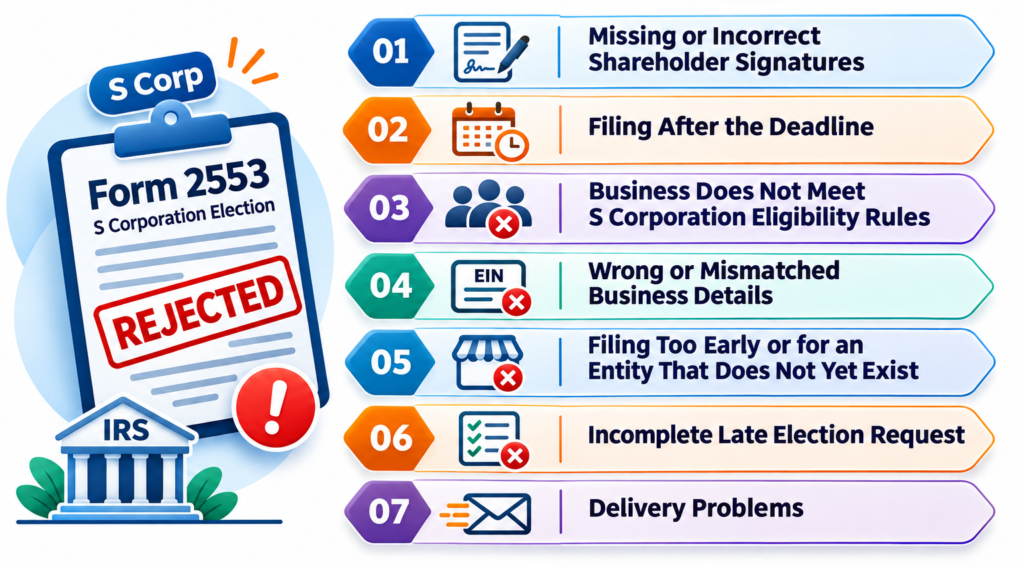
1. Missing or Incorrect Shareholder Signatures
Every person who owns shares on the day the election takes effect must sign the consent on Form 2553. If even one signature is missing, the IRS can reject the form. This includes co-owners and, in some states, spouses who have an ownership interest under community property rules. An officer of the corporation must also sign the form.
2. Filing After the Deadline
Form 2553 must be filed no more than 2 months and 15 days after the start of the tax year in which you want S Corp status. You can also file at any time during the year before. For a calendar-year business, the deadline is March 15 (or the next business day if that date falls on a weekend). Missing this date does not always mean rejection, but the election may be pushed to the following tax year. The IRS generally treats late elections as effective from the next year unless you qualify for relief.
3. Business Does Not Meet S Corporation Eligibility Rules
To qualify, the business must meet all of these basic rules:
- It must be a domestic (U.S.) corporation or an eligible LLC.
- It can have no more than 100 shareholders.
- Shareholders must generally be individuals, certain trusts, or certain estates. Corporations, partnerships, and most LLCs cannot be shareholders.
- It can have only one class of stock.
- It cannot have a nonresident alien shareholder.
That last rule matters a lot for NRIs and foreign founders, and we cover it in detail below.
4. Wrong or Mismatched Business Details
Small errors can cause big delays. Common ones include:
- A wrong or missing EIN
- A business name that does not match IRS records
- An incorrect effective date on the form
- Choosing a tax year that is not allowed for your business
- An incomplete or old version of the form
5. Filing Too Early or for an Entity That Does Not Yet Exist
If you file before the corporation or LLC is legally formed, the IRS may not have a valid entity to accept the election for. Make sure your EIN is issued and your business is registered before you submit.
6. Incomplete Late Election Request
If you are asking for late election relief, the IRS expects specific wording and statements. Missing any of these is one of the most common reasons late requests get rejected. We explain exactly what to include in the fix section below.
7. Delivery Problems
Form 2553 generally cannot be e-filed. It must be mailed or faxed to the correct IRS location, and the right address or fax number depends on where your business is located. If you send it to the wrong place, it may be delayed or lost. Always check the current Form 2553 instructions and keep proof that you sent it.
Special Warning for NRIs and Foreign Owners
This is one of the most common reasons for rejection among Indian founders running U.S. companies.
A nonresident alien cannot be a shareholder of an S corporation. If you are an NRI who does not pass the green card test or the substantial presence test, your U.S. company is generally not eligible for S Corp status. This applies even if the company is a properly registered U.S. LLC or corporation.
Here is what usually happens:
- The owner files Form 2553 thinking it will lower tax.
- The election is rejected, or it is accepted by mistake and later found invalid.
- The company is then taxed as a regular C corporation, which means a federal corporate tax rate of 21%. Profits paid out as dividends may also face U.S. withholding, which can be reduced under the India-U.S. tax treaty in some cases.
If you are a foreign owner, you may need to consider other options such as staying with a single-member LLC (which has its own reporting rules, including Form 5472), choosing a C corporation, or changing your structure.
What to Do First When You Receive the IRS Letter
Before you refile anything, take these steps:
- Read the notice fully. Find the notice number, the date, and the stated reason.
- Check the Form 2553 you filed. Compare every detail with the IRS letter: name, EIN, effective date, signatures, and tax year.
- Confirm eligibility. Check shareholders, share classes, and your entity type against the rules above.
- Gather proof. If you believe you filed on time, find your mailing receipt, fax confirmation, or any copy of the form with an IRS stamp.
- Do not ignore the deadline for a reply. If the letter has a response date, respond before it passes.
If the letter does not make sense, or the amount of tax involved is large, talk to a CPA or enrolled agent who has handled S election problems before.
How to Fix a Rejected S Corporation Election
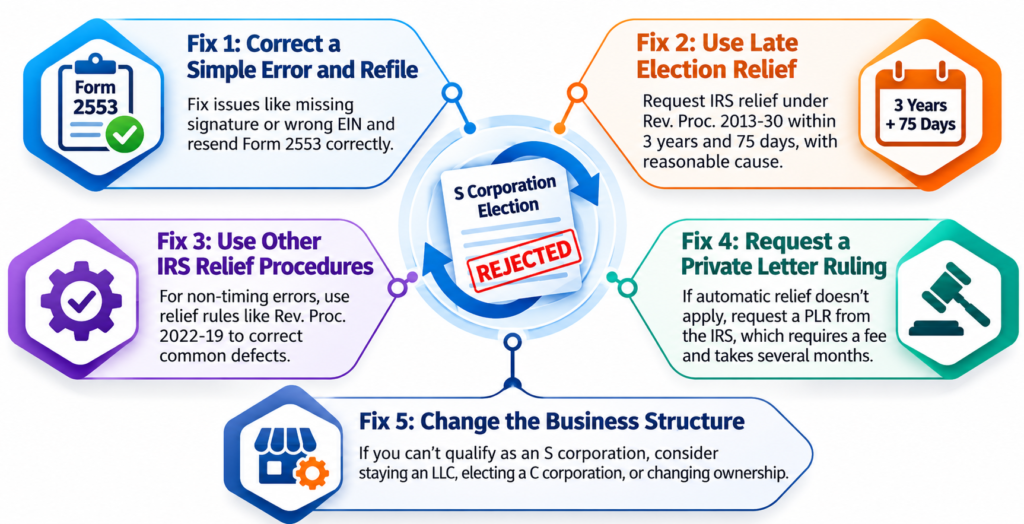
Fix 1: Correct a Simple Error and Refile
If the reason was a missing signature, wrong EIN, or incomplete information, you can usually fix the form and send it again. There is no waiting period to refile. Make sure:
- You use the current version of Form 2553
- All required shareholders and the corporate officer sign
- The effective date and tax year are correct
- You send it to the right address or fax number
Fix 2: Use Late Election Relief (Rev. Proc. 2013-30)
If your election was filed late, never filed, or was rejected and now it is too late to refile on time, the IRS offers a simple relief process under Revenue Procedure 2013-30. Here is why it is popular:
- You can request relief up to 3 years and 75 days after the date you wanted the election to start.
- There is no IRS user fee when you qualify under this procedure.
- You usually do not need a private letter ruling.
Generally, you qualify if:
- The only reason the business did not qualify as an S corporation is that Form 2553 was filed late.
- The business has reasonable cause for the delay (for example, a tax professional failed to file, the form was prepared but not sent, or the owners did not know a separate election was needed).
- The business and all shareholders have reported income consistently with S corporation status on all returns, from the first year the election should have applied.
To request relief, you must:
- Complete Form 2553 and write “FILED PURSUANT TO REV. PROC. 2013-30” at the top.
- Attach a reasonable cause statement that explains why the form was not filed on time.
- Include statements from all shareholders (current and former, covering the relevant period) saying they reported their income consistently with S Corp status.
- Make sure every shareholder signs the consent.
- File any overdue Forms 1120-S at the same time, in line with the requested effective date.
Some businesses may not need a time limit at all if they meet additional conditions, such as having already filed Form 1120-S for the first year and not having received an IRS notice about the problem. A tax professional can confirm whether this applies to you.
If you run an LLC and also missed a separate entity classification election (Form 8832), additional statements are needed on Form 2553 so both late elections can be covered together.
Keep in mind that relief under this procedure only works for elections that would otherwise be valid. It cannot fix a company that was never eligible, such as one with a nonresident alien shareholder.
Fix 3: Use Other IRS Relief Procedures for Errors
Some problems are not about lateness at all. For example, the form may have an inadvertent mistake, or a shareholder consent may be missing. The IRS has other relief rules for these situations, including Rev. Proc. 2022-19, which covers certain common S election defects. The fix usually involves sending a written explanation and the missing items to the IRS. Each issue has its own conditions, so confirm which one applies to you.
Fix 4: Request a Private Letter Ruling (PLR)
If you do not qualify for the automatic relief procedures, or if the IRS denies your request, your remaining option is often a private letter ruling under the IRS’s inadvertent invalid election rules. A PLR is more formal than other fixes. It requires a user fee, takes several months, and usually needs professional help. Use it only when the simpler routes truly do not apply.
Fix 5: Change the Business Structure
If the business can never qualify as an S corporation (for example, because the owner is a nonresident alien), the better fix may be to change the structure instead of fighting the rejection. Options may include:
- Staying an LLC taxed as a disregarded entity or partnership
- Electing C corporation treatment
- Changing ownership so that all shareholders become eligible
What Happens If You Do Nothing?
Ignoring a rejection can lead to expensive problems:
- You may be taxed as a C corporation. The business pays 21% federal tax on profit, and owners may pay tax again on dividends.
- Your tax returns may be wrong. If you filed Form 1120-S without a valid election, the IRS may treat the return as improper.
- Payroll problems. S Corp owners who work in the business must be paid a reasonable salary. If the election is not valid, this payroll setup may need to be reviewed.
- Penalties and interest. Filing the wrong return type or missing required forms can lead to penalties.
- Lost deadlines. Relief options have time limits, and some conditions are lost if the IRS contacts you first.
The best time to fix the problem is as soon as you find it.
How Long Does the IRS Take to Respond?
The Form 2553 instructions say the IRS should send an acceptance or non-acceptance notice within about 2 months of filing (or up to 5 months if the form was filed with certain early-election boxes checked). If you have not heard back by then, you can call the IRS business and specialty tax line at 1-800-829-4933 to follow up. Late election relief requests may take longer, often a few months, because they are reviewed on paper.
Always keep a copy of everything you send and use a trackable mailing method or a fax confirmation.
How to Avoid a Rejected S Corp Election Next Time
Use this checklist before you send Form 2553:
- Confirm that every owner is an eligible shareholder (no nonresident alien shareholders, no ineligible entities).
- Check that the company has only one class of stock.
- Use the correct legal name and EIN exactly as the IRS has them.
- Choose the right effective date and tax year.
- Get signatures from all required shareholders and the officer.
- File on time. For a business that wants S status starting January 1, 2027, file between now and March 15, 2027.
- Send the form to the correct address or fax number for your state.
- Keep proof of delivery.
- Wait for the IRS acceptance letter and save it with your records.
- Check your state’s rules too, since some states or cities treat S corporations differently from the federal government.
Should You Hire a Tax Professional?
You can fix a simple signature error on your own. But consider professional help if:
- You are an NRI, a foreign owner, or planning to leave the U.S.
- The business has more than one owner, or changing ownership.
- You need late election relief or a private letter ruling.
- You have already filed Form 1120-S without a confirmed election.
- The IRS has sent more than one notice.
A mistake in a relief request can cost you months, so it is often worth getting it right the first time.

Conclusion
A rejected S corporation election is a setback, but it is not the end of the road. Start by understanding the reason in your IRS letter. If it is a simple error, correct it and refile. If you missed the deadline, late election relief under Rev. Proc. 2013-30 may be a free and fast solution. If the issue is deeper, such as an ineligible shareholder, you may need to adjust your business structure instead.
Act early, keep good records, and double-check eligibility before you file again. If you are an NRI or foreign owner, get expert advice before relying on S Corp status, because the rules are strict and mistakes can be expensive.
Disclaimer
The content published on NriTaxs is intended for informational purposes only and does not constitute legal, tax, or financial advice. Readers are encouraged to consult qualified professionals before making any decisions based on the information provided.





Related Articles