

Every S corporation must file a federal tax return each year, even when the business owes no tax. That return is Form 1120-S. It reports your company’s income, deductions, and credits, and it tells each owner what to enter on their personal return. Many business owners find it confusing because it has several schedules and a strict deadline. But the process becomes simple once you know the right order. In this guide, you will learn what Form 1120-S is, who must file it, which documents to collect, and how to file it step by step for tax year 2026. You will also see the due date, late penalties, and common mistakes to avoid.
Quick Answer
Form 1120-S is the yearly federal tax return for S corporations. For tax year 2026, a calendar-year S corporation must file by March 15, 2027, or by September 15, 2027 with Form 7004. The late filing penalty is $260 per shareholder, per month, up to 12 months.
What Is Form 1120-S?
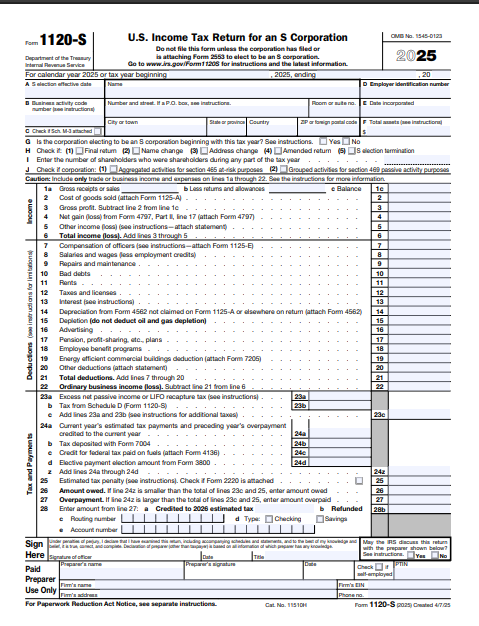
Form 1120-S is the U.S. Income Tax Return for an S Corporation. An S corporation is a business that has elected to pass its income, losses, deductions, and credits through to its shareholders. So the company itself usually does not pay federal income tax. Instead, Form 1120-S works as an information return. It shows the IRS how much the business earned and how profit or loss is divided among owners. Each shareholder then receives a Schedule K-1 and reports their share on a personal Form 1040. The corporation must file Form 1120-S every year, even when it has no income.
Differences Between Form 1120-S and Form 1120
Both forms are corporate tax returns, but they work very differently. Form 1120 is for C corporations, while Form 1120-S is for S corporations.
| Feature | Form 1120-S (S Corporation) | Form 1120 (C Corporation) |
| Who files it | Corporations with an approved S election | Standard C corporations |
| Federal income tax | Generally none at the company level | Flat 21% corporate tax |
| Who pays tax on profit | Shareholders, on their personal returns | The corporation first, then shareholders on dividends |
| Owner reporting | Schedule K-1 | Form 1099-DIV for dividends |
| Due date (calendar year) | March 15 | April 15 |
| Extension deadline | September 15 (Form 7004) | October 15 (Form 7004) |
| Shareholder limits | Up to 100, one class of stock, U.S. citizens or residents only | No limit on number or type |
| Late filing penalty | Per shareholder, per month | Percentage of unpaid tax |
Benefits of Filing Form 1120-S
Filing Form 1120-S keeps your S election in good standing and gives your business several tax advantages. If you are still comparing structures, our S Corp vs LLC tax comparison shows how the savings differ in real numbers.
- Pass-Through Taxation:- The company generally pays no federal income tax. Profits and losses pass to shareholders and are taxed once on personal returns, avoiding double taxation.
- Reduced Self-Employment Taxes:- Owner-employees pay payroll tax on a reasonable salary only. Remaining profit taken as distributions is generally not subject to the 15.3% self-employment tax.
- Access to Tax Deductions and Credits:- S corporations can deduct ordinary business expenses, and eligible owners may claim the qualified business income deduction of up to 20% on their personal returns.
- Limited Liability Protection:- Shareholders are generally not personally responsible for the corporation’s debts or lawsuits, so personal assets like your home and savings are usually protected.
- Flexible Profit Distribution:- Owners can split income between salary and distributions. Payouts must match ownership percentages, because an S corporation can have only one class of stock.
Who Needs to File Form 1120-S?
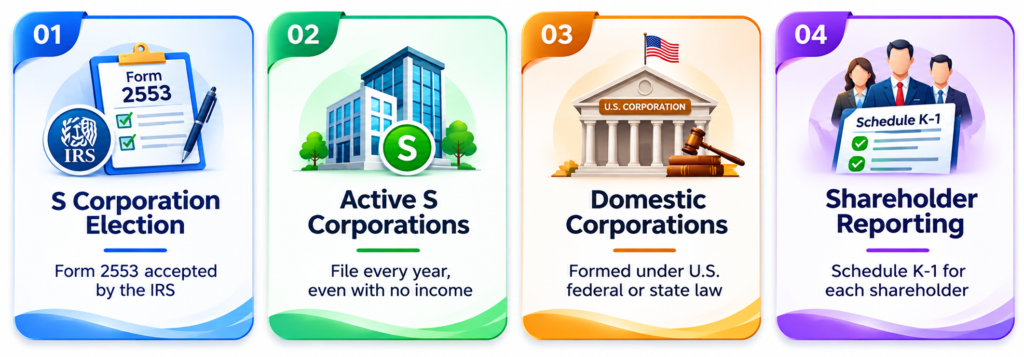
- S Corporation Election: – A business must first elect S status by filing Form 2553. Once the IRS accepts it, annual Form 1120-S filing begins.
- Active S Corporations:- Every S corporation that has not been dissolved must file each year, even with little or no income. Closing the business also requires a final Form 1120-S for the year you dissolve it.
- Domestic Corporations:- Form 1120-S is for domestic corporations, meaning companies formed under U.S. federal or state law. An LLC that elected S corporation status through Form 2553 also files this return instead of Form 1065 or Schedule C.
- Shareholder Reporting:- The corporation must report each shareholder’s share of income, deductions, and credits on a Schedule K-1. Shareholders then use that K-1 to report their part of the profit on their personal tax returns.
Can NRIs Be Shareholders in an S Corporation?
Only U.S. citizens and U.S. resident aliens (for tax purposes) can own S corporation shares. A nonresident alien cannot, and if one becomes a shareholder, the S election ends. Many NRIs living in the U.S. qualify as resident aliens under the green card test or the substantial presence test, but this depends on your facts. Check your tax residency before forming the company or transferring shares. Work-visa rules are separate and may limit the business activity you can do.
Documents Required to File Form 1120-S for 2026
Collecting records early makes filing faster. If your S corporation started as an LLC, our checklist of documents needed to file LLC taxes covers a few extra records worth having on hand.
| Document | Why You Need It |
| Form 2553 and IRS acceptance letter | Confirms your S election and its effective date |
| EIN confirmation letter | Identifies your corporation on the return |
| Last year’s Form 1120-S and K-1s | Helps carry forward balances and keep numbers consistent |
| Profit and loss statement | Supports total income and deductions |
| Balance sheet | Needed for Schedule L, when required |
| Bank and credit card statements | Used to verify income and expenses in your books |
| Payroll records (W-2s, Forms 941 and 940) | Support officer compensation and wages paid |
| Shareholder details (name, TIN, address, ownership %) | Needed to prepare each Schedule K-1 |
| Records of distributions and shareholder loans | Track payouts and support Schedule M-2 |
| Asset and depreciation schedule | Used to complete Form 4562 |
| Forms 1099-NEC and 1099-K | Confirm contractor payments and payment-app income |
How to File Form 1120-S: Step-by-Step Guide
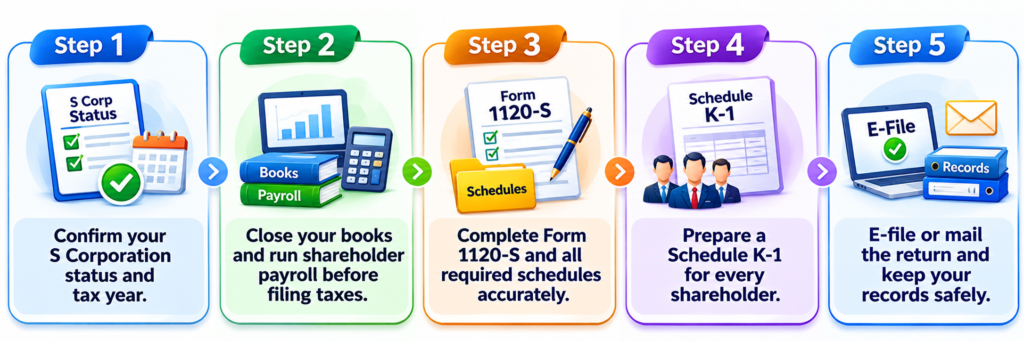
Follow these five steps in order. They cover the full process, from checking your status to submitting the return.
Step 1: Confirm Your S Corporation Status and Tax Year
Before you prepare anything, confirm that the IRS accepted your Form 2553 election. Look for your acceptance letter and note the effective date, because it decides your first Form 1120-S year. Next, confirm your tax year. Most S corporations use the calendar year, so your 2026 return covers January 1 to December 31, 2026. Also check that every shareholder is eligible to own S corporation stock.
Step 2: Close Your Books and Run Shareholder Payroll
Reconcile all bank and credit card accounts, then prepare a profit and loss statement and a balance sheet for 2026. If any shareholder works in the business, pay them a reasonable salary through payroll and issue a W-2. Record shareholder distributions and loans separately from wages and expenses. Clean books make every later step easier and reduce the risk of IRS questions.
Step 3: Complete Form 1120-S and the Required Schedules
Start with page 1, where you report income and deductions to arrive at ordinary business income or loss. Next, answer the Schedule B questions and complete Schedule K, which summarizes everything passing through to shareholders. Schedules L, M-1, and M-2 are required unless total receipts and total assets are both under $250,000. Attach extra forms, such as Form 4562 or Form 1125-E, when they apply to you.
Step 4: Prepare a Schedule K-1 for Every Shareholder
Each shareholder needs a Schedule K-1 showing their share of income, deductions, credits, and distributions. Calculate shares using ownership percentage and the number of days each person owned stock during the year. Double-check names, tax ID numbers, and ownership dates. Give each shareholder their K-1 on or before the day you file the return. If you have international items, Schedules K-2 and K-3 may also apply.
Step 5: E-file or Mail the Return and Keep Your Records
Submit the return through IRS-approved tax software or an e-file provider. E-filing is required if your corporation files 10 or more returns of any type in the year, counting items like W-2s, 1099s, and payroll returns. Smaller filers can mail a paper return to the IRS address listed in the instructions. Save your acceptance confirmation and keep a full copy of the return. Also check whether your state requires a separate S corporation return.
Important Schedules and Forms Used With Form 1120-S
| Form / Schedule | Purpose |
| Schedule B | Asks about your accounting method, business activity, and ownership |
| Schedule K | Summarizes income, deductions, and credits passing through to all shareholders |
| Schedule K-1 | Shows each shareholder’s individual share of those items |
| Schedule L | Reports the corporation’s balance sheet at the start and end of the year |
| Schedule M-1 | Reconciles book income with taxable income |
| Schedule M-2 | Tracks the accumulated adjustments account and distributions |
| Schedule M-3 | Gives a detailed income reconciliation for corporations with $10 million or more in total assets |
| Schedules K-2 and K-3 | Report international tax items such as foreign income and foreign taxes, unless an exception applies |
| Form 1125-E | Lists officer compensation when total receipts are $500,000 or more |
| Form 1125-A | Calculates cost of goods sold for businesses that sell products |
| Form 4562 | Reports depreciation and Section 179 expenses |
| Form 8825 | Reports rental real estate income or loss |
| Form 7004 | Requests an automatic six-month extension to file |
| Form 2553 | Elects S corporation status (filed once, not every year) |
What Is Schedule K-1 and Why Is It Important?
Schedule K-1 (Form 1120-S) is a statement that shows each shareholder’s share of the S corporation’s income, deductions, and credits. Shareholders use it to complete their own personal tax returns.
- Reports your share: It shows each owner’s percentage of income, loss, deductions, and credits from the business for the year.
- Feeds your personal return: Shareholders enter K-1 amounts on Form 1040, so mistakes here affect their own tax filing.
- Supports stock basis: K-1 amounts raise or lower basis, which decides whether losses and distributions are deductible or taxable.
- Has a delivery rule: Give each shareholder their K-1 on or before the filing date. Late or wrong K-1s can bring penalties.
Form 1120-S Due Date & Late Filing Penalties
The Form 1120-S deadline comes earlier than the personal tax deadline, so plan ahead. A calendar-year S corporation must file its 2026 return by the 15th day of the third month after year-end. The 2025 return was due March 16, 2026, because March 15 fell on a Sunday.
| Item | Date or Amount |
| Tax year 2026 return due date | Monday, March 15, 2027 |
| Deadline to file Form 7004 extension | March 15, 2027 |
| Extended due date | September 15, 2027 |
| Late filing penalty (returns due in 2027) | $260 per shareholder, per month or part of a month, up to 12 months |
| Missing or incorrect K-1 | A separate penalty for each K-1 |
| If tax is owed | Extra late filing and late payment penalties, plus interest |
The late filing penalty applies even when your S corporation owes no tax. For example, an S corporation with three shareholders that files two months late would owe $260 × 3 × 2 = $1,560. Filing Form 7004 on time extends the filing deadline, not the time to pay any tax due. If you miss a deadline, ask the IRS about first-time penalty abatement or reasonable cause relief.
Common Mistakes to Avoid When Filing Form 1120-S
Paying No Reasonable Salary
Taking only distributions while working in the business can trigger IRS reclassification of payments as wages, leading to back payroll taxes and penalties.
Missing the Deadline Without an Extension
Filing late without Form 7004 brings per-shareholder penalties, even when no tax is owed. If you need more time, file the extension by March 15.
Mixing Personal and Business Money
Paying personal bills from business accounts makes your books unreliable and can weaken liability protection. Keep separate accounts and record owner payments correctly.
Wrong K-1 or Shareholder Details
Incorrect ownership percentages, wrong Social Security numbers, or inaccurate distribution amounts create K-1 errors. These delay shareholder returns and can cause IRS notices and penalties.

Conclusion
Filing Form 1120-S does not have to be stressful. Confirm your S election, keep clean books, pay shareholders a reasonable salary, and gather your documents early. Then complete the form and schedules, prepare accurate K-1s, and file by March 15, 2027, or request an extension with Form 7004. Remember that penalties apply per shareholder, so even a short delay can be costly. If your business has several owners, shareholder loans, or international items, a tax professional can save time and prevent errors.
Disclaimer
The content published on NriTaxs is intended for informational purposes only and does not constitute legal, tax, or financial advice. Readers are encouraged to consult qualified professionals before making any decisions based on the information provided.




Related Articles