
Are you an NRI or OCI cardholder who wants to invest in the Indian stock market but finds the KYC process difficult from abroad? SEBI has announced new KYC rules that could make digital onboarding much easier for overseas investors. Starting December 3, 2026, eligible NRIs, OCIs and foreign nationals residing in FATF-compliant countries will be able to complete their investment KYC remotely, without travelling to India for physical verification. The new framework introduces important changes to digital document submission and video verification. Here’s what SEBI’s new KYC rules mean for NRIs and OCIs, who can benefit, and what changes from December 3.
What Has SEBI Changed in the New KYC Rules?
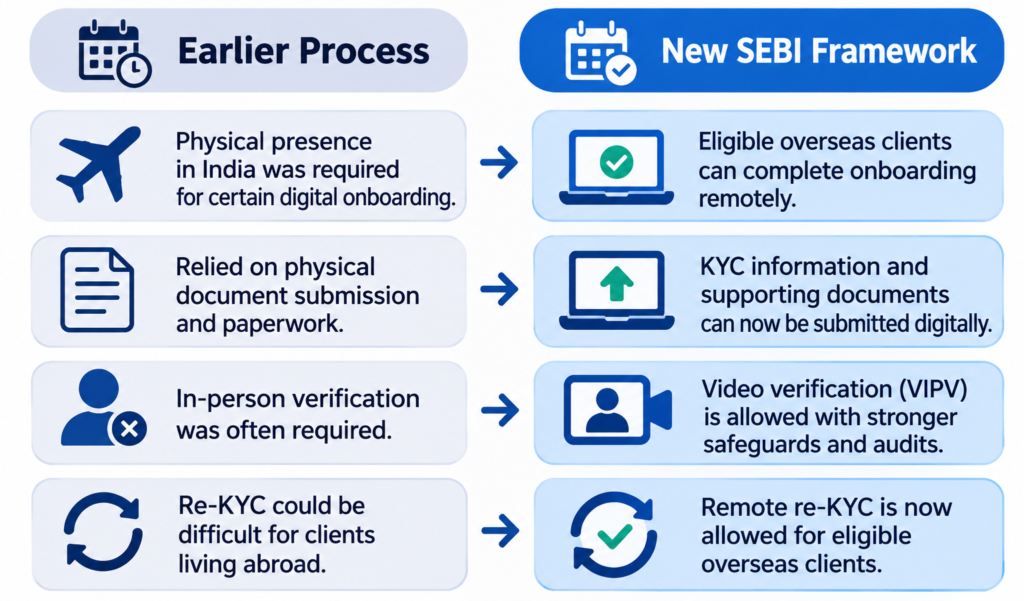
- Digital submission of KYC information and supporting documents: Eligible clients can now send their details and documents online to a SEBI-registered intermediary, instead of relying on physical paperwork.
- Electronic submission of KYC forms and specimen signatures: The KYC form and specimen signature can be submitted electronically. The signature is verified during the video verification.
- Relaxation of the requirement to be physically present in India during digital onboarding: Earlier, clients had to be located in India during digital onboarding. This condition has now been relaxed for eligible overseas clients.
- Revised video verification process: Where in-person verification is not possible, intermediaries can use video in-person verification (VIPV) with stronger safeguards and concurrent audits.
- The new framework also applies to re-KYC: Eligible overseas clients can update or refresh their KYC through the same digital process, which saves time on future compliance.
If you are new to the basics, our NRI KYC process guide explains the fundamentals.
Who Can Benefit From SEBI’s New Digital KYC Rules?
- Non-Resident Indians (NRIs): Non-Resident Indians living in eligible countries can complete KYC for trading, demat and mutual fund accounts from abroad, without travelling to India only for paperwork.
- Overseas Citizens of India (OCIs): Overseas Citizens of India can use the same remote process, submitting their passport, OCI card, PAN and overseas address proof to the intermediary.
- Foreign nationals: Foreign nationals from FATF-compliant countries can also complete digital KYC remotely, making it easier for eligible overseas investors to access Indian securities markets.
If you recently moved abroad and your KYC still shows resident status, read our guide on how to change KYC status from resident to NRI before completing your investment onboarding.
How Will Remote Digital KYC Work for NRIs and OCIs?
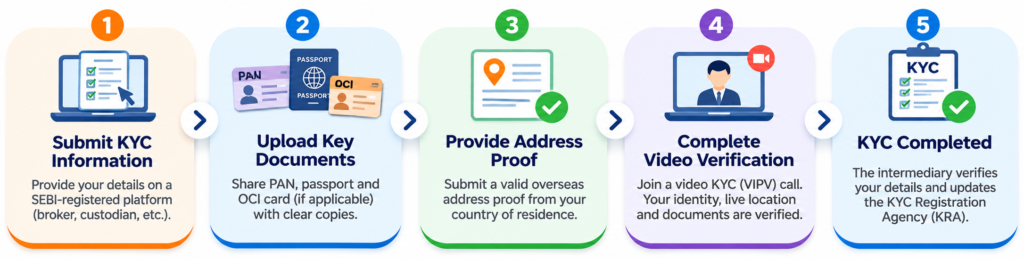
Submit KYC information and documents digitally
Submit your KYC information and supporting documents digitally to a SEBI-registered intermediary, such as a broker or custodian. You can sign the KYC form and specimen signature electronically, subject to verification during the video call.
Provide PAN, passport and OCI card
Provide clear copies of your PAN and passport. OCI cardholders must also share their OCI card. Documents must be valid, and details such as name and date of birth should match across all records.
Submit identity and overseas address proof
Submit valid identity proof and your current overseas address proof. The address should be in the country where you live, as the intermediary will check it against your live location during verification.
Complete the video verification
Join the video in-person verification (VIPV) from your location. An authorised official of the intermediary will be present, and your face, live location and identity details will be checked during the call.
The intermediary completes KYC and updates the KRA
After successful verification, the intermediary completes the KYC process and uploads the information to the KYC Registration Agency (KRA). Your record can then be reused more easily across other intermediaries, where permitted.
Before you start, make sure your bank accounts are in order. Our guide on NRE vs NRO accounts can help.
What Documents Will NRIs and OCIs Need for Digital KYC?
| Document | Applicable To | Purpose |
| PAN card | NRIs, OCIs, eligible foreign nationals (where applicable) | PAN verification and tax identification |
| Valid passport | NRIs, OCIs, foreign nationals | Proof of identity and citizenship details |
| OCI card | OCI cardholders | Confirms OCI status |
| Identity proof | All eligible clients | Verifies the client’s identity |
| Overseas address proof | All eligible clients | Confirms current residential address abroad |
| KYC form | All eligible clients | Captures personal and account details, submitted electronically |
| Specimen signature | All eligible clients | Submitted electronically and verified during video verification |
What Are the Video KYC Verification Requirements?
- Live geo-tagging: The client’s live location is captured during the call. It must match the country shown in the overseas address proof.
- Face-liveness checks: The system checks that a real person is on camera and not a photo, recording or deepfake.
- End-to-end encryption: The video session must be encrypted, so personal data and documents shared during the call stay protected.
- Presence of an authorised official of the intermediary during video verification: A real official from the intermediary must be on the call, and the process is subject to concurrent audit.
How Will the New KYC Rules Help NRIs and OCI Cardholders?
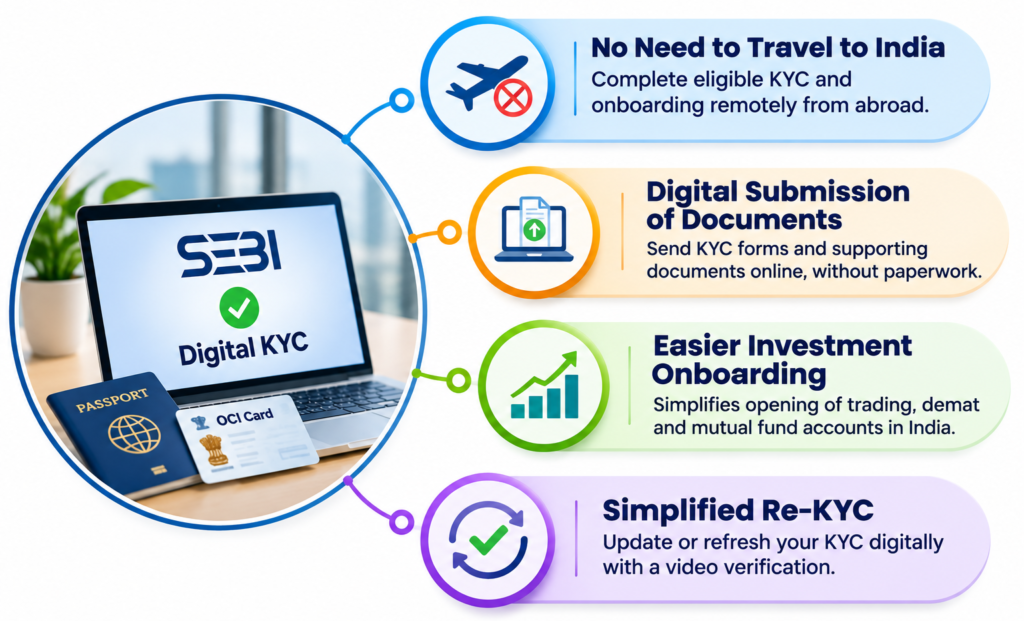
- No need to travel to India solely for eligible SEBI digital onboarding: Eligible NRIs and OCIs no longer need to fly to India only to complete SEBI digital onboarding, saving time, travel cost and effort.
- Easier onboarding for investments in India: Opening a trading or demat account becomes simpler, helping overseas Indians start investing in Indian shares, mutual funds and other securities with fewer procedural hurdles.
- Digital submission of documents: Documents and forms can be submitted electronically, which reduces courier delays and the heavy paperwork usually involved in opening an investment account from overseas.
- Improved portability of KYC records: KYC records become more portable, so you may not need to repeat the entire process when opening accounts with other intermediaries.
- Simplified re-KYC for eligible overseas clients: Eligible overseas clients can complete re-KYC through the same digital and video-based process, which makes keeping records updated far less time-consuming.
NRIs planning to invest in Indian mutual funds should also understand the mutual fund KYC process for NRIs, including the documents and verification requirements.
When Will SEBI’s New KYC Rules Come Into Effect?
- Announcement date: SEBI announced the revised framework through a circular dated November 4, 2026.
- Effective Date: December 3, 2026. From this date, SEBI-registered intermediaries can onboard eligible NRIs, OCIs and foreign nationals through the new digital process.
Intermediaries need time to update their systems, so check with your broker whether the facility is live.

Conclusion
SEBI’s revised KYC framework is a welcome step for overseas Indians and eligible foreign nationals who want to invest in India. By allowing digital document submission, electronic forms and remote video verification, it removes the need to be in India for eligible onboarding. The new rules take effect on December 3, 2026. NRIs and OCIs should keep their PAN, passport, OCI card and overseas address proof ready, and check with their broker about the exact process. Good preparation will help you complete KYC smoothly and start investing without delay.
Disclaimer
The content published on NriTaxs is intended for informational purposes only and does not constitute legal, tax, or financial advice. Readers are encouraged to consult qualified professionals before making any decisions based on the information provided.










Related Articles