
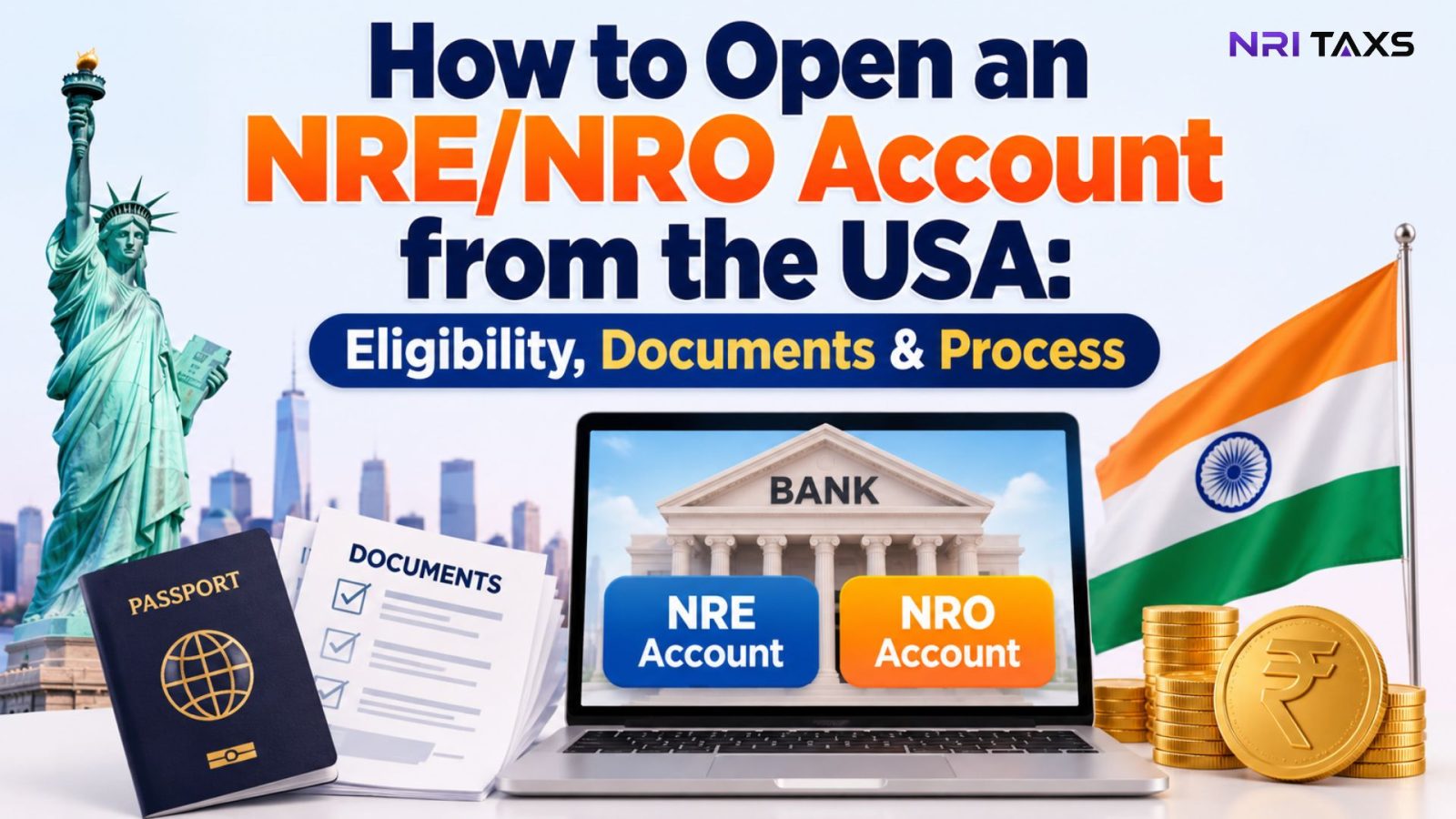
To open NRE/NRO account from USA, individuals need a clear path to manage their Indian finances. Many Non-Resident Indians (NRIs) seek a reliable way to handle earnings from India or send foreign income back home. The process involves understanding eligibility, preparing the correct documents, and following the bank’s procedures. This requires a systematic approach to ensure all requirements are met correctly. Our guide provides the necessary details for each stage, from choosing a bank to activating the account, making the process straightforward for those residing in the USA.
Key Takeaways
- ✔ NRE accounts are used to manage foreign earnings in India, with tax-free interest in India.
- ✔ NRO accounts are designed to manage India-based income such as rent, pension, and dividends.
- ✔ NRIs, PIOs, and OCI cardholders living in the USA can open NRE/NRO accounts, subject to applicable requirements.
- ✔ The account-opening process generally includes choosing a bank, completing the application, submitting KYC documents, attestation, and verification.
- ✔ You can open both NRE and NRO accounts to manage foreign earnings and Indian income separately.
- ✔ After becoming an NRI, your existing resident savings account should be redesignated as an NRO account for compliance.
What Is an NRE Account?
An NRE (Non-Resident External) account is a bank account in India for NRIs to deposit their foreign currency earnings. The foreign currency you deposit is converted into Indian Rupees (INR). The principal amount and the interest earned are fully repatriable, meaning you can transfer the funds back to the USA without restrictions. Interest earned on an NRE account is also exempt from income tax in India, making it a useful tool for managing foreign income.
What Is an NRO Account?
An NRO (Non-Resident Ordinary) account is designed for NRIs to manage income earned in India, such as rent, dividends, or pension. You can deposit both Indian and foreign currency into this account. While you can deposit money from abroad, the funds are subject to certain repatriation limits. The interest earned in an NRO account is taxable in India, and the funds are intended primarily for managing financial activities within the country.
Who Can Open an NRE/NRO Account from the USA?
The eligibility for opening these accounts is defined by residential status under the Foreign Exchange Management Act (FEMA). The primary requirement is being a Non-Resident Indian.
| Eligible Individuals | Description |
| Non-Resident Indian (NRI) | An Indian citizen who resides in the USA for employment, business, or any other purpose indicating an indefinite period of stay abroad. |
| Person of Indian Origin (PIO) | An individual who holds a foreign passport (other than from Pakistan or Bangladesh) but who was an Indian citizen at any time, or whose parents or grandparents were Indian citizens. |
| Overseas Citizen of India (OCI) | A foreign national of Indian origin who is registered as an OCI cardholder under the Citizenship Act, 1955. They have similar banking rights to NRIs. |
NRE/NRO Account Eligibility Requirements
Meeting specific eligibility criteria is the first step. The requirements differ slightly between NRE and NRO accounts, mainly based on the source of funds you intend to manage.
For NRE Account
- NRI status: You must qualify as an NRI, PIO, or OCI cardholder who is currently residing in the USA. This status confirms your non-resident standing for banking purposes.
- Valid Indian/foreign documents: You need a valid Indian passport if you are an Indian citizen. If you are a PIO or OCI, your foreign passport and OCI/PIO card are required.
- FEMA compliance: Your status must align with the definitions provided under the Foreign Exchange Management Act (FEMA), which governs foreign exchange transactions in India.
For NRO Account
- NRI status: Similar to an NRE account, you must be an NRI, PIO, or OCI cardholder living in the USA to be eligible to open an NRO account.
- Ability to receive/manage Indian-source income: The account is for managing income generated within India, such as rental income or salary credited in Rupees. Proof of such income may be requested.
- Valid KYC documents: Standard Know Your Customer (KYC) documents, including your passport, visa, and proof of address in the USA, are mandatory for account opening.
How to Open an NRE/NRO Account from USA: The Complete Process
Opening an account from abroad has become more accessible with digital processes. We outline the standard steps that most Indian banks follow for applicants from the United States.
Step 1: Choose a Bank
Research Indian banks that have a strong presence or dedicated services for NRIs in the USA. Compare features like interest rates, minimum balance requirements, and online banking facilities. Many major banks have branches or representative offices in the USA.
Step 2: Select NRE, NRO or Both
Decide which account type fits your needs. Choose an NRE account for foreign earnings you wish to send to India. Select an NRO account for managing income earned in India. You can also open both accounts simultaneously with most banks.
Step 3: Complete the Application
Most banks offer online application forms on their websites. Fill out the form with your personal details, address in the USA, passport information, and other required information. Ensure all details are accurate to avoid delays in processing.
Step 4: Submit KYC Documents
You will need to submit a set of documents for KYC verification. This typically includes a copy of your passport, US visa or Green Card, and proof of address like a utility bill or bank statement. Keep digital copies ready for upload.
Step 5: Complete Document Attestation
Documents submitted from the USA often need to be attested. You can get them attested by the Indian Embassy or Consulate, a Notary Public, or an official at an overseas branch of the Indian bank you are applying to.
Step 6: Complete Verification
After submission, the bank verifies your application and documents. Some banks now offer a Video KYC (V-CIP) process, allowing you to complete verification through a video call, which simplifies the process significantly by eliminating the need for physical attestation.
Step 7: Account Activation
Once verification is successful, the bank will open your account and send you a welcome kit. This kit usually contains your account number, debit card, and login credentials for internet banking. Your account is then ready for its initial funding.
Can You Open Both NRE and NRO Accounts from the USA?
Yes, you can open both an NRE and an NRO account from the USA. Many NRIs choose to have both to segregate their foreign earnings from their Indian income. This separation helps with financial management and simplifies tax reporting. Banks often allow you to apply for both accounts using a single application form, which streamlines the process. Having both provides flexibility for managing different types of funds effectively.
NRE/NRO Account Minimum Balance, Fees & Charges
| Charge Type | NRE Account | NRO Account |
| Average Monthly Balance (AMB) | Typically ranges from INR 10,000 to INR 25,000. Some premium accounts may require more. | Generally around INR 10,000, similar to resident savings accounts. |
| Fund Transfer Charges (Outward) | Varies by bank and transfer amount. Some banks offer a few free transfers per month. | Charges are applicable and may be higher due to repatriation rules and required documentation (Form 15CA/CB). |
| Debit Card Fees | Annual fees are common, similar to resident accounts. International usage fees may apply. | Annual fees apply. The card is primarily for domestic use, but international usage can be enabled. |
NRE vs NRO: Which Account Should You Choose?
| Feature | NRE (Non-Resident External) Account | NRO (Non-Resident Ordinary) Account |
| Purpose | To park foreign earnings in India. | To manage income earned in India (rent, salary, dividends). |
| Currency Deposit | Only foreign currency can be deposited, which is then converted to INR. | Both foreign and Indian currency can be deposited. |
| Repatriability | Principal and interest are fully and freely repatriable. | Interest is repatriable; principal is restricted (up to USD 1 million per year). |
| Taxation in India | Interest earned is completely tax-free in India. | Interest earned is subject to income tax and TDS (Tax Deducted at Source). |
| Joint Account | Can be held jointly with another NRI. | Can be held jointly with a resident Indian. |
Choose NRE if:
- You want to transfer your earnings from the USA to India and keep them in Indian Rupees.
- You need the flexibility to move your funds back to the USA without any restrictions.
- You prefer that the interest earned on your savings in India is not taxed.
- You plan to make investments in India using your foreign income.
Choose NRO if:
- You have sources of income in India, such as rent from property or pension payments.
- You need to manage existing funds that were in a resident account before you became an NRI.
- You need to make regular payments in India, like loan EMIs or insurance premiums.
- You want to hold an account jointly with a family member who is a resident of India.
Consider Both If:
- You have both foreign earnings to save and Indian income to manage separately.
- You want to keep your tax-free foreign funds apart from your taxable Indian income.
- You need to repatriate funds from your foreign earnings while also managing local Indian expenses.
- You wish to benefit from the tax advantages of an NRE account and the convenience of an NRO account.
What Happens to Your Existing Resident Savings Account After Becoming an NRI?
When your residential status changes from resident Indian to NRI, regulations require you to update your bank. Your existing resident savings account cannot be maintained once you become an NRI.
- You must inform your bank about your change in residential status.
- The bank will then re-designate your resident savings account into an NRO account.
- This allows you to continue receiving any income earned in India, like rent or dividends.
- The funds in the NRO account become subject to NRO rules, including taxation and repatriation limits.
- Failing to update your status can lead to non-compliance with FEMA regulations.
Taxation of NRE and NRO Accounts
Understanding the tax implications of NRE and NRO accounts is essential for proper financial planning. The tax treatment in India is different for each account type, directly impacting your net returns. These rules are governed by the Indian Income Tax Act.
NRE interest taxation
The interest earned on the balance in an NRE savings account or on NRE fixed deposits is completely exempt from income tax in India. This is a significant benefit, as no tax needs to be paid on this income.
NRO interest taxation/TDS
Interest earned on an NRO account is taxable in India at the applicable income tax slab rates. Banks are required to deduct tax at source (TDS) at a rate of 30%, plus applicable surcharge and cess.
Tax residency
Your tax liability depends on your tax residency status in India and the USA. Even as an NRI, if you have Indian income, you are required to file an income tax return in India for that income.
DTAA considerations
The Double Taxation Avoidance Agreement (DTAA) between India and the USA helps prevent you from being taxed on the same income in both countries. You may be able to claim a lower TDS rate on NRO interest or claim a tax credit in the USA for taxes paid in India.

Common Mistakes to Avoid When Opening an NRE/NRO Account
- Using outdated resident KYC details: Always provide your current US address and contact information. Using old Indian details can cause compliance issues.
- Choosing the wrong account type: Select the account based on your needs. Using an NRO account for foreign earnings can lead to unnecessary taxation.
- Not updating residential status: Forgetting to convert your resident account to an NRO account is a common oversight that violates regulations.
- Ignoring FATCA/CRS requirements: You must declare your NRI status and comply with Foreign Account Tax Compliance Act (FATCA) and Common Reporting Standard (CRS) norms.
- Not checking repatriation rules: Be clear on the rules for sending money back to the USA. NRE funds are freely repatriable, while NRO funds have limits.
- Assuming every bank has the same documentation requirements: Always check the specific document and attestation requirements of the bank you choose before sending your application.
Conclusion
Opening an NRE or NRO account from USA is a manageable process when you are prepared with the correct information and documents. These accounts are essential tools for NRIs to manage their Indian finances effectively, whether it is saving foreign income or handling local earnings. As digital banking continues to improve, the process is expected to become even more streamlined by 2026, offering greater convenience.
Disclaimer
The content published on NriTaxs is intended for informational purposes only and does not constitute legal, tax, or financial advice. Readers are encouraged to consult qualified professionals before making any decisions based on the information provided.







Related Articles