
Sending money to an SBI account from abroad? One incorrect banking detail can lead to a delayed transfer, additional checks, or a returned payment. That’s why finding the correct SBI Bank SWIFT code is an important step before initiating an international transaction. The State Bank of India (SBI) uses SWIFT/BIC codes to help identify the bank and route international financial messages. However, the code you need may depend on the receiving branch and SBI’s remittance instructions. In this guide, you’ll learn how to find the SBI SWIFT code, understand its format, check the official branch-wise code list, and identify the banking details required for international transfers. We’ll also cover SWIFT codes for NRI accounts, the difference between SWIFT and IFSC codes, and common mistakes to avoid when receiving money from overseas.
Quick Answer
The SWIFT code of State Bank of India is SBININBB (also written as SBININBBXXX). Most incoming international transfers are accepted with this code. Some forex-enabled branches also have their own 11-character code, like SBININBB + 3 characters.
What Is an SBI SWIFT Code?
A SWIFT code (also called a BIC code) is a bank’s address on the global payment network. When money moves from one country to another, the banks use this code to find each other. Without it, your money would not know which bank to go to. For SBI, the main code is SBININBB. You will see it written in two ways: the short 8-character form (SBININBB) and the long 11-character form (SBININBBXXX). They usually mean the same thing for everyday transfers. If you are comparing ways to get money into India, our guide on the best NRI remittance options in 2026 shows which services are fast and low-cost.
SBI Bank SWIFT Code Format Explained
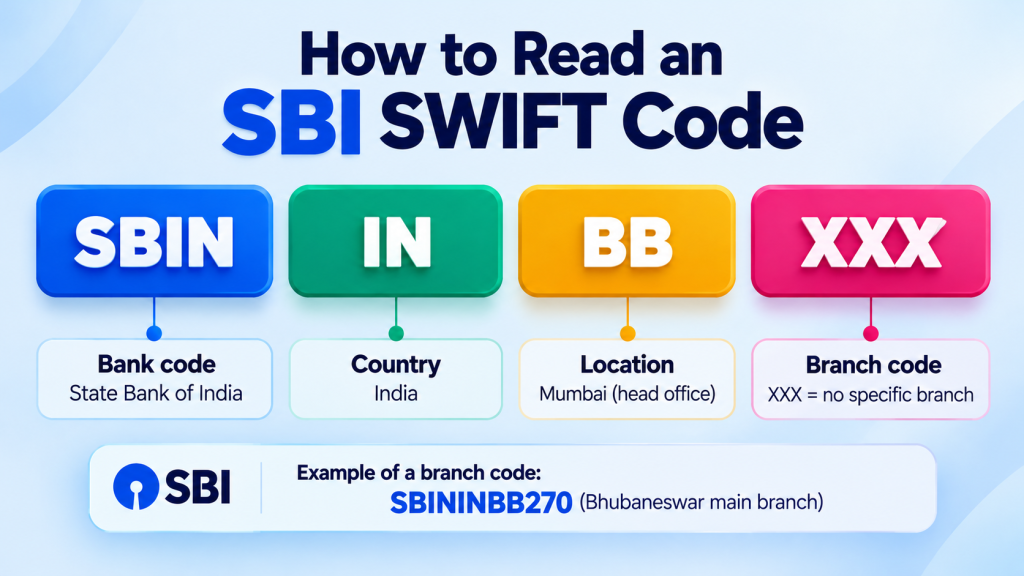
Every SWIFT code is built from four parts. Here is how SBININBB and an 11-character branch code are read:
| Part | Characters | Meaning |
| SBIN | 1–4 | Bank code for State Bank of India |
| IN | 5–6 | Country code for India |
| BB | 7–8 | Location code (SBI’s main SWIFT location) |
| XXX or 3 digits | 9–11 | XXX means the main office. Three digits point to one particular branch. |
Is the SWIFT Code the Same for All SBI Branches?
For most people, yes. The code SBININBB (or SBININBBXXX) works for the whole bank, and sending banks usually accept it for personal transfers such as family support or salary.
However, some SBI branches that handle foreign exchange have their own 11-character code. A few foreign banks ask for the branch-specific code, especially for business payments or large amounts. If your sender’s bank rejects the 8-character code, ask your branch for the full 11-character one.
SBI SWIFT Code Branch List (Sample)
SBI has thousands of branches, but only the forex-enabled ones have their own SWIFT code. Here are some commonly listed codes:
| Branch | SWIFT Code |
| Head office / default (all branches) | SBININBBXXX |
| New Delhi | SBININBB011 |
| Kolkata – Main Branch | SBININBB021 |
| Chennai – Main Branch | SBININBB031 |
| Bengaluru – Main Branch | SBININBB040 |
| Pune – Main Branch | SBININBB310 |
| Hyderabad – Main Branch | SBININBB466 |
| Bhubaneswar – Main Branch | SBININBB270 |
Important
Different websites list slightly different branch codes, and SBI can change them. Treat this table as a sample, not as a final source. Always confirm the code with your own branch before you give it to the sender.
Also check one basic thing first. Your account must be an NRI account, not an old resident account. If you moved abroad and never changed it, read how to convert your SBI resident account to an NRO account before you ask anyone to send you money.
SWIFT Code vs IFSC Code vs Branch Code
People mix these three up all the time. They are different codes with different jobs.
| Code | Used For | Format | Example |
| SWIFT / BIC | Money coming from or going to another country | 8 or 11 characters | SBININBBXXX |
| IFSC | Money moving inside India (NEFT, RTGS, IMPS) | 11 characters: SBIN + 0 + 6-character branch code | SBIN0001234 |
| Branch code | Identifies your branch in SBI’s records | Usually a 4–5 digit number | Printed on your passbook |
A simple way to remember it: SWIFT is for outside India, IFSC is for inside India. For an international transfer, senders usually need both your SWIFT code and your IFSC code, plus your account number.
How to Find Your SBI Branch SWIFT Code
- Start with SBININBB. For most personal transfers, this is enough. Share it with the sender and ask if their bank needs anything more.
- Call or email your home branch. Ask: “Does my branch have its own 11-character SWIFT code for incoming remittances?” NRI customers can also contact SBI’s NRI support team.
- Check Online SBI or the YONO app. Look in your account details or international services section. What you see can depend on your account type.
- Visit the branch. If you are in India, ask the staff to write the SWIFT code, branch address and your account details on a slip.
- Cross-check the code. If you find a code on a third-party website, confirm it with the branch before sending money.
How to Find Your SBI Branch Code
Your branch code is already printed in places you probably have.
- Passbook: The first page often shows the branch name, branch code and IFSC.
- Cheque book: The IFSC is printed at the bottom or top of every cheque. The last six characters of your IFSC show your branch.
- Bank statement: Your monthly or online statement lists the branch details.
- Net banking or YONO: Account details show your branch and IFSC.
Details the Sender Needs to Send You Money
Along with the SWIFT code, the sender’s bank will ask for a few more details. Keep them ready in one note on your phone:
- Your full name exactly as in the SBI account
- Your complete SBI account number
- SWIFT code (SBININBB or your branch-specific code)
- IFSC code of your branch
- Branch name and address
- Purpose of payment, such as family support or salary
Also be clear about which account the money should land in. Foreign income normally goes into an NRE account, while India-sourced money goes to an NRO account. If you are not sure which is right for you, this guide to NRE vs NRO accounts explains the difference in simple words.
How an International Transfer Reaches Your SBI Account
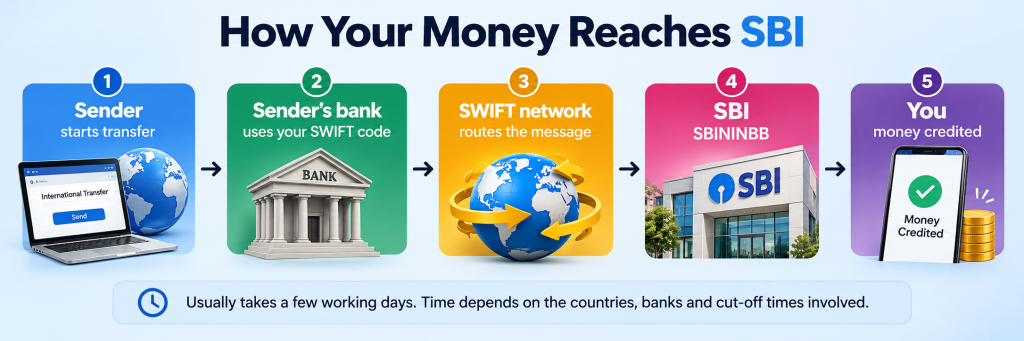
Once the money is in your account, you can spend it in India without carrying cash. Some NRIs now run daily payments through UPI on their NRE or NRO account, which makes it easy to pay bills and send money to family.
Using the SBI SWIFT Code to Send Money Abroad
SWIFT also works in the other direction. If you move money out of India, for example from your NRO account to a foreign account, you will need the receiving bank’s SWIFT code, not SBI’s. NRO transfers abroad also need tax paperwork. From 1 April 2026, the old Form 15CA and 15CB are replaced by Form 145 and Form 146 under the new Income-tax Act. The rules for how much you can move and when a CA certificate is needed are explained in this guide on NRO repatriation and Form 15CA/15CB for NRIs. Ask your bank which form it expects, since banks are still adjusting to the new names.

Common Mistakes People Make With the SBI SWIFT Code
- Giving the IFSC code instead of the SWIFT code. IFSC works only inside India. International senders need the SWIFT code.
- Writing the code wrong. One wrong letter can send the payment to the wrong place or get it rejected. SBIN is the bank, and the full code is SBININBB. Copy it, do not retype it.
- Using an old or random branch code from the internet. Websites can be outdated. Confirm any 11-character code with your branch.
- Sending money to a frozen or restricted account. If your NRI account has a pending KYC, credits and withdrawals can fail. Read why an NRI bank account gets frozen due to Re-KYC and how to fix it.
- Ignoring the KYC date. Many NRIs forget their periodic KYC refresh. This step-by-step guide to SBI NRI KYC update online shows how to do it from abroad.
Conclusion
The SBI SWIFT code is simple once you know the pattern. Use SBININBB (or SBININBBXXX) for most international transfers, and ask your branch for its own 11-character code only if the sender’s bank asks for it. Keep your SWIFT code, IFSC, account number and branch address in one place, make sure your account type and KYC are up to date, and your money should arrive without delay.
Disclaimer
The content published on NriTaxs is intended for informational purposes only and does not constitute legal, tax, or financial advice. Readers are encouraged to consult qualified professionals before making any decisions based on the information provided.







Related Articles