
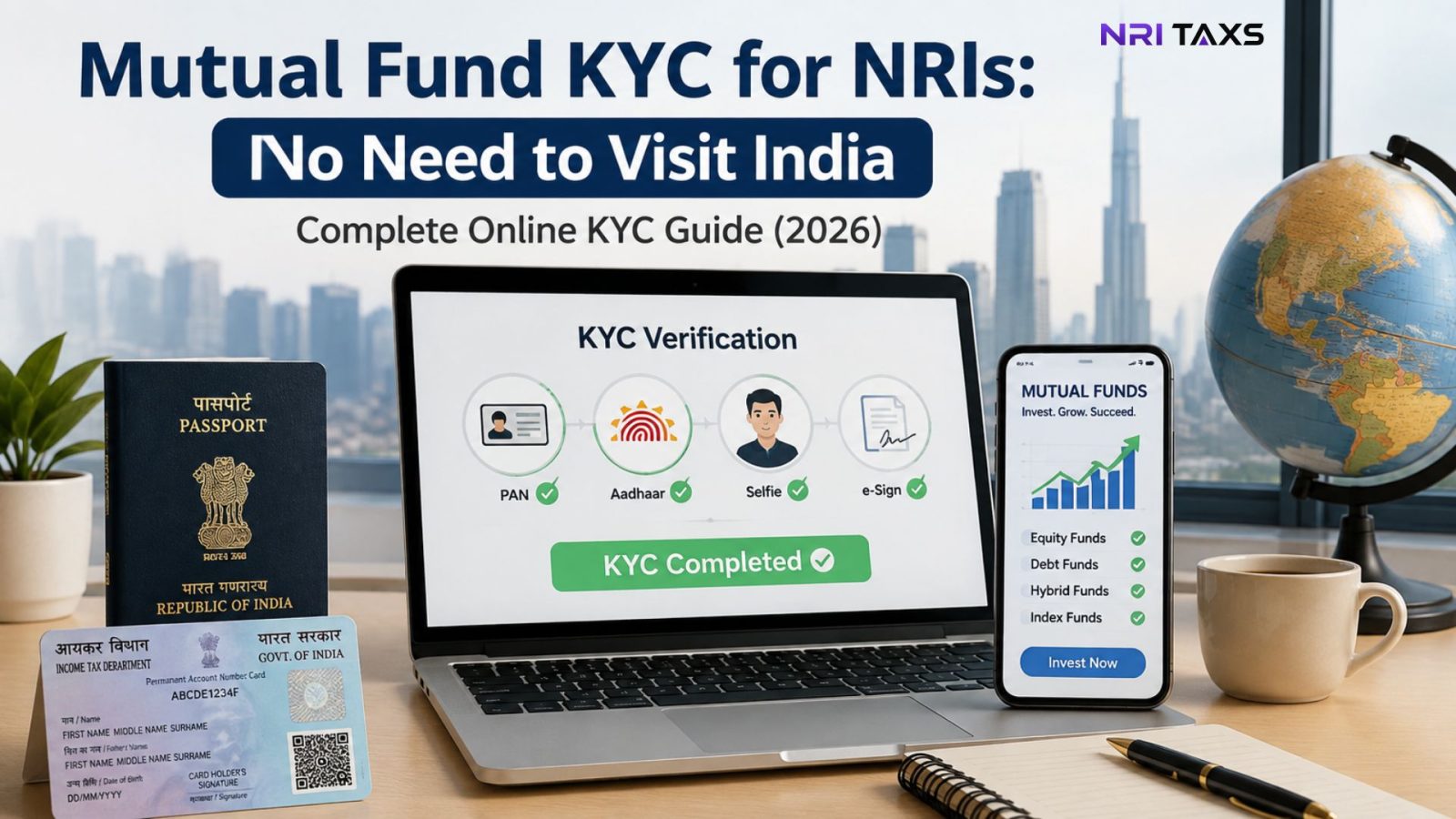
If you are an NRI and want to invest in Indian mutual funds, completing KYC is one of the first steps you need to take. And the best part is that you can generally complete your Mutual Fund KYC online without travelling to India. You may need to submit your PAN, passport, overseas address proof and FATCA/CRS details, along with the required identity verification. The exact process can vary depending on the KRA, AMC or platform you choose. In this guide, we explain the Mutual Fund KYC for NRIs, including the documents required, online verification, Video KYC, KYC status, Re-KYC requirements and common issues that can delay approval.
Key Takeaways
- ✔ Mutual Fund KYC for NRIs is mandatory under SEBI regulations before you can invest in any Indian mutual fund.
- ✔ You can complete the entire KYC process online through document upload, FATCA/CRS declaration, and Video IPV, without visiting India.
- ✔ As per SEBI’s December 2025 circular, existing NRI investors are no longer required to be physically present in India for digital re-KYC.
- ✔ Two KYC statuses matter: KYC Registered and KYC Validated. Full validation generally requires PAN-Aadhaar linkage where applicable.
- ✔ KYC completed through any registered KRA, such as CAMS, KFintech, or CVL, is accepted across all participating Asset Management Companies (AMCs).
What Is Mutual Fund KYC for NRIs?
Mutual Fund KYC for NRIs is the mandatory identity and address verification process that Non-Resident Indians must complete before investing in Indian mutual funds. Regulated by SEBI, it’s carried out through a KYC Registration Agency (KRA) such as CAMS or KFintech. Once approved by any one KRA, your KYC record is stored centrally, so you don’t need to repeat it for every mutual fund house you invest with.
Who Needs Mutual Fund KYC?
Anyone investing in Indian mutual funds from outside India needs to complete KYC before their first transaction. This includes:
- NRIs — Indian citizens residing abroad for work, business, or other purposes.
- OCI cardholders — Overseas Citizens of India investing through their NRE/NRO accounts.
- PIOs — Persons of Indian Origin who held Indian citizenship or have Indian-origin parents/grandparents.
- Returning NRIs — those who’ve recently moved back to India and need to update their existing KYC to reflect resident status.
- Foreign resident Indian investors — individuals of Indian origin settled abroad who wish to build a portfolio in India.
If you’re unsure whether your specific category is eligible to invest at all, our detailed guide on Can NRIs Invest in Mutual Funds in India covers eligibility, restrictions, and country-specific caveats (including for US and Canada-based investors) in more depth.
How to Complete Mutual Fund KYC for NRIs Online?
NRIs can generally initiate their mutual fund KYC online by submitting their personal details, identity and address documents, FATCA/CRS information, and completing the required verification.
Step 1: Choose a KYC Registration Agency or AMC
Start your KYC application through a KRA, AMC or authorised mutual fund platform that supports NRI investors.
Step 2: Enter Your Personal and Residential Details
Provide your PAN, name, date of birth, nationality, contact details and current overseas residential address. Make sure these details match your documents.
Step 3: Submit Your KYC Documents
Upload the required identity, address and bank-related documents. The exact documents and attestation requirements may vary depending on the KRA or intermediary.
Step 4: Complete FATCA/CRS Details
Declare your country of tax residence and provide your Tax Identification Number (TIN) or equivalent tax identification details where applicable.
Step 5: Complete Identity Verification
Complete the verification method offered by the KRA, AMC or platform, such as Video IPV where available.
Step 6: Submit the Application
Review your information carefully and submit the application for verification. If any document or information is incomplete, you may be asked to provide a correction or additional document.
Step 7: Check Your KYC Status
After submission, check your KYC status through the relevant KRA using your PAN and other requested details.
Step 8: Start Your Mutual Fund Investment
Once your KYC requirements are successfully completed, you can proceed with investing in eligible Indian mutual funds through an applicable AMC or platform.

Documents Required for Mutual Fund KYC for NRIs (2026)
| Document | Details / Notes |
| PAN Card | Mandatory; must be linked to Aadhaar to achieve “KYC Validated” status by the April 30, 2026 deadline. If you’re unsure whether your PAN is active, verify it before starting your KYC application. |
| Passport (self-attested copy) | Primary identity proof for all NRI, OCI, and PIO applicants |
| Overseas address proof | Utility bill, bank statement, or driving licence, generally not older than 3 months |
| Passport-size photograph | Recent photo, as per the KRA’s specifications |
| FATCA/CRS declaration | Mandatory tax-residency declaration form |
| Overseas bank account proof | Cancelled cheque or statement for your NRE/NRO account |
| Attestation | By an Indian embassy/consulate official, notary, court magistrate, or an authorized official of an overseas bank branch |
| Mariner’s declaration (if applicable) | Required only for NRIs employed in the Merchant Navy |
Can NRIs Complete KYC Without Visiting India?
Yes. This is one of the most common questions NRIs search for, and the honest, current answer is yes, with a few nuances worth understanding.
For years, the online route already worked without a trip home: NRIs could upload scanned documents, complete a FATCA/CRS declaration, and finish In-Person Verification (IPV) over a scheduled video call instead of an in-person visit. AMCs like Nippon India, UTI Mutual Fund, and Navi Mutual Fund have long accepted this digital, video-based approach for KYC for NRI without visiting India.
Until late 2025, even digital re-KYC required NRIs to be geo-verified as physically present in India, a rule that defeated the purpose of “digital” for anyone actually living abroad. In December 2025, SEBI issued a circular removing that requirement for existing NRI clients: re-KYC can now be completed digitally from any country, with security maintained through geo-tagging against your address proof, time-stamped sessions, and IP-spoofing checks. Re-KYC requirements are different from CKYC 2.0. Understanding the difference can prevent unnecessary document submissions. New client digital onboarding through app-based Video KYC still generally expects the applicant to be in India, so for a first-time NRI investor, the document-upload-plus-video-IPV route (rather than the fully automated in-app route) remains the practical no-visit path.
How Long Does Mutual Fund KYC Take for NRIs?
The time required to complete NRI mutual fund KYC can vary depending on the KRA, verification method, document quality and whether any additional information is required.
| Stage | Typical Timeframe |
| Document submission (online upload or courier) | 1–2 days |
| Video IPV completion | Same day to 2 days after scheduling |
| KRA verification and processing | 3–7 business days |
| KYC Registered status confirmed | Approximately 7–10 business days from submission |
| KYC Validated (Aadhaar-PAN linked) | Near-immediate once linkage is verified |
How to Check Mutual Fund KYC Status for NRIs?
After submitting your KYC application, you can check its status through the relevant KRA using your PAN and the details requested on the status-check page.
- Go o the CAMS KRA or KFintech KYC status-check page.
- Enter your PAN number in the search field.
- Complete the CAPTCHA verification.
- View your current status: KYC Registered, KYC Validated, or On Hold.
- If your status shows Registered or On Hold, complete the pending step (commonly Aadhaar-PAN linking) to move to Validated.
If your mutual fund KYC is On Hold or Rejected, check the reason provided by the KRA and complete the required correction or resubmission.
Re-KYC for Mutual Fund Investments: When Is It Required?
Re-KYC isn’t a one-time formality, it needs to be redone whenever your key details change or on a periodic basis tied to your risk category. Common triggers include:
- A change in your registered address, phone number, or email.
- A change in your name (e.g., after marriage).
- Moving from resident to NRI status, or vice versa, a shift that affects your account type, tax treatment, and KYC records, and is worth handling carefully and promptly.
- Periodic review cycles set by SEBI/RBI risk-based norms, which are shorter for higher-risk profiles and longer for low-risk ones.
Thanks to the December 2025 SEBI circular, existing NRI investors can now complete this re-KYC digitally without needing to be in India, which was previously one of the biggest friction points for long-settled NRIs maintaining Indian investments.
Can NRIs Complete Re-KYC Without Visiting India?
For eligible existing NRI investors, digital Re-KYC can be completed without being physically present in India under the applicable process. However, the exact verification method can vary between KRAs, AMCs and investment platforms. Before starting Re-KYC, check which documents and verification method your provider requires.
Important
Re-KYC is different from initial KYC. If you are investing for the first time, you need to complete the applicable initial KYC process rather than treating it as Re-KYC.
Mutual Fund KYC vs CKYC vs Bank KYC
| Aspect | Mutual Fund KYC | CKYC | Bank KYC |
| Regulator | SEBI | CERSAI (Central KYC Registry) | RBI |
| Purpose | Investing in mutual funds and securities | A single, shared KYC record across financial institutions | Opening and operating NRE/NRO/FCNR bank accounts |
| Agency | KRAs — CAMS, KFintech, CVL | CKYCR (Central KYC Records Registry) | Individual banks |
| Reusability | Valid across all AMCs once completed | Reused across banks, mutual funds, insurers, and brokers | Bank-specific unless linked to CKYC |
| Best for | NRIs starting mutual fund investments | Reducing repeated KYC across institutions | NRIs opening or maintaining Indian bank accounts |
Conclusion
Completing your Mutual Fund KYC correctly is the first step towards investing in Indian mutual funds. Keeping your documents updated, understanding SEBI’s latest requirements, and completing Re-KYC whenever required can help you avoid delays and keep your investments active. If you need professional assistance with Mutual Fund KYC, FATCA compliance, or NRI investment documentation, NRI Taxs can help you complete the process smoothly from anywhere in the world.
Disclaimer
The content published on NriTaxs is intended for informational purposes only and does not constitute legal, tax, or financial advice. Readers are encouraged to consult qualified professionals before making any decisions based on the information provided.




Related Articles