
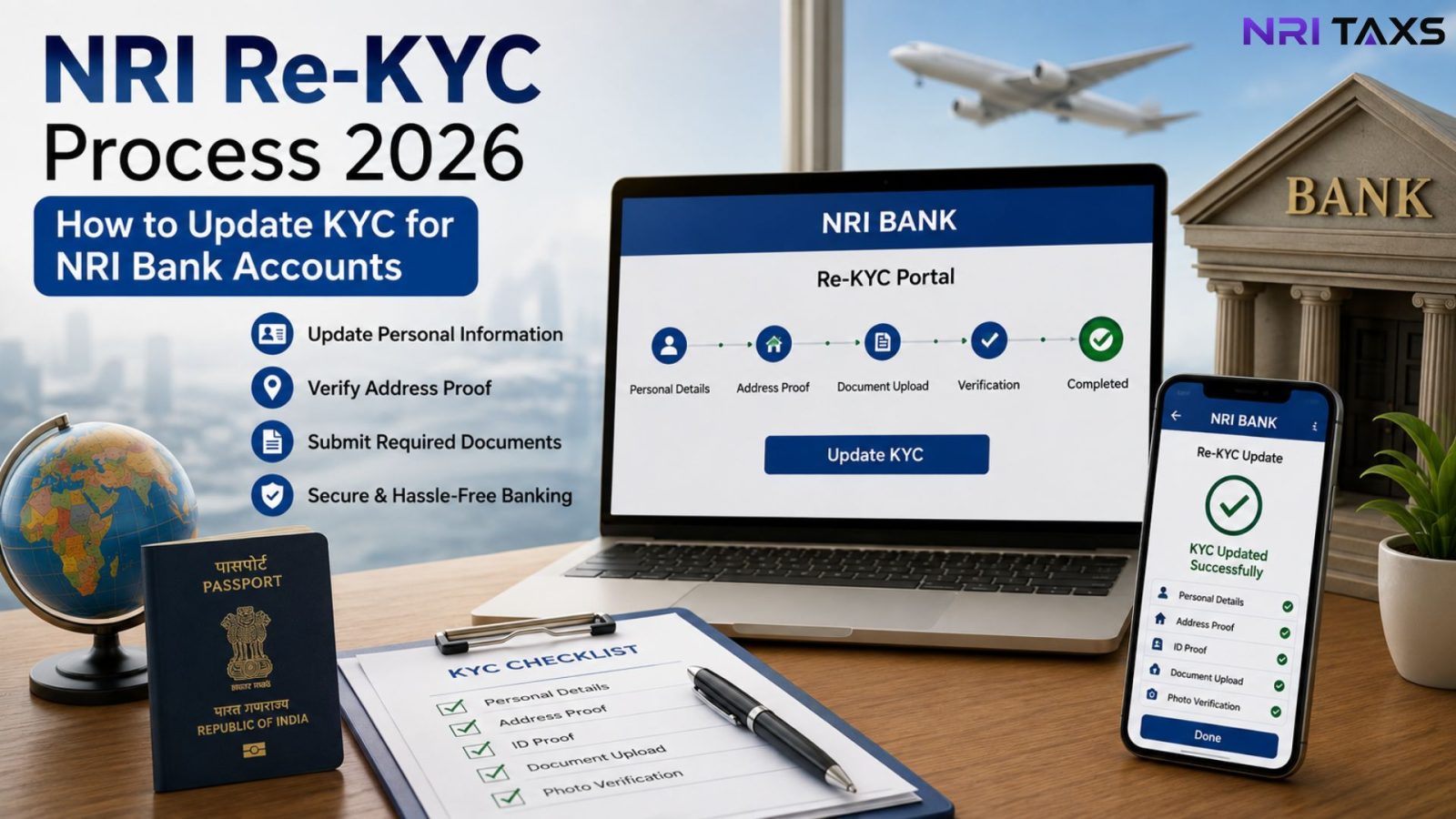
An email comes from the bank “Your KYC is due for update” and suddenly panic begins. Will my account get frozen? Do I need to fly to India? Which documents will they ask for this time? If you’re an NRI, this feeling is very familiar. Banks in India are required by the RBI to periodically re-verify customer details, and NRE, NRO, and FCNR accounts are no exception. But the best part is NRI Re-KYC process has become more manageable in 2026, with most banks now allowing it to be completed without a branch visit. This guide breaks down exactly what Re-KYC means, why it matters, what documents you’ll need, and how the process works bank by bank.
Key Takeaways
- ✔ NRI Re-KYC is mandatory to keep NRE, NRO, and FCNR accounts compliant and operational.
- ✔ Re-KYC is required periodically based on the account’s risk category.
- ✔ NRIs generally need passport, overseas address proof, visa or residency proof, and PAN or Form 60.
- ✔ Many Indian banks allow NRIs to complete Re-KYC online or through self-declaration.
- ✔ The Re-KYC process and document requirements vary by bank, so always check your bank’s latest procedure.
- ✔ KYC, e-KYC, and Re-KYC are different processes, with different purposes and applicability for NRIs.
- ✔ Missing Re-KYC can lead to transaction restrictions, an inoperative account, or account freezing.
What is Re-KYC For NRI Accounts
Re-KYC (Re-Know Your Customer) is the periodic re-verification of your identity, address, and account details that every bank is required to carry out under RBI’s KYC guidelines. It is not a one-time formality, it is meant to happen at fixed intervals throughout the life of your account. For NRI accounts specifically, Re-KYC confirms that your residential status, overseas address, contact details, and identification documents are still accurate and current. Since your NRE, NRO, or FCNR account depends entirely on your NRI status being correctly recorded, an outdated KYC file can create real complications from restricted transactions to a fully frozen account. If your residential status has recently changed, it is also important to understand the rules for converting your NRE/NRO accounts after returning to India.
Why Re-KYC Is Important For NRI Accounts?
Re-KYC isn’t just paperwork the bank insists on it protects both you and the bank in several concrete ways:
- Keeps your account active and operational. Banks restrict debit transactions or freeze accounts where Re-KYC has lapsed, which can be a serious problem if you’re relying on that account from abroad.
- Confirms your NRI status is correctly recorded. If your residential status isn’t updated, the bank may continue treating your account under resident rules, which conflicts with FEMA regulations for NRE/NRO accounts.
- Prevents fraud and unauthorized access. Updated contact details and documents make it harder for anyone to misuse a dormant or outdated account.
- Ensures smooth remittances and interest payments. Incorrect or expired KYC details can delay fund transfers, FD renewals, or interest credit into your account.
- Keeps you compliant with RBI regulations. Periodic KYC is a regulatory requirement, not a bank preference; non-compliance can trigger reporting flags on your account.
When is Re-KYC for NRI Accounts Required?
RBI mandates that KYC be periodically refreshed based on the risk category assigned to an account. For most individual NRI accounts, banks typically schedule Re-KYC as follows:
- Low-risk accounts: once every 10 years
- Medium-risk accounts: once every 8 years
- High-risk accounts: once every 2 years
Apart from these scheduled cycles, banks will also ask for Re-KYC if there’s a change in your address, contact number, or residential status (for example, moving from one country to another), if your existing identification documents have expired, or if the bank flags your account during an internal compliance review. RBI has also clarified that if there is no change in your KYC information, you can complete Re-KYC through self-declaration via registered email, net banking, or mobile banking you don’t always need to visit a branch or courier documents.
Documents Required For NRI Re-KYC?
| Document Type | Accepted Documents |
| Identity Proof | Valid Passport (mandatory for NRIs) |
| Overseas Address Proof | Utility bill, bank statement, driving licence, residence/work permit, or rental agreement from country of residence |
| Visa/Residency Proof | Valid visa copy, work permit, PIO/OCI card (where applicable) |
| PAN or Form 60 | PAN card copy, or Form 60 if PAN not available |
| Photograph | Recent passport-size photograph |
| Signature Proof | Signature verification as per existing bank records or attested specimen signature |
| Self-Declaration Form | Bank’s Re-KYC form, filled and signed |
Most banks require these documents to be self-attested. If you’re submitting from overseas, some banks may additionally ask for attestation by the Indian Embassy, Notary Public, or a banker in your country of residence; this varies by bank, so it’s worth confirming before you submit. For NRIs earning income in India, keeping your KYC and tax records updated also helps ensure smoother income-tax filing and compliance.
How to Complete NRI Re-KYC Process?
While the exact portal or form may differ slightly from bank to bank, the overall process for NRI Re-KYC generally follows the same six steps:
- Download or request the Re-KYC form. Get the form from your bank’s website, net banking portal, or by requesting it via email from your home branch.
- Fill in your updated details. Update your current overseas address, contact number, email ID, and residential status accurately on the form.
- Attach supporting documents. Self-attest copies of your passport, visa, address proof, and PAN as listed in the documents table above.
- Submit the form online or offline. Upload via net banking/mobile app, email to your branch, or courier the physical documents if the bank requires it.
- Bank verifies your documents. The branch or central KYC team cross-checks your submission against existing records and flags any discrepancies.
- Receive confirmation notification. Once verified, you’ll get an SMS, email, or letter confirming your Re-KYC is complete and your account status is updated.
Contact Us
Bank-Wise NRI Re-KYC Process
Here’s how the process typically works at major banks offering NRI accounts. Since procedures can be updated by banks from time to time, it’s a good idea to confirm the current steps on your bank’s official NRI banking page before you begin.
SBI NRI Re-KYC Process
- Log in to SBI’s YONO or internet banking portal, or contact your NRI branch directly for the Re-KYC form.
- Fill in updated address, contact, and residency details, and attach self-attested passport, visa, and address proof copies.
- Submit the completed form online through the portal, or email/courier it to your designated NRI branch.
- SBI verifies the submission and confirms via SMS or email once your KYC record is updated.
HDFC Bank NRI Re-KYC Process
- Access the Re-KYC section through HDFC Bank’s NetBanking or the NRI services page on the website.
- Complete the self-declaration form with your current overseas address and identification details.
- Attach self-attested copies of your passport, visa, and address proof, and submit online or via your relationship manager.
- HDFC reviews the documents and sends a confirmation once the update reflects in your account.
ICICI Bank NRI Re-KYC Process
- Visit ICICI Bank’s NRI Services portal or internet banking to locate the Re-KYC request option.
- Enter updated personal, address, and contact information as required by the form.
- Upload self-attested documents including passport, visa, and overseas address proof directly on the portal.
- ICICI verifies the details and notifies you by email once the Re-KYC process is successfully completed.
Axis Bank NRI Re-KYC Process
- Log in to Axis Bank’s internet banking or reach out to your NRI relationship manager for the Re-KYC form.
- Update your residential status, overseas address, and contact details on the provided form.
- Submit self-attested identity and address proof documents online, by email, or through courier to your branch.
- Axis Bank confirms completion via SMS or email after verifying your submitted documents.
Kotak Mahindra Bank NRI Re-KYC Process
- Access the Re-KYC request form through Kotak’s NRI net banking section or the NRI services page.
- Fill in your current details, including any changes to your address or residency status abroad.
- Attach self-attested passport, visa, and address proof, and submit through the online portal or your branch.
- Kotak processes the request and sends a confirmation once your KYC record is successfully refreshed.
RBL Bank NRI Re-KYC Process
- Request the Re-KYC form from RBL Bank’s NRI banking desk or download it from the official website.
- Complete the form with your updated overseas address, contact number, and identification details.
- Submit self-attested supporting documents via email, courier, or the net banking upload facility.
- RBL Bank verifies the documents and confirms the update through SMS or registered email.
NRI Re-KYC vs KYC vs e-KYC: What’s the Difference?
| Aspect | KYC | e-KYC | Re-KYC |
| When it happens | At the time of account opening | At account opening, via digital/Aadhaar-based verification | Periodically, throughout the life of the account |
| Purpose | Establish customer identity for the first time | Faster, paperless identity verification | Re-verify and refresh existing customer records |
| Applicability for NRIs | Mandatory when opening NRE/NRO/FCNR account | Limited use for NRIs, since Aadhaar-based e-KYC has restrictions for overseas addresses | Mandatory at periodic intervals or on status/detail changes |
| Mode | Branch visit or physical documentation | Aadhaar OTP, biometric, or video-based verification | Online self-declaration, email, courier, or branch visit |
How Long Does NRI Re-KYC Take?
| Submission Method | Typical Processing Time |
| Online self-declaration (no change in details) | 1–3 working days |
| Online submission with document upload | 5–10 working days |
| Email submission to home branch | 7–15 working days |
| Courier/physical documents from abroad | 2–4 weeks, depending on postal transit time |
Processing time can extend further if documents are incomplete, unclear, or not properly self-attested so it helps to double-check everything before submission to avoid a second round of correspondence.
What Happens If Re-KYC Is Missed
Missing your Re-KYC deadline doesn’t shut down your account instantly, but banks do apply escalating restrictions the longer it stays pending. Typically, you’ll first receive reminder notices via SMS and email. If there’s no response, the bank may restrict outward debit transactions while still allowing credits, meaning you can receive money but not send or withdraw it. If the delay continues further, the account can be marked inoperative or fully frozen until Re-KYC is completed. Reactivating a frozen NRI account usually takes longer than a routine Re-KYC, since the bank will require fresh document verification and, in some cases, may ask for a video KYC call. It’s far simpler to complete Re-KYC as soon as the bank sends the first reminder rather than waiting until the account is restricted. If your Re-KYC is already overdue or your account has been restricted, getting professional assistance can help you understand the required documents and complete the reactivation process correctly.
Conclusion
Re-KYC can feel like an inconvenience, especially when you’re managing it from another country, but it’s a routine compliance step that protects your account from disruption. With most Indian banks now supporting online submission and self-declaration, NRIs rarely need to make a trip to India just to keep their KYC current. Keep a scanned set of your passport, visa, and address proof ready, respond to your bank’s Re-KYC reminder as soon as it arrives, and your NRE, NRO, or FCNR account will continue running without interruption.
Disclaimer
The content published on NriTaxs is intended for informational purposes only and does not constitute legal, tax, or financial advice. Readers are encouraged to consult qualified professionals before making any decisions based on the information provided.





Related Articles