

Buying a home in India while living abroad can seem simple until you begin the home loan process. For NRIs, banks follow specific eligibility criteria and may require additional documents to verify overseas income, employment, and financial stability. Your country of residence, income, credit profile, NRE/NRO account status, and co-applicant requirements can also affect the loan process. Understanding these requirements before applying can help you avoid unnecessary delays and documentation issues. In this guide, we cover NRI home loan eligibility, interest rates, loan amounts, EMI calculation, required documents, application process, and other important factors you should know before applying for an NRI home loan in 2026.
Key Takeaways
- ✔ NRIs, OCIs, and eligible applicants can apply for a home loan in India, subject to the lender’s eligibility requirements.
- ✔ Banks mainly check age, income, overseas employment, credit score, existing liabilities, and NRE/NRO account status before approving the loan.
- ✔ Interest rates, loan amounts, repayment tenure, and financing limits vary by lender, so comparing different banks is important.
- ✔ NRIs should prepare passport, visa/work permit, employment proof, financial records, NRE/NRO statements, and property documents before applying.
- ✔ Many banks allow online NRI home loan applications, but certain documents may still require notarisation, attestation, or physical signing.
- ✔ Low credit score, high liabilities, incomplete documents, employment issues, and property-document problems can lead to delays or rejection.
What Is an NRI Home Loan?
An NRI home loan is a housing loan that Indian banks and housing finance companies offer specifically to Non-Resident Indians, OCIs, and PIOs to buy, construct, or renovate property in India. It works much like a resident home loan, except repayment flows through your NRE or NRO account, and lenders apply NRI-specific income verification and documentation rules.
Who Can Get an NRI Home Loan in India?
- Non-Resident Indians (NRIs): Indian citizens living abroad for employment, business, or any other purpose can apply, provided they meet the lender’s minimum age and income requirements for their loan amount.
- OCI Cardholders: Overseas Citizens of India are treated almost the same as NRIs by most banks and can apply for a home loan using the identical eligibility framework and documentation checklist.
- PIO Cardholders: Though the PIO scheme has now merged into OCI, some banks still process legacy PIO applicants under NRI eligibility norms with minor extra documentation requirements.
- Merchant Navy Employees: NRIs working as seafarers can also apply, though banks usually request extra proof like the Continuous Discharge Certificate and appointment letter to verify income.
- Salaried and Self-Employed NRIs: Both salaried professionals and self-employed NRIs running a business abroad qualify, as long as they meet the lender’s minimum income and stability thresholds.
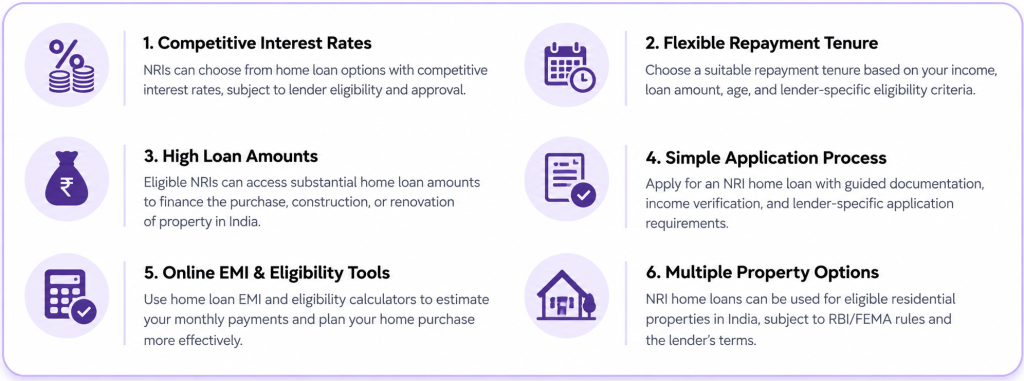
Features and Benefits of NRI Home Loan
NRI Home Loan Eligibility Criteria 2026
- Age Requirement: Most banks require applicants to be between 21 and 60 years old at the time the loan matures, though some extend this to 65 for self-employed applicants with stable income.
- Minimum Income: Lenders typically expect a minimum annual income equivalent to around 24,000–30,000 for salaried NRIs, though this varies by bank, loan amount, and country of residence.
- Employment Experience: Salaried NRIs generally need at least 2–3 years of continuous employment, while self-employed applicants are usually expected to show 3–5 years of stable business operation abroad.
- Minimum Work Experience Abroad: Most banks require you to have lived and worked overseas for at least 1–2 years before your NRI home loan application is considered eligible for processing.
- Credit/CIBIL Score: A CIBIL score of 750 or above significantly improves your approval odds and interest rate offer; scores below 650 often lead to rejection or a higher rate.
- Existing Loans and Liabilities: Banks calculate your debt-to-income ratio by factoring in existing loans, credit card dues, and other liabilities before finalising the loan amount you’re eligible for.
- NRE/NRO Account Requirement: An active NRE or NRO account in India is mandatory, since your down payment, loan disbursement, and EMI repayment must all flow through one of these accounts.
- Co-Applicant Requirements: Most banks require a resident Indian co-applicant, usually a close relative, particularly when the property being purchased is jointly owned or partly inherited.
If your NRE or NRO account isn’t active yet, or your KYC still reflects resident status, it’s worth sorting that out before you apply, since updating your KYC and account status from resident to NRI is something most banks will flag during loan processing anyway.
NRI Home Loan Interest Rates 2026
| Bank / HFC | Starting Interest Rate (p.a.) | Max Tenure | Max Financing (LTV) |
| SBI | 8.25% – 9.15% | Up to 30 years | Up to 80% |
| HDFC Bank | 8.70% – 9.10% | Up to 30 years | Up to 80% |
| ICICI Bank | 8.75% – 9.25% | Up to 30 years | Up to 80–90% |
| Axis Bank | 8.75% – 9.50% | Up to 20–30 years | Up to 75–80% |
| Bank of Baroda | 8.85% onwards | Up to 30 years | Up to 80% |
| PNB Housing Finance | 8.50% onwards | Up to 20 years | Up to 80% |
| LIC Housing Finance | 8.50% – 9.50% | Up to 20 years | Up to 75–80% |
NRI rates typically run 0.25%–0.50% higher than resident rates and are floating, repo-linked rates that move with RBI policy changes. Your exact rate depends on your CIBIL score, income stability, and country of residence, so treat this table as a starting reference and always confirm current rates directly with the bank before applying.
How Much Home Loan Can an NRI Get?
Most banks finance up to 80–90% of the property value, with the rest expected as your down payment. Your actual eligible amount depends on your income, existing liabilities, credit score, and the property’s value, calculated so your total EMI outgo (including this loan) generally stays within 40–50% of your monthly income.
Example: Arjun, an NRI in Dubai earning the equivalent of ₹1.5 lakh a month with no existing loans, could typically qualify for a home loan of roughly ₹80–90 lakh, depending on the bank’s exact income multiple and the property’s assessed value. If he were funding part of the purchase from existing India-based investments, checking how those holdings are taxed, similar to how NRI investment accounts such as NPS are treated, would factor into his overall repayment planning.
NRI Home Loan EMI Calculator
Your EMI depends on three factors: loan amount, interest rate, and tenure. A longer tenure lowers your monthly EMI but increases the total interest paid over the loan’s life, so it’s worth comparing a couple of tenure options before deciding.
| Loan Amount | Interest Rate | Tenure | Approx. Monthly EMI |
| ₹50,00,000 | 8.75% p.a. | 20 years | ₹44,300 |
| ₹75,00,000 | 8.75% p.a. | 20 years | ₹66,450 |
| ₹1,00,00,000 | 8.75% p.a. | 25 years | ₹82,700 |
Documents Required for NRI Home Loan
Identity Documents
Passport, visa/work permit copy, PAN card, OCI/PIO card (if applicable), passport-size photographs.
Overseas Employment Documents
Employment contract, salary certificate, appointment letter, work permit, Continuous Discharge Certificate (for seafarers).
Financial Documents
Last 6 months’ salary slips, last 6–12 months’ NRE/NRO bank statements, last 2–3 years’ overseas tax returns, credit report. If you’re still consolidating funds across a resident account that hasn’t been converted yet, sorting out how to convert a resident savings account into an NRO account beforehand will save you a scramble when the bank asks for consistent statements.
Property Documents
Sale agreement, title deed, approved building plan, No Objection Certificate (NOC), encumbrance certificate, property tax receipts.
How to Apply for an NRI Home Loan in India: Step-by-Step Process
- Check your eligibility: Use the bank’s eligibility calculator or speak to an NRI relationship manager to confirm your income, age, and credit score meet the minimum requirements before applying.
- Shortlist and compare banks: Compare interest rates, processing fees, maximum tenure, and loan-to-value ratio across two or three banks that actively serve NRIs from your country of residence.
- Gather your documents: Collect identity, employment, financial, and property documents in advance, and get overseas documents attested by the Indian Embassy or notarised where the bank requires it.
- Submit your application: Apply online through the bank’s NRI portal or through a local branch representative, and pay the applicable processing fee to begin document verification. Keeping your NRE/NRO accounts and KYC records correctly updated at this stage avoids delays during the bank’s income and identity checks.
- Property and document verification: The bank verifies your submitted documents, conducts a legal check on the property title, and may arrange a technical valuation before approving the loan.
- Loan sanction and disbursement: Once approved, you sign the loan agreement, and the bank disburses funds directly to the seller or builder, with EMIs starting from your NRE/NRO account.

Can NRIs Apply for a Home Loan Online?
Yes. Most major banks now offer a fully digital NRI home loan application process, letting you submit forms, upload documents, and track approval status entirely online from abroad. You’ll still need to get certain documents notarised or attested by the Indian Embassy or Consulate in your country of residence, and physical signing of the final loan agreement is sometimes required, either in person during a visit to India or through a Power of Attorney.
Best Banks for NRI Home Loans in India
| Bank | Known For | Processing Fee |
| SBI | Lowest starting rates, wide branch network, women borrower concessions | 0.35% + GST |
| HDFC Bank | Fast digital processing, property advisory services | Up to 0.50% |
| ICICI Bank | High loan-to-value ratio, express online sanction | Up to 0.50% |
| Axis Bank | Quick digital application process for NRIs | Up to 1% |
| LIC Housing Finance | Trusted for long-tenure loans | Up to 0.50% |
Common Reasons NRI Home Loan Applications Get Rejected
- Low credit score: A CIBIL score below the bank’s minimum threshold, often 650–700, is one of the fastest ways to get an application declined outright.
- Insufficient income: Falling short of the lender’s minimum income requirement for your loan amount and country of residence leads to automatic rejection at the screening stage.
- High existing liabilities: A high debt-to-income ratio from existing loans or credit card dues signals repayment risk and reduces your eligible loan amount significantly.
- Incomplete documentation: Missing attestations, unclear photocopies, or mismatched details across your passport, PAN, and address proof commonly stall or reject applications.
- Employment issues: Frequent job changes, unstable income, or employment in a country the bank considers high-risk can all work against your approval chances.
- Property-document problems: Disputed title, missing NOC, or an unapproved building plan on the property you’re purchasing will halt the loan regardless of your own eligibility. This is also where checking the seller’s own status matters, since an NRI seller’s TDS and capital gains position can affect how cleanly a resale transaction closes.
- Inability to verify overseas income: If your salary certificate, contract, or bank statements don’t clearly match your stated income, the bank cannot verify and approve the loan.
- Repayment-capacity concerns: Banks decline applications where the requested EMI would consume too large a share of your verified monthly income, even if other criteria are met.
Conclusion
An NRI home loan isn’t complicated once you know what banks are actually checking: your income stability, credit score, NRE/NRO account status, and the property’s paperwork. Get your documents organised early, compare two or three lenders on rate and tenure, and apply for a lower deduction or tax benefit only after your account status and KYC are properly updated. Most rejections come down to avoidable gaps, not eligibility itself.
Disclaimer
The content published on NriTaxs is intended for informational purposes only and does not constitute legal, tax, or financial advice. Readers are encouraged to consult qualified professionals before making any decisions based on the information provided.










Related Articles