
Have you recently moved abroad and are wondering whether your SBI Resident Savings Account needs to be converted into an NRO Account? You’re not alone. Many NRIs are unsure about when the conversion is required, whether they can complete it without visiting India, which documents they need, or what happens if they continue using their resident account after becoming an NRI.
Fortunately, the process isn’t as complicated as it may seem. With the right documents and a clear understanding of SBI’s requirements, you can complete the account conversion from abroad without unnecessary confusion. This guide covers how to convert SBI Resident account to NRO Account process in a simple, step-by-step format, along with the latest requirements, timelines, fees, and answers to the questions most NRIs have before applying.
Key Takeaways
✓NRIs must convert their SBI Resident Savings Account into an NRO Account after their residential status changes to remain FEMA compliant.
✓You can complete the entire SBI Resident to NRO Account conversion process from abroad without visiting India.
✓Keep your passport, PAN, overseas address proof, visa or OCI card, and other supporting documents ready before applying.
✓Properly attested documents and an accurately completed application help avoid delays or rejection.
✓Once approved, your account will operate as an NRO Account while generally retaining the same account number and banking access.
Can NRIs Continue Using an SBI Resident Savings Account?
No, under the Foreign Exchange Management Act (FEMA), 1999, an individual whose residential status changes to Non-Resident Indian is required to convert their existing resident savings account into an NRO (Non-Resident Ordinary) account, or an NRE account if the funds are foreign-sourced. There is no grace period written into the law that lets you keep operating a resident account indefinitely just because you haven’t gotten around to updating it.
- FEMA rule: FEMA classifies bank accounts by residential status. Once you qualify as an NRI (broadly, once you’ve been outside India for an extended period with the intention of staying abroad, or you take up employment, business, or a profession outside India), your account must reflect that status.
- RBI requirement: The Reserve Bank of India requires banks, including SBI, to re-designate a customer’s resident account into an NRO account as soon as they’re informed of the change in residential status RBI has been explicit that this is the bank’s obligation, not a discretionary courtesy.
- Consequences of not converting: Continuing to operate a resident account as an NRI is a technical violation of FEMA. In practice, this can surface as complications with income tax reporting, TDS mismatches, restrictions or freezes flagged during KYC re-verification, and because SBI’s declaration form ties into FATCA/CRS and CBDT reporting obligations potential scrutiny if your account activity doesn’t match your declared residential status.
This is exactly why SBI’s NRO account conversion process exists in the first place. It isn’t paperwork for its own sake, it’s how the bank keeps your account compliant with your actual legal status.
Who Needs to Convert an SBI Resident Savings Account?
Indian citizens moving abroad
If you’re an Indian citizen relocating overseas for work, study, or long-term stay, and you expect to remain outside India beyond the period that qualifies you as a resident under FEMA, your existing SBI account needs to be converted once your status changes.
NRIs
If you’ve already crossed into NRI status and still hold an unconverted resident account with SBI, this is the exact process you need SBI’s form is specifically titled for “change of residential status” from Resident Indian to NRI.
OCI cardholders
Overseas Citizens of India and Persons of Indian Origin (PIO) who hold a resident SBI account from before their status changed also need to convert it. SBI’s form treats PIO/OCI as a distinct status category with its own accepted proof documents (the OCI or PIO card itself, rather than a visa).
Seafarers (if applicable)
NRIs with a seafarer work profile are covered under a separate documentation track. Instead of a visa or work permit, SBI accepts a valid job contract, a Continuous Discharge Certificate (CDC) with a disembarkation stamp not older than six months, or a recent pay slip from the shipping company as proof of status.
Returning residents (special note)
If you’ve since moved back to India and your NRI status has ended, note that this particular process runs in reverse. You’d need to re-designate your NRO account back into a resident account, not use this conversion form. Don’t use the RI-to-NRO form if you’re returning to India; ask your branch for the resident re-designation process instead.
When Should You Convert Your SBI Resident Account?
You should initiate the conversion as soon as your residential status changes, not months later.
- Moving abroad for a job: Once you take up employment outside India with the intention of staying, your status change begins.
- Permanent Residency (PR) approval: Getting PR in another country is one of the clearest triggers for converting.
- Receiving your OCI card: If you’ve taken foreign citizenship and received an OCI card, your Indian resident account needs to be converted alongside the citizenship change.
- Acquiring foreign citizenship: This is a definitive status change and should trigger conversion immediately, not at your convenience.
Delaying the conversion doesn’t pause your legal obligation it just means more months of operating a technically non-compliant account.
How to Convert SBI Resident Account to NRO Account from Abroad
Here’s the exact process, step by step:
Converting your SBI Resident Savings Account to an NRO Account from abroad is a straightforward process, but it requires the correct form, supporting documents, and submission to your home branch. Before you begin, keep your passport, PAN card, overseas address proof, and other required documents ready to avoid delays.
Follow these steps to complete the conversion:
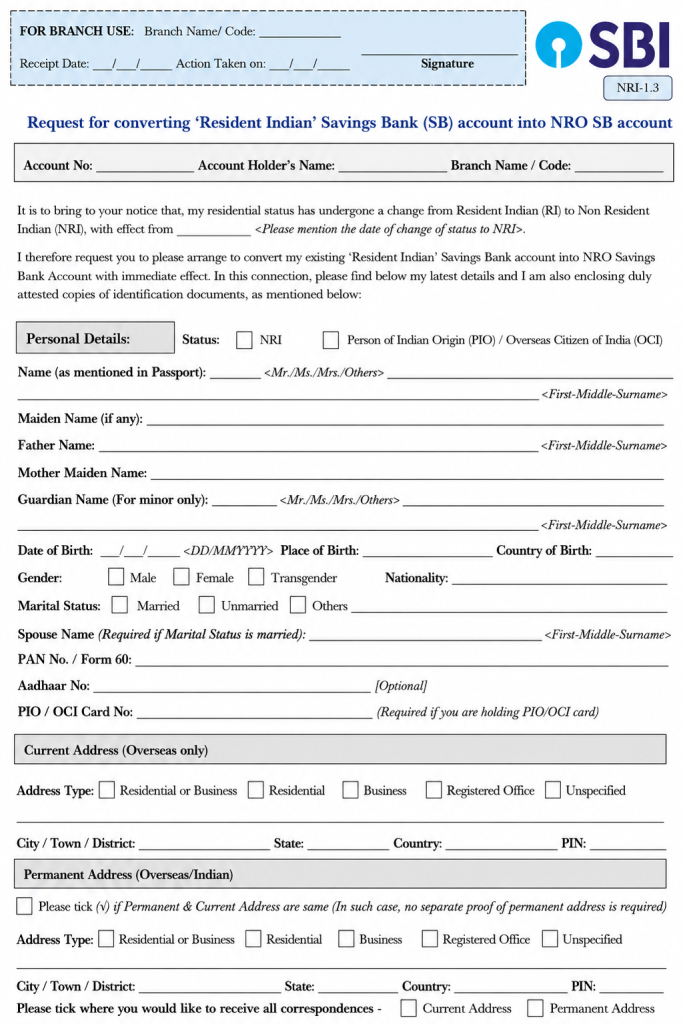
Step 1: Download the SBI Resident to NRO Account Conversion Form
The first step is to download the official Resident to NRO Account Conversion Form from SBI’s website. This is the prescribed application form used to request a change in your account status after becoming an NRI.
Tip: Always download the latest version of the form from SBI’s official website to ensure you’re using the current format.
Step 2: Complete the Application Form Carefully
Fill in all the required details exactly as they appear on your official documents. This includes your personal information, account details, overseas address, passport information, PAN, residential status, and tax residency details (if applicable).
Before submitting the form, double-check all the information. Even small errors, such as an incorrect passport number or address mismatch, can delay the verification process.
Step 3: Attach the Required Documents
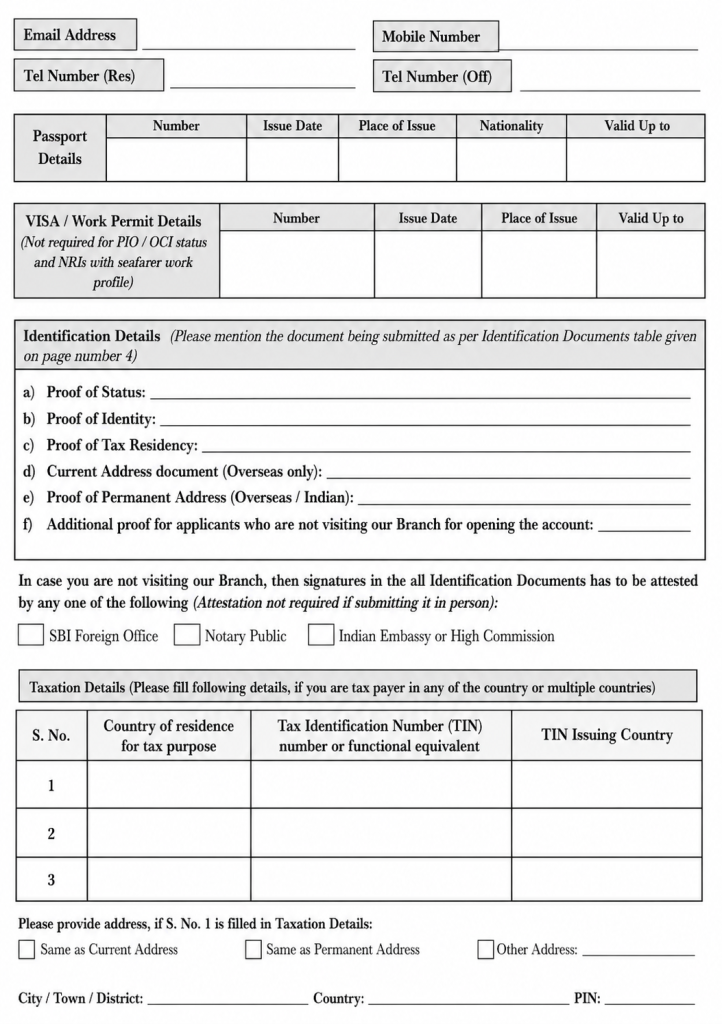
Once the application form is complete, attach all the supporting documents requested by SBI. These generally include your passport, valid visa or residence permit, PAN card, overseas address proof, and any other documents required by the bank. If you don’t have a PAN yet, learn how to apply for a PAN card as an NRI before proceeding with your SBI account conversion.
Important: If any document has been issued in a language other than English or Hindi, include a certified translated copy along with the original document.
Step 4: Send the Application to Your SBI Home Branch
After completing the application, courier the signed form along with the supporting documents to the SBI branch where your resident savings account is currently maintained.
Since this request involves updating your residential status, SBI generally requires physical document verification. Ensure that your courier contains all the required documents before dispatching it.
Step 5: Wait for SBI to Verify Your Documents
After your home branch receives the application, it will verify the information and supporting documents. If everything is in order, the conversion request will move forward. However, if any document is missing or additional clarification is required, the branch may contact you for further information.
Keeping copies of all submitted documents and your courier tracking details can be helpful until the process is completed.
Step 6: Receive Confirmation of Your Account Conversion
Once your request is approved, SBI will convert your Resident Savings Account into an NRO Account. After the conversion, your account will operate under NRO account rules, and you’ll be able to continue managing your banking needs in India as an NRI.
? Quick Tip
Before couriering your application, double-check that your form is signed, all required documents are attached, and the details on your passport, PAN, and overseas address proof match exactly. A quick review can help prevent unnecessary delays or document rejection.
It’s a good idea to log in to your internet banking account or contact your branch to confirm that the conversion has been successfully completed. If you find difficulty in completing the process you can take help from professional nri banking experts.
SBI Resident Account to NRO Account Conversion Checklist
Before sending your application to SBI, make sure you’ve completed the following steps to avoid unnecessary delays or requests for additional documents.
✓Downloaded the latest SBI Resident to NRO Account Conversion Form (NRI-1.3).
✓Completed all mandatory fields accurately.
✓Attached your passport, PAN, visa/OCI card, and overseas address proof.
✓Ensured all required document copies are properly attested (if applying from abroad).
✓Signed the application form wherever required.
✓Kept photocopies of all submitted documents for your records.
✓Used a reliable international courier service and saved the tracking number.
Documents Required to Convert SBI Resident Account to NRO Account
SBI’s form lists specific accepted documents for each category. Here’s the full checklist:
| Document | What SBI Accepts |
| Passport | Relevant pages, used as Proof of Identity and often Proof of Permanent Address |
| Visa / Work Permit | Required for NRIs (not required for PIO/OCI holders or seafarers, who submit alternate proof) |
| OCI / PIO Card | Accepted as Proof of Status for PIO/OCI applicants in place of a visa |
| Foreign Address Proof | Passport page showing overseas address, a self-declaration with a utility bill, driving licence, or overseas bank statement |
| PAN Card / Form 60 | PAN number is mandatory on the form; if you don’t have a PAN, Form 60 must be completed instead |
| Conversion Form (NRI-1.3) | Completed and signed in full, with account details filled in |
| Photographs | Passport-size photograph, generally attached per branch requirement |
| Declaration / Consent Section | Signed declaration covering FATCA/CRS reporting consent and confirmation that all details provided are accurate |
| Attestation | Required only if you’re not visiting the branch in person from an SBI Foreign Office, a Notary Public, or the Indian Embassy/High Commission |
If you’re not visiting the branch in person, SBI also asks for one additional document as proof of an active overseas financial life: a cancelled cheque from your overseas bank account, a recent pay slip, or a tax return.
Processing Time
| Stage | Typical Timeline |
| Courier transit to India | Varies by country and courier service, typically 5–10 days |
| Branch verification & conversion (documents in order) | Generally a few business days once complete documents are received, though this can vary by branch workload |
| Welcome kit (cheque book, debit card) by post | Around 7–8 working days after processing |
| Internet banking user ID | Around 2–3 working days after processing |
If your documents have any shortcoming, the branch will flag it and the process restarts from resubmission so getting the paperwork right the first time matters more than speed.
Charges
- Conversion fee: SBI does not charge a fee for converting a resident savings account to an NRO account it’s treated as a re-designation of your existing account, not a new account opening. It’s still worth confirming with your specific branch, since local charges can occasionally apply for related services.
- Courier costs: You bear the cost of couriering your documents to India this isn’t charged by the bank, but it’s a real out-of-pocket cost, especially with international courier and tracking.
- Attestation costs: Notary or embassy attestation fees vary by country and issuing authority, and are paid separately, outside of anything SBI charges.
What Happens After Conversion?
This is the part that affects your day-to-day banking the most, so it’s worth understanding clearly:
- Account number: In most cases, your account number stays the same this is a re-designation of the existing account, not a closure-and-reopening exercise.
- IFSC code: Since the account and branch remain unchanged, your IFSC code typically stays the same as well.
- Debit card: Your existing debit card may continue to work, but SBI often issues a fresh card reflecting your updated NRO status and address expect a new card to arrive with the welcome kit.
- Cheque book: A new cheque book reflecting NRO status is generally issued as part of the post-conversion welcome kit.
- Internet banking: Your internet banking access continues, though you may need a fresh user ID and password depending on how your original credentials were set up.
- Fixed Deposits: Any FDs linked to the resident account need to be flagged for NRO tax treatment going forward interest earned after your status change becomes subject to NRO TDS rates, which are meaningfully higher than resident TDS rates.
- Standing instructions: Existing standing instructions (SIPs, EMIs, utility payments) generally continue to run, but it’s worth reviewing them post-conversion since NRO accounts carry different rules around fund usage and repatriation than resident accounts.
Contact Us
Can You Convert an SBI Resident Account to an NRO Account Without Visiting India?
Yes. This is one of the most searched questions on this topic, and SBI’s process is built specifically for it. You do not need to fly back to India to convert your account. SBI’s online NRI services page is explicit that while its online account-opening facility can’t be used to convert an existing resident account, you can still complete the conversion remotely: download the standard conversion request letter, fill it out, get your identification documents attested, and post or courier the full package to your home branch. It’s a slower process than doing it in person, but it’s fully designed for NRIs living overseas.
Common Reasons SBI Rejects Conversion Requests
SBI’s branches are strict about document consistency, and rejections are common enough that it’s worth checking your package against this list before you courier it:
- Passport mismatch: Name spelling, date of birth, or other details on the form not matching exactly what’s printed in the passport.
- Missing attestation: Submitting photocopies without attestation from an SBI Foreign Office, Notary Public, or Indian Embassy/High Commission when you’re not visiting the branch in person.
- Address mismatch: Current address on the form not matching the address proof document submitted alongside it.
- PAN missing: Leaving the PAN field blank without submitting a completed Form 60 in its place.
- Signature mismatch: Your signature on the form not matching your signature on the attested identification documents a small inconsistency that’s flagged surprisingly often.
Conclusion
Convert SBI resident account to NRO account isn’t a formality you can put off — it’s a FEMA requirement that protects you from compliance issues down the line. The process is entirely doable from abroad: download SBI’s conversion form, get your documents attested, courier the package to your home branch, and you’re done. Getting the documentation right the first time is what separates a smooth conversion from weeks of back-and-forth over a mismatched signature or a missing attestation.
Not sure which documents apply to your specific situation, or dealing with a conversion SBI has already flagged? Talk to our NRI banking specialists at NRITaxs.com for a document review before you courier anything.
Disclaimer
The content published on NriTaxs is intended for informational purposes only and does not constitute legal, tax, or financial advice. Readers are encouraged to consult qualified professionals before making any decisions based on the information provided.







Related Articles