

Living outside India but earning income from India? You may still have to pay tax in India on your taxable Indian income. But the tax rate depends on your income, the tax regime you choose, and the type of income you earn. Salary, rent, NRO interest, dividends and capital gains don’t always follow the same rules, and a few NRI-specific exceptions like the Section 87A rebate not applying to you catch people out every year. This guide breaks down NRI Tax Slab Rates 2026-27, how the new and old regimes compare, and how to actually work out what you’ll owe.
Key Takeaways
- ✔ NRI tax slabs for 2026-27 differ between the New and Old Tax Regimes.
- ✔ Under the New Tax Regime, the Nil tax slab is up to ₹4 lakh, while the maximum slab rate is 30% above ₹24 lakh.
- ✔ Under the Old Tax Regime, the basic exemption limit is ₹2.5 lakh, with a 30% tax rate above ₹10 lakh.
- ✔ Section 87A rebate is not available to NRIs, so the ₹12 lakh tax-free rule for residents does not automatically apply to NRIs.
- ✔ NRO interest, rental income, dividends and capital gains may have different tax and TDS rules.
- ✔ TDS deducted by a bank or payer is not necessarily your final tax liability; excess TDS may be claimed as a refund through ITR.
- ✔ NRI senior citizens do not get the higher basic exemption limits available to resident senior citizens under the Old Tax Regime.
- ✔ Your final NRI tax liability depends on your income type, tax regime, applicable slab or special rate, deductions, surcharge, cess and TDS already deducted.
NRI Tax Slab Rates 2026-27 at a Glance
NRI New Tax Regime Slabs (FY 2025-26 / AY 2026-27)
| Taxable Income | Tax Rate |
| Up to ₹4 lakh | Nil |
| ₹4–8 lakh | 5% |
| ₹8–12 lakh | 10% |
| ₹12–16 lakh | 15% |
| ₹16–20 lakh | 20% |
| ₹20–24 lakh | 25% |
| Above ₹24 lakh | 30% |
NRI Old Tax Regime Slabs (FY 2025-26 / AY 2026-27)
| Taxable Income | Tax Rate |
| Up to ₹2.5 lakh | Nil |
| ₹2.5–5 lakh | 5% |
| ₹5–10 lakh | 20% |
| Above ₹10 lakh | 30% |
One point worth flagging early: under the old regime, resident senior citizens get a higher basic exemption limit based on age. NRIs don’t get this benefit the Income Tax Department’s own guidance is clear that NRI old-regime rates stay the same irrespective of date of birth.
New Tax Regime vs Old Tax Regime for NRIs
| Factor | New Regime | Old Regime |
| Basic exemption limit | ₹4 lakh | ₹2.5 lakh |
| Maximum slab rate | 30% | 30% |
| Deductions | Very limited | Wider range available |
| Applies to NRIs | Yes | Yes |
| Default regime | Yes, unless you opt out | Must be actively chosen |
Can an NRI Choose the Old Tax Regime?
Yes. The new regime is the default, but you can still opt for the old regime each year when you file your ITR, provided you don’t have business income that locks you into a choice for future years. Whether it’s worth switching depends entirely on how many deductions you can actually claim as an NRI which is fewer than what’s available to a resident.
Which Deductions Are Available to NRIs?
Under the old regime, NRIs can still claim several common deductions Section 80C (life insurance, ELSS, home loan principal), Section 80D (health insurance premiums), and interest deductions on a home loan under Section 24(b). What NRIs cannot claim are resident-only investment deductions like PPF and NSC contributions. Under the new regime, almost all of these deductions disappear except the standard deduction available to salaried/pension income, so the comparison really comes down to your specific income mix.
What Is the Basic Exemption Limit for NRIs?
The basic exemption limit is ₹4 lakh under the new regime and ₹2.5 lakh under the old regime. But don’t read this as “any income below this amount means I don’t need to file.” The basic exemption limit only means no tax is owed on income up to that amount; it does not automatically remove your filing obligation, especially if TDS has been deducted on your Indian income and you want to claim it back, or if you’ve earned capital gains that need to be reported regardless of the exemption threshold.
Is Section 87A Rebate Available to NRIs?
No. This is one of the most common misunderstandings NRIs carry into their tax filing, largely because the ₹12 lakh “tax-free” headline gets repeated everywhere without the fine print.
What Is Section 87A?
Section 87A gives a rebate that can bring your tax liability down to zero if your taxable income falls within a set limit currently up to ₹12 lakh under the new regime (rebate up to ₹60,000) or ₹5 lakh under the old regime. The Income Tax Department’s own guidance frames this rebate as applicable to resident individuals.
Can an NRI Claim ₹60,000 Rebate?
No. Even though NRIs are taxed at the same slab rates as residents, the 87A rebate itself is restricted to resident individuals. An NRI with ₹10 lakh in taxable Indian income will pay tax according to the slab rates, with no rebate wiping it out at the end.
Is ₹12 Lakh Income Tax-Free for NRIs?
No, and this is worth being direct about, since it’s one of the most searched NRI tax questions. The ₹12 lakh “tax-free” rule is a resident-only benefit created by the 87A rebate. For an NRI, tax applies from the first rupee of taxable income above the basic exemption limit, with no rebate step to zero it out later.
How Is NRI Income Tax Calculated in India?
The calculation broadly follows this sequence:
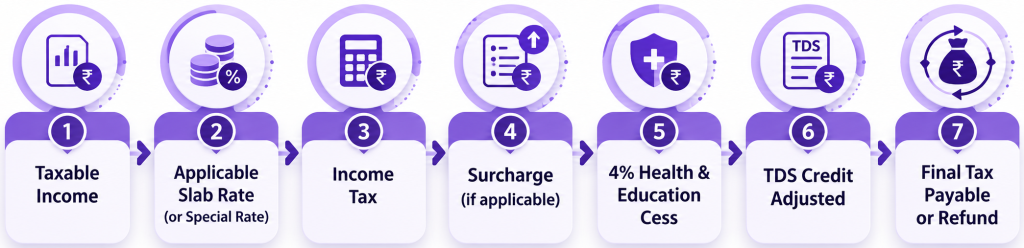
NRI Tax Calculation on ₹10 Lakh Income
Under the new regime, ₹10 lakh falls across the nil, 5% and 10% slabs, working out to roughly ₹52,500 before cess. Add 4% cess and the total comes to approximately ₹54,600. No 87A rebate applies, so this is what an NRI would actually pay unlike a resident with the same income, who would pay nothing.
NRI Tax Calculation on ₹20 Lakh Income
At ₹20 lakh, tax works out to roughly ₹2,90,000 before cess under the new regime, moving through each slab up to the 20% band. With 4% cess added, the figure comes to approximately ₹3,01,600.
NRI Tax Calculation on ₹50 Lakh Income
At ₹50 lakh, tax before cess works out to roughly ₹10,90,000 under the new regime. Since this crosses the ₹50 lakh mark, a surcharge also applies — 10% on the tax amount — bringing the pre-cess figure to around ₹11,99,000, and then 4% cess on top of that.
NRI Tax on Different Types of Income
Not every rupee an NRI earns from India is taxed the same way. Several income types carry their own rates instead of following the ordinary slabs above.
- Tax on NRO Account Interest:- NRO interest is fully taxable and typically taxed at slab rates, but banks deduct TDS upfront at a flat rate, usually 30% plus cess regardless of your actual slab. If you’ve recently moved your account from resident to NRO status, it’s worth revisiting how your KYC and account classification should be updated once your residential status changes, since an outdated classification is a common reason NRO interest gets taxed and reported incorrectly.
- Tax on NRE Account Interest:- Interest earned on an NRE account is generally exempt from Indian tax for as long as you qualify as an NRI, which is one reason NRE accounts remain popular for parking foreign earnings.
- Tax on Fixed Deposit Interest:- FD interest follows the account type NRO FDs are taxable with TDS deducted at source, while NRE FDs are typically tax-exempt. DTAA can bring the TDS rate down on NRO FDs if you submit the right documents to your bank in advance.
- Tax on Rental Income:- Rental income from Indian property is taxable at slab rates after allowing a standard 30% deduction and any home loan interest. The tenant is generally required to deduct TDS before paying rent to an NRI landlord.
- Tax on Salary Income From India:- Salary for services rendered in India, or salary received from an Indian employer, is taxable in India at slab rates, regardless of where you’re currently residing.
- Tax on Dividends:- Dividends from Indian companies are taxable, with TDS typically deducted at 20% (subject to a lower DTAA rate if documentation is submitted), rather than at your slab rate by default.
- Tax on Mutual Funds:- Mutual fund capital gains follow their own special rates depending on whether the fund is equity or debt-oriented and how long you held the units — not the ordinary slab structure above.
- Tax on Capital Gains:- Capital gains whether from property, shares, or mutual funds are taxed under separate short-term/long-term rules with their own rates, and are generally kept outside the ordinary slab calculation.
NRI TDS Rate vs Income Tax Slab Rate
TDS is not necessarily your final tax bill. It’s an upfront collection, and your actual liability is only settled when you file your return.
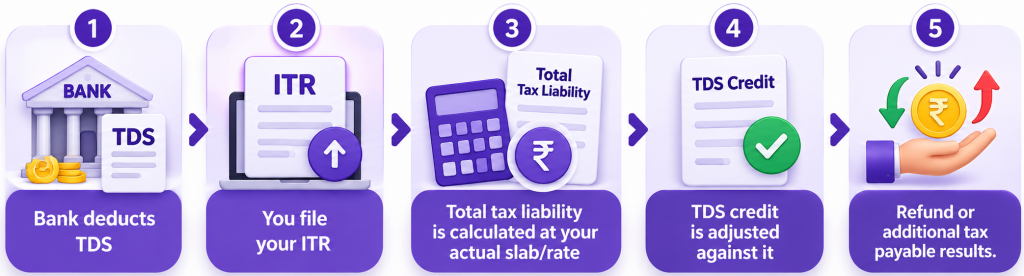
Why Is TDS on NRO Interest High?
Because banks default to a flat rate commonly 30% plus cess on NRO interest regardless of your actual income level, since they have no way of knowing your total taxable income across all sources. If your real tax liability is lower, or a DTAA rate applies, the excess only comes back through your ITR unless you’ve pre-arranged a lower rate with your bank. This entire mismatch, and how to fix it before it happens, is covered in more depth in this breakdown of TDS on NRO fixed deposits for NRIs.
Can an NRI Claim TDS Refund?
Yes. If the TDS deducted across your NRO interest, rent, dividends, or other Indian income exceeds your actual computed tax liability, you can claim the difference back by filing an ITR and reporting the TDS credit against your PAN.
What Happens If TDS Is More Than Actual Tax Liability?
The excess becomes a refund once your return is processed. This is extremely common for NRIs, since TDS on interest and rent is usually deducted at flat, conservative rates that rarely match your real effective tax rate after slabs and any applicable DTAA benefit are factored in.
NRI Capital Gains Tax Rates vs Normal Slab Rates
It’s worth separating these clearly, because capital gains don’t move through the slab table at all. Short-term capital gains on equity are typically taxed at a flat rate, long-term equity gains carry their own flat rate above an exemption threshold, and property or debt-fund gains follow their own separate rules depending on the holding period. None of this is calculated by simply applying your slab rate to the gain. Treating it that way is one of the most common NRI tax-calculation errors. If a property sale or a fund redemption is involved, it’s worth working the numbers through a proper capital gains calculator for property sales rather than assuming your salary-slab rate applies.
Does NRI Senior Citizen Get a Higher Basic Exemption Limit?
No. Resident senior citizens (60+) and super senior citizens (80+) get relaxed basic exemption limits under the old regime ₹3 lakh and ₹5 lakh respectively. NRIs don’t get this benefit at any age; the basic exemption limit for an NRI stays the same regardless of date of birth. This surprises a lot of NRIs who assume their age works the same way it would if they were filing as a resident.
NRI Tax on ₹10 Lakh, ₹20 Lakh & ₹50 Lakh Income
| Annual Taxable Income | New Regime (approx., before surcharge) | Old Regime (approx., before deductions) |
| ₹10 lakh | ₹54,600 | ₹1,17,000 |
| ₹20 lakh | ₹3,01,600 | ₹4,68,000 |
| ₹50 lakh | ₹12,47,000 (incl. 10% surcharge) | ₹13,53,000 |
These figures assume ordinary slab-rate income with no deductions and standard 4% cess applied. Your actual number will shift based on deductions claimed (old regime), surcharge slabs, and whether any part of your income is capital gains or another special-rate category instead of ordinary income.
NRI Tax Calculator — How Much Tax Will You Pay?
To get an accurate figure rather than a rough estimate, you’d typically need to plug in:
- Residential status and financial year
- Chosen tax regime
- Indian salary income
- Rental income
- Interest income (NRO/FD)
- Capital gains
- Other income
- Eligible deductions (old regime)
- TDS already deducted
Not sure which income or rate applies to your specific situation? Get your NRI tax calculation reviewed by a tax professional before you file, especially if your income spans salary, rent, interest and capital gains in the same year.
Do NRIs Have to File an Income Tax Return in India?
Not automatically in every case but far more often than most NRIs assume. Filing generally becomes necessary if your taxable Indian income exceeds the basic exemption limit, if TDS has been deducted and you want to claim a refund, if you’ve earned capital gains that need reporting, or if you want to claim DTAA benefits against tax paid in your country of residence. This is closely tied to your residential status determination for the year, and getting that classification wrong at the bank or KRA level is a common reason NRIs end up filing incorrectly or missing income altogether.

Conclusion
NRI tax slabs mirror resident rates on paper, but the details that actually decide your final bill: no 87A rebate, no senior-citizen relaxation, flat TDS that rarely matches your real liability, and capital gains taxed outside the slab system are where most NRIs go wrong. Get your regime choice, income classification and TDS credit right, and the calculation becomes far more predictable.
Disclaimer
The content published on NriTaxs is intended for informational purposes only and does not constitute legal, tax, or financial advice. Readers are encouraged to consult qualified professionals before making any decisions based on the information provided.










Related Articles