

Receiving a foreign asset disclosure notice from the Income Tax Department can be stressful, especially for NRIs who are unsure whether their overseas bank accounts, investments, or property needed to be disclosed in India. A notice may arise because of mismatches between your ITR, Schedule FA, AIS data, foreign remittances, or information received through CRS/FATCA.
However, receiving a notice does not automatically mean you have incurred a penalty. Your residential status for the relevant financial year, the type of foreign asset, and what was reported in your previous returns all matter. This guide explains why NRIs receive foreign asset notices, how to respond, possible penalties, and how FADS 2026 may help eligible taxpayers address certain past disclosure gaps.
Key Takeaways
- ✔ NRI Status Matters Your residential status for the relevant financial year determines whether foreign assets need to be disclosed in Schedule FA.
- ✔ Don’t Ignore the Notice Verify the notice, understand the reason, gather documents, review your past ITRs and respond within the given deadline.
- ✔ Undisclosed Assets Can Have Consequences Foreign asset non-disclosure can lead to tax, penalties, interest and, in serious cases, prosecution depending on the circumstances.
- ✔ FADS 2026 May Help Eligible Taxpayers Eligible taxpayers can use the 2026 disclosure window to address certain previously undisclosed foreign assets or income, subject to the scheme’s conditions
What Is a Foreign Asset Disclosure Notice?
A foreign asset disclosure notice is a communication from the Income Tax Department asking a taxpayer to explain, confirm, or correct information about assets or income held outside India. It is issued when the department’s records built from bank data, foreign remittance filings, or information shared by other countries don’t match what was reported, or wasn’t reported at all, in your Schedule FA or income tax return. It isn’t automatically a penalty notice; it’s usually the department’s first step to understand the gap before deciding whether further action is needed.
Why NRIs Are Receiving More Foreign Asset Disclosure Notices
- Inconsistent or Incomplete Schedule FA Filing:- Many taxpayers fill Schedule FA partially, report only some accounts, or skip small-balance and dormant foreign accounts entirely, assuming they don’t matter. The department treats any gap as incomplete disclosure, regardless of the account’s size or balance.
- AIS/Form 26AS Mismatches:- Your Annual Information Statement often captures foreign remittances, interest, and dividend data your return doesn’t mention. When the two don’t line up, the system flags the mismatch for review automatically, well before any officer looks at your file.
- High-Value Foreign Remittances:- Large transfers abroad, or large funds coming into India from foreign accounts, get reported to the tax department by banks. A pattern of sizable remittances with no matching asset disclosure is one of the easiest red flags to spot.
- Property Transactions in India:- When an NRI buys or sells property in India, the transaction gets reported through TDS filings and registration records, following the TDS and capital gains rules that apply specifically to NRI property sales. If the funding source traces back to an undisclosed foreign account or asset, it draws attention quickly.
- CRS/FATCA Information Exchange:- India automatically receives financial account information from over 100 countries under global information-sharing agreements. A foreign bank account you never reported in India may already be sitting in the department’s database, waiting to be matched.
- Foreign Tax Credit Claims:- Claiming a foreign tax credit requires disclosing the foreign income that generated it. Some taxpayers claim the credit while leaving the underlying asset or income out of Schedule FA, which creates an internal contradiction the system catches.
Types of Income Tax Notices NRIs Receive
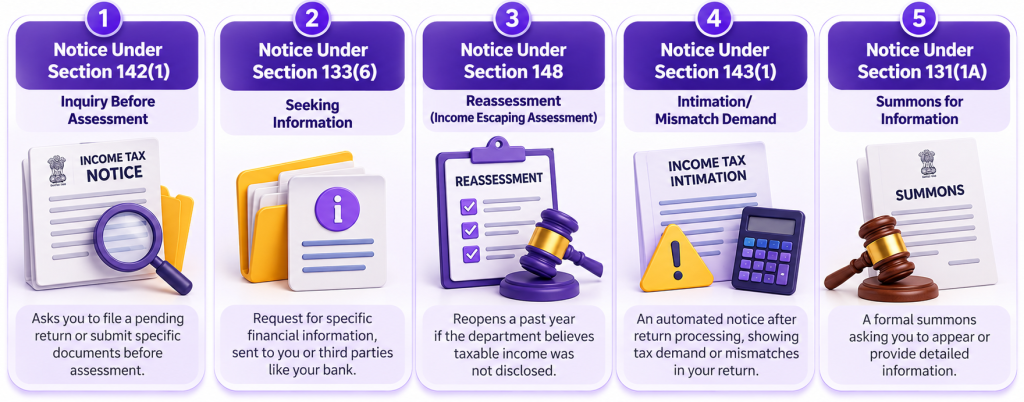
Notice Under Section 142(1) – Inquiry Before Assessment
- What It Is: A preliminary notice asking you to file a pending return or submit specific documents, accounts, or explanations before your assessment is completed.
- Why It Is Issued: Usually issued when a return hasn’t been filed yet, or when the officer needs additional details to proceed with assessment.
- Action Required: Respond within the given deadline with the requested documents or return; ignoring it can lead to a best-judgment assessment against you.
Notice Under Section 133(6) – Seeking Information
- What It Is: A formal request for specific financial information, which can be sent to you directly or to a third party like your bank.
- Why It Is Issued: Typically issued when the department is verifying a transaction, remittance, or foreign holding that appeared in third-party data.
- Action Required: Provide accurate, complete information by the stated deadline; incomplete responses usually trigger a follow-up notice or deeper scrutiny.
Notice Under Section 148 – Reassessment (Income Escaping Assessment)
- What It Is: A notice reopening a past assessment year because the department believes taxable income was not disclosed earlier.
- Why It Is Issued: Commonly linked to undisclosed foreign income or assets discovered through CRS/FATCA data after the original return was filed.
- Action Required: File the requested return for that year and respond with supporting evidence; professional help is strongly advisable at this stage.
Notice Under Section 143(1) – Intimation/Mismatch Demand
- What It Is: An automated intimation generated after your return is processed, flagging arithmetic errors or mismatches with AIS/Form 26AS data.
- Why It Is Issued: Issued routinely after processing, often because reported foreign income or TDS doesn’t match the department’s own records — the same mismatch that sometimes shows up as a delayed or stuck NRI tax refund.
- Action Required: Review the intimation carefully, pay any genuine demand, or file a rectification if the mismatch is due to a departmental error.
Notice Under Section 131(1A) – Summons for Information
- What It Is: A more serious summons, similar to a legal proceeding, compelling you to appear or submit sworn information and documents.
- Why It Is Issued: Generally issued when the department suspects concealment of income or assets, often following unresolved earlier notices.
- Action Required: Take this seriously, engage a tax professional immediately, and comply fully within the given timeframe to avoid further escalation.
Do NRIs Need to Disclose Foreign Assets in India?
In most cases, no, if you currently qualify as a Non-Resident or as RNOR, you are not required to report your foreign assets in Schedule FA of your Indian income tax return, because that obligation applies specifically to taxpayers classified as Resident and Ordinarily Resident. But this answer comes with an important catch: your obligation is decided year by year, and if you were a Resident and Ordinarily Resident in an earlier year when you acquired that asset or earned that income and didn’t disclose it then, that past gap doesn’t disappear just because your status has since changed.
NRI / Non-Resident
An individual who doesn’t meet India’s physical-presence tests for NRI residency in a financial year is classified as Non-Resident. Foreign assets and foreign income generally stay outside India’s reporting net for that year, with only India-sourced income remaining taxable.
RNOR
Resident but Not Ordinarily Resident is a transitional status, often applying to NRIs who’ve recently returned to India. Like a Non-Resident, an RNOR is not required to report foreign assets in Schedule FA for that financial year.
Resident and Ordinarily Resident (ROR)
Once you cross the thresholds for ordinary residency, usually after spending enough years back in India, you become an ROR. At this point, full global income and all foreign assets must be disclosed in Schedule FA.
Why Residential Status Matters
- It decides whether Schedule FA applies to your current year’s return at all.
- It determines whether your global income is taxable or only Indian income.
- Past-year ROR status can still trigger disclosure duties on old assets.
- Returning NRIs often cross into ROR without realising their obligations changed.
- Getting your residential status updated correctly on the income tax portal prevents notices based on outdated records.
What Foreign Assets Can Trigger Disclosure?
| Asset Type | Examples | Reporting Relevance |
| Foreign bank accounts | Savings, current, fixed deposits — even dormant or zero-balance | Must be reported if held any time during the year as ROR |
| Foreign equity/securities | Shares, mutual funds, ETFs, ESOPs, RSUs from foreign employers | Reportable once vested or allotted, regardless of gain |
| Immovable property abroad | Land, house, apartment located outside India | Reportable at cost of acquisition |
| Financial interest in foreign entities | Partnership stakes, company shareholding abroad | Reportable as a beneficial interest |
| Foreign trusts | Trustee, settlor, or beneficiary interest in a trust abroad | Must be disclosed regardless of distributions received |
| Signing authority accounts | Accounts you can operate but don’t own | Must be reported even without ownership |
| Foreign insurance/annuity contracts | Life insurance or annuity policies issued abroad | Reportable under specified asset categories in Schedule FA |
For a fuller breakdown of how each of these categories should actually be filled into your return, the detailed walkthrough in this guide to disclosing foreign assets in your income tax return covers Schedule FA field by field.
What Should an NRI Do After Receiving a Foreign Asset Notice?
Step 1: Verify the Notice. Confirm it’s genuinely from the Income Tax Department through the official e-filing portal, not a phishing attempt. Check the Document Identification Number (DIN) against your portal account before responding to anything.
Step 2: Understand the Reason. Read the notice fully to identify exactly which section it’s issued under and what specific discrepancy or information it’s asking about, rather than guessing or assuming the worst.
Step 3: Gather All Relevant Documents. Collect bank statements, investment records, property deeds, remittance proofs, and prior ITRs covering the years in question, so your response is backed by evidence rather than explanations alone.
Step 4: Determine Your Residential Status. Work out your residential status for each relevant financial year, since your disclosure obligation and tax liability both hinge entirely on whether you were NR, RNOR, or ROR that year.
Step 5: Review Your Schedule FA Filing. Go back through your filed returns to see whether the flagged asset was actually reported, partially reported, or missed entirely, so you know exactly what you’re responding to.
Step 6: Prepare Your Response. Draft a clear, factual response addressing the specific query, supported by your documents. Avoid vague statements, and don’t volunteer unrelated information beyond what’s actually asked.
Step 7: File Your Response. Submit your response through the e-filing portal within the stated deadline. If the matter is complex or involves multiple years, get a qualified tax professional to review it before submission.
What Are the Penalties for Undisclosed Foreign Assets?
Penalties Under the Black Money Law
The Black Money (Undisclosed Foreign Income and Assets) Act imposes a flat penalty of ₹10 lakh per assessment year for failing to disclose a foreign asset or account in Schedule FA, regardless of its actual value or balance.
Penalties for Incorrect or Incomplete Reporting
Partial disclosure reporting some accounts but not others, or understating values is treated the same as non-disclosure under the law. Even genuine oversights can attract scrutiny unless you can show the omission was unintentional.
Tax, Interest, Penalty & Prosecution
Undisclosed foreign income is taxed at a flat 30%, with no exemptions or deductions allowed against it, notably higher than the regular NRI tax slab rates that would otherwise apply. Interest accrues on unpaid tax, and wilful evasion can additionally lead to prosecution and imprisonment under the Act.

Foreign Assets of Small Taxpayers Disclosure Scheme (FADS) 2026
FADS 2026, introduced through the Finance Act 2026 and notified by the CBDT, is a one-time window letting eligible taxpayers voluntarily declare foreign assets or income they missed reporting earlier, by paying a specified tax or fee, instead of facing the full Black Money Act penalty.
Who Can Use FADS 2026?
Taxpayers who were resident in India in the year the undisclosed asset was acquired or the income arose, including those who are now NRIs or RNOR, can use this scheme.
Can NRIs or RNORs Qualify?
Yes. Even if you’re currently an NRI or RNOR, you qualify if you were resident when the asset was acquired or the undisclosed income originally arose.
What Assets/Income Can Be Declared?
Undisclosed foreign bank accounts, shares, property, and foreign income never offered to tax, as well as assets bought from already-taxed Indian income but never reported in Schedule FA.
FADS 2026 Timeline
The declaration window runs from 16 August 2026 to 31 December 2026, with 31 March 2026 fixed as the valuation date for computing asset value.
How Much Tax/Fee Is Payable?
Fully undisclosed assets or income up to ₹1 crore attract 30% tax plus an equal additional amount; assets up to ₹5 crore bought from already-taxed income attract a flat ₹1 lakh fee.
What Happens After the Declaration?
A valid declaration under FADS 2026 grants immunity from Black Money Act penalties and prosecution for the specific assets and income declared within the scheme.
If your situation involves foreign shares or ESOPs specifically rather than bank accounts or property, it’s worth reading how capital gains on shares are taxed for NRIs alongside your FADS 2026 declaration, since the two filings need to stay consistent with each other.
How to Avoid Foreign Asset Disclosure Notices
- File the Correct ITR Form: Using a return form that doesn’t support Schedule FA, or one that doesn’t match your actual residential status, is one of the most common and avoidable triggers for a notice.
- File Schedule FA Correctly: Report every account and asset held at any point in the year, including dormant or zero-balance accounts, rather than only the ones that earned income.
- Maintain Proper Documentation: Keep acquisition records, valuations, and statements for every foreign asset organised and easily accessible, so you can respond to any query without scrambling.
- Respond Promptly to Bank Communications: Banks regularly ask NRIs to confirm FATCA/CRS declarations and residential status; ignoring these requests often leads directly to mismatched data later.
- File ITR on Time: Late or missed filings delay your Schedule FA disclosure too, and a pattern of delayed filing tends to draw more scrutiny over time.
- Claim DTAA Benefits Correctly: When claiming a foreign tax credit or treaty benefit, make sure the underlying foreign income and asset are also fully disclosed in the same return.
- Understand Your Residential Status: Recalculate your residential status every year rather than assuming it carries over, especially around the years you move abroad or return to India.
- Seek Professional Help: If you’ve recently changed countries, sold property, or received a large remittance, a quick professional review before filing catches gaps a notice would otherwise catch later.
Conclusion
A foreign asset disclosure notice feels alarming, but it’s almost always a data-matching exercise rather than an accusation and it’s entirely manageable once you understand what triggered it and respond with the right documentation. With CRS/FATCA data-sharing now routine and FADS 2026 offering a genuine one-time window to fix old gaps before 31 December 2026, this is the right year to get your Schedule FA history in order rather than wait for a notice to force the issue. If you’ve received a notice, or you’re unsure whether an old foreign account or asset needs to be declared, NRITaxs can review your specific filing history and residential status to help you respond correctly and close the matter without unnecessary penalty exposure.
Disclaimer
The content published on NriTaxs is intended for informational purposes only and does not constitute legal, tax, or financial advice. Readers are encouraged to consult qualified professionals before making any decisions based on the information provided.








Related Articles