
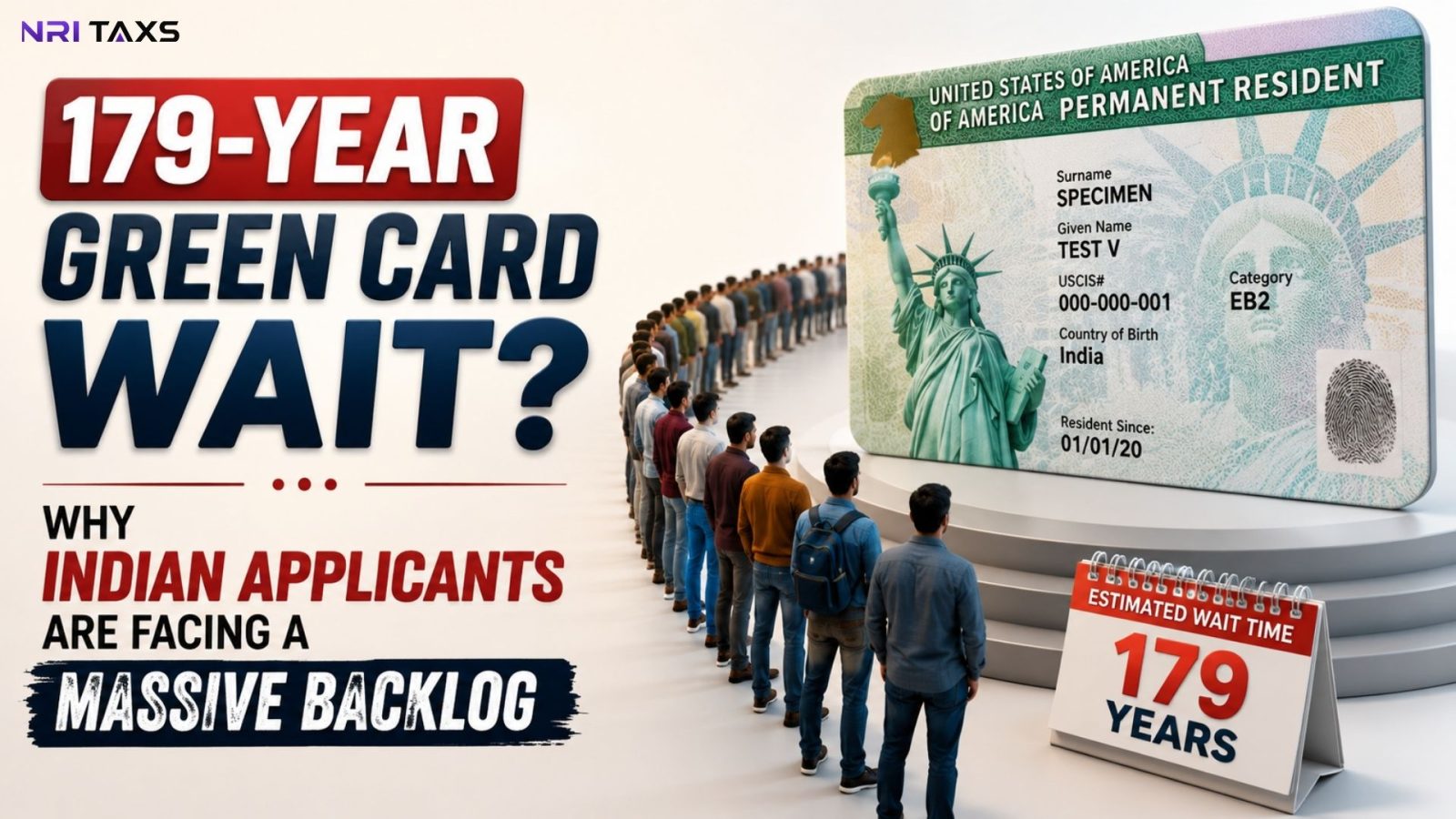
Indian professionals looking for U.S. Residency are facing an unprecedented backlog according to a new analysis by the National Foundation for American Policy (NFAP). The analysis estimates that some Indian professionals entering the EB-2 queue in 2026 could face a wait of up to 179 years. One million Indian professionals are already stuck across the major employment‑based Green Card categories.
This estimate has drawn attention to the long‑running Green Card backlog that affects Indian professionals in the United States. According to the analysis, Indian professionals account for 79% of the estimated backlog, across EB‑1, EB‑2 and EB‑3 even though the U.S. Employment‑based immigration system operates under annual and country‑specific limits.
Key Takeaways
- ✔ Nearly 1 million Indians are estimated to be waiting across EB-1, EB-2, and EB-3 Green Card categories.
- ✔ EB-2 India has the largest backlog, with an estimated 731,566 people waiting as of December 2025.
- ✔ NFAP estimates a potential 179-year EB-2 wait for some Indian applicants entering the queue in 2026 under current conditions.
- ✔ The September 2026 Visa Bulletin shows EB-2 India as unavailable, while EB-3 India has a January 1, 2014 Final Action Date.
- ✔ The 179-year figure is a projection, not a guaranteed wait time, and future immigration-law or visa-limit changes could significantly alter the timeline.
Nearly 1 Million Indians Are Stuck in the Green Card Backlog
NFAP estimates that 996,599 Indian professionals and their dependents were waiting in the first three employment-based Green Card categories as of December 2025.
The estimated Indian backlog was:
| Green Card Category | Indian Backlog |
| EB-1 | 51,619 |
| EB-2 | 731,566 |
| EB-3 | 213,414 |
| Total | 996,599 |
The overall backlog across EB-1, EB-2 and EB-3 was estimated at 1,264,495 people, putting India’s share at roughly 79%.
The biggest concentration is in EB-2, which alone accounts for more than 731,000 Indians in the estimated backlog. EB-3 adds another 213,414, while the EB-1 backlog was comparatively smaller.
Why Is the Green Card Wait So Long for Indians?
The main problem is the combination of high demand and country-based limits.
The U.S. employment-based immigration system has an annual numerical limit, while immigration law also applies a per-country limit. The September 2026 Visa Bulletin states that the FY2026 worldwide employment-based preference level is 186,317, with the statutory per-country limit set at 7% of the combined family-sponsored and employment-based preference limits. India is one of the countries currently subject to these oversubscription rules.
Because the number of Indian applicants is much larger than the number of visas available under the country allocation system, eligible applicants can remain in the queue for years or even decades.
EB-2 India Could See a Potential 179-Year Wait
The most striking figure in the NFAP analysis concerns EB-2 India.
According to the report, an Indian national whose labor certification application or employment-based immigrant petition was filed in January 2026 or later could potentially face:
| Category | Potential Wait |
| EB-1 India | About 5 years |
| EB-2 India | Up to 179 years |
| EB-3 India | About 38 years |
These figures are projections based on current backlog and visa availability. There are no official guarantees that an individual applicant will literally wait the stated number of years. Future visa availability, changes in demand, applicants leaving the queue and changes in U.S. immigration law could materially alter the timeline.
EB-2 Has Become the Biggest Problem for Indian Applicants
EB-2 usually includes professionals who have degrees or people who have special skills. This category has the waiting list from India.
NFAP says that the number of people waiting in the EB-2 category reached 731,566 by the end of 2025. The EB-3 waiting list was 213,414. The EB-1 waiting list was about 51,619.
The waiting list has kept getting longer during times when the United States made more employment-based Green Cards available.
From FY2020 to FY2024 NFAP found that around 980,460 employment-based Green Cards were given out. That is more than the five-year amount of, about 700,000. This created 280,000 extra employment-based numbers. Still the waiting list got bigger.
India’s Green Card Backlog Has Grown Despite Additional Visas
NFAP estimates that the total EB-1, EB-2 and EB-3 backlog increased from 1,048,342 in April 2020 to 1,264,495 in December 2025, representing a 20.6% increase.
For India specifically, the estimated backlog increased by 161,344 people, or 19.3%, during that period.
However, the categories did not all move in the same direction. The Indian EB-2 backlog increased by about 17.6%, while EB-3 rose by more than 50% according to the reported NFAP estimates. The EB-1 backlog, meanwhile, declined.
September 2026 Visa Bulletin Shows How Far Behind India Is
The latest U.S. Department of State Visa Bulletin provides another snapshot of the situation.
For September 2026, India’s employment-based Final Action Dates are:
| Category | India Final Action Date |
| EB-1 | October 15, 2022 |
| EB-2 | Unavailable |
| EB-3 | January 1, 2014 |
| EB-5 Unreserved | Unavailable |
The State Department has also warned that high demand could cause EB-1 India to become unavailable before the end of FY2026, while EB-2 could face further retrogression or become unavailable depending on visa usage.
The department had previously confirmed that all available FY2026 EB-2 visas for India had been used, with the annual limits scheduled to reset when FY2027 begins on October 1, 2026.
How Does India Compare With China?
The backlog is especially severe for people from India when compared with other countries.
NFAP says that a new Indian applicant might have to wait up to 179 years for an EB-2 visa and 38 years for an EB-3 visa while Chinese applicants might have to wait about 25 years for an EB-2 visa and seven years for an EB-3 visa. The wait times for EB-1 visas were similar for applicants and Chinese applicants.
This difference shows how the system that gives visas based on country affects people from countries where there is a high demand, for employment-based immigration.
The Problem Has Been Building for More Than a Decade
The current backlog did not emerge overnight.
NFAP’s analysis points to FY2016 as an example of how quickly the queue could grow. USCIS approved 47,601 EB-2 applications for Indians that year. After accounting for dependents, NFAP estimated that this represented around 98,594 people, while only 4,407 Indians received permanent residence through EB-2 that year.
That gap between the number entering the system and the number receiving Green Cards helped add thousands of people to an already growing queue.
What Does the 179-Year Estimate Actually Mean?
The 179-year figure needs to be understood carefully.
It does not mean every Indian person who applies for a Green Card today will wait 179 years.
The NFAP estimate applies to a skilled Indian national whose labor certification application or employment-based immigrant petition was filed in January 2026 or later under the conditions used in the analysis. It is a prediction based on visa limits, backlog levels and demand.
A change in the U.S. Immigration law, visa limits, country caps or future demand could make the actual waiting period very different.
Contact Us
What Happens Next for Indian Green Card Applicants?
For now, the biggest developments to watch are:
- The October 2026 Visa Bulletin and the start of FY2027
- Whether EB-2 India becomes available again
- Movement in the EB-1 and EB-3 India Final Action Dates
- Any Congressional changes to employment-based Green Card limits
- Any changes to per-country immigration limits
- Future updates to the Indian Green Card backlog
The September Visa Bulletin itself notes that employment-based categories can move forward, retrogress or become unavailable depending on demand and annual visa limits.
Bottom Line
The latest NFAP analysis shows just how big the Green Card backlog is for professionals. By the end of 2025 996,599 Indian applicants and their dependents were waiting in the EB-1, EB-2 and EB-3 categories. This number includes people who are trying to get residency in the United States.
For those who enter the queue in 2026 the wait times could be extremely long. According to NFAP estimates, someone applying under EB-2 might have to wait up to 179 years. For EB-3 the wait could stretch to 38 years. Even EB-1, which usually moves faster, could take around five years. These numbers are projections. They don’t mean every person will face that exact wait time.. The backlog itself is real and growing.
India makes up 79% of the total backlog in these categories. That means a huge number of professionals are affected. This situation has become one of the challenges for anyone, from India hoping to settle permanently in the United States. The long waits create uncertainty. Affect career plans, family decisions and life choices. It’s not a number that impacts real lives.
Disclaimer
The content published on NriTaxs is intended for informational purposes only and does not constitute legal, tax, or financial advice. Readers are encouraged to consult qualified professionals before making any decisions based on the information provided.









Related Articles