

Buying property from an NRI? A new TDS reporting change is coming into effect from 1 October 2026 that property buyers need to understand before completing the transaction. From this date, the resident individual or HUF buyer can report and deposit TDS through PAN-based Form 141 Schedule E. The new form captures the property, all parties, sale value, capital-gain category, applicable rate and certificate details. This change is designed to make NRI property TDS reporting more structured and PAN-based. Here’s what buyers and NRI property sellers need to know about the new Form 141 requirements.
What Are the New Property TDS Rules for Buying Property from an NRI?
From 1 October 2026, new TDS reporting provisions will apply when a resident individual or Hindu Undivided Family (HUF) purchases immovable property from a non-resident. CBDT Notification No. 121/2026, dated 22 September 2026, introduces a PAN-based reporting mechanism through Form 141 Schedule E for depositing and reporting TDS under Section 393(2), Table serial number 17.
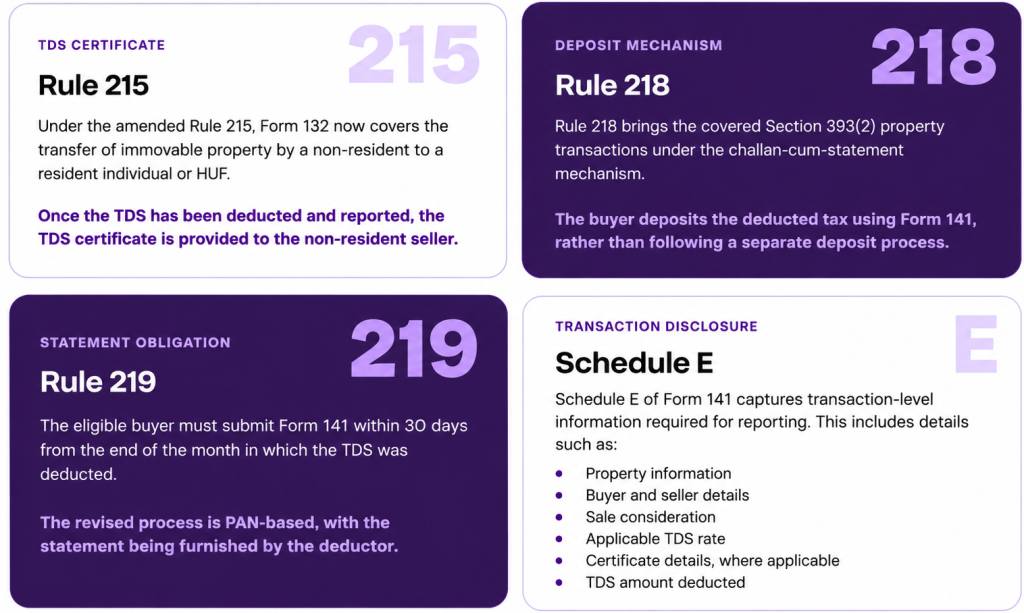
Under the new process, eligible resident individual and HUF buyers will no longer need to complete a separate TAN registration for this covered transaction. Instead, the TDS payment and reporting will be handled through a single challan-cum-statement using the buyer’s PAN.
Importantly, this change does not mean that NRI property purchases will be subject to the 1% TDS rate applicable to certain resident-property transactions. The buyer must continue to determine the applicable rate for payments to a non-resident, including surcharge and cess wherever applicable. A valid certificate under Section 395 may also affect the withholding requirement.
What Has Changed Under the New CBDT Rules?
The Income-tax (Fifth Amendment) Rules, 2026 introduce changes to Rules 215, 218 and 219 and revise Forms 132 and 141 in Appendix III. These changes put into practice the specific TDS procedure for a resident individual or HUF purchasing immovable property from a non-resident.
Who Is Eligible to Use Form 141 Schedule E?
The new Form 141 Schedule E route is not available to every buyer or every NRI property transaction. It is meant for a specific combination of buyer, seller and property type.
Buyer: Resident Individual or HUF
The buyer must be a resident individual or Hindu Undivided Family (HUF) covered under the special Section 393(2) route for purchasing immovable property from a non-resident.
Seller: Non-Resident Property Owner
The seller must be a non-resident for income-tax purposes and must be transferring qualifying immovable property, such as land, a building, part of a building, or both.
Residential Status Matters
Terms such as NRI, foreign citizen, overseas resident and non-resident are often used interchangeably, but for TDS purposes, the seller’s residential status under income-tax law for the relevant period is important.
Simply holding a foreign passport, living outside India, having an overseas address or maintaining an NRE account does not, by itself, determine the applicable TDS route.
Key Eligibility Checks
- Covered Buyer
A resident individual or HUF purchasing the property and responsible for deducting the applicable TDS. - Covered Property
Land other than agricultural land, a building, part of a building, or both. - Company or LLP as Buyer
Companies and LLPs should not automatically assume that the PAN-based concession applies to them. Their applicable TAN and TDS statement requirements should be reviewed separately. - If the Seller Is a Resident
The NRI-property withholding route does not apply. The buyer should instead follow the applicable TDS provisions for property purchased from a resident, including the relevant Form 141 requirements.
What Changes From 1 October 2026?
| Compliance area | How it worked earlier | What applies from 1 October 2026 |
|---|---|---|
| Eligible buyer | The provision applied to a resident individual or HUF purchasing qualifying property from a non-resident. | The same resident individual or HUF and non-resident seller combination remains relevant. |
| Buyer identification | The buyer generally followed the TAN-based compliance process applicable to the transaction. | Eligible buyers can use the new PAN-based challan-cum-statement mechanism. |
| TDS reporting | Reporting was handled through the applicable non-resident TDS compliance framework. | Form 141 with Schedule E is used for the covered transaction. |
| Tax payment & filing | Tax payment and reporting followed the earlier deductor compliance process. | Payment and reporting are brought together through a single challan-cum-statement route. |
| Filing timeline | The applicable timelines under the earlier TDS framework governed the transaction. | Form 141 must be furnished within 30 days from the end of the month in which TDS was deducted. |
| TDS certificate | The certificate was issued according to the earlier applicable framework. | Form 132 is used for the covered transaction, subject to the applicable provisions. |
| TDS rate | The buyer had to consider the applicable non-resident rate, along with surcharge, cess and any relevant certificate. | The underlying rate assessment does not disappear; the buyer must still determine the applicable non-resident withholding rate, surcharge, cess and certificate position. |
What Information Is Required in Form 141 Schedule E for NRI Property TDS?
Form 141 Schedule E requires more than just the TDS amount. The new schedule collects property, buyer, non-resident seller and payment-level information so that the complete transaction can be reported in one place. Before filing, the buyer should keep the following details ready.
1. Property Details
The form requires the address of the property and its type. The property category can include:
- Land other than agricultural land
- Building or part of a building
- Both land and building
2. Details of All Buyers
Details of all buyers have to be provided, including:
- PAN
- Name
- Each buyer’s proportion of the total sale consideration
The buyer proportions reported in the form should add up to 100%.
3. Non-Resident Seller Details
For each non-resident seller/deductee, Schedule E captures details such as:
- PAN, if available
- Name
- Status
- Contact number
- Email ID
- Address in the country or specified territory where the seller is resident
- Tax Residency Certificate (TRC) number
- Tax Identification Number (TIN)
- Seller’s proportion of the total sale consideration
These details make the seller-level reporting considerably more detailed than simply providing a PAN and name.
4. Agreement and Registration Details
The buyer also needs to report:
- Date of agreement
- Date of registration, if available
- Total stamp duty value of the property
- Total sale consideration
This helps connect the TDS filing with the underlying property transaction.
5. Lump-Sum or Instalment Payment
Schedule E asks whether the consideration is being paid as a lump sum or in instalments.
If the payment is in instalments, the form captures whether it is the:
- First instalment
- Subsequent instalment
- Last instalment
For subsequent or last instalments, the previous acknowledgement number may also need to be provided. For the last instalment, the form also asks for the total consideration paid or credited, including the current instalment.
6. Seller-Wise TDS Information
For each seller, the transaction details can include:
- PAN and name of the seller
- Applicable capital-gains category
- Proportionate stamp-duty value
- Previous instalments paid or credited
- Current payment
- Date of payment or credit
- Amount on which TDS is calculated
- Applicable TDS rate
- Certificate number under Section 395(1), where applicable
- Certificate number under Section 395(2), where applicable
- TDS amount deducted
- Date of deduction
- Unique acknowledgement number of the corresponding Form 145, where applicable
So, the Schedule E filing needs to be prepared seller-wise and payment-wise, rather than treating the entire property transaction as one undifferentiated TDS amount.
TDS rate on purchase of property from an NRI
1%
The calculation may require consideration of the type of capital gain, applicable tax rate, surcharge and health & education cess, along with any valid lower or nil deduction certificate under Section 395. Schedule E of Form 141 also requires the buyer to report the capital-gain category, TDS rate and relevant certificate details.
| What should the buyer check? | Why it matters | Records / documents to review |
|---|---|---|
| Is the seller a non-resident? | Determines whether the transaction falls under the non-resident TDS framework | Residential-status details and supporting records |
| What type of capital gain applies? | Schedule E requires the seller-wise capital-gain category to be reported | Purchase deed, acquisition details and transfer documents |
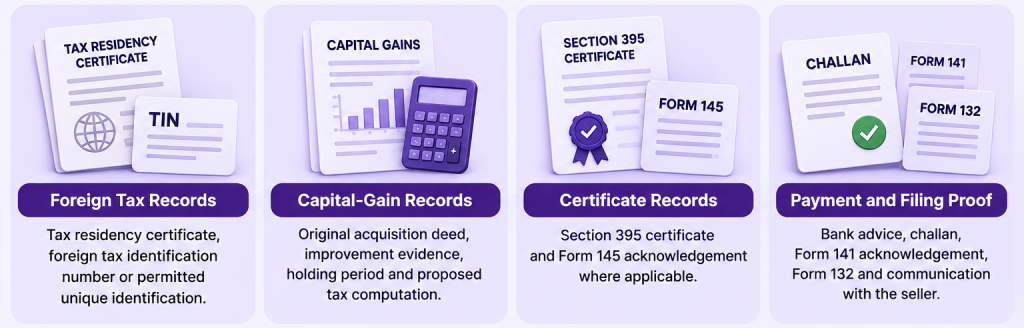
| Is a lower/nil deduction certificate available? | A valid Section 395 certificate can affect the amount that needs to be deducted | Relevant Section 395 certificate |
| Does the seller have PAN and foreign tax details? | PAN and prescribed foreign-residency details are relevant to identification and applicable withholding compliance | PAN, TRC and foreign TIN, where applicable |
| Do surcharge and cess apply? | They may increase the final TDS amount | Seller status, applicable rate and TDS computation |
| Is Form 141 Schedule E applicable? | From 1 October 2026, covered resident individual/HUF buyers report the transaction through this route | Form 141 + Schedule E |
Does an NRI Seller Need a Lower TDS Certificate?
A lower or nil TDS certificate is not compulsory in every NRI property sale. However, the NRI seller may apply for a certificate under Section 395 if the tax deductible on the transaction is expected to be lower than the amount that would otherwise be withheld.
This can be useful where the seller has a relatively low taxable capital gain, expects significant eligible deductions, or the applicable tax liability is lower than the standard withholding amount. If a valid certificate is issued, the buyer should deduct TDS according to the rate or amount specified in that certificate.
For Form 141 Schedule E: the buyer must report the relevant Section 395 certificate details, where a certificate has been obtained.
Form 141 Due Date & Form 132 Timeline
For a qualifying NRI property transaction covered by the new Schedule E route, the buyer must pay the deducted TDS and furnish Form 141 within 30 days from the end of the month in which the deduction is made. The same 30-day window applies to the challan-cum-statement under Rule 219.
Example 1 — TDS deducted on 5 October 2026
- Month of deduction: October 2026
- Month-end: 31 October 2026
- Form 141 due date: 30 November 2026
Example 2 — TDS deducted on 28 November 2026
- Month of deduction: November 2026
- Month-end: 30 November 2026
- Form 141 due date: 30 December 2026
Form 132 — TDS Certificate
After Form 141 becomes due, the buyer must generate and furnish Form 132 to the NRI seller within 15 days from the due date of Form 141. For example, if Form 141 is due on 30 November, Form 132 would be due by 15 December.
Keep Proof of Compliance
Keep copies of the filed Form 141, payment/challan details, Form 132 and supporting transaction records. This makes it easier to reconcile the TDS reported to the seller’s tax records.
Watch Every Instalment
If the purchase price is paid in instalments, each payment or credit needs to be checked for the TDS obligation. Don’t assume that compliance starts only when the sale deed is registered. Schedule E specifically captures instalment-wise payment information, including previous and current payments.

How to Complete TDS Compliance When Buying Property from a Non-Resident
1.Confirm the Seller’s Residential Status:- Before making any payment, verify that the seller qualifies as a non-resident for income-tax purposes. Keep the relevant residential-status details and supporting documents on record.
2.Determine the Applicable TDS Rate:- Do not automatically apply the 1% resident-seller property rate. For a covered purchase from a non-resident, determine the applicable rate under Section 393(2), Table Sl. No. 17, considering the transaction facts and any valid certificate under Section 395.
3.Deduct TDS When the Payment or Credit Becomes Liable:- Check each advance, instalment or other payment to determine when TDS becomes deductible. If the transaction involves instalments, maintain a payment-wise record because Schedule E requires details of previous and current payments.
4.Pay TDS and File Form 141:- For covered transactions from 1 October 2026, the resident individual/HUF can use Form 141 with Schedule E for the TDS payment and reporting. The tax and Form 141 are due within 30 days from the end of the month in which TDS was deducted.
5.Issue Form 132 and Keep the Records:- After filing Form 141, provide the prescribed Form 132 TDS certificate to the seller within the applicable timeline. Keep the Form 141 acknowledgement, payment proof, Form 132, sale documents, payment records and any Section 395 certificate safely for future reconciliation.
Documents required for NRI property TDS compliance

What Happens If the Buyer Uses the Wrong TDS Route?
- Incorrect TDS May Be Reported:- Using the resident-seller route for an NRI transaction can result in the wrong section, rate and transaction details being reported.
- Short Deduction Can Create a Tax Liability:- If the amount deducted is lower than the applicable TDS, the buyer may need to address the resulting tax shortfall and applicable consequences.
- Filing Details May Need Correction:- An incorrect Form 141 entry or transaction classification may require correction so that the TDS record matches the actual property transaction.
- Compliance Documents Can Become Inconsistent:- Wrong TDS reporting can create differences between the payment records, Form 141, TDS certificate and information maintained for the NRI seller.
Conclusion
For an NRI property purchase, the buyer should first confirm the seller’s residential status and applicable TDS provision before deducting tax. Form 141 does not have one fixed TDS rate; the applicable rate depends on the relevant payment and applicable provisions.
Disclaimer
The content published on NriTaxs is intended for informational purposes only and does not constitute legal, tax, or financial advice. Readers are encouraged to consult qualified professionals before making any decisions based on the information provided.






Related Articles