

NRI Selling a property in India while living abroad isn’t just about finding a buyer and completing registration. The moment the seller is an NRI, the transaction enters a completely different TDS and capital-gains framework than the one your resident neighbour or relative would go through. The buyer suddenly has to deduct tax at rates far higher than the familiar 1%, that deduction often lands on your entire sale price instead of your actual profit, and the money doesn’t leave India until a chain of compliance steps is closed out.
This guide walks through exactly how much TDS can be deducted, how your capital gain is actually calculated, how to legally bring that TDS down before the sale closes, how to claim back whatever was deducted in excess, and how to move your proceeds abroad once the paperwork is done.
Key Takeaways
- ✔ NRI property sales are subject to TDS under Section 195, and the buyer is generally responsible for deducting and depositing the tax.
- ✔ TDS and capital gains tax are not the same. TDS may be deducted on the sale consideration, while your final tax liability is calculated on the actual capital gain.
- ✔ NRIs can apply for a lower or nil TDS certificate before the sale to avoid excessive TDS being deducted from the property sale proceeds.
- ✔ From October 1, 2026, eligible resident individual and HUF buyers can use PAN instead of TAN for the specified NRI property TDS process, while the underlying TDS obligation remains.
- ✔ Excess TDS can generally be claimed back through the NRI’s ITR, while proper documentation, TDS reconciliation, tax compliance, and repatriation planning are essential before moving the sale proceeds abroad.
What Happens When an NRI Selling a property in India?
Basically an NRI property sale follows a set path. First you must confirm your NRI status, next the buyer figures out the TDS amount. Take that money out at the right rate, then your real capital gain is calculated on its own. After the registration is done you have to check the TDS against your tax bill when you file your tax return. If you paid much TDS you will get a refund. Once that is settled you can send the remaining money abroad.
The thing that confuses sellers is that these are two different numbers. The TDS the buyer takes at the time of sale is not the same as the capital-gains tax you owe. These two numbers are almost never the same. If you can understand the gap, between the TDS and the capital-gains tax you can save a lot of money during this process.
Is TDS Deducted When an NRI Selling a property in India?
Yes.. The obligation sits with the buyer not with you. Under Section 195 of the Income-tax Act any resident buyer who buys property from a non-resident seller must deduct TDS before paying and must deposit TDS with the government.
This is a different regime from a resident‑to‑resident sale. In that case the buyer only deducts a 1% under Section 194‑IA and only if the property value exceeds ₹50 lakh. That ₹50 lakh threshold does not apply to you. When the seller is an NRI, TDS under Section 195 kicks, in regardless of the sale value. A flat worth ₹25 lakh triggers TDS.
This is one of the common misconceptions that NRIs carry into a sale often because a broker or even the buyer thinks that resident rules apply.
TDS Rates on NRI Property Sale in 2026
| Property Holding Period | Capital Gain Type | Effective TDS/Tax Rate |
| More than 24 months | Long-term | 12.5% + applicable surcharge and 4% cess |
| 24 months or less | Short-term | Slab rate applicable to the seller, plus surcharge and cess |
For long-term gains property held over 24 months current Income Tax Department guidance sets the rate at 12.5% for transfers on or after July 23, 2024, without the benefit of indexation. Add surcharge (where applicable) and 4% cess, and the effective rate typically works out to somewhere between roughly 13% and 15%. Short-term gains are added to your other Indian income and taxed at the applicable rate for your income level, which can run as high as 30% plus surcharge and cess.
Don’t stop at “TDS is 12.5%.” Surcharge alone can add several percentage points depending on your total income, and if there’s any ambiguity about your residential status or the nature of the gain, this is exactly the kind of detail worth getting checked before the sale closes rather than after.
Is TDS Deducted on the Full Sale Value or Only the Capital Gain?
This is the shock I see most NRI sellers face and I want to be very honest with you: capital-gains tax and TDS deduction are not the same thing.
Let us look at an example. Say you sell a property for ₹1 crore and your original purchase cost was ₹60 lakh. Your actual capital gain is ₹40 lakh. Your real tax liability is 12.5% of that ₹40 lakh, which is about ₹5 lakh plus cess.. By default Section 195 does not ask the buyer to figure out your profit. Instead Section 195 requires TDS on the sale price unless you have made other arrangements. This means the buyer could deduct 13–15% of the full ₹1 crore, which is ₹13–15 lakh instead of the ₹5 lakh you actually owe. That extra money sits locked up with the tax department until you file your return and ask for it back.
The good news is that there is a legal way to stop this from happening before it starts. This is the important step, in the whole process: you should apply for a lower or nil TDS deduction certificate before you sell the property.
How to Reduce TDS on NRI Property Sale
Apply for a Lower TDS / Nil TDS Certificate (Form 13)
If you want to save money on taxes you can use Section 197 to help you. You should apply to the Income Tax Department before you register the sale. This allows you to get a certificate so the buyer can deduct TDS based on your estimated capital gain instead of the whole sale price. You need to file this application using Form 13 on the income tax efiling portal. When you fill out Form 13 you must list your estimated sale price, what you originally paid for the property, any costs for improvements and how tax you think you will actually owe. You also need to provide proof like your purchase deed and old TDS certificates.
After the assessing officer looks at your application they will give you a certificate. This certificate tells the buyer what lower rate or zero rate they should use for the TDS. You just give this certificate to the buyer. Then the buyer will deduct TDS at that rate instead of the usual high rate on the full price. This one step is the difference between NRIs who lose 13–15% of their sale price to taxes held for months and NRIs who only pay what they actually owe. The process does not happen instantly. I suggest you start the application soon as you find a buyer. Do not wait until the sale deed is ready to sign.
New NRI Property Sale TAN Rule From October 1, 2026
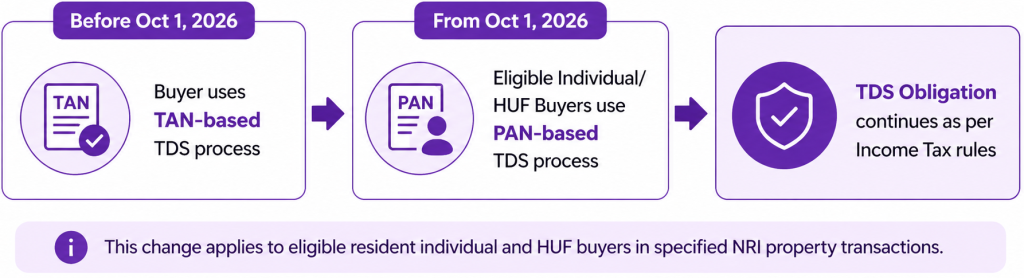
A meaningful compliance change is arriving this year, and it’s worth flagging clearly because of how many buyers still don’t know about it.
Before October 1, 2026: a resident buyer purchasing property from an NRI must first obtain a Tax Deduction and Collection Account Number (TAN), deduct TDS, deposit it under that TAN, and file a quarterly TDS return (Form 27Q). Many buyers find this step unfamiliar and time-consuming, and it has genuinely caused deals to stall or fall through.
From October 1, 2026: Budget 2026 removes the TAN requirement for resident individual and HUF buyers. They can instead deduct and deposit TDS using their own PAN through a challan-based system, similar to the process already used in resident-to-resident sales. This is a procedural simplification only — it does not change the TDS rates, the holding-period rules, or your right to apply for a lower deduction certificate. Buyers that are companies or firms will still need a TAN. If your sale is closing around this date, it’s worth confirming with your buyer and your CA which process applies, since the effective date is specific and the rules on either side of it are different.
How Is Capital Gains Tax Calculated for an NRI Selling Property?
The underlying formula is straightforward:
Sale Consideration − Cost of Acquisition − Eligible Transfer Expenses = Capital Gain
Short-Term Capital Gain
If you held the property for 24 months or less, the gain is short-term. It gets added to your total Indian income for the year and taxed at the slab rate applicable to you.
Long-Term Capital Gain
If you held the property for more than 24 months, the gain is long-term and taxed at a flat 12.5%, without indexation, plus applicable surcharge and cess, for transfers on or after July 23, 2024.
NRI Property Sale Capital Gains Tax Example
Example 1 — Long-Term Property
Rohan, an NRI based in the UAE, bought an apartment in Pune for ₹50 lakh eight years ago. He now sells it for ₹1.2 crore and spends ₹3 lakh on brokerage and transfer-related expenses.
Capital gain = ₹1.2 crore − ₹50 lakh − ₹3 lakh = ₹67 lakh. As a long-term gain, this is taxed at 12.5%, working out to roughly ₹8.4 lakh before cess and any applicable surcharge. Without a lower-deduction certificate, the buyer would by default withhold TDS on the full ₹1.2 crore sale value — closer to ₹16–18 lakh — leaving Rohan to claim back the difference through his ITR.
Example 2 — Short-Term Property
Meera, an NRI in the UK, bought a flat in Bengaluru 18 months ago for ₹70 lakh and sells it now for ₹90 lakh.
Since she held it for under 24 months, her ₹20 lakh gain is short-term and gets added to her other Indian income, taxed at her applicable slab rate rather than the flat long-term rate. TDS at the applicable short-term rate would again apply on the sale consideration by default, unless she’s obtained a lower-deduction certificate reflecting her true expected liability.
Is Indexation Available for NRI Property Sale in 2026?
No — not for property transferred on or after July 23, 2024. The indexation benefit, which previously let sellers adjust their purchase cost for inflation before calculating long-term gains, was removed alongside the shift to the flat 12.5% rate.
This is a genuinely contentious change: several NRIs have moved courts arguing it treats non-resident sellers less favourably than resident sellers on comparable transactions, and litigation on this point is ongoing in various High Courts. For now, though, the 12.5%-without-indexation rule is what applies in practice, and it’s worth planning your sale price and exemption strategy around it rather than assuming an older indexation-based calculation still holds.
2026 Update
For transfers on or after July 23, 2024, the long-term capital gains regime generally uses a 12.5% rate without indexation, subject to applicable rules and exceptions.
Capital Gains Exemptions Available to NRIs
Section 54
If the property you sold was a residential house and you held it long-term, you can claim exemption on the capital gain by purchasing another residential house within one year before or two years after the sale, or by constructing one within three years.
Section 54F
If you sold a long-term capital asset other than a residential house — for instance, a plot of land or commercial property — you can claim exemption by investing the net sale proceeds in a qualifying residential house, subject to conditions.
Section 54EC
Alternatively, you can invest the capital gain amount in specified bonds issued by entities like NHAI or REC — within six months of the sale, subject to an annual investment cap. This route doesn’t require buying property at all, which makes it useful if you don’t want to reinvest in Indian real estate.
If you’re weighing these exemptions against reinvesting in another property, running the numbers through a proper capital gains calculator for NRI property sales before you sell not after makes it much easier to decide which route actually saves you more.
Can an NRI Claim TDS Refund After Selling Property in India?
Yes Nri claimed tds refund. Sometimes the buyer takes out TDS than you actually owe in taxes. This happens a lot if you did not get a lower-deduction certificate before the sale. If this happens you can get that money back. To get your refund you have to file an ITR, ITR-2. You will report the sale, under capital gains figure out your tax liability and then ask for credit for the TDS already deducted. You will get your refund after you verify your return.
There is one thing you really need to watch out for. Your refund depends on the buyer reporting the TDS correctly against your PAN. If the buyer puts the TDS in the section or makes a mistake on the challan details that money might not show up in your Form 26AS or AIS. If the entries do not match or are missing the tax office might. Even block your refund. This is a problem that people face. I have seen NRI sellers have to go to court just to fix incorrectly reported TDS so they can get the money that belongs to them. I highly suggest that you insist on getting a TDS certificate like Form 16A away. You should also check your Form 26AS a weeks after the sale. Do not wait until you are ready to file your return to find out there is a mistake.

What Documents Does an NRI Need to Sell Property in India?
| Document | Purpose |
| PAN | Mandatory for the transaction and for TDS reporting |
| Passport / OCI card | Confirms identity and NRI status |
| Sale deed | Establishes ownership being transferred |
| Original purchase deed | Establishes cost of acquisition |
| Improvement bills/receipts | Adjusts cost of acquisition upward, where eligible |
| Earlier TDS certificates (if any) | Supports capital gains and lower-deduction applications |
| NRO bank account details | For receiving proceeds and later repatriation |
| Power of Attorney (if applicable) | Where a representative is handling the transaction on your behalf |
Can an NRI Sell Property Through Power of Attorney?
Yes. Many NRIs based abroad authorise a trusted representative in India, often a parent, sibling, or lawyer through a registered Power of Attorney to handle the sale on their behalf: negotiating with buyers, signing the sale deed, and completing registration. This is common and legal. What it doesn’t change is your tax position, the property is still yours, the capital gain is still calculated on your cost and holding period, and TDS is still deducted based on your NRI status, not your representative’s. A POA simplifies logistics; it does not shift the tax liability.
How Can an NRI Repatriate Property Sale Proceeds Abroad?
Once TDS has been deducted and the sale is registered, proceeds are typically credited to your NRO account rather than an NRE account, since they originate from an Indian asset. From there, you can repatriate up to USD 1 million per financial year (inclusive of other eligible remittances), subject to submitting Form 15CA and, where required, Form 15CB certified by a chartered accountant confirming the applicable tax has been paid or accounted for. If you’ve been managing an NRO-to-NRE transfer before and want the account mechanics refreshed, it’s worth revisiting how your bank accounts should be classified once your residential status changes to NRI, since an outdated KYC classification is one of the most common reasons NRO/NRE transfers get held up at the bank stage.
NRI Property Sale — NRE vs NRO Account
| Factor | NRE Account | NRO Account |
| Purpose | Holds foreign income remitted to India | Holds income earned within India |
| Property-sale proceeds | Not the default destination | Standard destination for sale proceeds |
| Repatriation | Generally freely repatriable | Subject to the USD 1 million/year limit and CA certification |
| Tax treatment | Interest generally tax-free for NRIs | Interest is taxable |
If your longer-term plan involves consolidating funds into your NRE account after the tax formalities are done, it helps to understand the mechanics of that transfer separately, since NRO-to-NRE movement has its own documentation requirements distinct from the property sale itself.
Contact Us
Does DTAA Apply When an NRI Sells Property in India?
Since the property is situated in India, India generally retains the primary right to tax the capital gain under domestic law, regardless of where you live. But your country of residence may also require you to report and potentially tax that same gain as part of your global income, creating a real risk of the same profit being taxed twice. This is where India’s Double Taxation Avoidance Agreements with over 90 countries come in they don’t eliminate India’s taxing right on the property sale, but they typically let you claim a foreign tax credit in your resident country for the tax already paid in India, so you aren’t paying full tax twice on the same gain. Getting this sequencing right pays and documents the Indian tax first, then claims the credit abroad, matters more than most sellers realise, and it’s covered in more depth in this breakdown of how NRIs can avoid double taxation on an Indian property sale.
Common Mistakes NRIs Make When Selling Property in India
- Assuming the ₹50 lakh threshold that applies to resident sellers also applies to them.
- Confusing the TDS deducted at sale with their actual final capital-gains tax.
- Accepting TDS on the full sale value without exploring a lower-deduction certificate.
- Not preserving purchase and improvement documents needed to calculate the real gain.
- Letting the buyer file TDS incorrectly and only discovering it while filing their return.
- Never checking their Form 26AS/AIS to confirm TDS was actually credited against their PAN.
- Ignoring DTAA and ending up taxed twice on the same gain.
- Skipping ITR filing altogether, assuming TDS deduction was the end of their obligation.
- Leaving repatriation paperwork (Form 15CA/15CB) until the last minute.
- Relying on outdated information from before the July 2024 indexation change or the October 2026 TAN change.
Conclusion
Selling property in India as an NRI comes with more moving parts than a resident sale, a different TDS section, a rate that often lands on your full sale price instead of your gain, and a repatriation process that only starts once the tax side is settled. None of it is unmanageable once you know the sequence: get your capital gain estimated properly, apply for a lower-deduction certificate before you sign anything, keep every document that supports your cost of acquisition, and reconcile your TDS credit before you file. Get those right, and the rest of the process, registration, filing, refund, repatriation, tends to move a lot faster than the horror stories suggest.
If your sale involves a specific complication, inherited property, a certificate application that’s stuck, or a TDS mismatch you’re trying to sort out, it’s worth getting a tax professional to look at your specific numbers before the sale closes rather than after.
Disclaimer
The content published on NriTaxs is intended for informational purposes only and does not constitute legal, tax, or financial advice. Readers are encouraged to consult qualified professionals before making any decisions based on the information provided.








Related Articles