
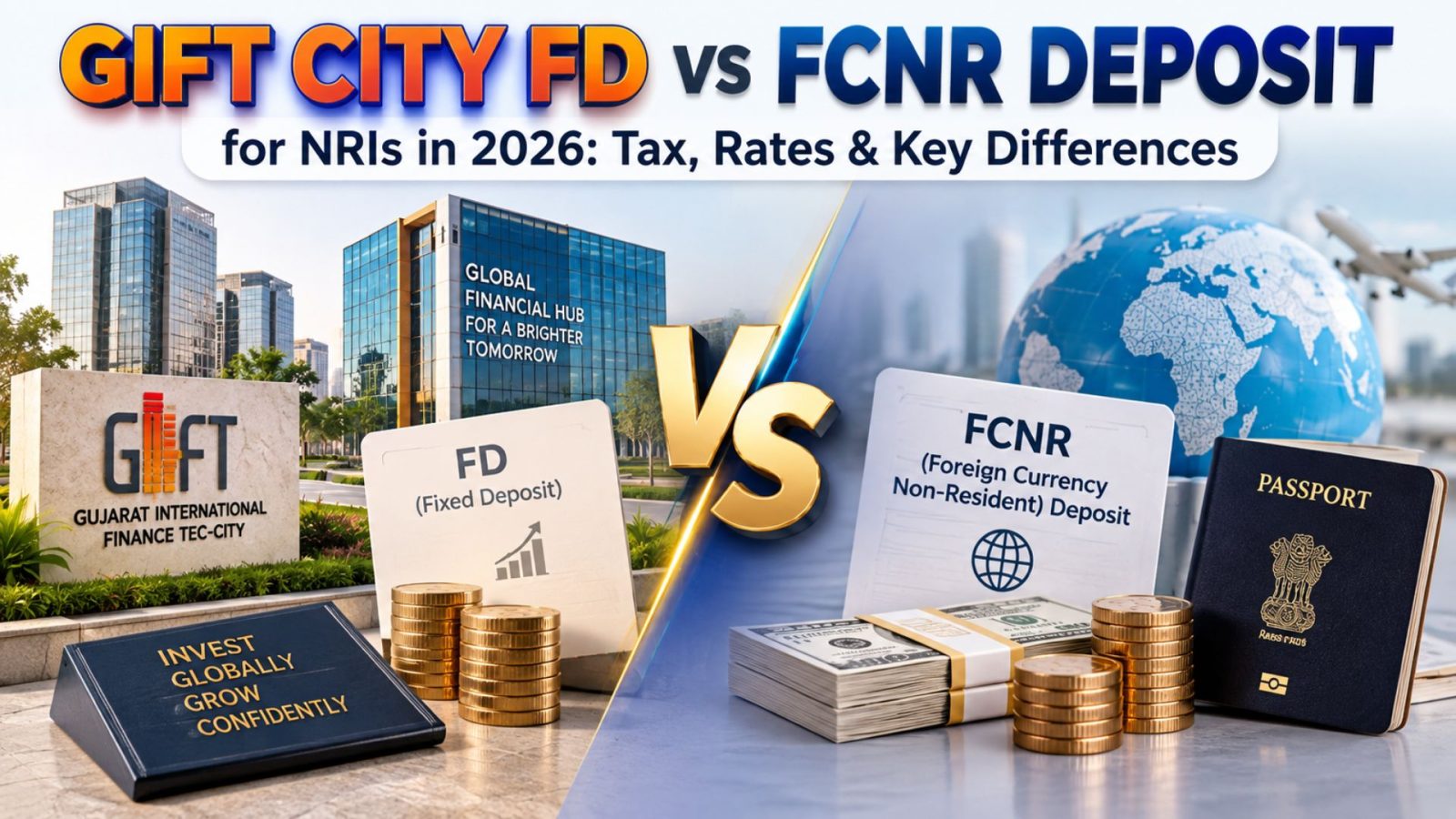
If you’re an NRI with money in foreign currency, you may be wondering where to keep it safely while earning a good return: a GIFT City FD vs FCNR deposit? Both let you hold foreign currency and offer tax benefits in India, so at first glance, they can seem almost the same. But they actually work differently. The interest rates, deposit insurance, tenure, tax rules, repatriation process, and banking structure can all vary. Choosing between them isn’t simply about finding the highest interest rate. This guide explains the key differences between GIFT City FD and FCNR deposits for NRIs in 2026, so you can compare them clearly.
Key Takeaways
- ✔ GIFT City FD and FCNR deposits both allow NRIs to hold savings in foreign currency and earn interest.
- ✔ GIFT City FDs are offered through IFSC banking units, while FCNR deposits are offered by regular Indian banks.
- ✔ Interest rates can differ based on the currency, deposit tenure, bank, deposit amount and prevailing rates.
- ✔ Tax treatment and TDS rules are important factors to compare before choosing between GIFT City FD and FCNR.
- ✔ Repatriation rules differ in terms of how NRIs can transfer their deposit proceeds and interest outside India.
- ✔ The right option depends on your currency, investment period, tax position, risk preferences and financial goals.
What Is a GIFT City Fixed Deposit?
A GIFT City FD is a foreign-currency term deposit opened through a bank’s IFSC Banking Unit (IBU) inside the Gujarat International Finance Tec-City Special Economic Zone. Under FEMA, an IBU is treated as being outside India, so these deposits work differently from a regular NRI FD back home, even when opened with the same bank you already use.
How Does a GIFT City FD Work for an NRI?
- You fund the deposit directly in foreign currency USD, GBP, EUR, or another permitted currency with no conversion to rupees needed at any stage.
- Deposits can be opened digitally for USD, while other currencies typically require reaching out to the bank’s GIFT City relationship team.
- Tenures are flexible, often starting from as little as 7 days, unlike the 1-year minimum common with domestic NRI deposits.
- Since the IBU is treated as a non-resident jurisdiction, your existing NRE or NRO account usually can’t be linked directly; funds move in via SWIFT transfer instead.
What Is an FCNR Deposit?
An FCNR (Foreign Currency Non-Resident) deposit is a term deposit held with the domestic branch of an Indian bank, denominated in a foreign currency like USD, GBP, or EUR. It’s been the traditional route for NRIs who want to earn interest without taking on rupee depreciation risk, and it sits fully within RBI’s regular banking framework.
How FCNR Deposit Works
- You open it at any RBI-licensed bank’s regular NRI banking desk, using funds remitted from abroad or transferred from your NRE account.
- The deposit stays in the chosen foreign currency throughout the tenure, so you’re shielded from rupee movement against that currency.
- Minimum tenure is typically one year, with options extending up to five years depending on the bank.
- Both principal and interest remain fully repatriable, and the deposit is renewed or closed in the same foreign currency at maturity.
GIFT City FD vs FCNR Deposits: How the Two Actually Compare
On paper, both products let you hold foreign currency and avoid rupee depreciation. In practice, they differ on the regulator overseeing them, the interest rates on offer, how quickly you can access your money, and most importantly for many NRIs whether your deposit carries government-backed insurance. The sections below walk through each of these one at a time.
Interest Rates in 2026
GIFT City FD Interest Rates
- Currency-wise: USD deposits are the most common and typically the most competitively priced; GBP, EUR, AUD, and JPY are available at most IBUs but often at different rates.
- Tenure-wise: Rates generally range from around 4.5% to just over 6% per annum, varying by how long you lock the deposit in for.
- Bank-wise variation: SBI, HDFC, ICICI, Axis, and Kotak all run GIFT City IBUs, and their published rates for the same tenure can differ by a full percentage point or more.
FCNR Interest Rates
- USD: Rates across major banks currently sit roughly between 3.5% and 6%, depending heavily on tenure and the specific bank’s current card rate.
- GBP: Typically lower than USD, often in the 3% to 4% range for similar tenures at most banks.
- EUR: Usually the lowest of the major currencies, often between 1.5% and 2.5%, reflecting broader European rate trends.
- Other currencies (AUD, CAD, JPY, SGD): Rates vary widely by bank and currency, with JPY typically offering minimal returns and AUD often higher than USD.
Which One Offers Higher Interest?
There’s no single winner here, and any article that declares one is oversimplifying. What actually decides the better rate for you is:
- Currency: A GIFT City USD FD might beat FCNR USD at one bank, while FCNR wins for GBP at another it isn’t consistent across currencies.
- Tenure: Short-tenure GIFT City FDs (7–30 days) have no FCNR equivalent at all, since FCNR requires a minimum one-year lock-in.
- Bank: Rate differences between banks for the identical product can be larger than the difference between GIFT City and FCNR themselves.
- Deposit size: Some banks offer better slabs for larger deposit amounts, especially on the GIFT City side.
- Date: Both products track global interest-rate cycles, so a rate that looks attractive today can shift within weeks.
The only reliable approach is to pull live rate cards from two or three banks for your specific currency and tenure before deciding, rather than relying on a general “GIFT City is better” or “FCNR is better” rule.
Tax Rules
GIFT City FD Tax Treatment for NRIs
- Interest taxation: Interest earned by an NRI on a GIFT City FD is exempt from Indian income tax, since the IBU is treated as an offshore jurisdiction under FEMA.
- TDS applicability: No TDS is deducted on this interest for NRI depositors, unlike most domestic Indian FD interest.
- Relevant IFSC tax provisions: The exemption flows from the special tax regime built for IFSC units, distinct from the standard Income-tax Act provisions applied to domestic deposits.
- Conditions/exemptions: The exemption applies specifically to non-resident depositors; resident Indians investing via the Liberalised Remittance Scheme follow standard domestic tax rules instead.
FCNR Deposit Tax Treatment
- Interest income: Interest earned on an FCNR deposit is treated as income arising from a foreign-currency asset held by a non-resident.
- Indian income-tax treatment: This interest is exempt from Indian income tax as long as you continue to qualify as a person resident outside India under FEMA.
- TDS: No TDS is deducted on FCNR interest for as long as the exemption conditions are met.
- Conditions for exemption: The moment your residential status changes to resident, this exemption stops applying, and the deposit needs to be reclassified with your bank, the same reclassification step covered in this guide on updating KYC status when your residential status changes.
Is GIFT City FD Tax-Free for NRIs?
Yes. For an NRI, interest earned on a GIFT City FD is exempt from Indian income tax and no TDS is deducted, because the deposit sits within an IBU treated as offshore under FEMA. This exemption is specific to your NRI status at the time — it doesn’t automatically extend once you become a resident again.
Is FCNR Interest Tax-Free?
Yes, with one important condition. FCNR interest is tax-free in India only while you remain a non-resident under FEMA. The moment you return to India and your status changes to resident, the exemption ends, and interest earned from that point becomes taxable so this is a status-linked exemption, not a permanent one tied to the deposit itself.
Tax in the NRI’s Country of Residence
| Country of Residence | Typical Treatment of GIFT City/FCNR Interest |
| USA | Interest is generally taxable as global income under US rules, regardless of India’s exemption |
| UK | Taxable under UK’s worldwide income rules for tax residents, subject to reporting |
| UAE | No personal income tax, so the India exemption effectively means no tax at all |
| Canada | Generally taxable as foreign investment income for tax residents |
| Singapore | Foreign-sourced interest is often not taxed unless remitted into Singapore |
India’s exemption never tells you the full picture, always check how your resident country treats foreign-currency interest before assuming it’s tax-free everywhere. If you’re also holding other Indian assets, the general logic of using DTAA to avoid being taxed twice on the same income applies here too, not just to property sales.
Currency Risk
Both products are designed to remove one layer of risk rupee depreciation since your money stays in foreign currency throughout. But that doesn’t mean risk disappears entirely. You’re still exposed to how that specific currency moves against your spending currency; a USD deposit is currency-neutral for someone earning and spending in USD, but still carries risk for someone who eventually needs GBP or AED. If you regularly move money across NRE, NRO, and FCNR-type products, it’s worth reading through a proper currency risk management approach for NRI investments before deciding which currency and product combination actually reduces your risk rather than just relocating it.
Repatriation Rules for NRIs
GIFT City FD
- Can maturity proceeds be sent abroad? Yes-both principal and interest are freely repatriable, with no annual ceiling applied.
- Repatriation process: Funds are typically wired out directly from the IBU account to your overseas bank account via standard SWIFT transfer.
- Bank documentation: Basic KYC and the maturity instruction are usually sufficient, since the funds never entered India’s domestic banking system in the first place.
FCNR
- Repatriation of principal: Fully repatriable without any RBI ceiling, since FCNR is treated as a foreign-currency, non-repatriation-restricted deposit.
- Repatriation of interest: Interest earned is equally repatriable along with the principal at maturity or on premature closure.
- NRI bank account route: Maturity proceeds are usually credited to your linked NRE account first, from where they can be wired abroad freely the same NRE/NRO routing question that trips up NRIs when they’re repatriating other investment proceeds like mutual fund redemptions.
Safety & Regulation
This is where the two products genuinely diverge. FCNR deposits sit inside RBI’s domestic banking framework and are covered by DICGC deposit insurance up to ₹5 lakh per depositor per bank, the same statutory guarantee that protects regular NRE and NRO deposits. GIFT City FDs, held through an IBU, are regulated by the IFSCA instead of the RBI, and they carry no DICGC cover. Your protection there comes from the parent bank’s overall balance sheet and IFSCA’s capital-adequacy rules rather than a government-backed insurance scheme not unsafe by any means, given that major banks run these IBUs, but structurally different from the safety net you get with a domestic FCNR deposit. If you’re weighing retirement-oriented, government-backed alternatives alongside these deposits.
GIFT City FD vs FCNR: Complete Comparison
| Feature | GIFT City FD | FCNR Deposit |
| Regulator | IFSCA | RBI |
| Currency | USD, GBP, EUR, and other permitted currencies | USD, GBP, EUR, and other permitted currencies |
| Minimum tenure | As low as 7 days | 1 year |
| Tax on interest (India) | Exempt, no TDS | Exempt while NRI status holds, no TDS |
| Repatriation | Fully repatriable, no ceiling | Fully repatriable, no ceiling |
| Deposit insurance (DICGC) | Not covered | Covered up to ₹5 lakh per depositor per bank |
| Investment ecosystem access | Broader — connects to GIFT City funds, AIFs, global equity | Limited to the deposit itself |
GIFT City FD vs FCNR: Which One May Suit You?
There’s no universal “better” option here; it genuinely depends on what you’re optimising for.
GIFT City FD may be relevant if:
- You want flexibility with shorter tenures, including deposits as short as a week or a month.
- You’re already exploring other GIFT City products AIFs, mutual funds, or global equity and want everything under one ecosystem, similar to how a PIS account works for NRIs investing in Indian equities.
- You’re comfortable relying on the parent bank’s strength rather than statutory deposit insurance.
FCNR may be relevant if:
- DICGC-backed deposit insurance genuinely matters to you, especially for smaller or moderate deposit amounts.
- You prefer working entirely within your existing domestic NRI banking relationship without opening a separate IBU account.
- You’re comfortable committing to a one-year-plus tenure in exchange for that added protection.

Documents Required
GIFT City FD
| Document | Purpose |
| Passport | Identity and NRI status verification |
| PAN | Required for certain transaction types |
| Overseas address proof | Confirms current residency abroad |
| Visa/work permit | Supports NRI status verification |
| SWIFT transfer details | Needed to fund the deposit from abroad |
FCNR
| Document | Purpose |
| Passport | Identity and NRI status verification |
| PAN or Form 60 | Standard KYC requirement for NRI banking |
| Overseas address proof | Confirms current residency abroad |
| NRE account details | For linking maturity proceeds and repatriation |
| FEMA declaration | Confirms non-resident status for the account type |
Common Mistakes NRIs Should Avoid
- Assuming both products carry identical safety, without checking that only FCNR has DICGC insurance backing.
- Locking into FCNR’s one-year minimum tenure when short-term flexibility from GIFT City would suit better.
- Ignoring their country-of-residence tax treatment, assuming India’s exemption means no tax anywhere.
- Not comparing rates across two or three banks before opening, since bank-to-bank differences can be significant.
- Forgetting to update their bank once they return to India, letting FCNR’s tax exemption lapse unnoticed.
Conclusion
Neither GIFT City FD nor FCNR is a flat-out better product, they solve slightly different problems. FCNR gives you the comfort of DICGC insurance and a familiar domestic banking relationship, while GIFT City trades that insurance for shorter tenures and access to a wider investment ecosystem. Both keep your money tax-free in India and fully repatriable, so the real decision comes down to how much you value deposit insurance versus flexibility, not which one has the marginally higher rate this month.
Disclaimer
The content published on NriTaxs is intended for informational purposes only and does not constitute legal, tax, or financial advice. Readers are encouraged to consult qualified professionals before making any decisions based on the information provided.









Related Articles