
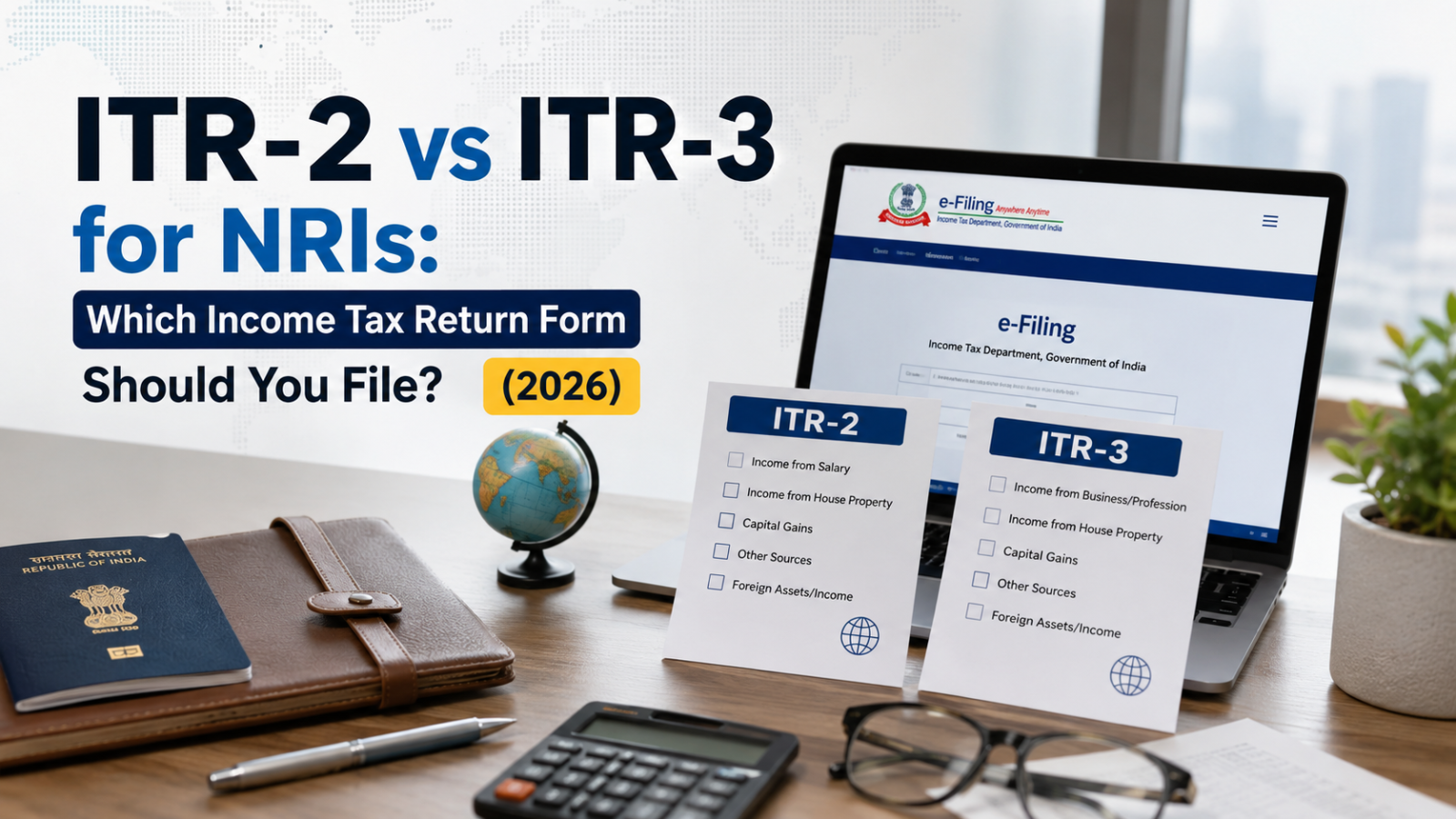
Choosing the wrong ITR form is one of the most common and costly mistakes NRIs make during tax season. Under Section 139(9), a return filed on the wrong form is treated as a defective return. Your refund gets held up, you get a notice demanding correction within 15 days, and if you miss that window, the return is treated as never filed at all, along with the loss of carry-forward benefits on any losses.
ITR-2 vs ITR-3 are the two income tax return forms most commonly used by Non-Resident Indians (NRIs). For most NRIs, the confusion is between ITR-2 and ITR-3. If you earn rental income from a property in India, sold shares or mutual funds, or have interest income on your NRO account, you’re probably looking at ITR-2. But if you also dabble in F&O trading, freelance for Indian clients, or hold a share in a partnership firm, ITR-3 may be the correct form instead and many NRIs don’t realise this until they get flagged.
This guide breaks down the exact differences between ITR-2 vs ITR-3 for NRIs, who should file which form, the common mistakes to avoid, and a step-by-step process to file the correct return for AY 2026-27 (FY 2025-26).
What Is ITR-2?
ITR-2 is the income tax return form for individuals and HUFs who do not have income from business or profession. It is the default form for most NRIs, since the majority of NRI income in India comes from passive sources of property, investments, and bank interest rather than active business activity.
ITR-2 allows you to report:
- Income from salary or pension (if applicable).
- Income from one or more house properties in India.
- Capital gains short-term and long-term from property, shares, and mutual funds.
- Income from other sources: NRO interest, dividends, etc.
- Foreign assets and foreign income disclosures (Schedule FA, where relevant).
- Agricultural income above ₹5,000.
Who Should File ITR-2?
As an NRI, you should file ITR-2 if any of the following apply to you:
- You have a rental property in India and earn rental income from it.
- You sold a property, mutual fund units, or shares in India during FY 2025-26 and have capital gains or losses to report.
- You earn interest income from an NRO account, or dividend income from Indian companies.
- You want to claim a TDS refund on excess tax deducted from rent, property sale, or bank interest.
- You have no business or professional income in India.
What Is ITR-3?
ITR-3 is meant for individuals and HUFs who have income from business or profession, in addition to any of the income types covered under ITR-2 (salary, house property, capital gains, other sources). It is a more detailed form, requiring schedules for profit and loss, balance sheet, and where applicable audit details.
Who Should File ITR-3?
As an NRI, ITR-3 becomes the correct form if:
- You trade in Futures & Options (F&O) this is treated as business income, not capital gains, regardless of frequency.
- You freelance or provide consulting services to clients in India and earn professional fees.
- You are a partner in an Indian partnership firm or LLP and receive a share of profit, salary, or interest from the firm.
- You run a proprietorship business with operations or income sourced in India.
A crucial point for NRIs: resident individuals with small business income can often use the simpler ITR-4 under the presumptive taxation scheme (Sections 44AD/44ADA). NRIs are explicitly barred from opting into this scheme. This means if an NRI has any business or professional income, ITR-3 is the only correct form; there is no shortcut through ITR-4.
ITR-2 vs ITR-3 for NRIs: 5 Key Differences
| Basis | ITR-2 | ITR-3 |
| Business Income | ❌ | ✅ |
| Salary | ✅ | ✅ |
| Rental Income | ✅ | ✅ |
| Capital Gains | ✅ | ✅ |
| NRO Interest | ✅ | ✅ |
| F&O (Futures & Options) Trading | ❌ | ✅ |
| Freelancing | ❌ | ✅ |
| Partnership Firm Income | ❌ | ✅ |
| Books of Account Required | ❌ | ✅ (If business/profession meets criteria) |
| Audit Applicable | No | Yes (If turnover exceeds legal limits) |
How to Choose Between ITR-2 and ITR-3 For NRIs
The correct ITR form depends entirely on the type of income you earn in India—not on how much you earn. Use the checklist below to identify the right form:
File ITR-2 if:
- You earn a salary or pension.
- You receive rental income from property in India.
- You have capital gains from shares, mutual funds, or property.
- You earn interest from NRO accounts or dividends.
- You do not have any business or professional income.
File ITR-3 if:
- You have business or professional income in India.
- You trade in Futures & Options (F&O) or intraday trading.
- You earn freelance or consultancy income from Indian clients.
- You are a partner in an Indian partnership firm or LLP.
- You run a proprietorship business in India.
If your income includes even a small amount of business or professional income, ITR-3 generally becomes the correct return form, even if your remaining income qualifies for ITR-2.
Decision Table
| Your Income Situation | Correct Form |
| Salary + rental income only | ITR-2 |
| Rental income + capital gains from property/shares/MFs | ITR-2 |
| NRO interest + dividend income, no business income | ITR-2 |
| F&O trading income (any amount, profit or loss) | ITR-3 |
| Freelance/consulting income from Indian clients | ITR-3 |
| Partner in an Indian partnership firm/LLP | ITR-3 |
| Capital gains + F&O trading (combined) | ITR-3 |
Income Covered Under ITR-2 and ITR-3
Covered in ITR-2
- Salary or pension income.
- Income from house property (up to any number of properties).
- Short-term and long-term capital gains.
- Income from other sources (interest, dividends).
- Foreign assets and income disclosures.
- Agricultural income above ₹5,000.
Covered in ITR-3 (in addition to everything above)
- Business or professional income (Schedule BP).
- F&O and intraday trading turnover and profit/loss.
- Partner’s share of profit, salary, and interest from a firm.
- Balance sheet and profit & loss account of the business.
- Tax audit details, where applicable under Section 44AB.

Common Mistakes NRIs Make While Choosing an ITR Form
1. Filing ITR-2 despite having business income
This is the single most common error. NRIs who trade F&O alongside their regular capital gains often continue filing ITR-2 out of habit, not realising that F&O income is classified as business income and requires ITR-3 regardless of how small the trading activity is.
2. Choosing ITR-3 unnecessarily
On the flip side, some NRIs assume that any trading activity including delivery-based equity or mutual fund transactions pushes them into ITR-3. It doesn’t. Delivery-based investments are capital gains, correctly reported under ITR-2. Filing ITR-3 unnecessarily adds complexity (P&L, balance sheet) without any benefit.
3. Ignoring residential status
Your residential status (Resident, Non-Resident, or RNOR) directly affects what income is taxable in India and which schedules apply. Filing without correctly confirming NRI status in the form can lead to global income being incorrectly reported, or DTAA relief being missed.
4. Forgetting foreign tax credit and DTAA relief
If tax has been withheld in India on income that is also taxable in your country of residence, you may be entitled to relief under the Double Taxation Avoidance Agreement (DTAA). This requires a Tax Residency Certificate (TRC) and Form 10F. Skipping this step means paying more tax than necessary.
5. Missing capital gains schedules
Property sales, mutual fund redemptions, and share transactions each have dedicated sub-schedules under Schedule CG. Lumping them together, or skipping quarter-wise breakup where required, is a frequent cause of processing delays and mismatches with your Annual Information Statement (AIS).
Can NRIs Switch Between ITR-2 and ITR-3?
Yes. There is no lock-in between ITR-2 vsITR-3 the correct form each year depends purely on the income you earned that year. If you only had capital gains and rental income last year but started F&O trading or freelancing this year, you simply move to ITR-3 for that assessment year. There’s no approval or prior intimation required to switch; you just select the applicable form based on your actual income sources for that year.
This is different from the tax regime choice (old vs new), where taxpayers with business income face restrictions on how often they can switch. Choosing between ITR-2 vs ITR-3 for Nris is not subject to that restriction; it is simply determined by your income profile.
Documents Required
- PAN card and passport (for residential status verification).
- Form 26AS and Annual Information Statement (AIS).
- NRO and NRE bank account statements and interest certificates.
- Capital gains statements from brokers, CAMS/KFintech (for mutual funds).
- Property sale deed, purchase deed, and improvement cost receipts (if property was sold).
- Lower TDS certificate under Section 197, if obtained.
- Tax Residency Certificate (TRC) and Form 10F, for DTAA relief.
- Profit & Loss account and balance sheet only if filing ITR-3.
- F&O contract notes and turnover statement, if applicable.
Step-by-Step Process to File the Correct ITR
- Log in to the Income Tax e-filing portal and select Assessment Year 2026-27.
- Confirm your residential status as Non-Resident in the personal details section this affects which income gets taxed in India.
- Based on your income sources, select ITR-2 vs ITR-3 For Nris using the decision table above.
- Fill in income schedules: House Property, Capital Gains, Other Sources, and for ITR-3 Schedule BP with P&L and balance sheet details.
- Claim DTAA relief where applicable, using the TRC and Form 10F.
- Cross-check TDS credits against Form 26AS and AIS before submitting.
- Verify your return. Most NRIs cannot use Aadhaar OTP for e-verification since it requires an Aadhaar-linked Indian mobile number, net banking of an Indian bank account or a Digital Signature Certificate (DSC) are the more reliable options.
Real-Life Example
Case 1 — ITR-2: Rohan, an NRI based in the US, earns a salary abroad, rents out an apartment in Bangalore, and redeemed some mutual fund units in India during FY 2025-26. None of this is business income Rohan files ITR-2, reporting rental income under House Property and the mutual fund redemption under Capital Gains.
Case 2 — ITR-3: Priya, also an NRI, has the same rental and capital gains income as Rohan, but she also actively trades in F&O on the side. Because F&O is classified as business income, Priya cannot file ITR-2 even though her other income looks identical to Rohan’s; she must file ITR-3, reporting her F&O turnover and profit/loss under Schedule BP alongside her rental and capital gains income.
This example is a good illustration of why NRIs with otherwise straightforward income (like a single rental property) can still find themselves needing ITR-3 the moment even a small amount of F&O activity is added to the mix.
Conclusion
For most NRIs, ITR-2 is the correct form it covers salary, rental income, capital gains, and interest or dividend income comfortably. The moment business or professional income enters the picture, whether through F&O trading, freelancing, or a partnership firm, ITR-3 becomes mandatory, and there’s no presumptive-taxation shortcut through ITR-4 available to NRIs. Getting this choice right the first time avoids defective return notices, delayed refunds, and unnecessary scrutiny.
Disclaimer
The content published on NriTaxs is intended for informational purposes only and does not constitute legal, tax, or financial advice. Readers are encouraged to consult qualified professionals before making any decisions based on the information provided.










Related Articles