

Could switching to an S Corporation save your business thousands in taxes, or end up costing you more? Many US small business owners consider S Corporation status for its potential tax savings, but additional payroll expenses, filing fees, and compliance requirements can reduce those benefits. So, is an S Corporation worth it? The answer depends on your business profits, reasonable salary, and overall operating costs. This guide explains S Corporation tax benefits, setup and ongoing costs, and how S Corp taxation compares with an LLC. You’ll also find a practical decision checklist to help determine whether S Corporation status makes financial sense.
Quick Answer
An S corporation is usually worth it when your business earns steady profit well above the salary you would pay yourself, and the tax savings are larger than the added payroll, filing, and state costs. If profit is low or uneven, staying a regular LLC or sole proprietorship is often cheaper.
What Is an S Corporation and How Does It Work?
An S corporation is a tax status, not a type of company. A corporation or LLC elects it with the IRS, so profit passes through to the owners’ personal tax returns and generally avoids a separate federal corporate income tax.
- Election: File Form 2553 with the IRS to be taxed as an S corporation. Here is how to elect S corporation status in simple steps.
- Pass-through profit: The business generally pays no federal income tax. Profit and loss flow to owners through Schedule K-1 and are taxed on personal returns.
- Owner salary: Owners who work in the business must be paid a reasonable W-2 salary. Payroll taxes apply to that salary, like any employee’s wages.
- Distributions: Remaining profit can be taken as distributions. These are not subject to self-employment tax, which is where most of the potential savings come from.
Is an S Corporation Worth It for Small Businesses?
An S corporation can be worth it when your business earns steady profit and you can pay yourself a fair salary. The savings must be larger than the extra payroll, filing, and state costs.
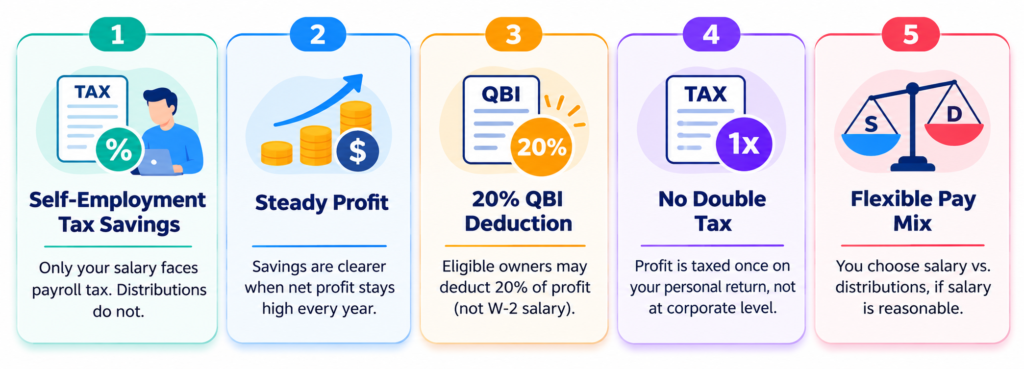
- Self-employment tax savings: Only your salary faces the 15.3% payroll tax. Profit taken as distributions avoids it, which can often save thousands each year once your earnings are high enough.
- Steady profit: Predictable profit makes the math reliable. Many advisors consider the election when net profit stays above roughly $60,000 to $80,000 a year; this varies by state and industry.
- 20% QBI deduction: Eligible owners may deduct up to 20% of qualified business income, now a permanent rule. It applies to pass-through profit, not W-2 salary, and has income limits.
- No double taxation: Unlike C corporations, profit is taxed once, on your personal return. You avoid a separate federal corporate income tax on the same earnings, so you keep more.
- Flexible pay mix: You decide how to split your income between salary and distributions, if salary stays reasonable. This gives you more control over payroll taxes than a standard LLC.
When Is an S Corporation Not Worth It?
- Low or inconsistent business profits: If your profit is small or changes a lot each year, the tax savings may not cover the new costs. You still must run payroll and file a separate tax return every year, even during slow months or low-profit years.
- High payroll and accounting costs: Payroll software, a separate Form 1120-S return, and bookkeeping can often add about $1,500 to $4,000 a year. If your expected tax savings are close to that amount, the election may not help you. Over time, these fees add up.
- Ineligible ownership structure: S corporations allow only one class of stock and up to 100 shareholders. Owners must be US citizens or residents, so nonresident aliens, partnerships, and corporations cannot hold shares. If you do not qualify, the IRS will reject the election.
- Additional compliance burden: You must run payroll on time, keep clean books, file Form 1120-S by March 15 each year, and give each owner a Schedule K-1. Late filing can cost over $250 per shareholder each month, even if no tax is due.
What Does S Corporation Taxation Cost?
- Payroll and employment-tax administration: You must run payroll for yourself, withhold taxes, and make deposits on schedule. That means paying for payroll software or a provider, plus employer taxes like Social Security, Medicare, and federal and state unemployment taxes.
- Corporate tax preparation: An S corporation files its own Form 1120-S and issues K-1s to every owner, on top of your personal return. Preparation usually costs more than a simple Schedule C return, often by $500 or more.
- State taxes and filing requirements: Many states honor S status, but some add their own taxes. California charges 1.5% of net income with an $800 minimum, and New York City does not recognize the election. Always check your state rules.
- Ongoing compliance: Keep salary records, separate business finances, match distributions to ownership, and file on time. Late returns can cost over $250 per shareholder for each month the return is overdue. Missing deadlines also triggers IRS notices.
How Much Does It Cost to Set Up and Maintain an S Corporation?
Form 2553 Filing and Election Costs
The IRS charges no fee to file Form 2553. You pay only if a tax professional prepares it. File it within two months and 15 days of the tax year’s start, or within 75 days of forming a new company.
State Formation and Annual Fees
If you still need a corporation or LLC, state filing fees often run about $50 to $500. Annual reports usually cost $50 to $300, a registered agent adds $100 to $300, and California adds an $800 minimum tax each year.
Payroll Processing Costs
Because you must pay yourself a salary, you always need payroll. Online payroll tools often cost about $480 to $1,800 a year, while full-service providers can cost $1,200 to $3,600 a year, depending on features and the number of employees.
Accounting and Tax Preparation Fees
Expect roughly $800 to $2,500 a year for Form 1120-S preparation, plus your personal return, depending on complexity. Bookkeeping costs extra. Clean records save time and money, so review the documents you need to file LLC taxes before tax season.
Ongoing Compliance Costs
Budget for a registered agent, annual reports, salary records, and occasional professional advice. Together these can add a few hundred dollars a year, and more if you operate or hire in several states. Plan for all these recurring costs early.
S Corporation vs LLC: Which Is More Cost-Effective?
A default LLC is simpler and cheaper to run, while an S corporation can save more tax as profit grows. This table shows the main differences. For a deeper tax comparison, read our S corp vs LLC taxes guide.
| Factor | LLC (Default) | S Corporation |
| Federal income tax | Pass-through; profit taxed on the owner’s return | Pass-through; profit taxed on owners’ returns |
| Self-employment tax | About 15.3% on net profit up to $184,500 (2026 wage base), then 2.9% | Payroll tax only on the owner’s salary; distributions are exempt |
| Owner payroll | Not required; owner takes draws | Required; owner must receive a W-2 salary |
| Business tax return | Schedule C (one owner) or Form 1065 (several owners) | Form 1120-S plus Schedule K-1 every year |
| Typical added yearly cost | Lowest | Higher; payroll and extra tax prep often add $1,500 to $4,000 |
| Ownership rules | Flexible; foreign owners are allowed | Up to 100 US citizen or resident shareholders; one class of stock |
| Best fit | New businesses or low, uneven profit | Steady, higher-profit businesses |
An LLC can also elect S corporation status, so you can start as an LLC and switch later. At lower profit, the LLC is usually more cost-effective. As steady profit rises, the S corporation often wins.
When Does an S Corporation Make Financial Sense?
- Business Profit and Owner Salary: It tends to make sense when steady annual profit comfortably exceeds the salary you would pay yourself. The bigger the gap between profit and a reasonable salary, the more income you can take as distributions.
- Reasonable Compensation Requirements: The IRS expects a salary close to what you would pay someone else for your work. Setting pay too low to avoid payroll tax is an audit trigger and can mean back taxes and penalties.
- Tax Savings Compared with Additional Costs: Add up the self-employment tax you expect to save each year, then subtract payroll, extra tax preparation, and state costs. If the result is clearly positive year after year, the election deserves very serious consideration.
- Business Growth and Long-Term Plans: Think about where the business is heading. Steady growth with a few US-based owners fits well. Outside investors, foreign owners, or a possible sale may point to a different structure. Review this plan every year.

S Corporation Decision Checklist
- ☐ My net profit is steady and ideally above $60,000 a year.
- ☐ I can pay myself a reasonable salary and still have profit left over.
- ☐ All owners are US citizens or US tax residents.
- ☐ The company has only one class of stock.
- ☐ My expected tax savings are higher than the added payroll, filing, an d state costs.
- ☐ I can run payroll and file Form 1120-S by March 15 (or extend with Form 7004).
- ☐ My state’s S corporation taxes will not erase the savings.
If you can tick most of these boxes, an S corporation is worth discussing with a CPA. If several boxes stay empty, a simple LLC may be the better choice for now.
Conclusion
So, is an S corporation worth it? It is worth it when your profit is steady, your salary is reasonable, and the tax savings clearly beat the added costs. It is not worth it when profit is low, ownership does not qualify, or compliance would strain your budget. Before you file Form 2553, run the numbers with a tax professional, check your state’s rules, and use the checklist above. A simple LLC may serve you well today, and you can still elect S corporation status later when profit grows enough.
Disclaimer
The content published on NriTaxs is intended for informational purposes only and does not constitute legal, tax, or financial advice. Readers are encouraged to consult qualified professionals before making any decisions based on the information provided.





Related Articles