

Choosing between an S corp and an LLC is one of the first big decisions a US business owner makes, and it affects how much tax you pay every year. But which option actually helps you save more on taxes? While both offer liability protection and pass-through taxation, they differ in how business income is taxed, how owners pay themselves, and what tax obligations they must meet. An LLC offers flexibility and simpler administration, whereas S Corporation taxation may provide potential tax savings for eligible businesses with consistent profits. However, additional payroll and compliance costs can also affect your overall savings. In this guide, we’ll compare S Corp vs LLC, covering their key differences, tax benefits, filing requirements, and costs to help you choose the right option for your business.
S Corp vs. LLC at a Glance
| Feature | LLC | S Corporation |
| What it is | A legal business structure | A tax status, not a business type |
| Default taxation | Pass-through (sole proprietor or partnership) | Pass-through (Form 1120-S) |
| Self-employment tax | 15.3% on all net earnings | Only on owner salary, not on distributions |
| Owners allowed | Unlimited, including foreign owners | Up to 100, US citizens or residents only |
| Management | Flexible | Board, officers, shareholders |
| Paperwork | Light | Heavier (payroll, minutes, Form 1120-S) |
| Best for | New or smaller businesses, mixed ownership | Steadily profitable businesses with US owners |
What Is an LLC?
A limited liability company (LLC) is a business structure created under state law. It separates your personal assets from the debts and lawsuits of the business, so your home and savings are generally protected. An LLC is popular because it is simple to set up, has few ongoing rules, and offers flexible taxation. Owners are called members, and they can choose how the LLC is taxed, including as an S corporation.
Ownership Structure of LLCs
An LLC can have one owner or many, called members. Members can be individuals, companies, or foreign persons, and there is no limit on the number. Profit shares can differ from ownership percentages if the operating agreement allows it.
Taxation of LLCs Explained
By default, a single-member LLC is taxed like a sole proprietorship and a multi-member LLC like a partnership. Profit passes to your personal return, where self-employment tax of 15.3% applies. Learn more in this guide on how to file LLC taxes for the first time.
Costs Involved in Establishing an LLC
Most states charge a one-time filing fee, usually between about $35 and $500. Some also require annual reports or yearly fees, and California adds an $800 minimum annual tax. A registered agent service and a federal EIN (free) complete the list.
How to Form an LLC?
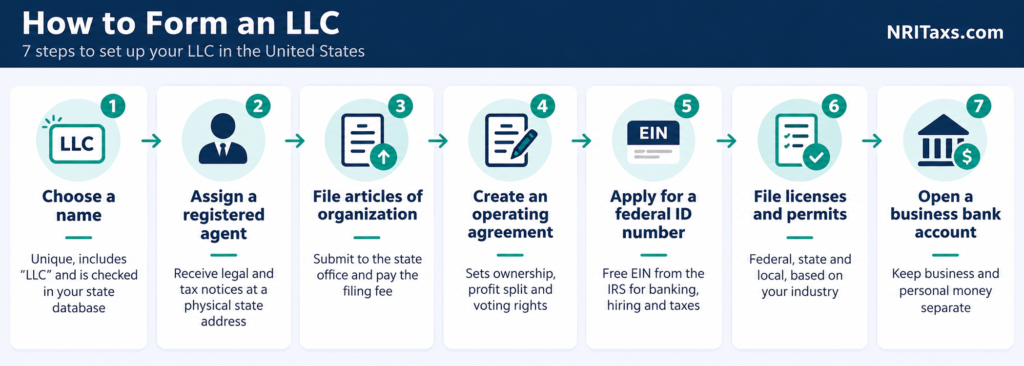
- Choose a name. Pick a unique name that includes “LLC” and is not already used in your state. Search your state’s business database first, and check domain and trademark availability too. Reserve the name if your state allows it.
- Assign a registered agent. A registered agent receives legal and tax notices for your LLC. They need a physical address in your state and must be available during business hours. You can act as your own agent or hire a service.
- File articles of organization. File this document with your state’s business office, usually the Secretary of State. It lists your LLC’s name, address, registered agent, and members. Pay the filing fee. Approval can take a few days to a few weeks.
- Create an operating agreement. This document sets out ownership shares, profit splits, voting rights, and what happens if a member leaves. Not every state requires one, but you should have it. It supports your liability protection and prevents later disputes.
- Apply for a federal ID number. Get a free Employer Identification Number (EIN) from the IRS website. You need it to open a bank account, hire staff, and file taxes. Owners without an SSN can apply by phone or fax using Form SS-4.
- File business licenses and permits. Check which federal, state, and local licenses your work needs, such as a business license, sales tax permit, or professional license. Requirements depend on your industry and city. Missing a permit can lead to fines.
- Open a business bank account. Use your EIN, articles of organization, and operating agreement to open a separate account. Keeping business and personal money apart protects your liability shield and makes US tax filing much easier.
Pros and Cons of Forming an LLC
| Pros | Cons |
| Personal asset protection | Self-employment tax applies to all net profit |
| Simple setup and low upkeep | Annual state fees vary and can be high (for example, California) |
| Flexible ownership, including foreign owners | Less familiar to some investors than a corporation |
| Choice of tax treatment, including S corp status | Rules and fees differ from state to state |
| Profits taxed once, at the owner level | Raising outside capital can be harder |
What Is an S Corporation?
An S corporation is not a separate type of business entity. It is a special tax status that a qualifying corporation or LLC can elect with the IRS. An S corp does not pay federal income tax itself. Profits and losses pass to the shareholders, who report them on their personal returns. Owners who work in the business must also be paid a reasonable salary, which can reduce self-employment tax on the remaining profit.
Ownership Structure of an S Corporation
An S corp can have up to 100 shareholders and only one class of stock. Shareholders must be individuals, certain trusts, or estates, and must be US citizens or residents. Nonresident aliens, partnerships, and corporations cannot own shares.
Taxation of S Corporations Explained
The S corp files Form 1120-S, and profit passes to shareholders on Schedule K-1. Shareholders pay income tax on their share. Self-employment tax applies only to salary, not distributions. Some states also tax S corps separately.
Costs Involved in Establishing an S Corporation
Costs include state formation fees, payroll service fees, and higher tax-preparation charges for Form 1120-S. Payroll taxes apply to owner salary. A corporation also needs bylaws and meeting records, so expect higher yearly spending than a basic LLC.
How to Elect S Corp Status
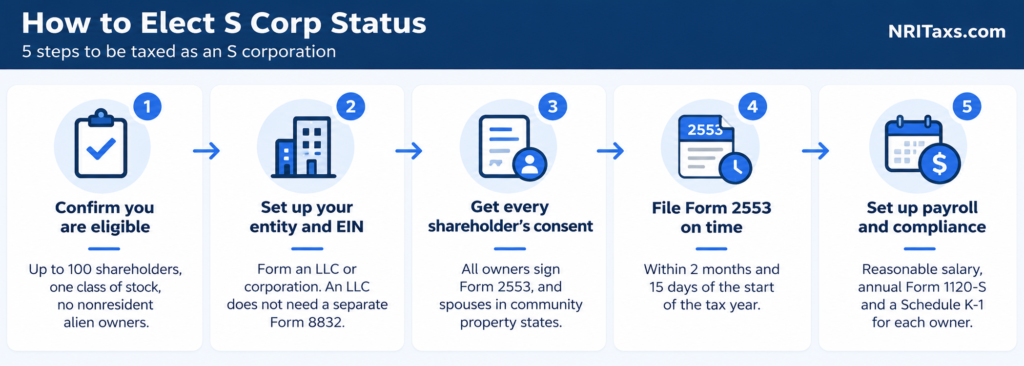
- Confirm you are eligible. Your business must be a domestic corporation or LLC with no more than 100 shareholders, one class of stock, and only eligible shareholders. Any nonresident alien owner makes the business ineligible, so check this before you file.
- Set up your entity and EIN. Form an LLC or corporation in your state and obtain an EIN. An LLC does not need a separate Form 8832 for this election. Filing Form 2553 is enough, and the IRS treats it as a request to be taxed as a corporation first.
- Get every shareholder’s consent. Every owner must sign Form 2553. In community property states, the spouse of an owner usually has to sign as well. Missing a signature can delay or invalidate the election, so collect them all before filing.
- File Form 2553 on time. File within 2 months and 15 days of the start of the tax year you want the election to apply. For a calendar-year business, that is March 15. Late relief may be available under Revenue Procedure 2013-30.
- Set up payroll and compliance. Pay yourself a reasonable salary through payroll and file the usual payroll returns. Keep records of salary and distributions. File Form 1120-S each year by March 15, and send a Schedule K-1 to every shareholder.
Pros and Cons of Forming an S Corporation
| Pros | Cons |
| Possible savings on self-employment tax | Owner must take a reasonable salary |
| Pass-through taxation, no double tax | Only US citizens and residents can be shareholders |
| May qualify for the QBI deduction of up to 20% | More payroll, filing, and record-keeping work |
| Credible structure for lenders and investors | One class of stock limits investor options |
| Clear separation of salary and profit | Some states tax S corps or do not recognize the status |
What Are the Differences Between an S Corp and an LLC?
The main difference is that an LLC is a legal structure, while an S corp is a tax status. They can also work together, because an LLC can elect to be taxed as an S corp.
Taxation
By default, LLC owners pay self-employment tax of 15.3% on all net earnings. In 2026, the Social Security part applies up to $184,500 of earnings, and Medicare applies to everything.
An S corp splits income into salary and distributions. Payroll taxes apply only to salary, so distributions avoid self-employment tax. That is where the savings come from, but the salary must be reasonable.
Ownership
An LLC allows unlimited members, including companies and foreign owners. Profit can be shared in any ratio agreed in the operating agreement.
An S corp is capped at 100 shareholders and one class of stock. Only US citizens and residents can own shares. If an ineligible owner joins, S status ends automatically.
Management
An LLC can be member-managed, where owners run the business, or manager-managed, where appointed managers do. You choose this in the operating agreement.
An S corp follows corporate structure: shareholders elect directors, and directors appoint officers. It is more rigid but clearer to lenders. An LLC taxed as an S corp keeps its flexible management.
Formalities
An LLC has few formalities. It needs an operating agreement and, in some states, an annual report. Formal meetings and minutes are generally not required.
An S corp needs bylaws, meeting minutes, payroll, Form 1120-S, and K-1s. Good records matter at tax time, so review the documents you need to file LLC taxes before you decide.
Cost
An LLC is cheaper to form and run. You pay the state fee, any annual fee, and file a simpler tax return.
An S corp adds payroll fees, an extra return, and sometimes state-level taxes. These costs are worth it only when the self-employment tax savings are larger than the added expense.
S Corp vs LLC: Which Business Structure Is Right for You?
| Feature | LLC | S Corporation |
| Business Type | Legal business structure | Federal tax status |
| Ownership | Unlimited members | Up to 100 eligible shareholders |
| Taxation | Pass-through taxation by default | Pass-through taxation |
| Tax Benefits | Flexible tax treatment | Potential employment tax savings |
| Management | Flexible management | Formal corporate structure |
| Tax Filing | Schedule C or Form 1065 | Form 1120-S |
| Payroll | Depends on tax classification | Payroll required for working shareholder-employees |
| Compliance | Fewer formalities | Additional payroll and filing requirements |
| Foreign Ownership | Foreign owners generally allowed | Nonresident aliens cannot be shareholders |
How to Choose Between an LLC and an S Corp?
There is no single best option for everyone. The right choice depends on your profit, your goals, and who owns the business.
Evaluate Your Business Needs
Think about profit, growth plans, number of owners, and funding. A new or modest-profit business often suits an LLC. A steadily profitable business may benefit from S corp status.
Understand the Tax Implications
Compare the self-employment tax you could save against added payroll and filing costs. S corp status usually makes sense only when profit is well above a reasonable salary.
Consider Liability Protection
Both an LLC and an S corp protect personal assets when you keep finances separate and follow the rules. Protection comes from the legal entity, not from the tax status.
Compare Management Structures
Choose an LLC if you want flexible management with few rules. Choose a corporation if you prefer a formal board and officer structure that lenders and investors know well.
Understand the Compliance Requirements
An S corp must file Form 1120-S every year, even with no income. An LLC may also need to file when it earned nothing. Missed deadlines bring penalties.
Seek Professional Advice
A CPA can model your numbers, check state rules, and confirm eligibility. This matters most for foreign owners, who cannot hold S corp shares directly.

Conclusion
An LLC gives you simple setup, flexibility, and personal asset protection. An S corp can lower self-employment tax once your profit is high enough to justify the extra payroll and paperwork. You can also combine them by electing S status for your LLC. Review your income, owners, and state rules before you decide, and speak with a tax professional to confirm the numbers.
Disclaimer
The content published on NriTaxs is intended for informational purposes only and does not constitute legal, tax, or financial advice. Readers are encouraged to consult qualified professionals before making any decisions based on the information provided.



Related Articles