
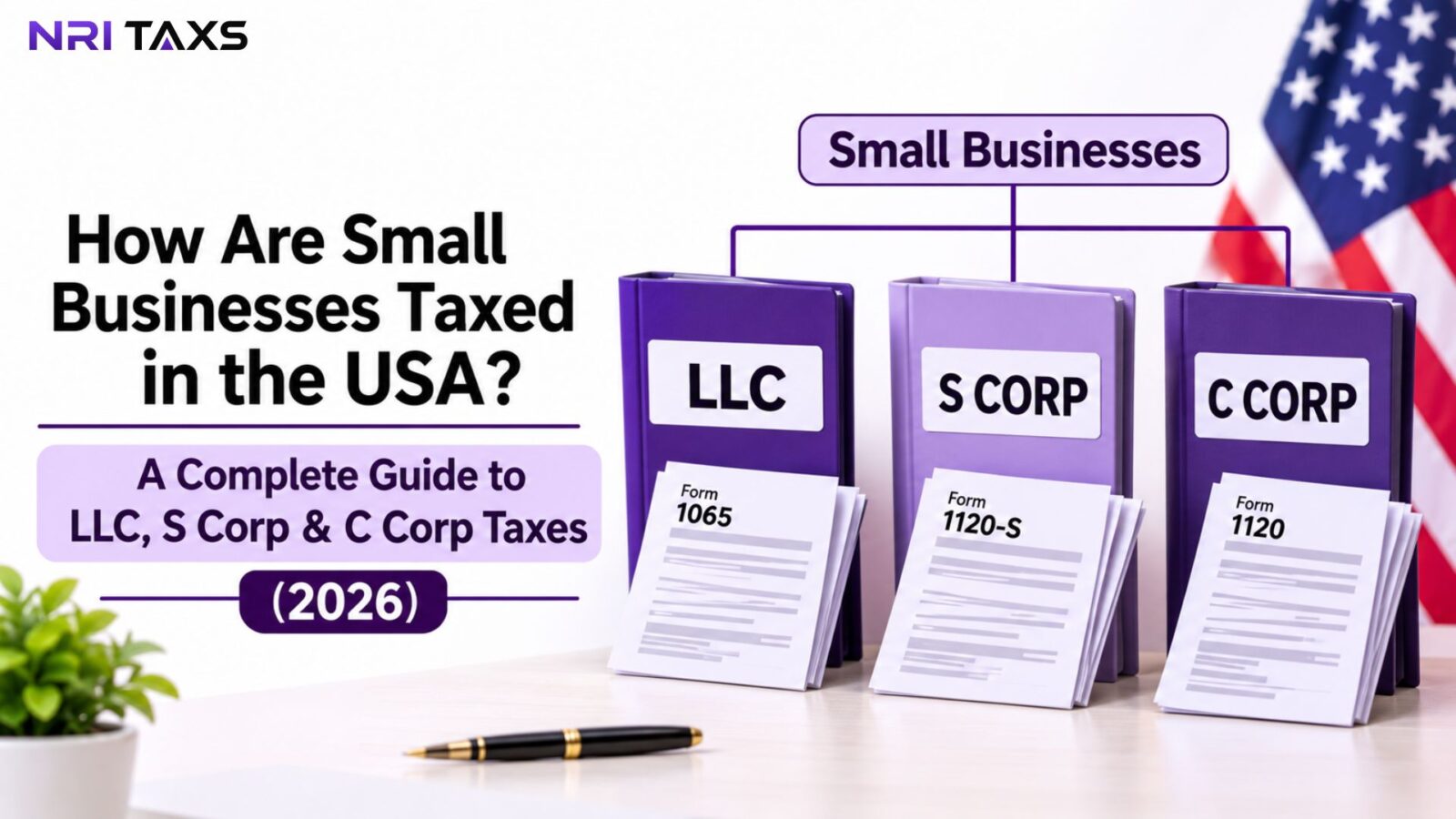
Understanding small business taxes in the USA can be challenging, especially when different business structures follow different tax rules. Whether you operate a sole proprietorship, LLC, S Corporation, C Corporation, or partnership, your tax obligations depend on how your business is classified for federal tax purposes. Small businesses may need to pay federal income tax, self-employment tax, payroll taxes, estimated taxes, and applicable state and local taxes. The forms they must file also depend on their business structure, income, employees, and tax elections.
In this guide, you will learn how small businesses are taxed in the USA, how different business structures are treated, which tax forms are required, what tax rates may apply, and how business owners can stay compliant in 2026.
Small businesses in the USA are taxed based on their business structure and federal tax classification. Sole proprietorships, LLCs, partnerships, and S Corporations generally follow pass-through taxation, while C Corporations pay separate corporate income tax. Businesses may also owe self-employment, payroll, estimated, and state taxes depending on their activities.
How Are Small Businesses Taxed in the USA?
Small businesses in the United States are generally taxed on their taxable income, but the way income is reported and taxed depends on the business structure and its federal tax classification. Some businesses use pass-through taxation, meaning business income generally passes to the owners and is reported on their individual tax returns. Other businesses, such as C Corporations, pay income tax at the corporate level.
The main types of taxes that may apply to small businesses include:
- Federal income tax: Tax on business profits, either at the owner’s individual level or at the corporate level.
- Self-employment tax: Social Security and Medicare taxes that generally apply to eligible self-employed individuals.
- Payroll taxes: Taxes related to employee wages, including Social Security, Medicare, federal income tax withholding, and federal unemployment tax.
- Estimated taxes: Periodic payments made toward expected tax liabilities when withholding is not sufficient.
- State and local taxes: Income taxes, franchise taxes, sales taxes, and other obligations depending on where the business operates.
- Excise taxes: Taxes that apply to certain products, services, and business activities.
A business does not necessarily pay every type of tax listed above. Its obligations depend on its activities, structure, employees, income, and applicable tax laws.
Types of Taxes Small Businesses Must Pay in the USA
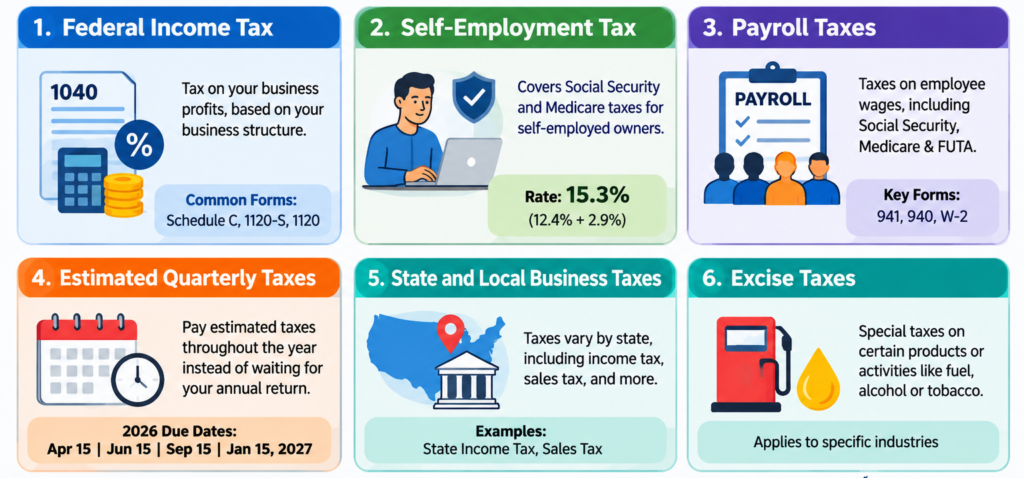
Before understanding how different businesses are taxed, it is important to know the main tax obligations that may apply to a US small business.
1. Federal Income Tax
Federal income tax is generally imposed on taxable income. The method of reporting depends on the business’s tax classification. For example, a sole proprietor generally reports business income on Schedule C attached to Form 1040. An S Corporation generally files Form 1120-S and passes applicable income items to shareholders through Schedule K-1. A C Corporation generally files its own income tax return and pays tax on its taxable corporate income.
2. Self-Employment Tax
Self-employment tax covers Social Security and Medicare taxes for eligible self-employed individuals. It generally applies to sole proprietors and many partners who receive income from active business activities. The combined standard self-employment tax rate is 15.3%, consisting of 12.4% for Social Security and 2.9% for Medicare, subject to applicable limits and additional rules.
For tax year 2026, the Social Security portion generally applies to the first $184,500 of combined covered wages and self-employment earnings. S Corporation shareholders generally do not pay self-employment tax on shareholder distributions. However, shareholder-employees who provide services to the corporation must generally receive reasonable compensation subject to applicable payroll taxes.
3. Payroll Taxes
Businesses with employees generally have payroll tax responsibilities.
These may include:
- Withholding federal income tax from employee wages.
- Withholding and paying Social Security taxes.
- Withholding and paying Medicare taxes.
- Paying the employer’s share of Social Security and Medicare taxes.
- Paying Federal Unemployment Tax Act (FUTA) tax when applicable.
Employers commonly use Form 941 to report quarterly federal payroll taxes and Form 940 to report annual federal unemployment tax. They also generally provide employees with Form W-2.
4. Estimated Quarterly Taxes
Business owners may need to make estimated tax payments during the year instead of waiting until they file their annual returns. Individuals, including many sole proprietors and pass-through business owners, generally use Form 1040-ES to calculate and pay estimated taxes. For the 2026 tax year, the general individual estimated tax payment dates are:
| Payment | Due date |
| First payment | April 15, 2026 |
| Second payment | June 15, 2026 |
| Third payment | September 15, 2026 |
| Fourth payment | January 15, 2027 |
C Corporations generally use Form 1120-W to estimate their tax and must make corporate estimated tax payments when required. Missing required estimated payments or paying too little may result in an underpayment penalty, even if the business owner pays the remaining balance when filing the return.
5. State and Local Business Taxes
In addition to federal taxes, businesses may have state and local tax responsibilities. Depending on the state and business activity, these may include:
- State income tax.
- Franchise tax.
- State sales and use tax.
- Local business taxes.
- State unemployment insurance contributions.
- Business license and registration fees.
For example, a business selling taxable products may need to collect and remit sales tax in states where it has the required tax obligations. A business operating in multiple states may also need to review whether it has income tax or sales tax nexus in those states.
6. Excise Taxes
Excise taxes apply to specific products, services, or business activities rather than all businesses. Businesses involved in certain fuel sales, transportation activities, alcohol, tobacco, or other specially regulated industries may have additional excise tax responsibilities. The applicable forms and payment requirements depend on the activity. Businesses should review the relevant IRS rules to determine whether excise tax filing applies.
How Are Different Types of Small Businesses Taxed?
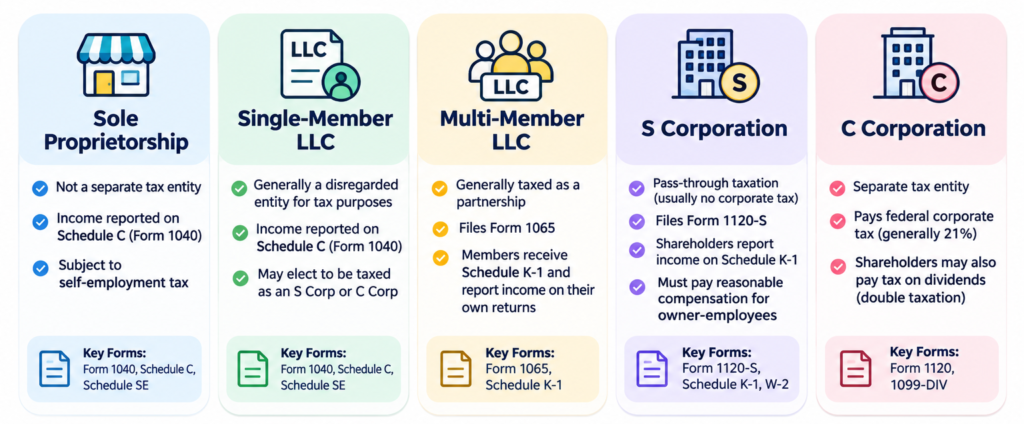
The biggest factor affecting small business taxation is the business’s federal tax classification. Below is an explanation of how the most common business structures are taxed in the USA.
1. Sole Proprietorship Taxes
A sole proprietorship is an unincorporated business owned by one individual. For federal income tax purposes, the business and its owner are generally treated as the same taxpayer. The owner reports business income and deductible expenses on Schedule C, which is attached to Form 1040. The business’s net profit is generally included in the owner’s individual taxable income. Eligible net earnings from self-employment may also be subject to self-employment tax.
Common Tax Forms Include:
- Form 1040: Individual income tax return.
- Schedule C: Reports business income and expenses.
- Schedule SE: Calculates self-employment tax when required.
- Form 1040-ES: Used for individual estimated tax payments.
For example, if a freelance consultant earns $100,000 in business revenue and has $30,000 in allowable business expenses, the business’s preliminary net profit is $70,000. This profit is generally reported on Schedule C and may be subject to income tax and self-employment tax.
2. Single-Member LLC Taxes
A single-member LLC has one owner, known as a member. For federal income tax purposes, the IRS generally treats a domestic single-member LLC as a disregarded entity unless it elects corporate tax treatment. This means the LLC’s business activity is generally reported on the owner’s federal income tax return rather than a separate federal income tax return for the LLC. If the LLC operates a trade or business owned by an individual, its income and expenses are generally reported on Schedule C. Net earnings may also be subject to self-employment tax.
A single-member LLC may elect to be taxed as a corporation. It may also qualify to elect S Corporation treatment if it meets the applicable eligibility requirements. Read this if you want to understand How Taxes Are Filed for Multiple Businesses Under One LLC.
Common Tax Forms Include:
- Form 1065: Partnership income tax return.
- Schedule K-1: Reports each member’s share of partnership items.
- Form 1040: Individual income tax return for an eligible individual member.
- Schedule SE, when applicable.
- Form 1040-ES, when estimated payments are required.
Although a single-member LLC is generally disregarded for federal income tax purposes, it is still treated as a separate entity for certain employment and excise tax purposes.
3. Multi-Member LLC Taxes
A domestic LLC with two or more members is generally classified as a partnership for federal income tax purposes unless it elects corporate treatment. The LLC generally files Form 1065, U.S. Return of Partnership Income, to report its income, deductions, credits, and other tax information. The business generally does not pay federal income tax on its ordinary partnership income. Instead, each member receives Schedule K-1 showing their share of applicable income, deductions, credits, and other items. Members report their respective shares on their own tax returns. Their tax obligations may apply even when the LLC does not distribute the corresponding cash.
Common Tax Forms Include:
- Form 1065: Partnership income tax return.
- Schedule K-1: Reports each member’s share of partnership items.
- Form 1040: Individual income tax return for an eligible individual member.
- Schedule SE, when applicable.
- Form 1040-ES, when estimated payments are required.
The exact treatment of a member’s income depends on the nature of the income and the applicable partnership tax rules.
4. S Corporation Taxes
An S Corporation is a corporation that elects pass-through tax treatment under Subchapter S of the Internal Revenue Code. Instead of generally paying federal income tax on ordinary business profits at the corporate level, the corporation passes applicable income, losses, deductions, and credits to its shareholders. The corporation files Form 1120-S and generally provides each shareholder with Schedule K-1.
Shareholders report applicable items on their individual tax returns. They may owe income tax on their share of S Corporation income even if the corporation does not distribute all of its profits. S Corporations must also follow important compensation and payroll rules. If a shareholder performs substantial services for the corporation, the corporation generally must pay reasonable compensation as wages before making non-wage distributions for those services.
Common Tax Forms Include:
- Form 1120-S: S Corporation income tax return.
- Schedule K-1: Reports each shareholder’s share of income and other tax items.
- Form 941: Quarterly payroll tax return, when applicable.
- Form 940: Federal unemployment tax return, when applicable.
- Form W-2: Reports employee wages.
To qualify for S Corporation status, a corporation must meet IRS eligibility rules. These include having allowable shareholders, no more than 100 shareholders, and only one class of stock. Nonresident alien shareholders are generally not permitted.
5. C Corporation Taxes
A C Corporation is treated as a separate taxpayer for federal income tax purposes. It files its own income tax return and generally pays tax on its taxable profits. The federal corporate income tax rate is generally 21% of taxable income, subject to applicable special rules and limitations. C Corporations generally file Form 1120 to report their income, deductions, credits, and tax liability. If the corporation distributes after-tax profits to shareholders as dividends, the shareholders may also owe individual income tax on those dividends. This is commonly known as double taxation.
Common Tax Forms Include:
- Form 1120: C Corporation income tax return.
- Form 941: Quarterly payroll tax return, when applicable.
- Form 940: Federal unemployment tax return, when applicable.
- Form W-2: Reports employee wages.
- Form 1099-DIV: Reports dividends to shareholders when required.
C Corporations may also need to make estimated corporate income tax payments during the year.
Small Business Tax Comparison: LLC vs S Corp vs C Corp vs Sole Proprietorship
Different business structures follow different federal tax rules. This LLC vs S Corp vs C Corp vs Sole Proprietorship comparison provides a basic overview.
| Business structure | General federal tax treatment | Common tax return |
| Sole Proprietorship | Owner-level taxation | Form 1040 + Schedule C |
| Single-Member LLC | Generally disregarded entity | Form 1040 + Schedule C |
| Multi-Member LLC | Generally partnership taxation | Form 1065 |
| S Corporation | Pass-through taxation | Form 1120-S |
| C Corporation | Separate corporate taxation | Form 1120 |
The comparison is based on default or common federal classifications. An LLC may elect corporate treatment, and its tax obligations can change based on the election. Business owners should not choose a structure based only on the tax rate. Ownership, liability protection, administrative requirements, state taxes, payroll obligations, and long-term business plans also matter.
Small Business Tax Rates in the USA (2026)
There is no single federal tax rate that applies to every small business in the United States. The applicable rate depends on the business’s tax classification and, for pass-through income, the owner’s individual tax situation.
Federal Income Tax Rates for Pass-Through Businesses
Sole proprietorships, many LLCs, partnerships, and S Corporations generally pass taxable business income to their owners. The applicable income is generally taxed under the individual federal income tax brackets, depending on the owner’s filing status and taxable income. For 2026, the individual federal income tax rates range from 10% to 37%. These are progressive tax rates, meaning different portions of taxable income may be taxed at different rates.
The business’s gross revenue is not automatically the amount subject to tax. Allowable deductions and other tax adjustments affect taxable income.
C Corporation Tax Rate
A C Corporation generally pays federal corporate income tax at a flat rate of 21% on taxable income. If the corporation distributes dividends, shareholders may have additional individual tax obligations on those dividends.
Self-Employment Tax Rate
Eligible self-employed individuals generally pay a combined Social Security and Medicare tax rate of 15.3% on net earnings from self-employment, subject to applicable wage limits and other rules. This tax is separate from individual federal income tax.
Important: Actual tax liability may also be affected by state taxes, deductions, credits, business losses, payroll, and other tax rules. A business owner should calculate tax based on the complete financial and tax situation rather than applying one percentage to total revenue.
How to Calculate Small Business Taxes in the USA

Small business tax calculations depend on the business structure, income, expenses, and applicable tax rules. However, business owners can use the following general process to understand their taxable business profit.
Step 1: Calculate Total Business Revenue
Start by identifying all business income received during the tax year.
This may include:
- Sales of products.
- Payments for services.
- Consulting fees.
- Business contract income.
- Other taxable business receipts.
Accurate revenue records help establish the starting point for tax calculations.
Step 2: Subtract Allowable Business Expenses
Identify expenses that qualify as deductible business costs. Common examples include rent, advertising, employee wages, insurance, office supplies, professional fees, and eligible business travel expenses. Personal expenses generally cannot be deducted as business expenses.
Step 3: Determine Business Profit
Subtract allowable expenses from business revenue to calculate preliminary business profit.
Example:
| Particulars | Amount |
| Annual business revenue | $150,000 |
| Allowable business expenses | $50,000 |
| Preliminary business profit | $100,000 |
This $100,000 is a simplified business profit figure, not necessarily the final taxable income. Other adjustments, deductions, and tax rules may apply.
Step 4: Identify Applicable Taxes
Determine which taxes apply to the business. For example, a sole proprietor may owe individual income tax and self-employment tax, while an S Corporation may have shareholder-level income tax and employer payroll tax responsibilities. A C Corporation generally calculates its own corporate income tax.
Step 5: Review Estimated Tax Payments
If estimated tax payments are required, calculate the expected tax liability and make payments by the applicable deadlines. Keep records of all payments so they can be properly accounted for when filing the tax return.
What Tax Forms Do Small Businesses Need to File?
The tax forms required for a small business depend on its federal classification and activities.
| Tax form | Purpose |
| Form 1040 | Individual income tax return |
| Schedule C | Reports sole proprietorship business income and expenses |
| Schedule SE | Calculates self-employment tax |
| Form 1065 | Reports partnership income and expenses |
| Schedule K-1 | Reports an owner’s share of pass-through tax items |
| Form 1120-S | S Corporation income tax return |
| Form 1120 | C Corporation income tax return |
| Form 941 | Quarterly federal payroll tax return |
| Form 940 | Annual federal unemployment tax return |
| Form 7004 | Requests an extension for certain business tax returns |
Not every small business needs to file all these forms. For example, a business without employees may not need Forms 941 or 940. Similarly, a single-member LLC using its default federal classification generally does not file Form 1065. Business owners should identify the correct forms before preparing their returns.
Small Business Tax Filing Deadlines in the USA
Tax filing deadlines vary according to the business structure and tax year.
For calendar-year businesses, the following are common federal income tax return deadlines for the 2026 tax year:
| Business type | Return | General due date |
| Sole Proprietorship | Form 1040 with Schedule C | April 15, 2027 |
| Partnership | Form 1065 | March 15, 2027 |
| S Corporation | Form 1120-S | March 15, 2027 |
| C Corporation | Form 1120 | April 15, 2027 |
These dates assume a calendar tax year and are subject to weekend and holiday adjustments and applicable exceptions. Businesses that need more time to file certain returns may request an extension using Form 7004 or the applicable individual extension form.
However, an extension to file generally does not extend the time to pay taxes owed. Businesses should estimate and pay any required tax by the original payment deadline to avoid additional interest or penalties.
Common Small Business Tax Deductions in the USA
Eligible business deductions can reduce taxable business income. However, an expense must meet the applicable tax requirements and be properly documented.
Common business expense categories include:
- Office rent and utilities: Eligible costs for business premises and utilities.
- Employee wages: Qualifying compensation paid to employees.
- Business insurance: Eligible premiums for business-related coverage.
- Marketing and advertising: Costs of promoting products or services.
- Professional fees: Qualifying payments to accountants, attorneys, and consultants.
- Business travel: Eligible travel expenses incurred for business purposes.
- Office supplies: Necessary supplies used in business operations.
- Vehicle expenses: Eligible business-use vehicle costs, subject to applicable rules.
- Retirement plan contributions: Qualifying employer contributions to eligible retirement plans.
For 2026, the IRS standard business mileage rate is 72.5 cents per mile for January 1 through June 30 and 76 cents per mile for July 1 through December 31. Businesses using the standard mileage method must follow the applicable substantiation and vehicle-use rules. Business owners should maintain receipts, invoices, mileage records, and other supporting documents for deductions they claim.

Common Small Business Tax Mistakes to Avoid
Tax filing mistakes can lead to incorrect returns, penalties, interest, and compliance problems.
Here are common issues small business owners should watch for:
- Choosing the wrong tax classification: An LLC’s legal structure does not automatically determine its federal tax treatment.
- Missing filing deadlines: Late returns can result in penalties, even when a business has little or no taxable income.
- Ignoring estimated tax payments: Eligible business owners may need to pay taxes throughout the year.
- Mixing personal and business expenses: Personal expenses should not be incorrectly reported as business deductions.
- Incorrect owner compensation: S Corporations must follow reasonable compensation rules for shareholder-employees.
- Missing payroll filings: Employers must follow applicable payroll reporting and deposit requirements.
- Poor recordkeeping: Incomplete records make it difficult to support reported income and deductions.
- Ignoring state tax obligations: Federal tax filing does not automatically satisfy state and local requirements.
Reviewing these areas regularly can help business owners avoid common filing and compliance problems.
Special Tax Considerations for NRIs Owning US Businesses
Non-Resident Indians (NRIs) who own or operate businesses in the United States may have additional tax and reporting considerations. Their obligations depend on their US tax residency, business structure, ownership, income sources, and applicable international tax rules.
1. US Tax Residency Matters
Being an NRI under Indian terminology does not automatically make someone a nonresident alien for US tax purposes. The United States applies its own tax residency rules, including the green card test and substantial presence test, subject to applicable exceptions and treaty provisions.
A person’s US tax residency can affect how business income is reported and taxed.
2. Foreign-Owned Single-Member LLC Reporting
A US single-member LLC wholly owned by a foreign person may have special information-reporting obligations. When the applicable reportable transaction requirements are met, a foreign-owned US disregarded entity generally must file Form 5472 attached to a pro forma Form 1120. This is an important distinction: a disregarded LLC may not have a regular federal income tax return filing requirement, but it can still have an information-reporting obligation.
3. S Corporation Shareholder Eligibility
S Corporations have strict shareholder eligibility rules. Nonresident aliens generally cannot be S Corporation shareholders. Therefore, an NRI who is classified as a nonresident alien for US tax purposes generally cannot own shares in an S Corporation. However, NRI status and US nonresident alien status are not interchangeable. Tax residency must be determined under US rules.
4. US Income and International Tax Reporting
An NRI who owns a US business may need to consider US-source income, effectively connected income, withholding obligations, and applicable reporting requirements. Depending on the individual’s circumstances, Indian tax residency and foreign income reporting may also need to be reviewed separately. NRIs should assess both US and Indian tax implications before selecting a business structure or making changes to ownership.
How Can Small Business Owners Stay Tax Compliant?
Maintaining accurate records and reviewing tax obligations throughout the year can make business tax filing easier.
Business owners should:
- Maintain updated bookkeeping records.
- Keep business and personal finances separate.
- Record all business income and expenses.
- Save invoices, receipts, and supporting documents.
- Review applicable federal and state tax requirements.
- Make required estimated tax payments.
- File payroll tax returns on time.
- Check business tax forms before submitting returns.
- Review changes in tax rules and filing deadlines.
- Seek professional tax assistance when their situation involves complex reporting or compliance requirements.
Regular tax planning can help businesses prepare their returns accurately and reduce avoidable filing problems.
Conclusion
Understanding US business taxes is important, but choosing the correct tax classification, preparing the required forms, reporting income accurately, and meeting filing deadlines can be challenging.
Whether you operate a sole proprietorship, LLC, S Corporation, or C Corporation, reviewing your tax obligations can help you avoid common filing mistakes and stay compliant.
Disclaimer
The content published on NriTaxs is intended for informational purposes only and does not constitute legal, tax, or financial advice. Readers are encouraged to consult qualified professionals before making any decisions based on the information provided.





Related Articles