
Choosing how your business is taxed can change how much money you keep every year. Many US business owners hear about the S corporation because it can reduce self-employment tax, but the rules are strict, and one mistake can cancel the election. An S corporation is not a separate type of company. It is a tax status that you ask the IRS to give your corporation or LLC by filing Form 2553. This guide explains what an S corporation is, who can qualify, how to elect it step by step, which forms you must file every year, and the main pros and cons. It also answers a common question for Indian-origin owners: can an NRI own an S corporation in the USA?
What Is an S Corporation?
An S corporation, or S corp, is a tax classification under Subchapter S of the Internal Revenue Code. It is not a business structure that you form with the state. You first form a corporation or an LLC, and then you elect S corp tax treatment with the IRS. Once the IRS accepts the election, the business itself generally does not pay federal income tax. Instead, profits and losses pass through to the shareholders, who report them on their personal tax returns. Shareholders who work in the business must also be paid a reasonable salary. Because only part of the income is paid as salary, S corp owners may save on self-employment tax.
How Does an S Corporation Work?
- Formation and Election:- You first form a corporation or LLC under state law. Then you file Form 2553 with the IRS, and every shareholder signs it. The election is not automatic, because the IRS must accept it.
- Ownership and Management:- Shareholders own the company and elect directors, who appoint officers. Owners who work in the business are treated as employees, so they must be placed on payroll like any other staff member.
- Profit Distribution:- Profits are shared strictly by ownership percentage, because an S corp can have only one class of stock. A shareholder who owns 60% of the shares receives 60% of every distribution.
- Pass-Through Taxation:- The company files an information return, and each shareholder receives a Schedule K-1. Shareholders pay tax on their share of the profit, even if no cash was actually withdrawn.
- Limited Liability:- Shareholders are generally not personally responsible for business debts or lawsuits. Your personal assets stay protected, as long as you keep business money and personal money separate.
Who Qualifies for S Corp Status? Eligibility Requirements
Not every business can become an S corporation. The IRS sets clear rules for the company, its owners, and its stock, and you must meet all of them, both when you elect and every year after.
S Corp Eligibility Checklist
- Must Be a Domestic Corporation:- The business must be organized in a US state as a corporation, or as an LLC that chooses to be taxed as a corporation. Foreign corporations cannot make the S election.
- Maximum 100 Shareholders:- An S corp can have no more than 100 shareholders. Family members, such as spouses and descendants of a common ancestor, can elect to be counted together as one shareholder.
- Eligible Shareholders Only:- Shareholders must generally be individuals who are US citizens or residents. Certain estates, some trusts, and certain tax-exempt organizations can also hold shares. Most other entities cannot.
- No Nonresident Alien Shareholders:- A nonresident alien cannot own S corp shares, even a single share. If one becomes a shareholder, the S election ends from that date.
- Only One Class of Stock:- All shares must carry identical rights to profits and liquidation proceeds. Differences in voting rights are allowed, but unequal distributions can be treated as a second class of stock.
- Restrictions on Certain Business Types:- Some businesses cannot elect S status, including certain financial institutions, such as banks that use the reserve method for bad debts, and insurance companies taxed under special rules.
- Shareholder Consent Requirements:- Every person who owns shares on the day the election is made must sign Form 2553. In community property states, a spouse who holds a community interest must usually sign as well.
| Requirement | What Is Allowed | What Is Not Allowed |
| Type of company | US corporation, or LLC taxed as a corporation | Foreign corporation |
| Number of shareholders | Up to 100 (family members count as one) | More than 100 |
| Who can own shares | US citizens, resident aliens, certain trusts and estates | Partnerships, corporations, most other entities |
| Nonresident aliens | None | Any nonresident alien shareholder |
| Classes of stock | One class (voting differences are fine) | Preferred stock or unequal profit rights |
| Business type | Most operating businesses | Certain banks and insurance companies |
| Consent | All shareholders sign Form 2553 | Missing even one signature |
Who Cannot Be an S Corp Shareholder?
- Nonresident Aliens Disqualify the Election Entirely:- One nonresident alien shareholder is enough to make the whole company ineligible. If the election is already in place, it ends on the day that shareholder acquires shares.
- Corporations and Partnerships Cannot Hold S Corp Stock:- Only individuals and a few specific entities can be shareholders. A business entity, such as a corporation or partnership, cannot own S corp shares, so holding structures need careful planning.
- Most Trusts Are Ineligible, but Some Are Not:- Grantor trusts, qualified subchapter S trusts (QSSTs), and electing small business trusts (ESBTs) can qualify. Other trusts usually cannot, unless they fit a narrow exception.
- Eligibility Is Not a One-Time Check:- You must stay eligible every year. Selling shares to an ineligible person, issuing a second class of stock, or exceeding 100 shareholders can end your S status immediately.
How to Elect S Corp Status: Step-by-Step
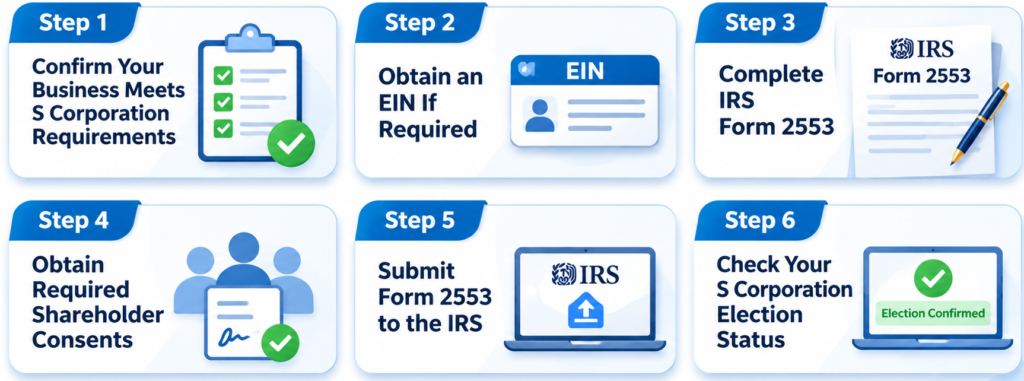
Step 1: Confirm Your Business Meets S Corporation Requirements
Check the entity type, shareholder count, shareholder eligibility, and stock structure against the IRS rules. Also confirm that your business can pay the owner a reasonable salary, since payroll becomes mandatory once the election is effective.
Step 2: Obtain an EIN If Required
Your business needs an Employer Identification Number to file Form 2553. If your corporation or LLC does not have one, you can apply for free on the IRS website and receive it the same day.
Step 3: Complete IRS Form 2553
Enter the business name, EIN, address, state of formation, and the date you want the election to start. If you operate as an LLC, keep your formation papers and prior tax records ready, and this checklist of documents needed to file LLC taxes in the US will help you gather them.
Step 4: Obtain Required Shareholder Consents
Each shareholder must sign the consent section of Form 2553 and list the number of shares owned. Where state law gives a spouse a community property interest, that spouse should sign too.
Step 5: Submit Form 2553 to the IRS
Send the signed form to the IRS address or fax number listed in the current Form 2553 instructions. Use a trackable method, and keep a copy plus proof of the date you sent it.
Step 6: Check Your S Corporation Election Status
The IRS usually mails an acceptance letter, known as CP261, within several weeks. If you hear nothing after about 60 days, call the IRS business line to confirm that your election was received and approved.
Compliance Requirements After Electing S Corp Status
- Run payroll: Pay working shareholders a reasonable salary through payroll, with proper tax withholding and deposits.
- File annual returns: Submit Form 1120-S every year and give each shareholder a Schedule K-1.
- Keep clean records: Maintain separate bank accounts, bookkeeping, and records of distributions and shareholder basis.
- Plan before year-end: Review salary, distributions, and deductions early, using a year-end tax planning checklist for small businesses.

What Are the Benefits of an S Corporation?
Potential Self-Employment Tax Savings
Self-employment tax applies to salary, not to the remaining profit paid as distributions. If your salary is reasonable, this split can lower your total payroll tax bill.
Pass-Through Taxation
Business income is taxed once, on the shareholders’ personal returns. Many owners may also qualify for the qualified business income (QBI) deduction on that pass-through income.
Avoiding Regular C Corporation Double Taxation
A C corporation pays tax on profit, and shareholders pay tax again on dividends. An S corporation avoids that second layer, so profit is generally taxed only once.
Business Losses May Pass Through to Shareholders
Losses can flow to your personal return and offset other income, within limits set by your stock basis, debt basis, at-risk rules, and passive activity rules.
Retirement and Employee Benefit Planning
Salary paid through payroll can support retirement contributions, such as a 401(k). The company can also offer other employee benefits, subject to special rules for owners holding more than 2%.
What Are the Disadvantages of an S Corporation?
Strict Shareholder Eligibility Rules
Only certain owners can hold shares. This makes it hard to bring in foreign investors, companies, or partnerships, and a single wrong transfer can end the election.
Payroll and Reasonable Compensation Requirements
You cannot skip salary and take only distributions. The IRS expects working owners to receive reasonable pay, and low salaries are a common audit trigger.
Additional Tax Filing and Compliance
An S corp must file Form 1120-S, issue K-1s, run payroll, and file payroll returns. This is more work than filing a simple Schedule C.
Restrictions on Ownership and Stock Structure
With only one class of stock, you cannot create preferred shares or give owners different profit shares. This limits flexibility when raising money or rewarding partners.
State-Level Taxes and Fees
Some states tax S corporations at the entity level or charge minimum fees. California, for example, applies a 1.5% S corp tax and a minimum annual franchise tax.
Higher Administrative Costs Compared with Some LLCs
Payroll software, bookkeeping, and a corporate tax return add cost. If profits are low, these expenses can be larger than the tax you save.
S Corporation vs LLC vs C Corporation
These three options are often confused, but they work differently. An LLC is a legal structure, a C corporation is the default corporate tax status, and an S corporation is a special tax election. For a deeper look at the tax difference, see this guide on S corp vs LLC taxes.
| Feature | S Corporation | LLC (Default Tax Status) | C Corporation |
| What it is | A tax election for a corporation or LLC | A legal structure created under state law | A corporation taxed separately from its owners |
| Federal income tax | Passes through to shareholders | Passes through to members | Corporation pays 21% federal tax |
| Double taxation | No | No | Yes, on dividends |
| Self-employment tax | Only on salary | On all net earnings | Only on salary |
| Who can own it | US citizens and residents, limited entities, up to 100 owners | Almost anyone, including foreign owners | Anyone, with no limit on owners |
| Stock classes | One class only | Flexible profit sharing | Multiple classes allowed |
| Annual federal return | Form 1120-S | Schedule C, or Form 1065 for multi-member LLCs | Form 1120 |
| Best for | Profitable US-owned small businesses | New or flexible businesses | Startups seeking investors |
When Should You File Form 2553?
S Corporation Election Deadline
File no later than 2 months and 15 days after the start of the tax year in which you want S status. For a calendar-year business electing for 2027, that date is March 15, 2027.
How to Choose the Effective Date
The effective date is usually the first day of the tax year, or the day a new corporation starts business. Choose a date when you meet every eligibility rule, because an ineligible start date causes problems.
What If You Miss the Form 2553 Deadline?
If you file late without relief, the IRS generally treats the election as effective from the next tax year. Until then, the business is taxed as a C corporation or in its default LLC status.
Late S Corporation Election Relief
Under Rev. Proc. 2013-30, the IRS may accept a late election if you had reasonable cause and file within 3 years and 75 days of the intended date. Write “FILED PURSUANT TO REV. PROC. 2013-30” at the top of the form.
What Tax Forms Does an S Corporation Need to File?
Form 1120-S: Annual Business Tax Return
This is the S corporation’s annual information return, reporting income, deductions, and credits. It is generally due on March 15 for calendar-year companies, or you can request an extension.
Schedule K-1: Shareholder Income Reporting
Each shareholder receives a K-1 showing their share of income, losses, deductions, and credits. Shareholders use it to complete their personal Form 1040 and track their stock basis.
Form W-2: Shareholder-Employee Wages
Working shareholders are employees, so the company must issue them a W-2 for their salary. Wage statements are generally due to employees and the SSA by January 31.
Form 941: Quarterly Payroll Tax Return
Form 941 reports wages paid, income tax withheld, and Social Security and Medicare taxes. It is filed every quarter, with due dates at the end of April, July, October, and January.
Form 940: Federal Unemployment Tax Return
Form 940 reports the employer’s federal unemployment (FUTA) tax. It is filed once a year, generally by January 31, and applies when the company pays wages to employees.
Form 7004: Business Tax Return Extension
If you need more time, file Form 7004 by the original due date. It gives a six-month extension to file Form 1120-S, but it does not extend the time to pay any tax owed.

Can an NRI Own an S Corporation in the USA?
No, a nonresident alien cannot be an S corporation shareholder, so an NRI living outside the US cannot own S corp shares. However, the rule depends on US tax status, not Indian origin. A green card holder or a US citizen of Indian origin, or a person who qualifies as a US resident alien, can be a shareholder. Nonresident owners usually choose an LLC or a C corporation instead.
How NRITaxs Can Help
- Eligibility review: We check your owners, residency status, and stock structure before you file Form 2553, so the election does not fail.
- Election filing: We prepare Form 2553, collect shareholder consents, and track IRS acceptance, including late election relief if a deadline was missed.
- Salary and tax planning: We help set reasonable compensation and balance salary and distributions to manage your tax bill.
- Annual compliance: We handle Form 1120-S, K-1s, and payroll filings, so you stay compliant with the IRS year after year.
Conclusion
An S Corporation can offer valuable tax advantages to eligible US business owners through pass-through taxation and potential employment tax savings. However, understanding shareholder eligibility, reasonable compensation, Form 2553 requirements, and annual tax filing responsibilities is essential before making the election. For NRIs, US tax residency and shareholder eligibility rules require additional consideration. Choosing the right tax structure depends on your business income, ownership, and long-term goals. Professional tax guidance can help you make an informed decision and maintain compliance.
Disclaimer
The content published on NriTaxs is intended for informational purposes only and does not constitute legal, tax, or financial advice. Readers are encouraged to consult qualified professionals before making any decisions based on the information provided.





Related Articles