

December 31 could be the deadline that determines how much tax your small business pays for 2026. If you wait until tax season to review your finances, you may miss valuable opportunities to reduce your tax bill. From claiming eligible deductions and reviewing equipment purchases to checking estimated tax payments and retirement contributions, several important decisions need attention before the year ends.
Year-end tax planning for small businesses helps you identify potential tax savings, avoid costly mistakes, and prepare for a smoother filing season. With important tax rules and reporting requirements to consider in 2026, having a clear plan matters more than ever. In this guide, you’ll discover 10 practical steps to take before December 31, a checklist tailored to different business structures, and common tax planning mistakes to avoid before filing your 2026 business taxes.
Key Takeaways
- ✔ Review Tax Deductions: Identify eligible business expenses and potential tax-saving opportunities before December 31, 2026.
- ✔ Plan Equipment Purchases: Evaluate business equipment and technology investments and their potential tax implications.
- ✔ Check Estimated Tax Payments: Review your payments to identify potential underpayment issues before year-end.
- ✔ Organize Financial Records: Reconcile accounts, update bookkeeping, and maintain accurate receipts and invoices.
- ✔ Review Retirement Contributions: Determine whether eligible retirement plan contributions could help reduce your taxable income.
- ✔ Prepare for Tax Season: Review your business structure, gather required documents, and consult a tax professional to plan your 2026 tax filing.
Why Is Year-End Tax Planning Important for Small Businesses?
- You can still change your tax result:- Tax rules look at what happened by December 31. Until then, you can still time income, pay bills, buy equipment, and fund retirement plans. After the year ends, you can only report what already happened, so planning early gives you control.
- You avoid surprise tax bills:- Many owners only learn their tax number in March or April. A year-end review shows your expected profit and tax early, so you can set cash aside and avoid a bill you cannot pay. Early numbers also make budgeting much easier.
- You claim every deduction you qualify for:- Missed deductions are lost money. Reviewing expenses now helps you find unrecorded costs, such as software, mileage, and contractor payments. It also shows which deductions need action before year-end, like equipment placed in service or a retirement plan opened.
- You stay compliant and avoid penalties:- Late estimated payments, missing payroll deposits, and unfiled contractor forms can all create penalties and interest. A year-end check helps you catch these gaps while there is still time to correct them or make a payment before the deadline.
- You start tax season with clean records:- Organized books make filing faster and cheaper. When income, expenses, and receipts are already sorted, your tax preparer spends less time cleaning up and more time finding savings. You also have strong proof if the IRS ever asks questions.
10 Year-End Tax Planning Steps for Small Businesses in 2026
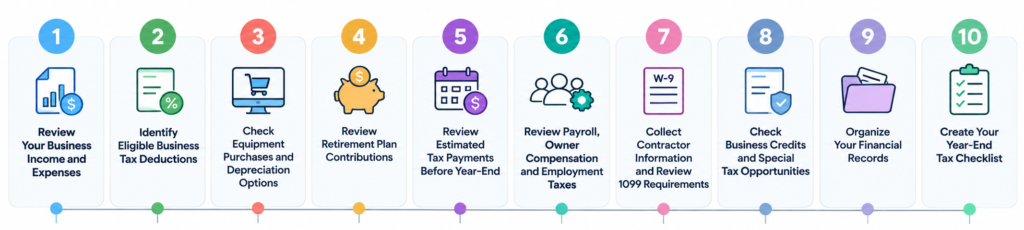
1. Review Your Business Income and Expenses
Start by running a profit and loss report from January through today. Compare it with last year and estimate your full-year profit. Check that every deposit and expense is recorded and sorted into the right category. Knowing your expected profit now tells you how much tax planning room you have and which steps below matter most.
2. Identify Eligible Business Tax Deductions
List the common deductions you may qualify for: rent, software, marketing, insurance, professional fees, business travel, vehicle use, and a home office if you use space regularly and only for business. Many owners also qualify for the 20% qualified business income deduction, which is now permanent. Business meals are usually 50% deductible. Keep a receipt or record for every claim.
3. Check Equipment Purchases and Depreciation Options
If you need equipment, vehicles, or computers, timing matters. For 2026, Section 179 allows up to $2,560,000 in expenses, and 100% bonus depreciation is permanent for qualifying property. The asset must be bought and placed in service by December 31. Heavy vehicles and SUVs have extra limits. Buy only what your business truly needs, not just for a deduction.
4. Review Retirement Plan Contributions
Retirement plans lower taxable income while building your savings. For 2026, a SEP IRA allows up to 25% of compensation or $72,000, whichever is less. A solo 401(k) allows $24,500 in employee deferrals, with the same $72,000 total cap. A new solo 401(k) generally must be set up by December 31. SEP IRAs can be funded by your filing deadline.
5. Review Estimated Tax Payments Before Year-End
Most owners without withholding must pay estimated tax quarterly. The final 2026 payment is due January 15, 2027. Compare what you have paid with your expected tax. To avoid penalties, you generally need to pay at least 90% of this year’s tax or 100% of last year’s, and 110% if your prior income was above $150,000. Corporations follow different dates.
6. Review Payroll, Owner Compensation and Employment Taxes
Check that payroll deposits and quarterly filings are up to date. S corporation owners who work in the business must receive reasonable W-2 pay. Confirm each worker is classified correctly as an employee or contractor. Bonuses generally count as 2026 wages only if paid by December 31. W-2s are due to employees by February 1, 2027.
7. Collect Contractor Information and Review 1099 Requirements
Collect a Form W-9 from every contractor now, not in January. For payments made in 2026, Form 1099-NEC is generally required once you pay a contractor $2,000 or more, up from $600. Forms are due to contractors and the IRS by February 1, 2027. Card payments are reported by the card processor instead. Total each contractor’s 2026 payments before year-end.
8. Review Your Business Structure and Tax Election
Your structure decides how your income is taxed. A growing LLC may benefit from an S corporation election, which can reduce self-employment tax but adds payroll duties. Compare your profit, owner pay, and costs before deciding.
9. Organize Your Business Tax Records and Financial Documents
Gather bank and credit card statements, invoices, receipts, payroll reports, mileage logs, asset purchase records, and last year’s return. Reconcile every account monthly, then once more after year-end. Store copies digitally in one folder. Keep records for at least three years. If you are not sure what your preparer will need, see our checklist of documents needed to file LLC taxes.
10. Create a Tax Preparation Plan for the 2027 Filing Season
Set your timeline now. Book your tax professional early, list the forms you expect, and note key dates: January 15 for estimated tax, February 1 for W-2 and 1099-NEC, March 15 for partnership and S corporation returns, and April 15 for sole proprietors and C corporations. Extensions extend filing, not payment. Decide who will collect documents and by when.
2026 Year-End Quick Reference
| Item | 2026 Figure or Date |
| Section 179 expensing limit | $2,560,000 (phase-out begins at $4,090,000) |
| Bonus depreciation | 100%, permanent for property acquired after January 19, 2025 |
| Form 1099-NEC / 1099-MISC threshold | $2,000 for payments made in 2026 |
| SEP IRA limit | Lesser of 25% of compensation or $72,000 |
| Solo 401(k) employee deferral | $24,500 (same $72,000 total cap) |
| Final 2026 estimated tax (individuals) | January 15, 2027 |
| W-2 and 1099-NEC due dates | February 1, 2027 |
| Partnership and S corporation returns | March 15, 2027 |
| Sole proprietor and C corporation returns | April 15, 2027 |
Year-End Tax Planning Checklist by Business Structure
Sole Proprietorship and Single-Member LLC
Profit flows to your personal return on Schedule C, with self-employment tax. Review estimated payments, retirement contributions, and home office records. Even a quiet year may still require a federal or state filing, so check whether an LLC must file taxes with no income.
Multi-Member LLC and Partnership
The business files Form 1065 and gives each partner a Schedule K-1. Review the operating agreement, partner capital accounts, and guaranteed payments. Agree on profit allocations before year-end, and confirm each partner’s estimated tax payments. The partnership return is due March 15, 2027.
S Corporation
An S corporation files Form 1120-S, and profit passes to owners through K-1s. Pay owner-employees reasonable wages through payroll, and keep distributions separate. Review shareholder basis and payroll filings. The return is due March 15, 2027, with Form 7004 available for extension.
C Corporation
A C corporation files Form 1120 and pays its own corporate tax, currently a flat 21%. Review estimated payments, owner salaries, and any dividends planned. Remember that dividends are taxed again on shareholders’ returns. Calendar-year returns are due April 15, 2027.
How NRITaxs Can Help With Year-End Tax Planning
NRITaxs supports small business owners, including NRI and Indian-origin founders running U.S. companies, with year-end tax review and U.S. business tax filing. We look at your income, deductions, estimated payments, payroll and 1099 duties, and entity filing needs, so gaps are found before December 31.
If you want a clear plan before the year ends, contact NRITaxs for guidance. Sharing your business structure and year-to-date numbers early lets us suggest practical next steps well before the filing season begins.

Common Year-End Tax Planning Mistakes Small Businesses Should Avoid
- Waiting until tax season to organize financial records:- Late cleanup hides missing receipts and unrecorded income. By January, many details are forgotten. Reconcile accounts monthly so year-end is a review, not a rescue project.
- Assuming every business expense is deductible:- Personal costs, fines, and most entertainment are not deductible. Claiming them risks penalties. Deduct only expenses that are ordinary, necessary, and documented. Meals are limited.
- Making purchases solely to claim deductions:- Spending a dollar to save less than a dollar in tax still costs you money. Buy equipment only when your business needs it and can afford it.
- Overlooking estimated tax payments:- Missing quarterly payments can trigger underpayment penalties even if you pay in full at filing. Check your payments and make the January 15 payment on time.
- Missing payroll or contractor reporting requirements:- Late payroll deposits and unfiled W-2s or 1099-NECs bring penalties per form. Track contractor payments all year and meet the February 1, 2027 deadlines.
- Assuming every business has the same filing deadlines:- Deadlines depend on structure. Partnerships and S corporations file by March 15, while sole proprietors and C corporations file by April 15. State dates may differ.
Conclusion
Year-end tax planning does not need to be complicated. Review your income and expenses, use deductions you qualify for, make smart equipment and retirement decisions, and confirm your payments, payroll, and contractor forms are in order. Most of these actions must happen before December 31, so start now. Good records and an early plan make filing in 2027 faster, cheaper, and far less stressful. Even a few well-timed actions can lower your tax bill and prevent penalties. If anything feels unclear, speak with a qualified tax professional before the year ends.
Disclaimer
The content published on NriTaxs is intended for informational purposes only and does not constitute legal, tax, or financial advice. Readers are encouraged to consult qualified professionals before making any decisions based on the information provided.






Related Articles