

If you are an NRI sending money to parents in India, you may wonder whether the amount you transfer is taxable, whether it is treated as a gift, or whether a large transfer could attract an Income Tax notice. In most cases, money sent by an NRI to their parents is not automatically taxable simply because it is transferred to India. However, the tax treatment can depend on the nature of the transfer, the relationship between the sender and recipient, and what the parents do with the money after receiving it.
This guide explains the NRI tax rules for sending money to parents in India in 2026, including gift tax, tax on income earned from the transferred money, documentation requirements, and when a transaction may raise questions from the Income Tax Department.
Quick Answer
Money sent by an NRI to their parents in India is generally tax-free, with no upper limit, because parents fall under the specified relative category under Section 56(2)(x) of the Income Tax Act. However, if parents invest that money and earn interest, rent, or capital gains from it, that income is taxable in the parents’ hands. Large or unexplained deposits may also attract questions from the Income Tax Department, so keeping proper records of the gift and its source is important.
Can NRIs Send Money to Their Parents in India?
Yes, NRIs are allowed to remit funds to India for family maintenance, medical treatment, education support, investments, or simply savings, without needing any prior approval from the RBI, as long as the money moves through proper banking channels and the source of funds is legitimate. This is one of the most flexible parts of India’s foreign exchange framework; inward remittances into India carry no ceiling, unlike outward remittances from India, which are capped under the Liberalised Remittance Scheme (LRS). If you want to understand the broader tax treatment of money transferred between India and overseas accounts, see our detailed guide on NRI Remittance Tax in India.
Is Money Sent by an NRI to Parents Taxable in India?
No. The money itself is not taxable to your parents when they receive it. This surprises a lot of NRIs because they assume any large inward transfer must attract tax somewhere. It doesn’t, provided the transfer genuinely goes to a parent and isn’t disguised as something else, like undisclosed business income routed through a family account. The exemption exists specifically because Indian tax law treats parent-child transfers as personal, not commercial.
Is Money Sent to Parents Considered a Gift?
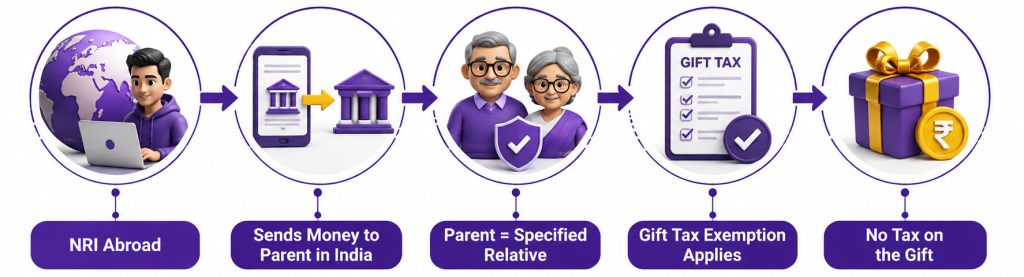
Legally, yes. Under the Income Tax Act, any money you send your parents without expecting anything back is classified as a gift. But not every gift is taxed the same way in India. The tax outcome depends entirely on who is giving and who is receiving. When the relationship qualifies as a “specified relative,” the gift is fully exempt, no matter the amount. When it doesn’t, different rules kick in.
Gift Tax Rules for NRI-to-Parent Transfers
Section 56(2)(x) of the Income Tax Act is the section that governs this. It says that money or property received without consideration is taxable in the recipient’s hands only if it exceeds ₹50,000 in a financial year unless the person receiving it is a “specified relative.” Parents are explicitly on that list, along with spouses, siblings, children, and certain other close family members. So when parents receive money from their NRI son or daughter, the ₹50,000 threshold simply doesn’t apply to them. The exemption is complete and unconditional.
Compare this to a gift from a friend or a cousin: if that crosses ₹50,000 in a year, the entire amount becomes taxable as “income from other sources” for the recipient, not just the portion above the threshold. That’s the trap most non-relative gifting falls into, and it’s exactly what the parent-child exemption protects you from.
Who Pays Tax on Money Sent by an NRI?
Nobody pays tax on the transfer itself. Not the NRI sending it, and not the parents receiving it. Where tax does eventually show up is on what the money does after it lands. If your parents deposit ₹15 lakh into a fixed deposit and earn interest on it, that interest is income in their hands and gets taxed at their applicable slab rate. The original ₹15 lakh stays untouched by tax; only the earnings from it become taxable going forward. This is a distinction a lot of NRIs miss, and it matters when deciding how your parents should hold or invest the money you send.
When Can Parents Receive Money Tax-Free?
Money from a child to a parent is tax-free in every one of these situations:
- A one-time lump sum transfer, such as retirement support or a house down payment
- Regular monthly transfers for household expenses or medical care
- Money meant for parents to invest on their own behalf
- Funds sent for a specific purpose like a medical procedure or home renovation
In all these cases, the amount and frequency don’t matter. What matters is that the money is genuinely going to a parent and is routed through a proper banking channel with a clear paper trail.
Can Sending Money to Parents Trigger an Income Tax Notice?
This is where many NRIs get caught by surprise. Just because a money transfer is tax-exempt does not mean the tax department will not notice it. The tax system in India now checks bank deposits, big transactions and AIS (Annual Information Statement) data closely. If the bank account of your parents shows an amount of money that has no clear reason the tax office might ask questions. This can happen even if the money transfer was never meant to be taxed in the place.
I have seen this actually happen to NRIs. A large money transfer to a parent gets marked as a “high-value transaction” or “unexplained cash credit.” Then the family has to spend time proving that the money was a gift and not hidden income. In some cases NRIs have had to fight this through a long appeal process. They eventually won because their bank records and proof of their relationship were solid. The real lesson is not that the money transfer is risky. The real lesson is that a money transfer that lacks paperwork looks risky on paper, when the money transfer is perfectly legal.
The best habit to have is very simple. You should always send money through your NRE & NRO accounts using official bank channels. You should never send money as cash. If you are unsure whether your overall Indian income requires an ITR, then you need to understand which ITR form to use, and how to stay compliant.

Is there any limit on family remittances?
There is no upper limit on inward remittances into India. You can send ₹50,000 or ₹50 lakh in a single transfer, and the amount by itself does not create a tax liability. What large transfers do require is stronger documentation, since the bigger the number, the more likely it is to be flagged for routine verification. If you’re a US-based NRI, keep in mind this is a two-country conversation: India doesn’t tax the transfer, but the IRS has its own annual gift-reporting threshold on the sending side, so it’s worth checking your obligations there separately.
NRE vs NRO Account: Which Should You Use to Send Money?
Most NRIs already maintain both account types, but the choice matters for this specific purpose. If you’re setting up dedicated accounts for family transfers for the first time, our detailed NRE/NRO account for NRIs walks through the process end to end.
| Feature | NRE Account | NRO Account |
| Best used for | Sending your own foreign earnings to India | Receiving or holding India-sourced income |
| Can it receive gifts from residents? | No — resident gifts generally cannot be credited here | Yes, this is where resident-to-NRI gifts are typically routed |
| Interest taxability (for the NRI) | Tax-free in India | Taxable, with TDS deducted |
| Repatriability | Fully repatriable | Limited repatriation, subject to conditions |
| Ideal for sending money to parents | Yes — transfer directly into parents’ resident savings account | Not typically needed for this purpose |
Tax on Interest Earned by Parents
Once the money reaches your parents, it becomes theirs, and any income it generates is taxed under their name, at their tax slab, not yours. If your parents are senior citizens, they benefit from a higher basic exemption limit and a deduction of up to ₹50,000 on interest income under Section 80TTB, which can make holding the money in their name genuinely tax-efficient. This is worth factoring in if you’re deciding whether to invest funds directly yourself or gift them to your parents to invest.
If you are also transferring your own foreign earnings to India through an NRE account, it is important to understand when that foreign income remains outside the Indian tax net. See our guide on Foreign Salary Credited to NRE Account.
What Documents Should Parents Keep?
| Document | Why It Matters |
| Bank remittance advice / SWIFT confirmation | Proves the money came from the NRI’s own foreign account |
| Relationship proof (birth certificate, passport) | Confirms the sender qualifies as a “specified relative” |
| Source of funds proof (salary slips, foreign tax returns) | Shows the money was legitimately earned abroad |
| Simple gift letter or note | Not legally mandatory for cash transfers, but useful as supporting evidence |
| Parents’ bank statements | Shows the credit entry matches the remittance amount and date |
Example: NRI Sending ₹10 Lakh to Parents
Rohan is a US-based NRI. He wires ₹10 lakh from his NRE account directly into his father’s savings account in India, to help fund a home renovation. Since his father is a “specified relative” under Section 56(2)(x), this entire ₹10 lakh is completely tax-free for his father, and Rohan owes no tax in India on the transfer either. His father later puts ₹4 lakh of it into a fixed deposit earning 7% interest. That interest, roughly ₹28,000 a year, is taxable income for his father, reported in his father’s ITR, and subject to TDS by the bank once it crosses the threshold. The ₹10 lakh principal itself is never taxed only the return it generates going forward.
How to Send Money to Parents Safely
- Always transfer through a bank, wire transfer, or RBI-approved remittance platform never through informal cash carriers or hawala-style channels.
- Send directly from your own NRE/foreign account into your parents’ account, avoiding intermediary accounts.
- Use the correct purpose code (such as family maintenance) when prompted by your bank or remittance app.
- Keep a simple record each time date, amount, and purpose even if it feels unnecessary for smaller transfers.
- If a single transfer is unusually large, consider a short gift letter as backup documentation.
Contact Us
Common Mistakes NRIs Should Avoid
- Sending large cash amounts informally. Cash gifts above ₹2 lakh can attract penalties under the Income Tax Act, even between relatives, because the law wants a traceable banking trail.
- Assuming parents don’t need to report anything. Even though the gift is exempt, parents should still be able to explain the source if the deposit shows up in their AIS or triggers a query; silence looks worse than a documented, exempt gift.
- Ignoring tax on the income the money generates. NRIs often assume that because the transfer was tax-free, everything downstream is too. It isn’t interest, rent, or capital gains on the gifted funds are taxable to the parent.
- Mixing up NRE and NRO account rules when parents send money back to the NRI, which is a different transaction with its own LRS and routing requirements.
- Not keeping any documentation because the transfer “obviously” looks like family support until a notice arrives and there’s nothing to point to.
Conclusion
The core rule here is refreshingly simple: money from an NRI child to a parent is tax-free in India, with no ceiling and no gift tax return required in most cases. The complexity only shows up around the edges how the money is invested afterward, how well it’s documented, and how it looks to an automated system scanning bank deposits. Get the routing right, keep basic records, and this remains one of the cleanest, most stress-free transfers in the entire NRI financial toolkit.
Disclaimer
The content published on NriTaxs is intended for informational purposes only and does not constitute legal, tax, or financial advice. Readers are encouraged to consult qualified professionals before making any decisions based on the information provided.








Related Articles