
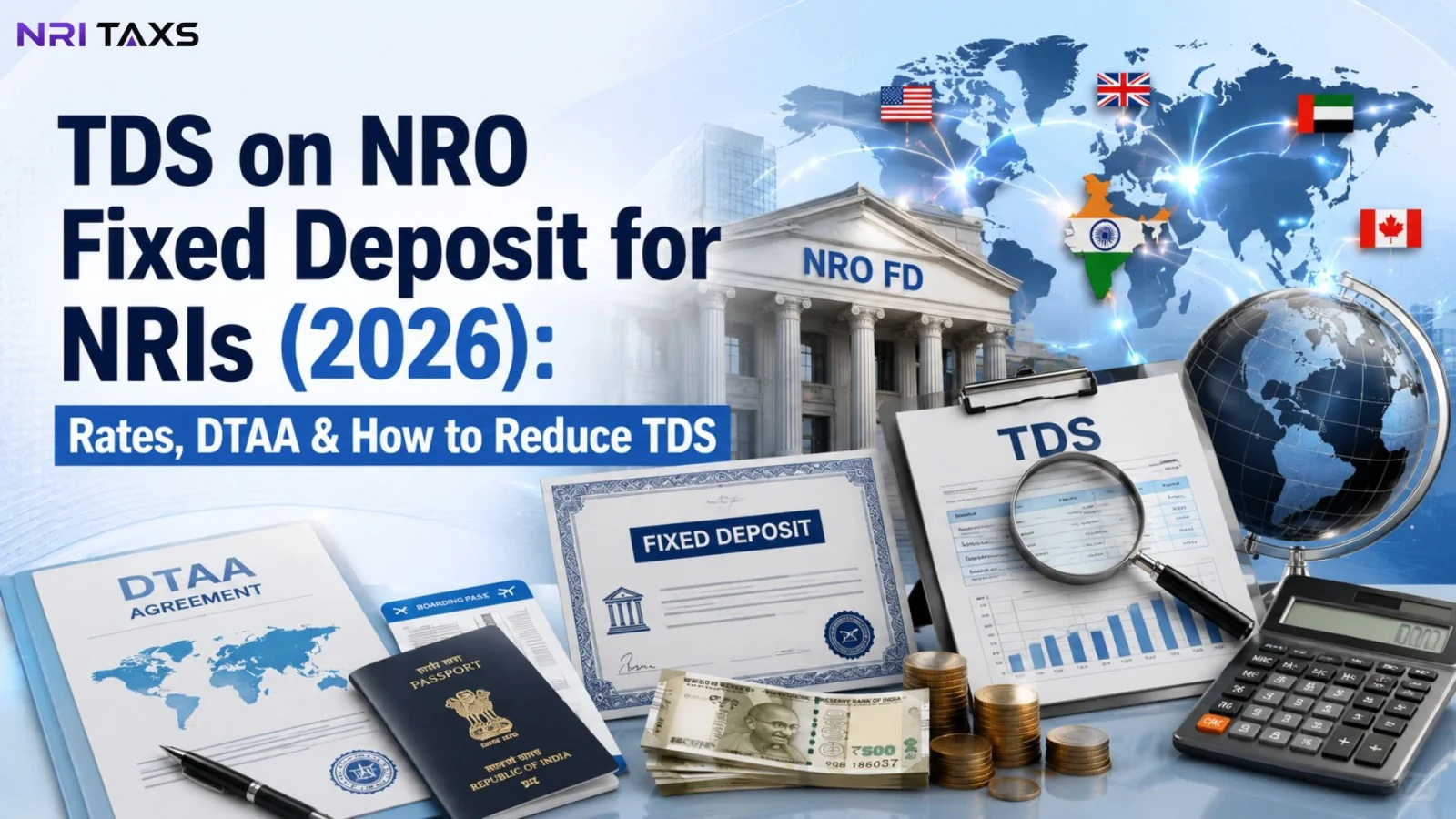
If you’re an NRI holding a Fixed Deposit in an NRO account, you’ve likely wondered why the amount credited to your account is lower than the interest your deposit actually earns. The reason is Tax Deducted at Source (TDS), which banks are required to deduct before crediting interest to your account. While this deduction is mandatory, it doesn’t always reflect your final tax liability.
Many NRIs end up paying more tax than necessary because they are unaware of DTAA benefits, fail to submit the required documents to their bank, or miss the opportunity to claim a refund of excess TDS through their income tax return. This guide explains everything you need to know about TDS on NRO Fixed Deposits for NRIS, including the latest TDS rates, how TDS is calculated, when DTAA benefits can reduce the deduction, the documents you’ll need, and the step-by-step process to claim a refund if excess TDS has already been deducted.
What Is an NRO Fixed Deposit?
An NRO (Non-Resident Ordinary) Fixed Deposit is a rupee-denominated FD held in an NRO account, which is the account NRIs use to manage income earned in India rent, dividends, pension, or interest from other Indian investments. Unlike an NRE account, which holds foreign earnings remitted to India, an NRO account is meant for India-sourced income, and that distinction is exactly why NRO FD interest is taxed in India while NRE FD interest generally isn’t.
If you have recently moved abroad and are still using a regular savings account, you should first convert your resident savings account to an NRO account before opening an NRO Fixed Deposit.
Is TDS Applicable on NRO Fixed Deposits for NRIs?
Yes. Interest earned on an NRO FD is treated as income accruing in India, and under Section 195 of the Income Tax Act, the bank is required to deduct TDS on it before crediting the interest to your account regardless of the amount. This is a key difference from resident FDs, where TDS only kicks in once interest crosses a threshold (currently ₹40,000, or ₹50,000 for senior citizens, under Section 194A). For NRO FDs, there’s no such exemption limit; TDS applies from the very first rupee of interest.
NRO Fixed Deposit TDS Rates in 2026
Here’s how the TDS on NRO fixed deposit interest compares with a resident FD:
| Depositor Type | Applicable Section | TDS Rate |
| Resident Indian | Section 194A | 10% (only above ₹40,000 / ₹50,000 for senior citizens) |
| NRI (NRO FD, no DTAA claimed) | Section 195 | 30% + surcharge (if applicable) + 4% cess — effectively ~31.2% to ~35.88% depending on income slab |
| NRI (NRO FD, DTAA claimed with valid TRC & Form 10F) | Section 195 read with DTAA | As low as 7.5%–15%, depending on India’s tax treaty with your country of residence |
Unlike the domestic TDS rate, DTAA rates are not increased by surcharge or cess the treaty rate is the final rate, which is one reason claiming DTAA benefits makes such a meaningful difference.
How TDS Is Calculated on an NRO FD?
TDS is deducted on the gross interest credited or paid, whichever happens first, not on your final tax liability. For example, if your NRO FD earns ₹5,00,000 in annual interest and no DTAA benefit has been claimed, the bank deducts roughly 30% (plus applicable surcharge and 4% cess), leaving you with a TDS deduction of approximately ₹1,50,000 or more, even if your actual tax liability for the year after applicable deductions turns out to be lower. That mismatch between what’s deducted and what’s actually owed is exactly what DTAA and lower-deduction certificates are designed to fix.
Can NRIs Reduce TDS on NRO Fixed Deposits?
Yes and this is the part most NRIs never act on simply because nobody explains it clearly. There are two separate routes to reducing TDS on NRO FD interest, and understanding both is the difference between losing money every year and keeping it.
Your eligibility for DTAA benefits and your overall tax liability in India also depend on your NRI residential status under the Income Tax Act. If you’re unsure how your status is determined, read our detailed guide on NRI Residential Status in India.

Route 1: Claiming DTAA Benefits
India has a Double Taxation Avoidance Agreement (DTAA) with over 85 countries. If you’re a tax resident of one of these countries, you can have your bank apply the treaty rate directly to your NRO FD interest, instead of the standard 30%. Treaty rates vary by country Mauritius sits at the lower end around 7.5%, most Gulf and continental European countries fall around 10%, the UAE is typically around 12.5%, and the US, UK, Singapore, Canada, and Australia are generally capped around 15%. A small number of countries have no comprehensive DTAA with India, in which case the full 30% domestic rate applies with no treaty relief available.
To claim this rate at source, you need to submit specific documents to your bank before the interest is credited, not after.
Route 2: Lower Deduction Certificate Under Section 197 (Form 13)
If your actual tax liability in India is lower than even the DTAA rate for instance, if your total Indian income falls below the basic exemption limit you can apply to the Income Tax Department for a Lower Deduction Certificate under Section 197, using Form 13 on the TRACES portal. One important update for 2026: following Budget 2025 changes, NRIs can no longer apply for a NIL TDS certificate only a lower-rate certificate is available, based on your estimated income and tax liability for the year, as determined by the Assessing Officer.
Route 3: PAN — The Non-Negotiable Baseline
Regardless of which route you use, you need a valid PAN on file with your bank. Without one, banks are required under Section 206AA to deduct TDS at the higher of the treaty rate, the domestic rate, or 20% whichever is highest which defeats the purpose of claiming any DTAA benefit at all.
Documents Required to Claim DTAA Benefits
To have your bank apply the lower DTAA rate on your NRO FD interest, you’ll typically need to submit these documents at the start of each financial year:
| Document | Purpose |
| PAN | Mandatory identification; without it, the highest possible TDS rate applies by default |
| Tax Residency Certificate (TRC) | Issued by the tax authority of your country of residence, proving you are a tax resident there |
| Form 10F | Self-declaration providing details not captured in the TRC (status, nationality, tax ID, address, period of residency) |
| Self-Declaration / Beneficial Ownership Declaration | Confirms you are the beneficial owner of the interest income and are eligible to claim treaty benefits |
| Passport copy | Supports proof of NRI status and country of residence |
These documents typically need to be submitted fresh for each financial year, since a TRC is usually only valid for the specific year it’s issued for.
How to Apply for Lower TDS Under DTAA?
Here’s the practical, step-by-step process to get the lower DTAA rate applied to your NRO FD:
Step 1: Confirm Your Tax Residency Status
Before anything else, confirm you qualify as a tax resident of your country of current residence for the relevant financial year this is what your TRC will certify.
Step 2: Obtain Your Tax Residency Certificate (TRC)
Apply for a TRC from the tax authority of your country of residence for example, the IRS in the US, HMRC in the UK, or the relevant tax department in the UAE. Processing time varies by country, so it’s worth starting this well before your FD’s interest is due to be credited.
Step 3: Complete Form 10F
Fill out Form 10F, which is typically filed online through the Income Tax e-filing portal and requires a PAN and, in most cases, a digital signature. From FY 2026-27 onward, this form is being replaced by a revised Form 41 as part of the government’s compliance updates, so check the current requirement with your bank before filing.
Step 4: Submit Documents to Your Bank
Submit your PAN, TRC, Form 10F, self-declaration, and passport copy to your bank’s NRI services desk, well before the FD’s interest credit date. Most banks require this at the start of the financial year or at the time of FD renewal.
Step 5: Verify the Rate Applied at the Time of Credit
Once your documents are processed, check your next TDS certificate (Form 16A) or interest credit advice to confirm the reduced treaty rate was actually applied, rather than the default 30%.
What If the Bank Already Deducted Higher TDS?
If your bank deducted TDS at the standard 30% rate before your DTAA documents were processed which is common if you open or renew an FD mid-year you’re not stuck with the loss. You can claim the excess TDS as a refund by filing your Income Tax Return (ITR) for that financial year, reporting the actual DTAA-eligible tax liability and claiming credit for the TDS already deducted. The refund typically takes a few months to process once your ITR is filed and verified.

Can NRIs Avoid TDS Completely?
Not entirely, and it’s important to be clear about this: NRO FD interest is taxable income in India, so some TDS will generally apply regardless of your country of residence. What you can do is bring that rate down significantly through DTAA, to as low as 7.5%–15% depending on your country, or further still through a Section 197 lower deduction certificate if your actual tax liability is lower than even the treaty rate. A NIL TDS certificate, however, is no longer available to NRIs following recent Budget changes, even in cases where no tax may ultimately be owed.
NRO FD vs NRE FD: Tax Comparison
| Feature | NRO FD | NRE FD |
| Source of funds | Income earned in India (rent, dividends, pension, etc.) | Foreign earnings remitted to India |
| Interest taxability in India | Taxable, TDS applies from the first rupee | Fully exempt from Indian tax |
| TDS rate (no DTAA) | ~30% + surcharge + cess | Not applicable (interest is tax-exempt) |
| TDS rate (with DTAA) | As low as 7.5%–15%, by country | Not applicable |
| Repatriation of funds | Restricted — up to USD 1 million per financial year, subject to conditions | Fully and freely repatriable |
| Currency | Indian Rupees | Indian Rupees (funded via foreign currency remittance) |
Common Mistakes NRIs Make
- Not submitting DTAA documents at the start of the financial year, so the bank defaults to the full 30% rate for months before catching up.
- Assuming a DTAA-eligible country automatically gives a lower rate the reduced rate only applies once the TRC and Form 10F are actually submitted.
- Letting the TRC lapse most banks require a fresh TRC every financial year, not a one-time submission.
- Confusing a Lower Deduction Certificate with a NIL certificate NIL certificates are no longer available to NRIs after recent Budget changes.
- Not filing an ITR to claim back excess TDS, assuming the deducted amount is simply lost once the financial year ends.
- Forgetting to update PAN details with the bank, which can trigger the higher default rate under Section 206AA.
Conclusion
TDS on NRO fixed deposit interest is one of the most overlooked drains on an NRI’s Indian income not because the rules are impossible to navigate, but because the paperwork needs to happen before the interest is credited, not after. If you’re currently having 30% deducted and you’re a tax resident of a DTAA country, there’s a good chance you’re leaving real money on the table every single year. Get your TRC and Form 10F filed early in the financial year, and if TDS has already been over-deducted, don’t skip filing your ITR that’s how you get it back.
Disclaimer
The content published on NriTaxs is intended for informational purposes only and does not constitute legal, tax, or financial advice. Readers are encouraged to consult qualified professionals before making any decisions based on the information provided.







Related Articles