
Running a small business in the USA means managing expenses, employees, taxes, and everyday operational costs. But are you paying more in taxes than your business actually owes? Many small business owners miss valuable tax deductions, credits, and savings opportunities simply because they don’t know which tax rules apply to them. Whether you operate an LLC, S Corporation, partnership, or sole proprietorship, the right tax planning strategies can help reduce your taxable income legally. In this guide, discover 15 practical ways small businesses save on taxes in 2026 and avoid common tax mistakes.
15 Legal Ways Small Businesses Can Save on Taxes in the USA
Each strategy below is legal and widely used. Check that it fits your business type before you claim it.
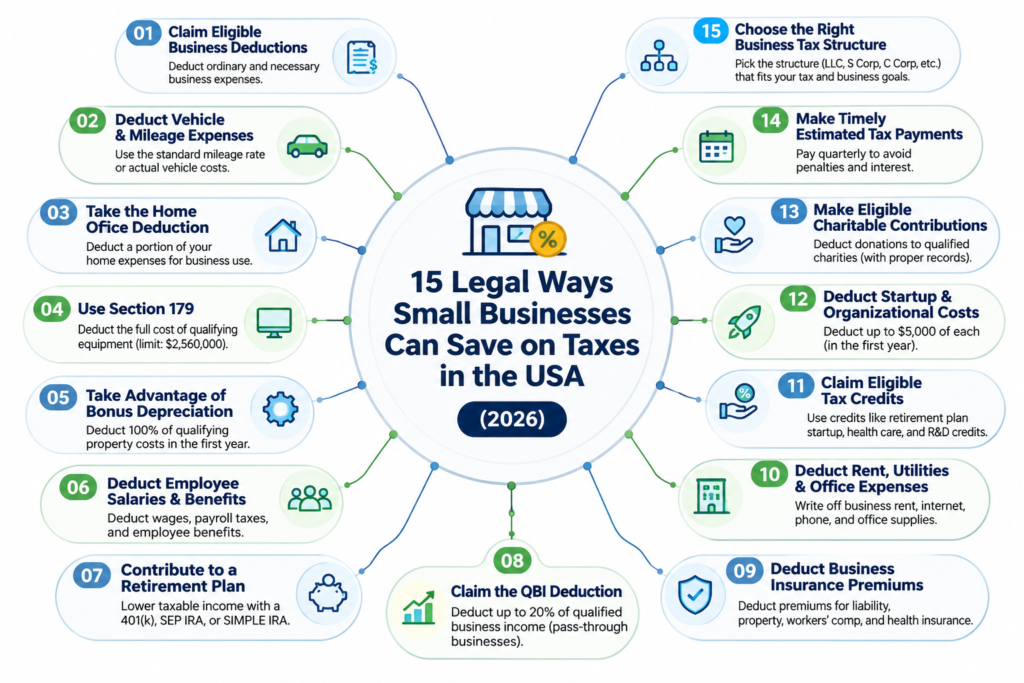
1. Claim All Eligible Small Business Tax Deductions
The IRS lets you deduct expenses that are ordinary and necessary for your business, such as advertising, software, professional fees, supplies, and travel. Business meals are generally 50% deductible. Keep receipts and note the business purpose of each expense. If you own an S corporation, read our guide to S corporation tax deductions to see which expenses apply to your return.
2. Deduct Business Vehicle and Mileage Expenses
If you use a car or truck for business, you can deduct either your actual costs or the standard mileage rate. For 2026, the rate is 72.5 cents per mile for miles driven through June 30 and 76 cents per mile from July 1. Keep a log with the date, miles, and purpose of each trip. Commuting miles do not count.
3. Take Advantage of the Home Office Deduction
If you use part of your home regularly and exclusively for business, you may deduct a share of your home costs. The simplified method allows $5 per square foot, up to 300 square feet, which is a maximum of $1,500. The regular method uses actual expenses such as rent, utilities, and insurance. W-2 employees cannot claim this deduction.
4. Use Section 179 to Deduct Qualifying Equipment Purchases
Section 179 lets you deduct the full cost of qualifying equipment in the year you place it in service, instead of spreading it over several years. For 2026, the limit is $2,560,000, and it starts to phase out once purchases pass $4,090,000. It covers machinery, computers, furniture, and off-the-shelf software. The deduction cannot be more than your business income for the year.
5. Take Advantage of Bonus Depreciation
Bonus depreciation lets you deduct 100% of the cost of qualifying property in the first year. Under the 2025 tax law, 100% bonus depreciation is permanent for property acquired and placed in service after January 19, 2025. Unlike Section 179, it has no dollar cap and can create a business loss. It applies to both new and used equipment.
6. Deduct Employee Salaries, Wages and Benefits
Wages, bonuses, payroll taxes, and benefits you pay to employees are deductible business expenses. This includes health insurance contributions, retirement plan matches, and paid leave. If you own an S corporation and work in the business, you must pay yourself a reasonable salary.
7. Contribute to a Small Business Retirement Plan
Retirement plans lower your taxable income while you build savings. For 2026, you can defer up to $24,500 into a 401(k), with extra catch-up amounts if you are 50 or older, or $17,000 into a SIMPLE IRA. The overall limit for plans like a solo 401(k) or SEP-IRA is $72,000, subject to pay limits. Deadlines differ by plan, so set it up before year-end.
8. Claim the Qualified Business Income (QBI) Deduction
Owners of pass-through businesses, such as sole proprietorships, partnerships, LLCs, and S corporations, may deduct up to 20% of qualified business income. The 2025 tax law made this deduction permanent and added a $400 minimum deduction for owners with at least $1,000 of QBI from an active business. Income limits and special rules for service businesses apply, and C corporations cannot claim it.
9. Deduct Business Insurance Premiums
Premiums for general liability, professional liability, property, cyber, and workers’ compensation insurance are generally deductible. Self-employed owners may also deduct health insurance premiums for themselves, their spouse, and their dependents if they are not eligible for an employer plan. Owners of more than 2% of an S corporation follow special reporting rules, so ask your tax preparer.
10. Deduct Business Rent, Utilities and Office Expenses
Rent for your office, shop, or co-working space is deductible, along with electricity, internet, phone service, software subscriptions, and office supplies. Only the business share of mixed-use costs counts, such as a phone used for both work and personal calls. Paying these bills from a business account makes them easier to track and support.
11. Claim Eligible Business Tax Credits
A tax credit reduces your tax bill dollar for dollar, which is stronger than a deduction. Common small business credits include the retirement plan startup credit (up to $5,000 a year for three years), the small employer health care credit for employers with fewer than 25 full-time equivalent employees, and the R&D credit, which qualifying startups can use against payroll taxes up to $500,000. The Work Opportunity Tax Credit was scheduled to end after 2025, so confirm its status before you claim it.
12. Deduct Eligible Startup and Organizational Costs
New businesses can deduct up to $5,000 of startup costs and $5,000 of organizational costs in the first year. Each deduction shrinks once its total costs pass $50,000, and any remaining amount is deducted over 180 months. Startup costs include market research, advertising, and training. Organizational costs include legal fees to form your entity. Even if your new LLC made no money, it may still have filing duties, as explained in our guide on whether an LLC needs to file taxes if it made no money.
13. Make Eligible Business Charitable Contributions and Donations
Donations to qualified charities may be deductible if you keep proper records, including a written acknowledgment for gifts of $250 or more. C corporations deduct gifts on the business return, but beginning in 2026 only the amount above 1% of taxable income counts, up to a 10% cap. For pass-through businesses, gifts usually flow to the owners’ personal returns. Sponsoring a local event in exchange for advertising may qualify as a business advertising expense instead.
14. Make Timely Estimated Tax Payments
Estimated payments do not shrink your tax bill, but they protect your savings from penalties and interest. Business owners who expect to owe at least $1,000 generally pay quarterly. The 2026 due dates are April 15, June 15, September 15, and January 15, 2027. To avoid underpayment penalties, pay at least 90% of this year’s tax or 100% of last year’s tax (110% if your income was above $150,000).
15. Choose the Right Business Tax Structure
Your structure affects how much tax you pay. Sole proprietors and default LLCs pay income tax plus 15.3% self-employment tax on profit. An S corporation election may reduce self-employment tax on profit above a reasonable salary, but it adds payroll and filing costs. C corporations pay a flat 21% tax. Compare your options in our guide to S corp vs LLC taxes. Note that nonresident aliens cannot own S corporation shares.

How Much Can a Small Business Save on Taxes?
Savings depend on your income, structure, and tax rate, so this is only an illustration. Maria runs a single-member LLC, taxed as a sole proprietorship, with $150,000 of profit before planning. She assumes a 24% federal tax rate.
| Strategy | Deduction | Estimated Tax Saved (24%) |
| Section 179 on $20,000 of equipment | $20,000 | $4,800 |
| Retirement plan contribution | $20,000 | $4,800 |
| Business mileage (3,000 miles at 72.5¢ + 3,000 miles at 76¢) | $4,455 | $1,069 |
| Home office (200 sq. ft. at $5) | $1,000 | $240 |
| Total | $45,455 | $10,909 |
Maria lowers her taxable income by $45,455 and her estimated federal income tax by about $10,909. Remember that the equipment cost and retirement contribution are real money spent or saved, so the benefit is a lower tax bill, not free cash. This example leaves out self-employment tax, state tax, and the QBI deduction, which would change the final result.
How Tax-Saving Strategies Differ by Business Structure
Your business structure decides which strategies apply and how they work. Use this table to see where to focus.
| Business Structure | How Profit Is Taxed | Tax-Saving Areas to Focus On |
| Sole proprietorship or single-member LLC | Reported on Schedule C of the owner’s personal return, plus self-employment tax | Home office, vehicle costs, self-employed health insurance, retirement plans, QBI deduction, Section 179 |
| Partnership or multi-member LLC | Profit passes to partners through Schedule K-1 and is taxed on their personal returns | Guaranteed payments, partner health insurance, retirement plans, QBI deduction, equipment deductions |
| S corporation | Profit passes to shareholders through Schedule K-1; owners pay themselves a salary and may take distributions | Reasonable salary, payroll deductions, accountable plan reimbursements, QBI deduction, retirement plans |
| C corporation | Taxed at the corporate level at a flat 21%; dividends are taxed again to shareholders | Owner wages, employee benefits, retirement plans, Section 179, credits, and the 1% charitable floor to plan around |
Small Business Year-End Tax Planning Checklist for 2026
The most useful tax moves must happen before December 31, 2026. Work through this checklist now.
- Review your profit-and-loss statement now. Knowing your expected 2026 income shows which deductions, retirement contributions, and equipment purchases are worth making before December 31.
- Place qualifying equipment in service by December 31, 2026. Section 179 and bonus depreciation only apply to assets that are ready for use this year.
- Open or fund your retirement plan. Employee 401(k) deferrals generally must be made through payroll by year-end, so confirm your plan’s deadline with your provider.
- Check your estimated tax payments. The last 2026 payment is due January 15, 2027, so compare what you paid with your expected tax liability.
- Collect Form W-9 from every contractor and update payroll records. Form 1099-NEC is required for contractors paid $2,000 or more in 2026, due February 1, 2027.
- Organize receipts, mileage logs, and bank statements now. Use a small business tax preparation checklist to gather every document your tax preparer will ask for.
- Make charitable gifts and pay deductible bills before year-end. Cash-basis businesses generally deduct expenses in the year paid, but prepaid costs have special rules.
Common Small Business Tax Mistakes That Can Cost You Money
Mistake 1: Mixing Personal and Business Money
Using one account for personal and business spending makes records unreliable, weakens deductions in an audit, and can hurt your LLC’s liability protection.
Mistake 2: Keeping Poor Records
Without receipts, mileage logs, and invoices, the IRS can deny deductions. Record each expense when it happens and briefly note the business purpose.
Mistake 3: Skipping Estimated Tax Payments
Paying everything at filing time can trigger underpayment penalties. Pay quarterly, using safe harbor amounts such as 90% of this year’s tax or 100% of last year’s.
Mistake 4: Misclassifying Workers
Treating employees as contractors can lead to back payroll taxes, penalties, and interest. Review IRS and state rules before classifying anyone as an independent contractor.
Mistake 5: Filing Late or Missing Deadlines
Late returns bring penalties even when no tax is due. A late S corporation return costs $260 per shareholder, per month, so file or extend.
When Should You Hire a Small Business Tax Professional?
- You have employees or contractors. Payroll filings, W-2s, and 1099s carry strict deadlines and penalties, and a professional keeps them accurate and on time.
- You are choosing or changing your structure. Moving from an LLC to an S corporation affects taxes for years, so an expert can test the numbers first.
- You are making a large purchase. Equipment, vehicles, and property involve Section 179, bonus depreciation, and timing choices that are easy to get wrong.
- You earn income in several states or countries. Multi-state sales, foreign owners, or overseas income add filing rules, such as extra state returns or foreign reporting forms.
- You received an IRS notice or missed a deadline. A professional can respond to notices, request penalty relief, and fix past returns before small problems grow.

Conclusion
Saving on small business taxes is not about tricks. It comes from using the rules the tax code already gives you: claiming every eligible deduction, timing big purchases, funding retirement plans, using credits, and choosing the right structure. Start with clean records, review your numbers before December 31, 2026, and compare strategies against your business type. Tax rules change, so confirm current limits with the IRS or a qualified professional. Planning now can keep thousands of dollars in your business.
Disclaimer
The content published on NriTaxs is intended for informational purposes only and does not constitute legal, tax, or financial advice. Readers are encouraged to consult qualified professionals before making any decisions based on the information provided.





Related Articles