

The Jio IPO for NRIs is the biggest investing story in India right now. Jio Platforms is raising up to ₹30,213 crore, the largest public issue India has ever seen, and bidding closes on Friday, 23 October 2026. If you live in the UAE, US, UK or anywhere else abroad, you probably have three questions. Can I apply? Which account should I use? How much tax will I pay if the shares list well? This guide answers all three in simple steps. You will learn who is eligible, how NRE and NRO accounts differ for this IPO, how to place your bid, and how your gains are taxed.
Quick Answer
Yes. NRIs, OCI cardholders and PIOs can apply for the Jio Platforms IPO with an NRE or NRO bank account, an NRI demat account and a valid PAN. There is no separate NRI quota, so you bid in the Retail or NII category. Shares bought from an NRE account can be repatriated; NRO-funded shares cannot be freely sent abroad. A PIS account is generally not needed to apply, but confirm this with your bank or broker.
Jio Platforms IPO 2026: Key Details at a Glance
Jio Platforms is the digital and telecom arm of Reliance Industries. The offer is a fresh issue only, so there is no offer for sale and the money goes to the company. Most of it, about ₹27,500 crore, will be used to repay borrowings of Reliance Jio Infocomm. At the top of the price band, the company is valued at roughly ₹10.3 lakh crore (about $108 billion), and Reliance will still hold around 66.43% after listing.
| Detail | Jio Platforms IPO |
| Issue type | Fresh issue of up to 27 crore shares |
| Price band | ₹1,065 to ₹1,119 per share |
| Issue size | Up to ₹30,213 crore at the top of the band |
| Lot size | 12 shares (₹13,428 at ₹1,119) |
| Anchor bidding | 19 October 2026 |
| Public bidding | 21 to 23 October 2026 |
| Allotment | 26 October 2026 |
| Refund and share credit | 27 October 2026 |
| Listing | 28 October 2026 (tentative), on NSE and BSE |
| Allocation | QIB up to 50%, NII at least 15%, Retail at least 35% |
Dates can shift, so always check your broker app and the official offer document before you bid.
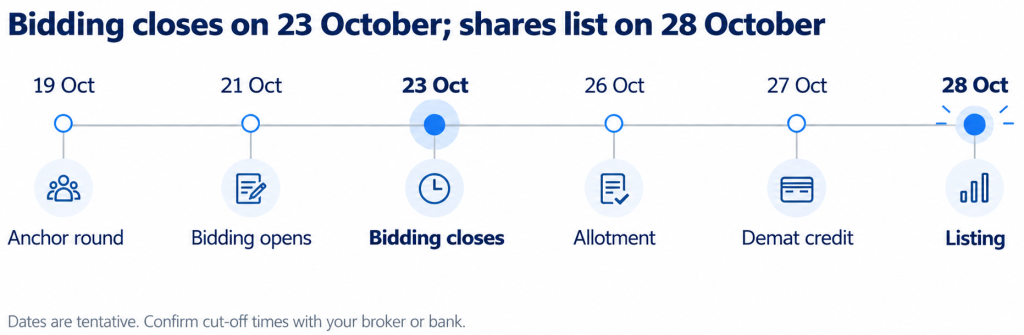
The public window is three days: bidding opens on 21 October and closes on 23 October, with listing tentatively on 28 October.
Can NRIs Apply for the Jio IPO? (Eligibility)
Yes. NRIs, PIOs and OCI cardholders can bid through an NRE or NRO account. Living abroad is not enough on its own. You must be an Indian citizen living outside India, or hold OCI or PIO status. Foreign nationals without OCI cannot use this route.
There is no separate NRI quota in this issue. You compete with resident Indians in the same pool. NRIs usually apply in one of two categories:
- Retail: total bid up to ₹2 lakh. At the top of the band, that is a maximum of 14 lots (168 shares), or ₹1,87,992.
- NII (non-institutional investors): bids above ₹2 lakh.
When you place the bid, choose the cut-off price option. It means you accept whatever final price is fixed within the band, which keeps your bid valid.
Reliance shareholder quota: Jio has reserved a separate portion for individuals and HUFs who held Reliance Industries shares on or before 14 October 2026. Eligible holders can apply under this quota (up to ₹2 lakh) and also in the retail category. If you hold Reliance shares as an NRI, ask your broker whether you qualify before you rely on it.
OCI cardholders often ask whether they face extra limits.
NRE vs NRO Account for the Jio IPO: Which One to Use?
You can pay for the IPO from either account. The choice decides whether you can send the money back abroad later.
| Feature | NRE account | NRO account |
| Source of funds | Money sent from abroad | Income earned in India (rent, dividends and similar) |
| Investment basis | Repatriation basis | Non-repatriation basis |
| Sending proceeds abroad | Generally allowed | Restricted; needs tax payment and paperwork, up to USD 1 million per financial year |
| Best for | Fresh money from your overseas salary | Funds already sitting in India |
| Refund and sale proceeds | Credited back to the NRE account | Credited back to the NRO account |
Do you need a PIS account? Several banks and brokers say a Portfolio Investment Scheme (PIS) account is not required to apply in an IPO. A PIS account matters mainly when you buy or sell shares on the exchange on a repatriation basis. Because rules differ slightly between banks, ask your bank or broker whether your account setup lets you sell on a repatriation basis after listing.
Rule of thumb: if you want to move profits back to the UAE, US or UK, fund the bid from your NRE account.
Documents and Accounts You Need
Keep these ready before you start:
- PAN card linked to your NRI status.
- NRI demat and trading account. Your old resident demat account cannot be used once you become an NRI. Doing so can lead to penalties, as explained in our post on the FEMA penalty for an NRI using a resident demat account.
- NRE or NRO savings account with updated KYC.
- Passport or OCI card and overseas address proof.
- FATCA declaration, which brokers collect when opening your NRI demat account.
- UPI-enabled bank account (optional). If your NRE or NRO account is not linked to UPI, you can use ASBA through net banking.
How to Apply for the Jio IPO as an NRI: Step-by-Step
- Check your bank account. Make sure your NRE or NRO account is active with updated KYC.
- Open an NRI demat and trading account. Do this with a broker or bank that offers NRI IPO applications. Submit your documents and FATCA form.
- Choose your payment method. UPI works only if your NRE or NRO account is linked to UPI and your platform supports it. Otherwise, use ASBA.
- Open the IPO section. Log in to your broker or bank platform and select Jio Platforms from the list of open issues.
- Enter your bid. Pick the Retail category, enter at least one lot (12 shares, ₹13,428 at the upper price) and tick the cut-off price.
- Approve the payment request. Accept the UPI mandate or confirm the ASBA block on time. Your money stays in your account but is blocked until allotment.
Bidding ends on Friday, 23 October 2026. Some banks and brokers set an earlier internal cut-off, so do not wait for the last minute.
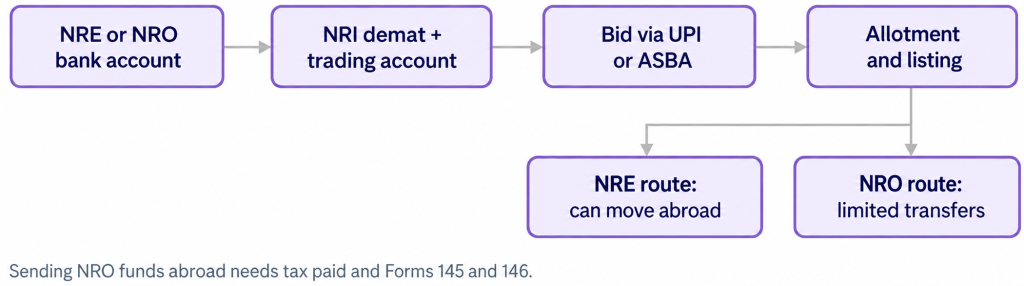
The steps are the same for both routes; the account you fund from decides whether profits can move abroad freely.
What Happens After You Apply: Allotment, Refund and Listing
Allotment is expected on 26 October. If you get shares, the blocked amount is debited and the shares reach your demat account on 27 October. If you do not, the block is released. The registrar for this issue is KFin Technologies, and you can also check status on the BSE and NSE websites.
Allotment is not guaranteed. When retail demand is higher than the quota, shares are given by lottery. To follow demand day by day, read our guide on how to check IPO subscription status online.
After listing on 28 October (tentative), NRIs can sell on the same day. NRIs can trade in delivery only, so intraday trading is not allowed. Sale proceeds are credited to your linked NRE or NRO account after tax is deducted at source.
If you miss the IPO, you can still buy Jio shares on the exchange once they list. For a repatriable purchase, you will need an NRE PIS setup through your bank.
Tax on Jio IPO Gains for NRIs
Tax depends on how long you hold the shares. Current rates for listed equity are:
- Short-term (12 months or less): 20%.
- Long-term (more than 12 months): 12.5% on gains above ₹1.25 lakh in a year.
These rates continue under the Income-tax Act, 2025, which applies from tax year 2026-27. Surcharge and 4% cess are added where applicable.
TDS applies on every sale. Unlike residents, NRIs have tax deducted at source on capital gains, with no minimum limit. Your broker deducts it at the same rates (plus surcharge and cess) before crediting the money. Your final tax is worked out in your return, and any excess TDS can be claimed back.
Sending money abroad. Money in an NRE account moves freely. Profits parked in an NRO account need tax clearance and Form 145 and Form 146 (earlier Form 15CA and 15CB), within the annual limit of USD 1 million.
Tax in your country of residence:
- UAE: There is generally no personal income tax on capital gains, so the Indian TDS is usually the end of the story.
- US: You must report the gain on your US return. You can usually claim a foreign tax credit for Indian tax paid using Form 1116. Your Indian demat and bank accounts also count towards FBAR if combined foreign balances cross $10,000.

Example: How Rahul in Dubai Applies
Rahul lives in Dubai and has money in his NRE account. He bids for one lot of 12 shares at the cut-off price. At ₹1,119, ₹13,428 is blocked in his account.
Suppose he gets an allotment and sells within a week at a hypothetical price of ₹1,300. His gain is ₹181 per share, or ₹2,172 for 12 shares. Short-term tax at 20% is about ₹434, or roughly ₹452 with 4% cess (before any surcharge). His broker deducts this as TDS, and the rest reaches his NRE account, which he can send to Dubai. This is only an illustration, not a price forecast.
Common Mistakes NRIs Make While Applying
- Using an old resident demat or bank account instead of NRI accounts.
- Funding the bid from an NRO account and expecting to send profits abroad freely.
- Waiting for a separate NRI quota that does not exist.
- Not linking UPI, or approving the mandate after the cut-off time.
- Bidding more than ₹2 lakh by accident, which moves the application into the NII category.
- Leaving KYC or FATCA details outdated.
- Forgetting that TDS and repatriation paperwork will reduce what lands in your account.
Should NRIs Invest in the Jio IPO?
This is a personal decision, and this article is not investment advice. Here are points investors are weighing.
- In favour: Jio reported over 524 million subscribers as of March 2026. For FY26, Jio Platforms posted revenue of about ₹1.47 lakh crore and profit after tax of roughly ₹30,000 crore, up about 15%.
- To weigh: The valuation is high at the top of the band. Most proceeds go to repaying debt, not new growth. Analysts also note that Jio earns ₹214 per user a month against ₹257 at Airtel, so future growth may depend on tariff hikes. Grey market premium numbers are unofficial and can change quickly.
Read the offer document carefully and speak to a SEBI-registered adviser before you bid.
Conclusion
NRIs can take part in the Jio IPO with the right accounts in place: an NRE or NRO account, an NRI demat account and a valid PAN. Choose NRE if you want to send profits abroad, apply before 23 October, and plan for TDS and paperwork from day one. Take a few minutes to confirm the rules with your bank or broker before you bid.
Disclaimer
The content published on NriTaxs is intended for informational purposes only and does not constitute legal, tax, or financial advice. Readers are encouraged to consult qualified professionals before making any decisions based on the information provided.








Related Articles