

If you are an NRI looking to invest in Indian shares, you may come across the term PIS Account while opening your NRI investment account. A PIS (Portfolio Investment Scheme) account is a bank account mechanism that allows eligible NRIs to invest in Indian equity markets through an authorised dealer bank, subject to applicable RBI and FEMA rules.
Understanding the PIS account rules, eligibility, charges, NRE/NRO linkage, taxation, and account opening process is important before you start investing. The process can also differ depending on whether your investment is on a repatriable or non-repatriable basis. In this guide, we explain what a PIS account for NRI, who can open one, how it works, what documents are required, the charges involved, and the key rules NRIs should know before investing in India.
Key Takeaways
- ✔ A PIS account allows eligible NRIs to invest in Indian listed equities through an authorised dealer bank.
- ✔ PIS investments can be made on a repatriation or non-repatriation basis through NRE or NRO accounts.
- ✔ NRIs generally need PAN, KYC, a demat account, a trading account and an authorised dealer bank.
- ✔ Repatriable investments are routed through NRE (PIS), while non-repatriable investments are routed through NRO (PIS).
- ✔ PIS investments may involve account opening, maintenance, transaction, brokerage and demat charges.
- ✔ NRIs may be subject to applicable capital gains tax, TDS and tax on dividends from their Indian investments.
What Is a PIS Account for NRI?
A PIS (Portfolio Investment Scheme) account is an RBI-regulated banking facility, governed under FEMA, that permits NRIs and OCIs to buy and sell shares and convertible debentures listed on Indian stock exchanges. It works as a designated channel: a single authorised bank tracks every trade you make and reports it to the RBI, which is how foreign ownership limits in Indian companies get monitored in real time.
How Does a PIS Account Work for NRIs?
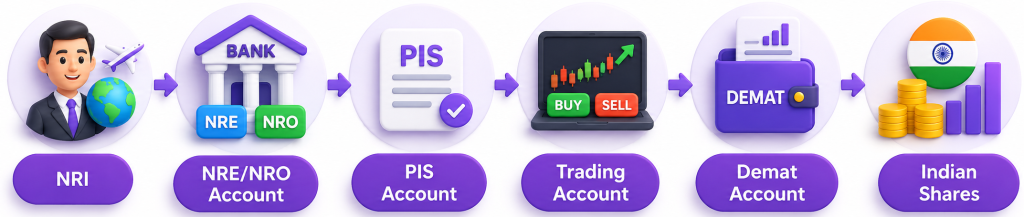
Your funds start in your NRE or NRO account. The PIS account sits between that bank account and the stock market, acting as the RBI-approved gateway. Once approved, it’s linked to a trading account (to place orders) and a demat account (to hold shares digitally), completing the chain that lets you actually buy and sell on NSE or BSE.
Who Is Eligible for a PIS Account?
Before a bank will open a PIS account for you, it checks that you meet a specific set of conditions. Here’s what each one actually means:
NRI/OCI Status
You must qualify as a Non-Resident Indian or Overseas Citizen of India under FEMA. Resident Indians and other foreign nationals cannot use the PIS route to invest in Indian equities.
Valid PAN
A Permanent Account Number is mandatory since every trade, dividend, and capital gain gets reported and taxed against your PAN, and banks won’t process the application without it.
NRE/NRO Bank Account
You need a designated NRE account for repatriable investments or an NRO account for non-repatriable ones, since the PIS account is always linked to one of these two.
Demat Account
A demat account in your name, opened with a SEBI-registered depository participant, is required to hold the shares you purchase in electronic form.
Trading Account
You’ll also need a trading account with a broker to actually place buy and sell orders, which then settle through your linked demat account.
Authorized Bank Relationship
PIS must be opened with an RBI-authorised dealer bank, and you can hold only one PIS account at a time across all banks.
Types of PIS Accounts for NRIs
Repatriable PIS Account
Linked to your NRE account, this lets you freely move your investment proceeds, sale value, dividends, everything back abroad, subject to RBI reporting requirements.
Non-Repatriable PIS Account
Linked to your NRO account, this holds investments made from India-sourced funds, and repatriation of proceeds is subject to the standard NRO limits and CA certification.
| Feature | Repatriable PIS | Non-Repatriable PIS |
| Linked Account | NRE Account | NRO Account |
| Fund Source | Foreign remittances | India-sourced income |
| Repatriation | Freely repatriable abroad | Subject to NRO limits and Form 15CA/15CB |
| Common Use Case | Investing fresh foreign capital in Indian equities | Reinvesting rental income, dividends, or other Indian earnings |
How to Open a PIS Account for NRI
Step 1: Choose an Authorized Dealer Bank
Pick an RBI-authorised bank that offers PIS services, since only these banks are permitted to open and operate this account for you.
Step 2: Open/Maintain the Required NRE or NRO Account
Decide whether you want a repatriable or non-repatriable route, then open or continue using the corresponding NRE or NRO account with that bank.
Step 3: Submit PIS Application
Fill out the bank’s PIS application form specifying your investment preference, account details, and the type of PIS account you’re applying for.
Step 4: Complete KYC
Complete Know Your Customer verification with the bank, confirming your identity, NRI status, and both your overseas and Indian addresses.
Step 5: Submit Required Documents
Provide your PAN, passport, visa/OCI card, overseas address proof, and passport-size photographs along with the completed application.
Step 6: Bank Verifies the Application
The bank cross-checks your documents, confirms your NRI status, and validates the linked NRE/NRO account before proceeding further.
Step 7: Receive PIS Approval/Account Details
Once verified, the bank issues a PIS approval letter along with your designated PIS account details, which you’ll need for the next step.
Step 8: Link PIS with Trading and Demat Account
Share your PIS approval letter with your broker so they can link it to your trading and demat accounts, completing the required chain.
Step 9: Start Permitted Investment Transactions
With everything linked, you can now place buy and sell orders on NSE/BSE-listed shares, with every transaction automatically reported to the RBI by your bank.
Documents Required to Open a PIS Account
| Document | Purpose |
| PAN Card | Mandatory for tax reporting and trade linkage |
| Passport Copy | Confirms identity and citizenship |
| Valid Visa/OCI/PIO Card | Establishes NRI or OCI status |
| Overseas Address Proof | Confirms current country of residence |
| Indian Address Proof (if any) | Used for correspondence, where applicable |
| Passport-size Photographs | Standard KYC requirement |
| NRE/NRO Bank Account Details | Account to be linked with the PIS facility |
| FATCA/CRS Declaration | Mandatory tax-residency self-certification |
PIS Account Charges for NRI
| Charge | Typical Range |
| Account Opening Fee | ₹500 – ₹1,000 (one-time, varies by bank) |
| Annual Maintenance Fee | ₹500 – ₹2,500 per year |
| PIS Transaction Charges | 0.15% – 0.75% of transaction value |
| Bank Charges | Flat fee or percentage per remittance/transfer instruction |
| Brokerage | 0.05% – 0.5% per trade, depending on broker |
| Demat Charges | ₹500 – ₹1,500 annually for account maintenance |
| DP (Depository Participant) Charges | Per debit transaction, usually ₹15 – ₹50 |
| GST/Other Applicable Taxes | 18% on applicable service charges |
| Charges on Purchase/Sale Transactions | Combined PIS + brokerage + DP charges per trade |
Exact charges vary by bank and broker, so it’s worth requesting a written fee schedule before opening the account rather than relying on published rate cards, which change periodically.
PIS Account Taxation for NRIs
Tax on Capital Gains
Short-term capital gains (shares held 12 months or less) on listed equity are taxed at a flat rate applicable to short-term equity gains, plus applicable cess.
Long-term capital gains (shares held over 12 months) are taxed at the long-term equity rate above the exempt threshold, plus applicable cess and surcharge.
TDS on Sale of Shares
How TDS may apply: Your designated PIS bank automatically deducts TDS on capital gains at the time of sale, based on the applicable short-term or long-term rate. NRIs should also understand how capital gains are taxed in India before selling their investments.
Difference between purchase and sale: No TDS applies when you purchase shares; TDS is deducted only on the gain calculated at the time of sale.
Dividend Taxation
Tax treatment: Dividends received on Indian shares are fully taxable in the NRI’s hands at the applicable slab or treaty rate, with no exemption threshold.
TDS: Companies deduct TDS on dividends paid to NRIs before crediting the amount, typically at a rate that can be reduced under an applicable DTAA with the correct documentation.

Can NRI Claim TDS Refund?
ITR filing: You must file an Indian income tax return to report your actual capital gains and dividend income for the year, regardless of TDS already deducted.
TDS credit: The TDS deducted by your bank or the company is credited against your PAN and reflected in your Form 26AS and AIS.
Refund process: If your actual tax liability is lower than the TDS deducted — often the case after DTAA relief — the excess is refunded once your return is processed.
If you’re also holding an NRO fixed deposit alongside your PIS investments, it’s worth checking how TDS is deducted and refunded on NRO fixed deposits separately, since interest income and capital gains are reported and reconciled differently at the time of filing.
Can NRI Invest in Indian Stocks Without a PIS Account?
Yes, but only for specific routes. PIS approval is required when you’re buying and selling listed equity shares on a repatriable basis through your NRE account. However, you don’t need PIS for non-repatriable equity trades made through your NRO account, for investing in mutual funds, or for applying to IPOs — these fall outside the PIS framework entirely and use a standard Non-PIS demat and trading setup instead.
If mutual funds are a bigger part of your plan than direct equity, it’s worth reading separately about how NRIs can invest in Indian mutual funds, since the account setup and repatriation rules there differ meaningfully from the PIS route covered here.
PIS Account vs Non-PIS Account for NRI
| Feature | PIS Account | Non-PIS Account |
| Applicable For | Repatriable secondary-market equity trades via NRE | Non-repatriable equity, mutual funds, IPOs |
| RBI Approval | Required, with per-trade reporting | Not required |
| Linked Account | NRE (or NRO for non-repatriable PIS) | NRO (non-repatriable basis) |
| Repatriation of Proceeds | Freely repatriable (NRE-PIS route) | Restricted to NRO repatriation limits |
| Charges | Additional PIS transaction charges apply | Standard brokerage and DP charges only |
Is PIS Account Mandatory for NRIs?
Not universally it depends on what you’re investing in and how you want the money to move. PIS is mandatory only when you want to buy and sell listed Indian shares on a repatriable basis through your NRE account. If you’re investing through your NRO account on a non-repatriation basis, or sticking to mutual funds, IPOs, or government bonds, you don’t need PIS approval at all. The confusion mostly comes from banks and brokers using “PIS” loosely to describe any NRI investment account, when it technically applies to a narrower set of transactions.
Conclusion
A PIS account isn’t an extra formality, it’s the specific RBI-approved bridge that makes repatriable equity investing legal for NRIs in the first place. Once it’s set up correctly and linked to your trading and demat accounts, buying and selling Indian shares works much like it does for resident investors, with the added layer of RBI reporting and NRI-specific taxation running quietly in the background. Getting the account type right at the start repatriable versus non-repatriable, saves far more hassle later than trying to fix it after you’ve already started investing.
Disclaimer
The content published on NriTaxs is intended for informational purposes only and does not constitute legal, tax, or financial advice. Readers are encouraged to consult qualified professionals before making any decisions based on the information provided.








Related Articles