
Do you really need Form 15CA and Form 15CB before sending money abroad? Many NRIs, OCIs, and foreign nationals assume these forms are mandatory for every international remittance, but that’s not always true. Whether you’re repatriating property sale proceeds, transferring funds from an NRO account, paying a foreign consultant, or sending money to your family overseas, the documentation required depends on the amount being remitted, its taxability, and the applicable provisions of the Income Tax Act and Rule 37BB. Understanding these requirements before initiating a transfer can help you avoid unnecessary delays, rejected remittances, and costly compliance mistakes.
In this complete 2026 guide, we’ll explain everything you need to know about Form 15CA & Form 15CB for NRIs, who needs to file them, when they’re mandatory, the documents required, exemptions under Rule 37BB, the online filing process, penalties for non-compliance, and the latest changes every NRI should know before making an overseas remittance.
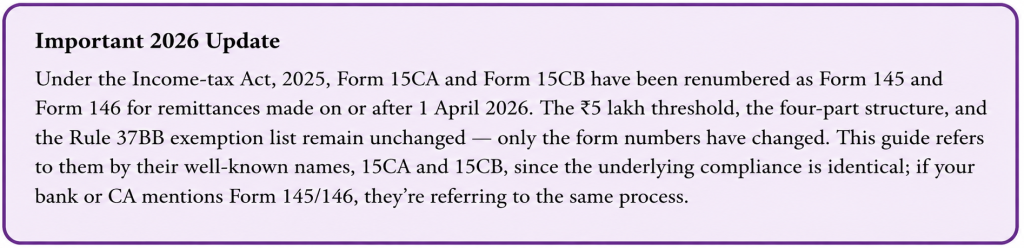
What Are Form 15CA & Form 15CB?
What Is Form 15CA?
Form 15CA is an online declaration filed on the Income Tax e-filing portal by the person making a payment to a non-resident or a foreign company. It captures details of the remittance the amount, the nature of the payment, the recipient’s country, and whether tax has been deducted. Authorised dealer banks will not release funds abroad unless they have the acknowledgement number from a filed Form 15CA. If you’re unsure which part of Form 15CA applies to your remittance or need assistance with filing Form 15CA and Form 15CB, professional support can help you avoid delays and compliance issues.
What Is Form 15CB?
Form 15CB is a certificate issued by a practising Chartered Accountant after reviewing the transaction. The CA examines the nature of the remittance, checks whether it’s taxable under the Income Tax Act, applies the relevant Double Taxation Avoidance Agreement (DTAA) provisions where applicable, and confirms the correct rate of TDS. Form 15CB is only required when the remittance exceeds ₹5 lakh in a financial year and no exemption or lower/nil deduction certificate applies. In practice, most NRIs dealing with property sale proceeds, consultancy income, or larger NRO repatriations will need Form 15CB from a chartered accountant before their bank proceeds.
Why Are Form 15CA & Form 15CB Required?
These forms exist because once money leaves India, the Income Tax Department has no practical way to verify that the correct tax was paid on it. Four things are being checked simultaneously:
- Foreign remittance compliance: Every outward remittance under the Foreign Exchange Management Act (FEMA) needs a documented tax position before an authorised dealer bank can process it.
- Income Tax compliance: The forms create a paper trail confirming that the remitter has assessed whether the payment is taxable in India before the money is sent out.
- TDS verification: Under Section 195, tax must generally be withheld at source on payments to non-residents. Form 15CB confirms the applicable TDS rate has been correctly identified and applied.
- DTAA consideration: Where a Double Taxation Avoidance Agreement applies, the CA verifies the remitter’s Tax Residency Certificate (TRC) and Form 10F to confirm whether a reduced treaty rate can be used instead of the standard domestic rate.
When Do NRIs Need to File Form 15CA & 15CB?
NRIs need to file these forms any time they’re remitting money out of India that isn’t specifically exempted under Rule 37BB this covers repatriating property sale proceeds, transferring NRO funds abroad, sending consultancy or professional fees to a non-resident, or paying royalties. The obligation kicks in before the transfer is initiated, not after; banks will ask for the Form 15CA acknowledgement number (and Form 15CB certificate number, where applicable) as part of the outward remittance paperwork.
It’s worth being precise about the timing here. The requirement isn’t tied to your residential status changing, or to the financial year closing it’s tied to the act of remittance itself. Every time you initiate a new outward transfer that crosses the ₹5 lakh aggregate threshold for the financial year (adding up all your remittances so far that year, not just the current one), a fresh round of Form 15CA and Form 15CB for NRIs is triggered, even if you filed the same forms for an earlier transfer a few months ago. This trips up a lot of NRIs who assume one filing covers them for the rest of the year.
Who Needs to File Form 15CA & Form 15CB?
Applicability depends on residential status and the nature of the transaction. Here’s a general breakdown:
| Person | Form 15CA | Form 15CB |
| Resident Individual (remitting abroad) | ✅ Yes | Sometimes — only if taxable and above ₹5 lakh |
| NRI (repatriating funds from India) | Depends on exemption & amount | Depends on taxability & amount |
| OCI cardholder | Depends on exemption & amount | Depends on taxability & amount |
| Foreign National (with Indian-source income) | Depends on exemption & amount | Depends on taxability & amount |
| Company / Business entity | ✅ Yes | Usually, above ₹5 lakh threshold |
When Are Form 15CA & Form 15CB Required?
Common situations where NRIs will need to complete Form 15CA online filing, and often Form 15CB as well, include:
- Property sale proceeds: Repatriating the net sale amount of an Indian property to a foreign bank account.
- Gifts: Sending gifted funds abroad above the exempted family-maintenance thresholds.
- Consultancy or professional fees: Payments made to a non-resident consultant or freelancer for services rendered.
- Royalty payments: Remittances for the use of intellectual property, licences, or technical know-how.
- NRO to overseas transfer: Repatriating income accumulated in an NRO account rent, interest, dividends to an overseas account.
- Investments: Certain outward investment remittances, depending on the type of instrument and whether RBI approval is needed.
When Are Form 15CA & Form 15CB NOT Required?
This is the part most NRIs get wrong and it matters, because filing forms you didn’t need to is a minor inconvenience, but skipping forms you did need attracts a penalty. Rule 37BB maintains a specified list of 33 categories of payments that are exempt from Form 15CA and Form 15CB entirely. Some of the most relevant categories for NRIs are below.
| Situation | Why It’s Exempt |
| Remittance under the Liberalised Remittance Scheme (LRS) by a resident, not requiring RBI approval | Covered under Rule 37BB(3), within the LRS annual limit |
| Family maintenance and savings remittances by an NRI | Specifically listed in the Rule 37BB specified payments schedule |
| Personal gifts and donations (within specified categories) | Listed as an exempt payment nature under Rule 37BB |
| Advance payments against imports | Added to the exemption list after the 2015 amendment |
| Remittance amount is below the taxable threshold and clearly non-taxable | No TDS applies, so Form 15CB certification isn’t triggered — though Part D of Form 15CA may still apply |
Two cautions are worth keeping in mind. First, even where a transaction is technically exempt under Rule 37BB, some banks may still request Form 15CB as part of their internal compliance process, particularly for certain NRO account remittances above ₹5 lakh. If you’re planning to remit funds from your NRO account after returning to India, it’s also important to ensure your bank accounts have been correctly redesignated. Read our guide on How to Convert an NRE Account to an NRO Account to understand the process and required documentation.
Second, “not taxable” does not always mean “no forms required.” If a remittance falls outside the specified exemption list under Rule 37BB, Part D of Form 15CA may still need to be filed even where Form 15CB is not required.
Difference Between Form 15CA & Form 15CB
| Aspect | Form 15CA | Form 15CB |
| Filed by | The remitter, on the income tax e-filing portal | A practising Chartered Accountant |
| Nature | Self-declaration | Professional certification |
| Trigger | Any remittance to a non-resident (unless exempt) | Only when remittance exceeds ₹5 lakh and is taxable, without an AO certificate |
| Signature required | Remitter’s e-verification / DSC | CA’s Digital Signature Certificate |
| Where it’s used | Submitted directly to the bank as proof of filing | Its certificate number is referenced inside Form 15CA Part C |
Understanding the Four Parts of Form 15CA
Which part of Form 15CA you fill in depends on the remittance amount and its taxability — not on personal choice.
- Part A: Used when the remittance, or the aggregate of remittances during the financial year, does not exceed ₹5 lakh.
- Part B: Used when the remittance exceeds ₹5 lakh and the remitter already holds a certificate or order under Section 195(2), 195(3), or 197 from the Assessing Officer.
- Part C: Used when the remittance exceeds ₹5 lakh and a Chartered Accountant’s certificate (Form 15CB) has been obtained. Form 15CA Part C is the section most NRIs end up filing, since it applies to the bulk of taxable remittances above the threshold, such as property sale proceeds and larger NRO transfers.
- Part D: Used when the remittance is not chargeable to tax under the Income Tax Act at all, and no Rule 37BB exemption applies.
Contact Us
How to File Form 15CA Online (Step-by-Step)
Here’s the general process for Form 15CA online filing on the Income Tax e-filing portal:
- Log in to the Income Tax e-filing portal using your PAN-linked credentials.
- Navigate to e-File → Income Tax Forms → File Income Tax Forms, and search for Form 15CA.
- Select the correct part (A, B, C, or D) based on the remittance amount and taxability, as outlined above.
- Enter remittance details — remitter and remittee information, amount, currency, nature of remittance, and the relevant purpose code.
- Attach the Form 15CB certificate number if you’re filing Part C, once your CA has issued and uploaded the certificate.
- Verify and submit using your Digital Signature Certificate or electronic verification code (EVC).
- Download the acknowledgement and share it with your bank along with the Form 15CB certificate to initiate the remittance.
Note that Form 15CA can be withdrawn within 7 days of submission if you spot an error, so double-check the remittance details, but you’re not permanently locked in if a correction is genuinely needed.
How to Get Form 15CB from a Chartered Accountant
Documents to Provide Your CA
- Bank statements showing the source of the funds
- Invoice, sale deed, or contract underlying the remittance
- TDS challans or proof of tax already deducted, if any
- Property documents (for property sale proceeds)
- Tax Residency Certificate (TRC) and Form 10F, if you’re claiming DTAA benefits for NRIs on the remittance
The CA’s Role
The Expert Chartered Accountant (CA) reviews the underlying transaction, verifies the source and nature of funds, determines taxability under the Income Tax Act, and applies the correct DTAA rate where a TRC and Form 10F are provided. The CA then issues Form 15CB electronically.
Digital Signature Certificate (DSC)
The CA must file Form 15CB using their Digital Signature Certificate registered on the income tax portal it cannot be submitted with a manual signature or EVC. Once filed, the system generates a certificate number that the remitter then quotes while filing Form 15CA Part C.
Typical Timeline
Most CAs issue Form 15CB within 1–2 working days of receiving complete documentation for straightforward remittances. Cases involving DTAA relief, royalty, or capital gains on property tend to take 3–5 working days because of the additional treaty analysis involved. Start the process at least a week before your planned remittance date to avoid delays.
Common Mistakes to Avoid
- Filing the wrong Part of Form 15CA: Choosing Part A when the remittance actually crosses ₹5 lakh, or Part D when the transaction doesn’t genuinely qualify as non-taxable, is one of the most frequent errors. Remember that the ₹5 lakh threshold is cumulative for the financial year, not per transaction an NRI who has already remitted ₹3 lakh earlier in the year and now sends another ₹3 lakh has crossed the threshold, even though neither individual transfer looks like it on its own.
- Applying the wrong DTAA rate: Using a treaty rate without a valid Tax Residency Certificate and Form 10F on file can invalidate the DTAA benefits for NRIs claim entirely, leaving the remitter exposed to the higher domestic withholding rate plus interest if the claim is later questioned.
- Getting the TDS calculation wrong: Under-withholding tax on the remittance shifts liability and interest exposure back to the remitter, not the recipient; this is a common surprise for NRIs who assume the non-resident recipient bears the tax risk.
- Using an incorrect purpose code: Banks match the purpose code on Form 15CA against the nature of the underlying transaction; a mismatch between, say, “property sale proceeds” and a purpose code meant for consultancy fees can hold up the remittance or trigger unnecessary scrutiny from the bank’s compliance desk.
- Assuming NRO to NRE transfers are automatically exempt: Because both accounts sit within India, some NRIs assume no remittance forms are needed. Most banks disagree and will still ask for Form 15CA and, above ₹5 lakh, Form 15CB as an internal compliance requirement.
Penalty for Non-Compliance
Failing to file Form 15CA or Form 15CB when required or filing either with inaccurate information attracts a penalty under Section 271-I of the Income Tax Act. The penalty is the lower of ₹1 lakh or the amount of the remittance, and it can apply per default, meaning both the remitter and the transaction can be flagged even if the underlying tax itself was correctly paid. The breach being penalised is the failure to file or the inaccuracy, not necessarily an unpaid tax amount.
The penalty applies when:
- Form 15CA or Form 15CB was required but not filed before the remittance was made.
- The forms were filed but contained inaccurate or misleading information.
- A relief under Section 273B may be available if the remitter can demonstrate a reasonable cause for the lapse, but this is assessed case by case and isn’t guaranteed.
Beyond the direct penalty, banks routinely refuse to process remittances at all without valid Form 15CA and Form 15CB documentation, which means non-compliance doesn’t just risk a fine; it can hold up your money indefinitely until the paperwork is sorted out.

Conclusion
Form 15CA and Form 15CB for NRIs come down to one practical question: does your remittance cross ₹5 lakh and is it taxable? If yes, budget a week for your CA to review documents, verify DTAA eligibility if relevant, and issue Form 15CB before you file Form 15CA Part C. If your transaction falls squarely within the Rule 37BB exemption list, you can skip the paperwork but confirm with your bank first, since internal bank policy sometimes asks for the forms anyway. Getting this right the first time avoids both the Section 271-I penalty and the far more common headache of a remittance stuck in limbo at your bank.
Need help figuring out which part of Form 15CA applies to your remittance, or want a CA to issue your Form 15CB? Get in touch with our NRI tax team today for a same-week filing.
Disclaimer
The content published on NriTaxs is intended for informational purposes only and does not constitute legal, tax, or financial advice. Readers are encouraged to consult qualified professionals before making any decisions based on the information provided.







Related Articles