
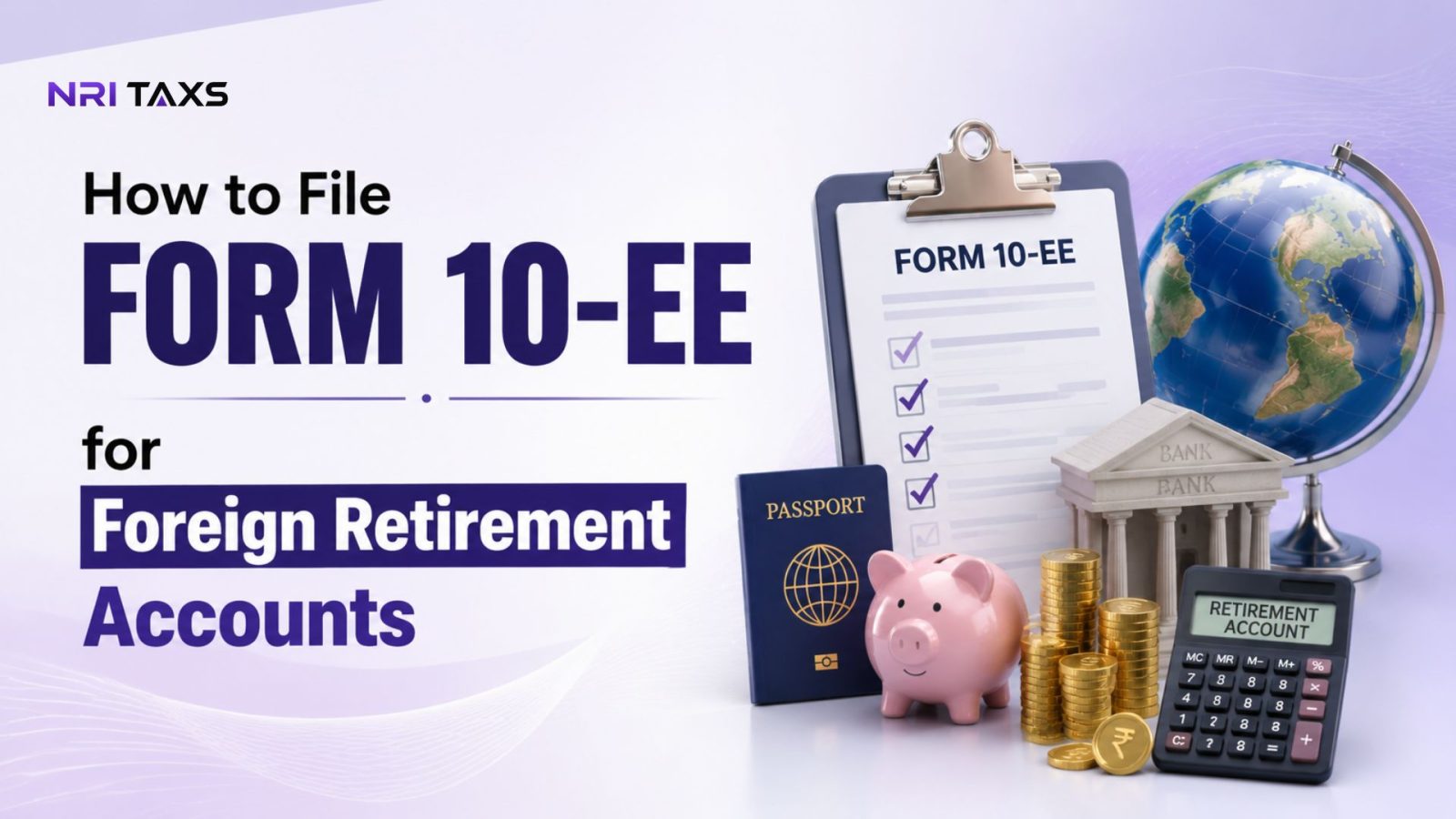
Imagine paying tax twice on the same retirement savings—once in the country where you earned them and again in India. For many NRIs and returning residents, this is a real concern when dealing with foreign retirement accounts. Fortunately, Form 10-EE can help eligible taxpayers claim the relief available under the Income-tax Act, but only if it is filed correctly and within the prescribed timeline.
The challenge is that Form 10-EE is still unfamiliar to many taxpayers. Questions like Who needs to file it? Which foreign retirement accounts qualify? What documents are required? and How to File Form 10-EE often lead to confusion, filing mistakes, or missed tax benefits.
This guide answers all those questions in a simple, practical way. You’ll learn who is eligible to file Form 10-EE, the complete online filing process, required documents, due dates, common mistakes to avoid, and how to stay compliant while maximizing the tax relief available for your foreign retirement account.
Quick Answer
Form 10-EE is filed online through the Income Tax e-Filing portal under e-File → Income Tax Forms → File Income Tax Forms → Form 10-EE. It must be submitted before filing your Income Tax Return (ITR) and no later than the due date under Section 139(1). Filing Form 10-EE allows eligible taxpayers to claim relief under Section 89A, deferring Indian tax on income earned in specified foreign retirement accounts, such as a 401(k), IRA, RRSP, or SIPP, until the year the funds are actually withdrawn.
What Is Form 10-EE?
Form 10-EE is the official declaration form that residents of India must file to claim relief under Section 89A of the Income Tax Act on income accrued in a foreign retirement account. Filing Form 10-EE tells the Income Tax Department that you’re opting to defer tax on your foreign retirement account until the year the foreign country taxes it, typically the year of withdrawal instead of paying Indian tax on the annual growth as it accrues.
What Is Section 89A?
Section 89A was introduced through the Finance Act, 2021, effective from Assessment Year 2022-23, specifically to solve the timing mismatch between how India taxes foreign retirement accounts and how countries like the US, UK, and Canada tax them. It’s worth noting that under the new Income Tax Act, 2025 (effective from FY 2025-26), this relief has been renumbered as Section 158, read with Rule 74 but the substance is unchanged, and the form used to claim it is still commonly referred to as Form 10-EE. Once you opt in for a particular account by filing Form 10-EE, the choice is irrevocable and applies to all future years for that account.
Who Can File Form 10-EE?
You can file Form 10-EE if you meet all of the following conditions:
- You are currently a resident of India (Resident and Ordinarily Resident) for the relevant financial year.
- You opened your retirement account in a notified country while you were a non-resident of India and a tax resident of that country.
- The account is a genuine retirement benefits account not a regular savings, brokerage, or fixed deposit account.
- The foreign country taxes that account on a withdrawal or redemption basis, not on annual accrual.
If you’re still a Non-Resident Indian (NRI) or in your RNOR (Resident but Not Ordinarily Resident) years, your foreign retirement income isn’t taxable in India yet anyway, so Section 89A eligibility doesn’t apply to you until you become a full resident.
Who Should Not File Form 10-EE?
Not every taxpayer with a foreign retirement account is eligible to file Form 10-EE. The form is specifically meant for residents of India who satisfy the conditions under Section 89A. You should not file Form 10-EE if any of the following apply to you:
- You are still a Non-Resident Indian (NRI) for the relevant financial year.
- You qualify as RNOR (Resident but Not Ordinarily Resident) and Section 89A does not yet apply to your situation.
- Your retirement account is held in a country that has not been notified by the Central Board of Direct Taxes (CBDT).
- Your account is a Roth IRA, brokerage account, savings account, or fixed deposit, as these are not qualifying retirement benefit accounts under Section 89A.
- You opened the retirement account while you were already a resident of India.
- The foreign country taxes the account on an annual accrual basis instead of when withdrawals are made.
If you’re unsure whether your retirement account qualifies, it’s advisable to verify your eligibility before filing Form 10-EE to avoid incorrect reporting.
Which Foreign Retirement Accounts Qualify?
Only accounts maintained in a country notified by the Central Board of Direct Taxes (CBDT) qualify for relief. As of now, the notified countries for Section 89A relief are the USA, UK, and Canada.
| Country | Qualifying Account Types |
| United States | 401(k), Traditional IRA |
| United Kingdom | SIPP (Self-Invested Personal Pension), Employer Pension Schemes |
| Canada | RRSP (Registered Retirement Savings Plan) |
Roth IRAs, regular brokerage or trading accounts, and standard savings or fixed deposit accounts do not qualify, since they aren’t taxed on a withdrawal basis by the foreign country in the way Section 89A requires.
Documents Required Before Filing Form 10-EE
Keep the following ready before you start filing Form 10-EE online:
- PAN (Permanent Account Number). Don’t have a PAN Card? For smooth application process read our guide on How NRIs Can Apply for a PAN Card.
- Aadhaar (linked to PAN)
- Income Tax e-Filing portal login credentials.
- Foreign retirement account statement (showing account number, opening date, and current balance).
- Details of income accrued in the account during the financial year (interest, dividends, capital gains).
- Withdrawal details, if any withdrawals were made during the year.
- Country details — where the account is held and the residency period there.
- Previous years’ tax records, if you’ve claimed relief under Section 89A before.

How to File Form 10-EE Online (Step-by-Step)
Here’s how to file Form 10-EE on the Income Tax e-Filing portal:
Step 1: Log In to the Income Tax e-Filing Portal
Go to the official Income Tax e-Filing portal and log in using your PAN and password.
Step 2: Navigate to Income Tax Forms
From your dashboard, go to e-File → Income Tax Forms → File Income Tax Forms, and search for Form 10-EE in the list of available forms.
Step 3: Choose the Assessment Year
Select the correct Assessment Year (AY) for which you’re claiming relief under Section 89A. This should match the AY for which you’ll be filing your ITR.
Step 4: Fill in Personal Details
Confirm your PAN, name, address, and residential status for the relevant financial year. Your residential status must show as Resident for the form to proceed correctly.
Step 5: Enter Retirement Account Details
Provide the account number, the notified country where it’s maintained, the date the account was opened, and confirmation that it was opened while you were a non-resident of India.
Step 6: Enter Income Information
Report the income accrued in the account during the year interest, dividends, and capital gains along with any withdrawal amounts, if applicable.
Step 7: Verify and Submit
Review all the details, verify the form using Aadhaar OTP, Digital Signature Certificate (DSC), or your registered method, and submit. Save the acknowledgment for your records.
Step 8: Information Required in Form 10-EE
Here’s a quick summary of the fields the form actually asks for:
| Field | Details Needed |
| Personal Information | PAN, name, address, residential status |
| Account Information | Account number, notified country, account type (401(k)/IRA/RRSP/SIPP) |
| Period of Non-Residence | Dates confirming the account was opened while you were a non-resident |
| Income Details | Interest, dividend, and capital gains accrued during the year |
| Withdrawal Details | Amount withdrawn, if any, and the year of taxation in the foreign country |
| Declaration | Confirmation that the account is taxed on a withdrawal basis abroad |
Filing Timeline for Form 10-EE
| Stage | Timeline |
| Become Resident in India | FY concerned |
| Check Section 89A eligibility | Before ITR |
| File Form 10-EE | Before filing ITR |
| File Income Tax Return | Before due date |
Benefits of Filing Form 10-EE
- Avoid double taxation — you’re no longer taxed in India before you’ve even received the money abroad.
- Better foreign tax credit alignment — since both countries now tax the income in the same year, your foreign tax credit claim actually works.
- Tax deferral — Indian tax liability is pushed to the year of withdrawal, improving your cash flow in the interim.
- Compliance and documentation — filing Form 10-EE creates a clean paper trail with the tax department for your foreign retirement account.
- No unnecessary Indian tax — you don’t pay tax in India on paper gains you haven’t actually accessed yet.
When Should You File Form 10-EE?
Form 10-EE must be filed before you file your Income Tax Return, and on or before the ITR due date specified under Section 139(1) typically July 31 following the end of the financial year for most individual taxpayers, though this date can be extended by the CBDT in a given year, so it’s worth confirming the current deadline before you file. Don’t wait until you sit down to file your return to look for this form. Filing the ITR first and discovering Form 10-EE afterward is the single most common way people lose this relief for the year once the return is filed without it, the deferral for that year cannot be claimed retroactively.
Contact Us
Common Mistakes While Filing Form 10-EE
- Selecting the wrong Assessment Year — this mismatches your form with your actual ITR filing year.
- Incorrect residential status — if you’re still NRI or RNOR for the year, the form doesn’t apply yet.
- Selecting the wrong country — only the USA, UK, and Canada are currently notified; other countries aren’t eligible.
- Missing retirement income — leaving out interest, dividends, or capital gains accrued during the year.
- Entering the wrong account number — small errors here can cause mismatches during assessment.
- Not checking Section 89A eligibility first — filing the form for an account that doesn’t actually qualify (like a Roth IRA or a regular brokerage account) can lead to the relief being disallowed.
Conclusion
If you’re a returning NRI with a 401(k), IRA, RRSP, or SIPP sitting abroad, filing Form 10-EE is one of the highest-value compliance steps you can take, it’s the difference between paying Indian tax on money you haven’t touched yet and paying tax only when you actually withdraw it. File it before your ITR, keep your account and income documentation ready, and double-check your residential status and country eligibility before you submit.
Not sure if your foreign retirement account qualifies, or need help filing Form 10-EE correctly before your deadline? Get in touch with our NRI tax team for a quick eligibility check and end-to-end filing support.
Disclaimer
The content published on NriTaxs is intended for informational purposes only and does not constitute legal, tax, or financial advice. Readers are encouraged to consult qualified professionals before making any decisions based on the information provided.




Related Articles