
As 2026 comes to an end, U.S. investors have an important opportunity to review their investment portfolios and potentially reduce their tax bills before December 31. If some of your stocks, ETFs, or mutual funds are currently worth less than what you paid, tax-loss harvesting may help turn those investment losses into valuable tax benefits. By strategically selling investments at a loss, you may be able to offset capital gains and, in certain cases, reduce taxable ordinary income. However, IRS rules, especially the wash sale rule, can affect your deductions. Here’s what you need to know before year-end.
Quick Answer
Tax-loss harvesting is selling investments at a loss in a taxable account to offset capital gains. If losses exceed gains, you can deduct up to $3,000 of other income ($1,500 if married filing separately). Extra losses carry forward. Complete your sales by December 31, 2026, and do not rebuy the same security within 30 days.
What Is Tax-Loss Harvesting?
Tax-loss harvesting is the practice of selling an investment for less than you paid and using that realized loss to reduce your taxes. Losses first cancel gains of the same type, then gains of the other type. If your losses are bigger than your gains, you can deduct up to $3,000 against other income. Anything left over carries forward to future years. This strategy works only in taxable brokerage accounts. Gains and losses inside IRAs and 401(k)s are not reported this way. The goal is not to lose money. It is to make a loss useful while you stay invested.
How Does Tax-Loss Harvesting Work in the USA?
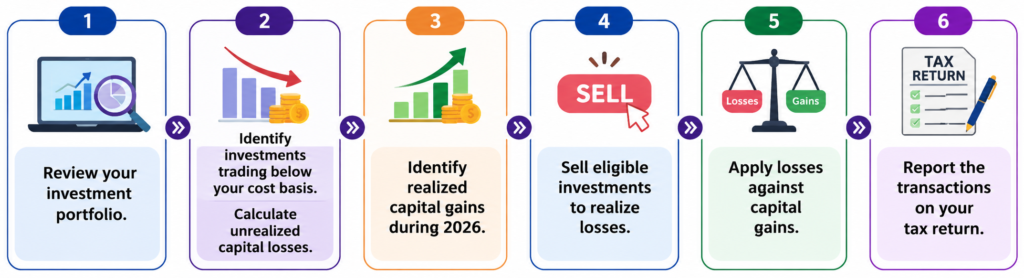
- Review your investment portfolio. Log in to your brokerage account and list every holding in your taxable accounts, including stocks, ETFs, and mutual funds, with the date you bought each one.
- Identify investments trading below your cost basis. Compare each position’s current price with what you paid. Anything worth less than your cost basis is a possible harvesting candidate.
- Calculate unrealized capital losses. Subtract current value from cost basis for each candidate. Note if the loss is short-term (held one year or less) or long-term.
- Identify realized capital gains during 2026. Add up your year-to-date gains from sales and fund distributions. This shows how much loss you actually need.
- Sell eligible investments to realize losses. Place the sell order before the December 31 deadline. A loss counts only after the sale is executed, not while it sits on paper.
- Apply losses against capital gains. Short-term losses offset short-term gains first, and long-term losses offset long-term gains. Any remaining loss then offsets the other type.
- Report the transactions on your tax return. Report each sale on Form 8949 and summarize it on Schedule D when you file in 2027. Keep your Form 1099-B and trade confirmations.
Tax-Loss Harvesting Example: How the Numbers Work
Here is a simple example for a single filer in the 24% bracket. The figures are for illustration only.
| Item | Without Harvesting | With Harvesting |
| Short-term gains | $10,000 | $10,000 |
| Long-term gains | $4,000 | $4,000 |
| Short-term losses harvested | $0 | ($7,000) |
| Long-term losses harvested | $0 | ($2,000) |
| Taxable short-term gain (24%) | $10,000 | $3,000 |
| Taxable long-term gain (15%) | $4,000 | $2,000 |
| Estimated federal tax | $3,000 | $1,020 |
| Estimated savings | $1,980 | |
7. Tax-Loss Harvesting Strategies to Consider Before December 31
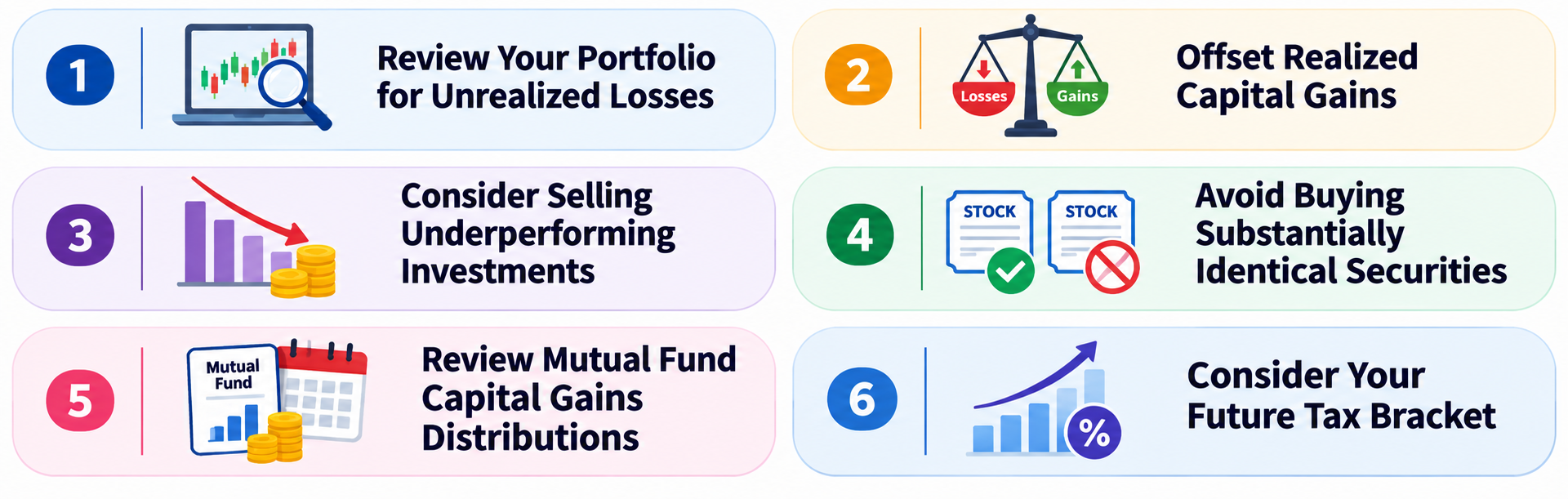
Review Your Portfolio for Unrealized Losses
Scan every taxable account for positions below cost basis. Most brokers offer a tax-lot or unrealized gain/loss report that shows the exact loss on each lot, which makes this review quick.
Offset Realized Capital Gains
Match losses against gains you already booked this year. Short-term gains are taxed as ordinary income, up to 37%, so offsetting them is often worth more than offsetting long-term gains, which are taxed at 0%, 15%, or 20% capital gains tax rates for 2026.
Consider Selling Underperforming Investments
If you already planned to sell a weak holding, doing it before year-end captures the loss. Do not sell only for the tax break if the investment still fits your long-term goals.
Avoid Buying Substantially Identical Securities
After selling, do not buy the same or a substantially identical security within 30 days before or after. A similar but different funds can keep you invested without triggering the wash sale rule.
Review Mutual Fund Capital Gains Distributions
Funds often pay out gains in November and December. Check estimated distributions before buying new mutual fund shares, because new buyers can owe tax on gains they never enjoyed.
Consider Your Future Tax Bracket
If you expect a higher bracket next year, saving losses may help more later. If you sit in the 0% long-term bracket now, your 2026 tax bracket may favor harvesting gains instead.
When Is the Deadline for Tax-Loss Harvesting in 2026?
| Date | What Happens | What You Should Do |
| Now to mid-December 2026 | Funds announce estimated year-end distributions | Review your portfolio and check fund distribution estimates |
| December 31, 2026 (Thursday) | Last day to sell so the loss counts for 2026. The trade date matters, not the settlement date | Place sell orders early. Avoid waiting for the final trading day |
| 30 days after your sale | Wash sale window stays open | Do not rebuy the same security. For a December 10 sale, wait until January 10, 2027 |
| Mid-February 2027 | Brokers send Form 1099-B (some send corrected forms later) | Check proceeds, cost basis, and wash sale amounts |
| April 15, 2027 | 2026 federal tax return due | File Form 8949 and Schedule D with Form 1040 |
Wash Sale Rule Explained: Avoid Losing Your Tax Deduction
The wash sale rule stops you from claiming a loss when you sell a security and quickly buy it back. Here is what to know:
- The window: 61 days in total. It covers 30 days before the sale, the sale day, and 30 days after.
- What triggers it: Buying the same or a substantially identical stock, fund, or option on it.
- Accounts covered: All your accounts, including IRAs and purchases made by your spouse.
- What happens: The loss is disallowed for now and added to the cost basis of the new shares. It is deferred, not always gone.
- Common trap: Automatic dividend reinvestment can buy shares inside the window.
- How to avoid it: Wait 31 days, or buy a similar but not identical investment.
| Situation | Wash Sale? |
| Sell XYZ at a loss, rebuy XYZ after 10 days | Yes |
| Buy XYZ, then sell your older XYZ shares at a loss within 30 days | Yes |
| Sell XYZ at a loss, your spouse buys XYZ | Yes |
| Sell XYZ at a loss, buy XYZ in your IRA | Yes. The loss may be lost permanently |
| Sell a fund, buy one tracking a different index | Generally no. The IRS has not defined “substantially identical” clearly |
| Sell XYZ at a loss, wait 31 days to rebuy | No |
Wash sales also affect how you report losses. If you hold investments in several accounts, track every purchase across all accounts so one forgotten trade does not wipe out a deduction.
How to Report Tax-Loss Harvesting on Your 2026 Tax Return
Form 1099-B: Reporting Investment Sales
Your broker sends Form 1099-B showing sale proceeds, cost basis, dates, and any wash sale loss disallowed. Compare it with your own records and ask your broker to correct any wrong basis.
Form 8949: Reporting Capital Gains and Losses
Form 8949 lists each sale, split into short-term and long-term. Check the box that matches your 1099-B. For a wash sale, enter code W and the disallowed amount. See our guide on how to fill out Form 8949 for line-by-line help. Simple sales fully reported to the IRS with no adjustments can often go straight to Schedule D.
Schedule D: Calculating Net Capital Gains and Losses
Schedule D totals your short-term and long-term results and nets them together. If you end with a net loss, only $3,000 ($1,500 if married filing separately) can reduce other income this year. The result flows to Form 1040.
Capital Loss Carryover to 2027
Any net loss above the $3,000 limit carries forward with no expiry. It keeps its short-term or long-term character. Use the Capital Loss Carryover Worksheet in the Schedule D instructions, then enter the amounts on your 2027 Schedule D.

Conclusion
Tax-loss harvesting is one of the few tax tools you can still use right before year-end. Review your taxable accounts, match losses against 2026 gains, and finish your trades before December 31. Be careful with the wash sale rule, because one early rebuy can cancel the benefit. Keep clean records so Form 8949 and Schedule D are easy to complete. Every situation is different, so check your numbers with a tax professional before making large sales.
Disclaimer
The content published on NriTaxs is intended for informational purposes only and does not constitute legal, tax, or financial advice. Readers are encouraged to consult qualified professionals before making any decisions based on the information provided.







Related Articles