
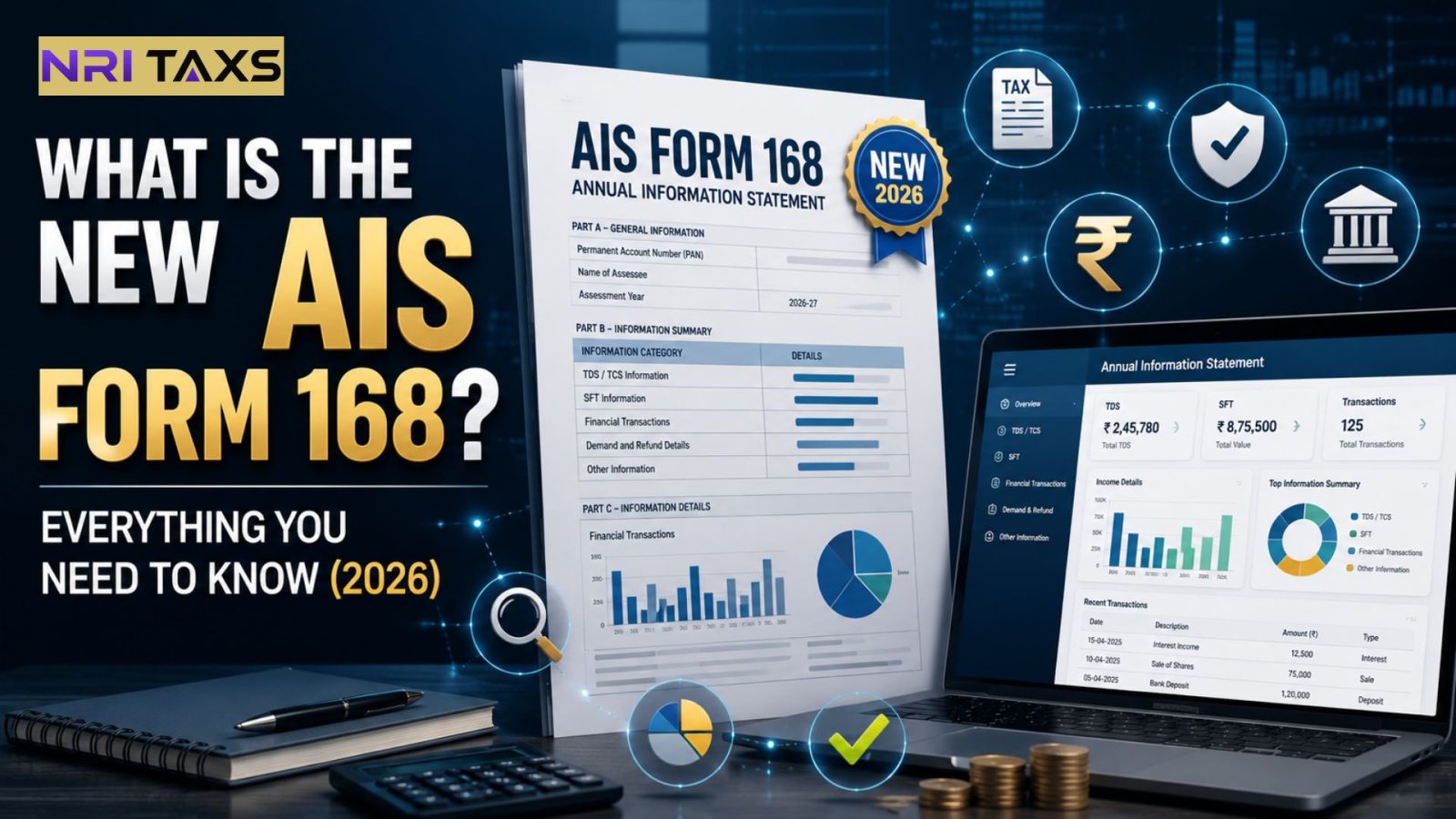
If you’ve logged into the income tax portal recently expecting to see Form 26AS and found a new name instead, you’re not imagining things. Under India’s new Income Tax Act, 2025 and the Income Tax Rules, 2026, Form 26AS has been replaced by Form 168 a renumbered, expanded version of the tax statement every filer has relied on for two decades. This guide breaks down exactly what is New AIS Form 168, how it differs from Form 26AS and AIS, when it actually applies to your filing, and what NRIs specifically need to know before their next return.
What Is New AIS Form 168?
Form 168 is the Annual Information Statement (AIS) under the Income-tax Rules, 2026. It is the new form corresponding to the earlier Form 26AS under the Income-tax Rules, 1962. Form 168 provides a consolidated view of tax-related information and specified financial transactions linked to a taxpayer’s PAN.
It can include information such as TDS, TCS, tax payments, specified financial transactions (SFTs), demand and refund details, pending and completed proceedings, and other information authorised under the Income-tax Rules, 2026.
Form 168 is automatically generated by the Income-tax Department and uploaded to the taxpayer’s registered e-filing account. Taxpayers do not manually file Form 168.
Why Has Form 168 Replaced Form 26AS?
The short answer: the entire income tax framework changed underneath it. The Income Tax Act, 2025 replaced the six-decade-old Income Tax Act, 1961, and as part of that overhaul, the Central Board of Direct Taxes (CBDT) renumbered and restructured several core forms. Form 26AS wasn’t eliminated; it was rebuilt and relabeled as Form 168, with a mandate to do more than the old version ever did.
The bigger motivation is transparency and reconciliation. For years, taxpayers had to check two separate places Form 26AS for tax credits, and AIS for the wider picture of high-value transactions, dividends, mutual fund activity, and property deals. That split created gaps: a transaction could show up in AIS but not yet be reflected in 26AS, or vice versa, leading to mismatches, notices, and delayed refunds. Form 168 is the department’s answer to that problem, a single, more comprehensive statement meant to reduce the gap between what you report and what the department already knows about your PAN.
In practical terms, this means less back-and-forth reconciliation for taxpayers and tax professionals, and at least in theory fewer surprises at the scrutiny stage. Whether it fully replaces the need to check AIS separately is still playing out, but the direction is clear: one wider, department-verified financial record per PAN, per year.
There’s also a numbering logic behind the change that’s worth understanding. The Income Tax Act, 1961 used a section-and-form structure that had been patched and amended for over sixty years, resulting in forms whose numbers no longer matched their actual position in the law. The Income Tax Act, 2025 renumbers the entire framework from the ground up — which is why familiar documents like Form 26AS, and even some ITR schedules, now carry new identifiers. Form 168 sits within this renumbered structure, but the reporting logic behind it data pulled from employers, banks, mutual fund houses, registrars, and other financial institutions is a direct continuation of how Form 26AS and AIS have always worked. Nothing about how the department collects your financial data is changing; only how it’s organized, labeled, and presented to you has changed.
Is Form 168 the Same as Form 26AS?
Functionally, yes, with more added on top. Form 168 carries forward everything Form 26AS reported TDS, TCS, advance tax, self-assessment tax, and refunds under a new form number and an expanded structure. If you’re comparing the two side by side, think of Form 168 as Form 26AS’s successor rather than a completely different document: same core job, broader dataset, new name.
Is Form 168 the Same as AIS?
Yes. Under the Income-tax Rules, 2026, Form 168 is the Annual Information Statement (AIS).
Under the earlier Income-tax framework, the Annual Information Statement was associated with the previous Form 26AS framework. Under the Income-tax Rules, 2026, the corresponding form is Form 168.
In simple terms:
Form 168 = Annual Information Statement (AIS) under the new Income-tax Rules, 2026.
It contains tax-related information as well as specified financial transaction and other authorised information linked to the taxpayer’s PAN.
Form 168 vs Form 26AS vs AIS
Here’s a side-by-side comparison to make the distinction concrete:
| Feature | Form 26AS | AIS | Form 168 |
| Legal basis | Income Tax Act, 1961 | Introduced administratively alongside Form 26AS | Income Tax Act, 2025 / Income Tax Rules, 2026 |
| Primary focus | TDS, TCS, advance tax, refunds | Wider financial transactions: dividends, mutual funds, property, deposits | Combines tax-credit data with a broader transaction footprint |
| Applicable from | Continues for FY 2025-26 (AY 2026-27) | Continues alongside Form 26AS this year | FY 2026-27 onwards |
| Editable by taxpayer | No — feedback only via AIS | No — feedback only, TIS is not directly editable | No — same feedback-based correction process |
| Where to access | e-filing portal via TRACES, or net banking | e-filing portal, AIS section | e-filing portal, TRACES, and authorised banks |
July 2026 Update: Foreign Financial Information in Form 168
A major development in 2026 is the inclusion of foreign financial information received under the Automatic Exchange of Information (AEOI) framework in taxpayers’ Annual Information Statements.
CBDT issued orders in July 2026 authorising the Income-tax Department to upload foreign financial information received through AEOI into the relevant Annual Information Statement, including Form 168 under the Income-tax Act, 2025.
This is particularly important for NRIs and taxpayers with overseas financial connections. Foreign financial information appearing in Form 168 should be carefully reviewed and reconciled with the taxpayer’s own records and applicable income-tax disclosure requirements.
If you find foreign financial information that appears incorrect or does not relate to you, review the information carefully and use the applicable feedback or correction mechanism available through the Income-tax portal.
Does Form 168 Show Foreign Bank Accounts or Investments?
Form 168 may contain foreign financial information received by the Income-tax Department under applicable information-sharing arrangements and authorised under the Income-tax Rules.
For NRIs and other taxpayers with overseas financial connections, such information should be reviewed carefully. The appearance of foreign financial information in Form 168 does not by itself determine the taxpayer’s final tax liability. Taxpayers should reconcile the information with their actual financial records and consider the applicable disclosure and tax rules before filing their ITR.
Why Is Form 168 Important for NRIs?
Form 168 is particularly relevant for NRIs because their tax affairs can involve Indian-source income as well as financial information connected with overseas accounts and investments.
NRIs should review Form 168 for information relating to:
- TDS on NRO account interest
- TDS on the sale of Indian property
- Interest and dividend income from Indian investments
- Capital gains reported by mutual fund houses, brokers or registrars
- Specified financial transactions
- Foreign financial information received through applicable information-sharing mechanisms
NRIs should not assume that every entry appearing in Form 168 is automatically taxable. The information should be reconciled with bank statements, investment statements, TDS certificates and the taxpayer’s actual income before filing the ITR.
What’s Inside Form 168
Form 168 is structured in two main parts, carrying forward the logic of Form 26AS’s existing layout:
Part A: Your Personal Details
This section confirms your identifying information name, PAN, address, and the assessment year the statement covers. It’s worth checking this first; a mismatch here (an old address, a misspelled name) is often a sign that your PAN records need updating before you file.
Part B: Your Financial Data
This is where the real substance sits TDS deducted by employers, banks, and clients; TCS collected on large purchases; advance tax and self-assessment tax you’ve paid; refunds issued during the year; and, in line with the AIS-style expansion, details of high-value transactions such as interest income, dividend payouts, mutual fund transactions, and property-related TDS.If you’re an NRI with income from Indian sources, this is the section where NRO account interest, capital gains TDS, and rental TDS will show up. If you’re selling property in India, you may be eligible to apply for a Lower TDS Certificate to reduce the amount of tax deducted at source.
Within Part B, expect the data to be grouped the way AIS currently groups it today by category of transaction rather than by date alone. Salary and TDS entries typically appear first, followed by interest and dividend income, then securities and mutual fund transactions, and finally property or high-value transactions such as large cash deposits, foreign remittances, or credit card spends above the reporting threshold. Each entry usually shows the reporting entity’s name, the amount reported, and the transaction date, which makes it easier to trace a mismatch back to its source for instance, matching a specific TDS entry to the exact bank statement or Form 16A it came from.

When Form 168 Actually Applies?
Form 168 is introduced under the Income-tax Rules, 2026 as the Annual Information Statement corresponding to the earlier Form 26AS framework. It is generated and uploaded electronically by the Income-tax Department in the taxpayer’s registered e-filing account.
The statement is dynamically updated as TDS, TCS, specified financial transaction reports, tax payments and other information are received and processed by the department.
For taxpayers, this means Form 168 should be treated as an important source for checking tax and financial information linked to their PAN before filing Income-tax Return.
How to View Form 168 Online?
Form 168 is generated electronically by the Income-tax Department and uploaded to the taxpayer’s registered e-filing account.
To access your Annual Information Statement:
- Log in to the official Income-tax e-filing portal.
- Go to e-File → Income Tax Returns.
- Select View Annual Information Statement (AIS).
- Select the relevant tax year.
- Review the information reported against your PAN.
- Download or save the statement for your records where required.
The Income-tax Department’s current guidance provides the AIS access option through the e-filing portal.
Form 168 is also expected to remain accessible through net banking on authorised banks, the same way Form 26AS is today, and through TRACES directly for tax professionals filing on behalf of clients.
A few practical notes for when the transition happens: download the statement in PDF rather than relying on the on-screen HTML view alone, since a saved PDF gives you a dated record you can refer back to if a mismatch surfaces months later. If you’re an NRI accessing the portal from outside India, expect the same login flow as today PAN-based credentials work regardless of where you’re logging in from, though OTP delivery to an Indian mobile number can occasionally lag, so having your registered email as a backup verification option is worth confirming in advance.
How to Fix a Wrong Entry in New AIS Form 168
Mistakes in auto-generated statements aren’t rare; a duplicate TDS entry, an interest amount reported twice, or a transaction that isn’t even yours can all show up. Form 168 is expected to carry forward the same feedback-based correction process used in AIS today:
- Open the relevant section and locate the specific transaction you want to flag.
- Click “Give Feedback” against that entry.
- Choose the category that fits — “Incorrect,” “Duplicate,” “Not related to taxpayer,” or similar options depending on the transaction type.
- Submit the feedback. You cannot directly edit the summary (TIS) yourself, but it updates automatically once the department processes your feedback.
Keep a screenshot or PDF of both the original entry and your submitted feedback for your records this is useful if a mismatch triggers a notice later and you need to show you flagged the error in good time.
Contact Us
Common Mistakes to Avoid When Using Form 168
- Assuming Form 168 applies now. If you’re filing for AY 2026-27, you still need Form 26AS not Form 168.
- Filing before reconciling. Always cross-check Form 168 (or Form 26AS/AIS this year) against your Form 16, bank interest certificates, and capital gains statements before you file — don’t rely on the auto-populated numbers blindly.
- Ignoring small mismatches. Even a small discrepancy between what you report and what’s reflected in the statement can trigger a notice or delay a refund. Flag it early.
- Forgetting NRO/NRE-linked entries. NRIs sometimes overlook TDS on NRO interest or property sale proceeds because it’s buried lower in the transaction list check every line, not just the top summary.
- Not keeping proof of feedback submitted. If you flag an incorrect entry, save documentation of when and how you raised it.
- Waiting until the deadline to review. Feedback on incorrect entries takes time to process and the department doesn’t update TIS instantly. Review the statement well before your filing deadline so any correction has time to reflect.
- Treating the statement as the final word. Form 168, like Form 26AS and AIS before it, is a reconciliation tool, not a legal determination of your income. If you know an entry is wrong, don’t adjust your own return to match a mistaken figure just to avoid a mismatch flag file based on your actual income and support it with your own documentation.
Does New AIS Form 168 Affect NRI Taxpayers?
Yes, and arguably more than it affects resident taxpayers, simply because NRI tax situations tend to involve more moving parts that flow through this exact statement. Once Form 168 is applicable to your filing year, it becomes the single place to verify:
- TDS on NRO account interest, which is typically deducted at a much higher rate than for residents and needs to be reconciled correctly to claim DTAA relief. To understand how NRO interest is taxed, read our guide on NRE vs NRO Accounts.
- TDS on property sale proceeds under Section 195, especially relevant if you’ve sold Indian real estate and are tracking whether a lower-TDS certificate (Form 13) was correctly applied by the buyer.
- Capital gains-related transactions flowing in from mutual fund houses and registrars. Learn how these gains are taxed in our complete guide to Capital Gains Tax for NRIs.
- Dividend and interest income from Indian investments that need to be reported correctly in your ITR, particularly if your residential status has recently shifted from Resident to NRI or RNOR.
Because Form 168 is designed to give a more complete transaction footprint than Form 26AS ever did, it also raises the stakes on accuracy if a bank or registrar over-reports or misattributes a transaction to your PAN, that error is now visible in a single, more prominent statement the department relies on heavily during assessment. For NRIs, this makes it worth reviewing the statement carefully every year, not just at the tax-credit level but across every financial transaction listed.
There’s a practical filing-season implication too. Many NRIs currently juggle multiple documents when preparing their return Form 26AS for tax credits, AIS for the broader transaction picture, plus their own bank-issued interest certificates and capital gains statements from mutual fund registrars. Once Form 168 becomes the single reference point, that reconciliation process should, in theory, get simpler. But until the transition is complete and tested across a full filing cycle, it’s worth continuing to keep your own supporting documents on hand rather than relying on the statement alone particularly for DTAA claims, where the exact character and source of income (interest versus capital gains, for example) still needs to be established independently to support relief under India’s tax treaties.

Conclusion
Form 168 is the Annual Information Statement under the Income-tax Rules, 2026, corresponding to the earlier Form 26AS framework. It provides taxpayers with a broader view of tax-related information and specified financial transactions linked to their PAN.
For NRIs, the importance of Form 168 is even greater because the statement may contain information relating to Indian-source income, investments and, where applicable, foreign financial information received through information-sharing mechanisms.
Before filing an ITR, taxpayers should review Form 168 carefully, reconcile the information with their own records and correct any inaccurate information through the applicable Income-tax Department process.
Disclaimer
The content published on NriTaxs is intended for informational purposes only and does not constitute legal, tax, or financial advice. Readers are encouraged to consult qualified professionals before making any decisions based on the information provided.










Related Articles