
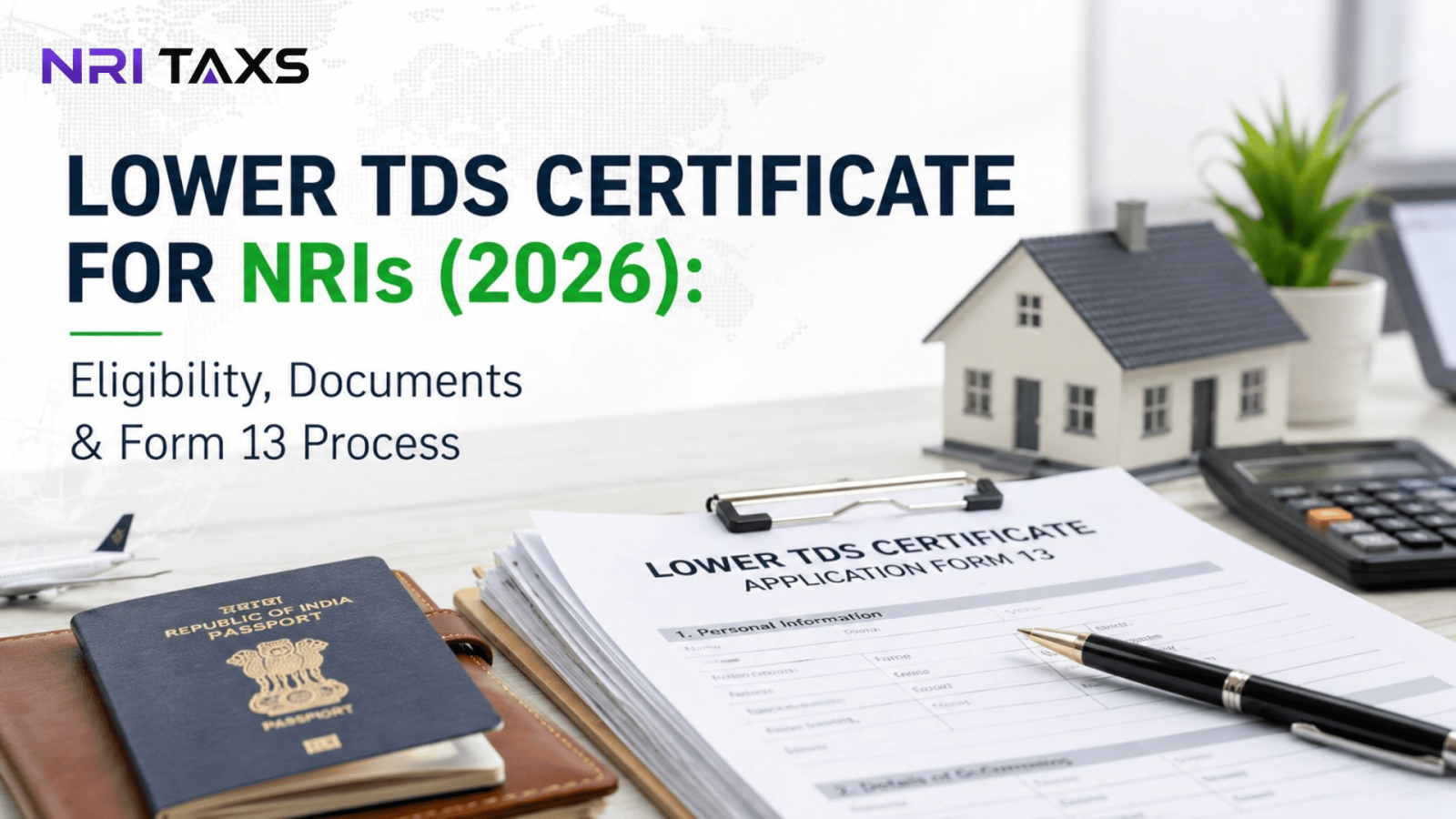
Selling property or receiving income in India as an NRI often results in TDS deductions far higher than the actual tax owed. Under Section 195, buyers and payers are required to withhold tax at rates of 20–30% (plus surcharge and cess) on the gross transaction value not on the real profit or income. That difference can lock up lakhs of rupees for months while a refund is processed.
A Lower TDS Certificate, obtained through Form 13 under Section 197 of the Income Tax Act, helps eligible NRIs align TDS with their actual tax liability instead of the inflated default rate. This guide walks through eligibility, required documents, the step-by-step application process, processing timelines, common rejection reasons, and how a Lower TDS Certificate compares to claiming a refund later.
What Is a Lower TDS Certificate?
A Lower TDS Certificate is a formal authorisation issued by the Jurisdictional Assessing Officer (TDS) under Section 197 of the Income Tax Act, 1961. It directs the payer, a property buyer, tenant, or bank to deduct tax at a reduced rate (or not at all) instead of the standard statutory rate under Section 195.
The certificate is obtained by filing an online application known as Form 13 through the TRACES portal, supported by a computation of actual income or capital gains and supporting documentation. Once approved, the certificate specifies the exact TDS rate to apply, and is valid for a defined period, deductor, or transaction.
Regulatory update: Under the Income Tax Act, 2025, Form 13 is set to be renumbered as Form 128, effective 1 April 2026. The underlying Section 197 mechanism and eligibility rules remain unchanged only the form number is being updated, so NRIs already familiar with the process will find the requirements identical.
Why Do NRIs Need a Lower TDS Certificate?
NRIs are taxed at source under Section 195 on a wide range of Indian income property sales, rent, NRO interest, dividends, and professional fees and this withholding is calculated on the gross amount, not the net taxable income. For a property sale, that means TDS can be deducted on the full sale price even if the actual capital gain (after cost of acquisition, improvement, and exemptions) is much smaller.
- Without a certificate, TDS may be withheld at 12.5%–30% (plus surcharge and cess) of the transaction value.
- The excess amount can only be recovered by filing an income tax return and waiting for a refund, which often takes several months.
- A Lower TDS Certificate prevents this cash-flow gap by fixing the correct rate upfront, before money changes hands.
A Lower TDS Certificate is just one way to reduce unnecessary tax deductions. NRIs should also understand how TDS applies to property sales, rental income, NRO interest, dividends, and other Indian income sources. Read our complete guide on TDS for NRIs: How Can NRIs Reduce High TDS Deductions? to explore all available options for reducing excess TDS.
Who Is Eligible for a Lower TDS Certificate?
Any NRI who expects their actual tax liability to be lower than the standard TDS rate can apply under Section 197, provided they hold a valid PAN, have no major outstanding tax defaults, and can substantiate their income or capital gains computation. Eligibility applies across several common income categories:
Property Sellers
NRIs selling residential or commercial property in India where the computed long-term or short-term capital gain is significantly lower than the sale consideration. This is the most common use case, since Section 195 TDS applies to the full sale price rather than the gain.
Rental Income
NRIs earning rental income from Indian property, where allowable deductions (standard deduction, home loan interest, municipal taxes) bring the actual taxable income well below the flat TDS rate applied by tenants.
NRO Interest
NRIs with NRO fixed deposits or savings accounts where bank-deducted TDS exceeds the tax actually payable under their applicable slab rate or DTAA benefit.
Dividend Income
NRIs receive dividends from Indian companies or mutual funds where DTAA provisions allow a lower withholding rate than the domestic default.
Professional Income
NRIs earn fees for professional or technical services rendered to Indian entities, where actual profit margins are lower than the flat TDS rate applied under Section 195.

Documents Required for Form 13 Application
Documentation requirements vary slightly by income type, but the table below covers what is commonly requested by the Assessing Officer:
| Document | Purpose |
| PAN card and passport copy | Identity and residential status verification |
| Computation of estimated income / capital gains | Basis for the requested lower rate |
| Property purchase deed / original cost documents | Establishes cost of acquisition for capital gains |
| Sale agreement / MOU with buyer’s PAN | Links the certificate to a specific transaction and deductor |
| Last 2–3 years’ ITR acknowledgements | Demonstrates regular compliance history |
| Bank statements (NRO/NRE) for the relevant income | Supports interest or rental income figures |
| FMV / registered valuer’s report (for pre-2001 property) | Required for indexed or fair-market-value cost basis |
| Details of TDS already deducted, if any | Reconciliation with Form 26AS / AIS |
Step-by-Step Income Tax Form 13 Process
The entire Form 13 process is online and faceless, run through the TRACES portal. Here is how it typically unfolds:
- Check eligibility to confirm your estimated tax liability is genuinely lower than the standard Section 195 TDS rate before applying.
- Collect documents gathering PAN, passport, cost records, sale agreement, and prior ITRs as listed above.
- Prepare the capital gains or income computation ideally with a CA, since this figure is the core of the application.
- Submit the application on TRACES, log in with PAN, complete Form 13, upload documents, and e-verify via DSC or net banking.
- Respond to officer queries the jurisdictional Assessing Officer may request clarifications, additional evidence, or schedule a hearing.
- Receive the certificate once satisfied, the AO uploads the Lower/Nil TDS Certificate digitally, specifying the approved rate.
- Share it with the buyer or payer the deductor then withholds TDS strictly at the certified rate instead of the default Section 195 rate.
When Should NRIs Apply for a Lower TDS Certificate?
Since a Lower TDS Certificate is intended to reduce tax before TDS is deducted, NRIs should submit their application well in advance of the transaction. Waiting until the last moment may result in the buyer, tenant, or bank deducting TDS at the standard rate, leaving you to claim a refund later through your income tax return.
Ideally, NRIs should apply:
- Before signing the sale agreement for an Indian property.
- Before the buyer deducts or releases any payment.
- Before receiving rental income if TDS is applicable.
- Before banks deduct TDS on NRO interest income.
- As soon as all required documents are ready, including PAN, income computation, and supporting transaction documents.
Lower TDS Certificate Processing Time
Timelines depend on the Assessing Officer’s workload, the complexity of the income computation, and how quickly supporting documents are provided:
| Stage | Typical Duration |
| Application submission and initial review | 3–7 working days |
| Document verification / officer queries | 1–3 weeks |
| Hearing (if required) and final assessment | 1–2 weeks |
| Total processing time (straightforward cases) | 30–45 days |
| Complex cases (large property sales, disputed cost basis) | Up to 2–3 months |
Tip: For property sales, apply as early as possible — ideally before signing the sale agreement since the certificate must be issued before the buyer remits any substantial payment, including advance deposits.

Common Reasons Why Lower TDS Certificate Applications Get Rejected
- Wrong or unsupported capital gain calculation figures not backed by valid cost-acquisition documents.
- Missing documents incomplete purchase deed, valuation report, or bank statements.
- PAN mismatch details on PAN, passport, and property documents don’t align.
- Buyer details missing TAN/PAN of the deductor not provided, so the certificate can’t be linked to a transaction.
- Incomplete application sections left blank or unsigned on the TRACES form.
- Wrong residential status application filed as resident instead of non-resident, or vice versa, affecting the applicable rate.
Benefits of a Lower TDS Certificate
- Better cash flow funds aren’t locked up for the entire assessment year.
- Avoid refund delays no need to wait months for the Income Tax Department to process a refund.
- Lower tax deduction TDS matches actual liability rather than a flat statutory rate on gross value.
- Faster property transactions buyers gain statutory protection to deduct at the certified lower rate, reducing negotiation friction.
Real-Life Example: How a Lower TDS Certificate Helped an NRI Save Lakhs
| Detail | Value |
| NRI | Raj, based in the USA. |
| Transaction | Selling an apartment in India. |
| Without certificate | Buyer would deduct TDS on the full sale value at the standard rate. |
| With Lower TDS Certificate | Buyer deducted TDS at a reduced rate closer to Raj’s actual capital gains liability. |
| Outcome | Several lakhs that would otherwise have been locked up were available immediately, instead of waiting for a refund after ITR filing. |
Lower TDS Certificate vs TDS Refund
| Lower TDS Certificate | TDS Refund |
| Applied for before the transaction/deduction | Claimed after TDS has already been deducted |
| Preserves cash flow immediately | Funds remain blocked until refund is processed |
| Prevents excess TDS from being withheld at all | Recovers excess TDS only after filing an ITR |
| Requires proactive application (Form 13) | Requires waiting through the assessment cycle |
Conclusion
For NRIs with Indian income especially property sales, where TDS applies to the gross sale value a Lower TDS Certificate under Section 197 is one of the most effective tools to protect cash flow and avoid the long wait for a refund. The process is entirely online through TRACES, but success depends heavily on an accurate capital gains computation and complete documentation. Applying early, ideally with a CA who specialises in NRI taxation, significantly improves the chances of approval within the standard 30–45 day window.
Disclaimer
The content published on NriTaxs is intended for informational purposes only and does not constitute legal, tax, or financial advice. Readers are encouraged to consult qualified professionals before making any decisions based on the information provided.








Related Articles