
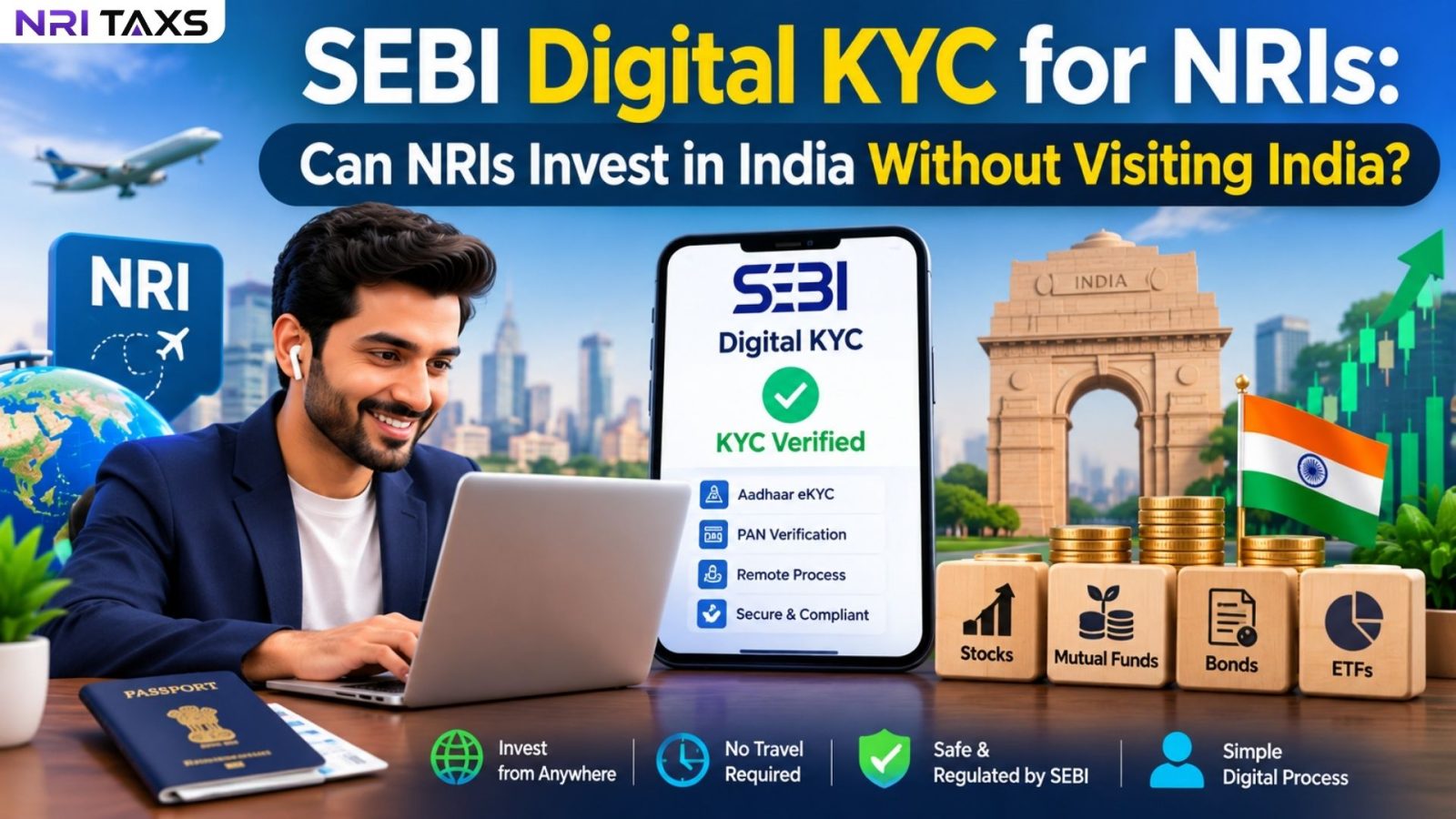
For many NRIs, investing in India starts with one frustrating question: Do I really need to visit India just to complete KYC? SEBI’s latest digital KYC proposal could make that process much easier. Under the proposed framework, eligible NRIs, OCIs and certain foreign investors may be able to complete KYC and investment onboarding digitally while staying abroad, reducing the need for physical visits, paperwork and courier-based verification.
But this does not mean every NRI can immediately open an investment account from abroad. The proposal comes with eligibility conditions, verification safeguards and other requirements that NRIs still need to understand. In this guide, we explain SEBI Digital KYC for NRIs, who may qualify, how the proposed process could work, what documents may be required, and whether NRIs can actually invest in India without visiting India.
Key Takeaways
- ✔ SEBI has proposed digital KYC for eligible NRIs, OCIs, and certain foreign investors.
- ✔ Eligible NRIs may be able to complete KYC from abroad without physically visiting India.
- ✔ The proposed process could use digital verification, video or liveness checks, and location-based safeguards.
- ✔ NRIs would still need to satisfy applicable PAN, FEMA, tax, banking, and investment requirements.
- ✔ Digital KYC does not automatically remove every requirement for opening an NRI demat, trading, or investment account.
- ✔ The framework is proposed, not yet a final universal rule, so NRIs should check the final SEBI notification before relying on it.
- ✔ The changes could significantly reduce paperwork, courier delays, and physical KYC hassles for NRIs investing in India.
What Is SEBI’s New Digital KYC Proposal for NRIs?
Right now, if an NRI wants to complete digital KYC with a broker, mutual fund, or other SEBI-registered intermediary, the system requires their location (captured through GPS coordinates) to be inside India at the time of verification. That single requirement is the reason most NRIs end up doing KYC the old-fashioned way, printing documents, getting them notarised or attested, and shipping them to India, or simply waiting until their next trip home.
SEBI’s consultation paper, titled “Review of Know Your Client Process for Individual Persons Resident Outside India,” proposes removing that geo-location restriction for eligible investors. Under the proposal, an NRI, OCI, or foreign national living in a country compliant with the Financial Action Task Force (FATF) would be able to submit KYC documents, complete video verification, and e-sign forms from wherever they currently live.
This isn’t SEBI’s first step in this direction either. Back in December 2025, the regulator had already relaxed geo-tagging requirements for NRIs doing re-KYC (updating existing KYC details). This August 2026 proposal goes several steps further by covering fresh onboarding as well, not just updates to an existing account.
Can NRIs Invest in India Without Visiting India?
Yes, NRIs can invest in Indian mutual funds, stocks and bonds without living in India, provided they hold an NRE or NRO bank account and complete KYC. The part that has genuinely required physical presence is the KYC and account-opening step itself, since digital onboarding wasn’t available to someone located outside India.
Once SEBI’s proposal is finalised, the “physically present in India” requirement for KYC would go away for eligible investors. But investing itself was never blocked for NRIs living abroad; it’s the onboarding process that’s being simplified. You’d still need a bank account in India, a PAN, and to meet FEMA rules that already apply to NRI investments, none of that changes.
Who Will Be Eligible for SEBI Digital KYC?
| Category | Eligible Under the Proposal? | Condition |
| Non-Resident Indians (NRIs) | Yes | Must be residing in a FATF-compliant country |
| Overseas Citizens of India (OCIs) | Yes | Must be residing in a FATF-compliant country |
| Foreign nationals living abroad | Yes | Must be residing in a FATF-compliant country |
| Individuals in FATF non-compliant countries | No | Existing (physical presence) KYC rules continue to apply |
| Foreign Portfolio Investors (FPIs) | No | Governed separately under the FPI regulatory framework |
What Will Change for NRIs Under the New KYC Rules?
This is really the heart of the proposal, and it’s worth going through each change on its own, because they add up to a meaningfully different experience for someone sitting in Dubai, New Jersey, or London trying to invest back home.
Digital submission of KYC documents. Instead of printing, signing, and physically mailing forms, NRIs would be able to submit KYC applications and supporting documents through an app, website, or other digital channel offered by the intermediary.
No physical presence in India required. This is the single biggest change. The current rule that ties digital KYC completion to a GPS location inside India would be relaxed for eligible investors, meaning the whole process could genuinely happen from your country of residence.
Digital verification from overseas. Verification would rely on tools like video-based identification, DigiLocker, or digital Aadhaar authentication rather than an in-person visit to a branch or intermediary office in India.
Reduced paperwork. With electronic and digital signatures accepted in place of wet-ink signatures on physical forms, a chunk of the traditional documentation load disappears.
Lower courier dependency. Right now, a huge part of NRI onboarding delay comes from international courier turnaround for signed and attested documents. Digital submission removes much of that dependency.
Potentially faster onboarding. Industry voices have pointed out that a process which currently takes two to three weeks, sometimes longer, could realistically be completed within a day or two once digital KYC is fully operational.
Portable KYC records across intermediaries. SEBI has also proposed making KYC records portable, so an NRI who has already completed verified KYC with one SEBI-registered intermediary might not need to repeat the entire exercise from scratch when approaching another one.
Taken together, these changes target the exact pain points NRIs have complained about for years: geography, paperwork, and duplication.
If you have recently moved abroad and your existing KYC still shows you as a resident, you may need to update your records separately. See our guide on Change Your KYC Status from Resident to NRI Online for the complete process.
How Will Digital KYC Work for NRIs?
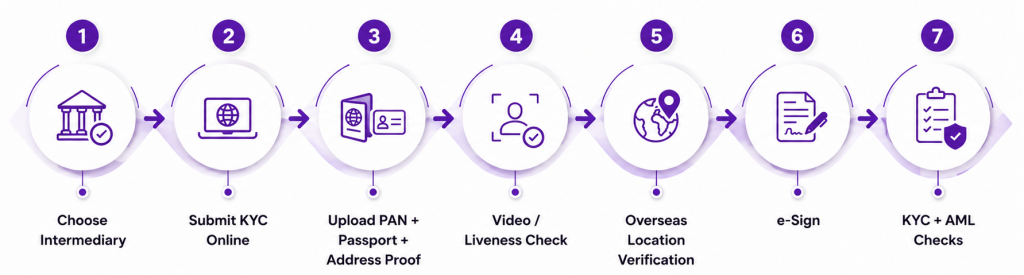
SEBI hasn’t issued a final operating procedure yet, since this is still a consultation paper open for public comment. But based on what’s been proposed, here’s the process NRIs can broadly expect once it’s implemented. Treat this as an expected workflow, not a confirmed step-by-step procedure.
- Select a SEBI-registered intermediary — a broker, mutual fund, or portfolio manager that offers digital KYC for overseas clients.
- Submit KYC details digitally through the intermediary’s app, website, or online portal.
- Upload required documents, such as your PAN, passport, and proof of overseas address. Don’t have a PAN card, don’t worry you can easily apply for NRI PAN Card Online.
- Complete video or liveness verification to confirm your identity in real time.
- Verify your overseas location, which the intermediary would capture and match against your proof-of-address country.
- Complete e-sign or electronic verification of your KYC application and account-opening forms.
- The intermediary completes internal KYC checks, including anti-money-laundering (AML) screening and KRA/CKYCRR database verification.
- Your investment account gets activated once the intermediary approves the application.
If you are specifically investing in Indian mutual funds, the KYC process has some additional requirements such as FATCA/CRS declaration and verification. Read our detailed guide on Mutual Fund KYC for NRIs.
What Documents Will NRIs Need for Digital KYC?
| Document | Applies To | Notes |
| PAN Card | All NRIs, OCIs, foreign nationals | Remains mandatory, subject to existing exemptions |
| Passport | NRIs, OCIs, foreign nationals | Continues to be required as identity and address proof |
| OCI Card | OCI cardholders only | Additional document required alongside passport |
| Overseas address proof | All applicants | Must match the GPS location captured during video verification |
| Bank account proof (NRE/NRO) | All NRIs | Investment transactions still route through an Indian bank account |
| Email ID | All applicants | Proposed to be made mandatory under the new framework |
What KYC Safeguards Will Apply to NRIs?
SEBI’s proposal is not about removing checks, it’s about relocating where those checks happen. To keep remote onboarding secure, the consultation paper outlines several safeguards intermediaries would need to build in:
- A liveness check during video verification, to confirm a real person is completing the process in real time
- Live capture of the applicant’s latitude and longitude, matched against the country listed on their address proof
- Prevention of connections from spoofed IP addresses
- KYC verification carried out in the presence of an authorised representative of the intermediary
- Concurrent audits of the digital onboarding process
- Compliance with cybersecurity requirements set by SEBI
In short, the process becomes remote, but it doesn’t become loosely verified. If anything, the location-matching and liveness requirements are more layered than a simple in-person signature ever was.

Can NRIs Invest in Stocks, Mutual Funds and Other Securities From Abroad?
Stocks: NRIs can invest in listed Indian company shares through the Portfolio Investment Scheme (PIS), subject to RBI and FEMA conditions, using an NRE or NRO account linked to a designated PIS bank account.
Mutual Funds: Most Indian mutual fund houses accept NRI investments, though a few restrict investments from NRIs based in the US and Canada due to additional compliance requirements under FATCA. This won’t change simply because KYC becomes digital.
Bonds: NRIs can invest in government bonds, corporate bonds, and sovereign gold bonds, generally on a repatriable or non-repatriable basis depending on the funding account used.
ETFs: Exchange-traded funds are accessible to NRIs in much the same way as mutual funds and listed stocks, through a demat account.
Other securities: Access to alternative investment funds (AIFs), REITs, and InvITs is also available to NRIs, though some categories carry additional eligibility or minimum-investment conditions.
Digital KYC vs Existing NRI KYC Process
| Aspect | Existing Process | Proposed Digital KYC |
| Physical presence | Required to be in India for digital onboarding | Not required, for FATF-compliant countries |
| Document signing | Wet-ink signature, often notarised/attested | Electronic or digital signature |
| Document delivery | International courier | Digital upload |
| Verification method | In-person or notarised documents | Video-based liveness and location verification |
| Typical turnaround | 2-3 weeks, sometimes longer | Potentially 1-2 days, once operational |
| Record portability | Often repeated with each new intermediary | Proposed to be portable across intermediaries |
What Problems Will SEBI’s Digital KYC Solve for NRIs?
The proposal directly targets three long-standing complaints from the NRI investor community: the need to travel to India purely for paperwork, the slow courier-and-attestation cycle, and having to repeat KYC every time you approach a new broker or fund house. If implemented as proposed, it could meaningfully widen NRI participation in Indian markets, something Zerodha’s Nithin Kamath and others in the industry have publicly welcomed, pointing out that removing this friction could expand the NRI investor base considerably.
Contact Us
What Problems Will Still Remain for NRI Investors?
This is the part that’s easy to gloss over in the headlines, so it’s worth being direct about it: digital KYC solves an onboarding problem, not the entire NRI investment compliance picture. Several requirements stay exactly as they are.
- Bank account requirements: You’ll still need an NRE or NRO account in India to route investment funds; KYC digitisation doesn’t remove this.
- NRE/NRO requirements: Which account you use still determines whether your investment is repatriable, and the rules around that don’t change.
- FEMA rules: All existing foreign exchange regulations on NRI investment continue to apply in full.
- Tax compliance: Digital KYC has nothing to do with tax filing. You’re still responsible for reporting investment income correctly, and for NRIs, that usually starts with getting your residential status determination right, since that single classification decides how much of your income India can actually tax.
- Broker-specific requirements: Individual intermediaries may still have their own onboarding checks, minimum balances, or documentation on top of SEBI’s baseline.
- Investment restrictions: Sectoral caps and company-wise investment limits for NRIs under FEMA remain unaffected.
- PIS/non-PIS requirements: Where the Portfolio Investment Scheme route applies, its conditions and reporting obligations are untouched by this proposal.
- Country eligibility: If you live in a country that isn’t FATF-compliant, none of this applies to you yet, you’d continue under the existing physical-presence process.
- Final implementation: Perhaps the biggest one, this is still a proposal. It becomes usable only after SEBI reviews public comments and issues a final circular.
When Will SEBI Digital KYC for NRIs Start?
SEBI released the consultation paper on August 14, 2026, and has invited public comments until September 4, 2026. After reviewing feedback, SEBI may finalise, modify, or further clarify the framework before issuing a final circular. Once that circular is issued, the proposed rules are stated to take effect 30 days later. There’s no confirmed go-live date yet, so NRIs should treat this as “on its way” rather than “available now.”
Conclusion
SEBI digital KYC proposal is one of the more practical, overdue changes on the table for NRI investors, and the reaction from the industry so far suggests it’s being taken seriously. But “proposed” and “effective” are two different things. Until SEBI issues a final circular, the physical-presence requirement for fresh digital KYC still technically applies, and every other piece of the NRI investment puzzle, your bank account, your FEMA compliance, your tax filing, stays exactly as important as it always was.
Disclaimer
The content published on NriTaxs is intended for informational purposes only and does not constitute legal, tax, or financial advice. Readers are encouraged to consult qualified professionals before making any decisions based on the information provided.









Related Articles