
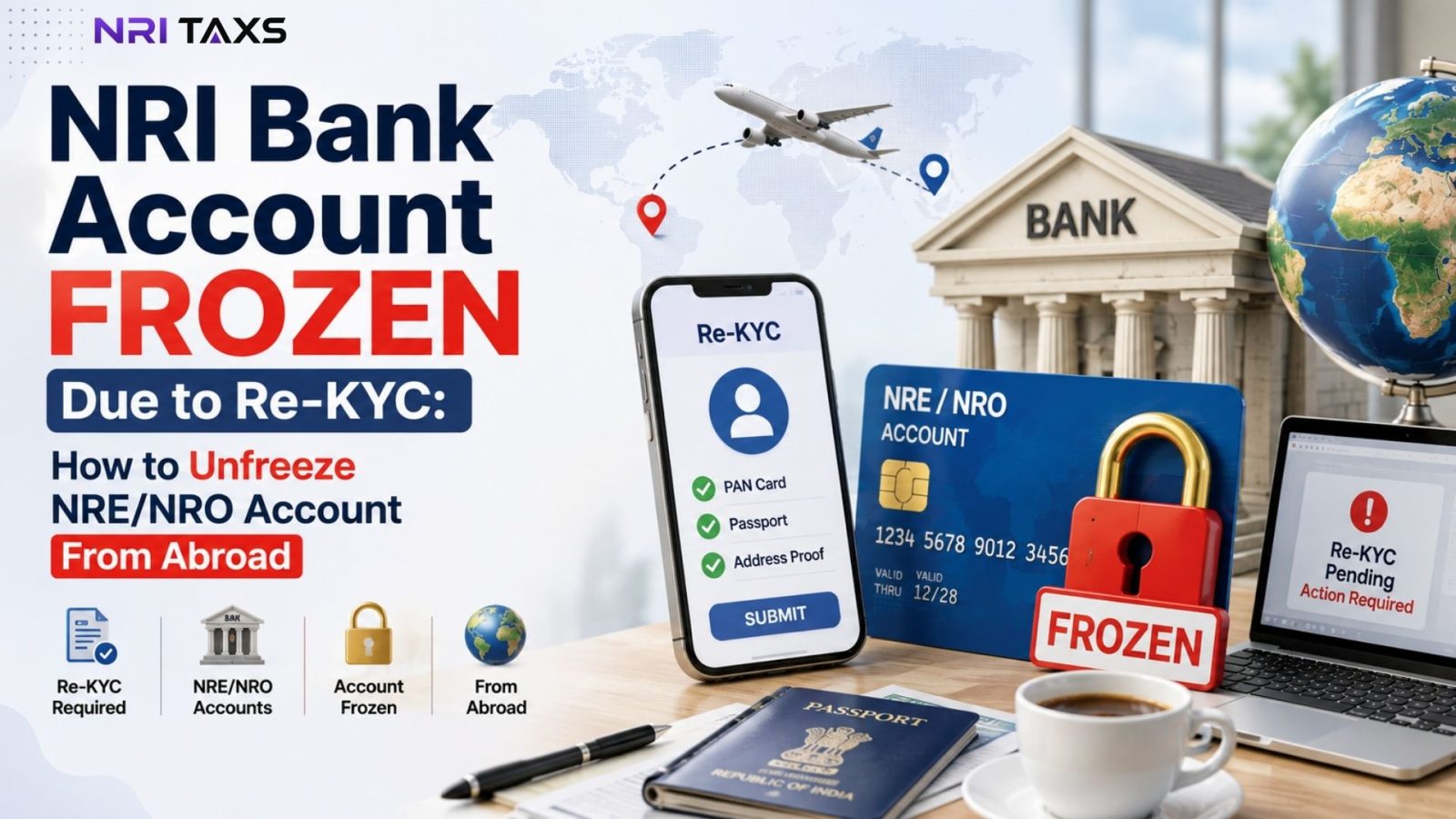
You tried to transfer money to your parents’ account in India, or simply check your NRE balance, but your banking app showed a restriction message. No withdrawal, no transfer, and sometimes limited account access. Your first thought might be, “Did someone hack my account?” But one common reason is simpler: your Re-KYC was due, and the bank restricted your account because you missed it.
This can happen to NRIs living abroad when Re-KYC reminders sent to their registered email or mobile number go unnoticed. By the time you notice, your NRE or NRO account may already have transaction restrictions.
You may not need to travel to India to resolve it. Depending on your bank, you may be able to complete Re-KYC remotely and request the restriction to be removed. This guide explains NRI Bank Account Frozen Due to Re-KYC and how to unfreeze NRE/NRO accounts from abroad.
Quick Answer
Banks freeze NRE/NRO accounts when periodic Re-KYC is not completed within the RBI-mandated timeline. To unfreeze it, submit updated KYC documents—passport, visa/residence permit, overseas address proof, and PAN—through your bank’s NRI email ID, net banking portal, or a signed self-declaration if nothing has changed. Most banks restore full access within 3 to 10 working days once the documents are verified.
Why Banks in India Freeze NRI Accounts Due to Re-KYC?
Re-KYC is not a bank’s personal policy, it comes directly from RBI’s Master Direction on KYC. Every bank in India is legally required to periodically re-verify a customer’s identity and address, and the frequency depends on how the bank classifies your risk category: broadly, high-risk customers are reviewed every 2 years, medium-risk every 8 years, and low-risk every 10 years, though individual banks can choose to review more frequently based on their internal policy.
For NRIs specifically, banks tend to treat the profile as needing more frequent attention, simply because your address, visa status, contact number, and even residency status can change more often than a resident customer’s. When your Re-KYC falls due and you don’t respond to the bank’s reminders in time, the account gets marked for restriction not because of suspicious activity, but purely because your file is “outdated” in the bank’s compliance records. Another issue can arise when the citizenship or residential status recorded on your PAN does not match the information provided to your bank. NRIs should ensure that their PAN details accurately reflect their current status to avoid unnecessary KYC mismatches and account restrictions.
Can a Bank Legally Freeze an NRI Account Because Re-KYC Was Not Updated?
Yes, and this is completely within RBI’s rules. Banks are required to maintain up-to-date KYC records to comply with anti-money laundering regulations, and if a customer fails to respond even after repeated notices, the bank can restrict debit transactions until the update is done. It’s worth knowing that RBI’s 2026 revision to the KYC framework gives some relief to low-risk customers for them, normal transactions can continue for up to a year past the due date, or until June 30, 2026, whichever comes later, giving a grace window before any freeze kicks in. But for medium and high-risk accounts, or once that grace period lapses, the freeze can happen fairly quickly.
So no, this isn’t a bank being unreasonable. It’s a compliance mechanism. The frustrating part for NRIs is usually not the rule itself, but the fact that reminder emails often land in an old inbox or an unused Indian phone number nobody checks anymore.
What Happens When an NRI Bank Account Frozen Due to Re-KYC?
The exact restrictions vary slightly bank to bank, but the pattern is fairly consistent across HDFC, ICICI, SBI, Axis, and most others.
Impact on NRE Account Transactions
Once frozen, you typically cannot initiate new outward remittances, cannot set up standing instructions, and in many cases cannot even do a simple online fund transfer out of the account. The account still technically exists; it just becomes non-operational for anything beyond viewing the balance.
Impact on NRO Account Transactions
The same restriction pattern applies to NRO accounts. If you’re relying on your NRO account for rent collection, EMI payments, or managing Indian expenses for family, a freeze can disrupt all of that at once, since most banks block withdrawals and transfers uniformly once the KYC flag is triggered. Understanding the key differences between NRE and NRO accounts can also help you choose the right account for managing your Indian income and transactions.
Incoming Money and Credits During Account Restrictions
This is the part that surprises most people: incoming credits usually still work. Rent from a tenant, dividend payouts, interest on fixed deposits, or a family member depositing money into your NRO account generally continues to go through even when the account is frozen, because the restriction is on outward movement of funds, not inward.
Withdrawals and ATM Transactions After a Freeze
ATM withdrawals, cheque payments, and UPI/debit card transactions are usually the first things to stop working. If you try an ATM withdrawal on a frozen account, it will simply decline, sometimes without a clear reason shown on screen.
Fund Transfers From a Frozen NRI Account
Any transfer out NEFT, RTGS, IMPS, or even an internal transfer to your own resident family member’s account — will be blocked until the Re-KYC is completed and the bank lifts the restriction manually.
How to Unfreeze NRE/NRO Accounts From Abroad?
Here’s the step-by-step approach that works across most Indian banks.
Step 1: Confirm Why the Account Was Frozen
Call your bank’s dedicated NRI helpline or check net banking for a specific message. Occasionally a freeze happens for a different reason, a lien, a court order, or an inactive account marker so confirming the exact cause before you start the paperwork saves time.
Step 2: Check Your Re-KYC Status
Most banks show a “KYC due” or “KYC expired” flag directly on the net banking dashboard or the mobile app under account details. If you can’t see it there, your relationship manager or NRI service email can confirm it within a day or two.
Step 3: Prepare the Required NRI KYC Documents
Gather these before you contact the bank so the process doesn’t stall halfway.
| Document | Purpose |
| Passport (self-attested copy) | Identity proof |
| Valid visa / residence permit / work permit | Proof of overseas residency status |
| Overseas address proof (utility bill, bank statement, driving licence) | Confirms current foreign address |
| PAN card copy | Tax identification linkage |
| Recent passport-size photograph | Bank record update |
| FATCA/CRS self-declaration (for US, UK, Canada and other applicable countries) | Regulatory tax-residency disclosure |
| Signed Re-KYC form | Formal request to the bank |
Step 4: Complete Re-KYC From Abroad
You don’t need to travel to India for this. Most banks let you email self-attested scanned copies from your registered email ID, or upload them directly through net banking or the mobile app. Some banks also offer video KYC as an option, which can complete the whole process in a single call.
Step 5: Ask the Bank to Remove the Restriction
Once documents are submitted, follow up specifically asking for the freeze to be lifted document submission and account unfreezing are sometimes treated as two separate steps internally, so don’t assume it happens automatically the moment you send your papers.
Step 6: Follow Up If the Account Is Still Frozen
If nothing changes after a week, escalate through the NRI relationship manager, or raise a formal service request through net banking. Keep a record of every email and reference number it makes escalation much faster if needed.
Can NRIs Complete Re-KYC Without Visiting India?
Yes, NRIs Complete Re-KYC Without Visiting India. Nearly every major Indian bank accepts Re-KYC through email, net banking upload, or video KYC for NRIs. If none of your details have changed since your last KYC same passport, same address, same visa status many banks will even accept a simple signed self-declaration email stating “no change in KYC information,” which is the fastest possible route.
What Documents Are Needed to Unfreeze NRE/NRO Accounts?
Here’s a consolidated checklist so you’re not scrambling document by document.
| Category | Accepted Documents |
| Identity Proof | Passport (mandatory for all NRIs) |
| Residency Proof | Valid visa, residence permit, work permit, or OCI/PIO card where applicable |
| Overseas Address Proof | Utility bill, foreign bank statement, driving licence, or government-issued ID showing address |
| Indian Identity Linkage | PAN card |
| Tax Declaration | FATCA (US) / CRS (UK, Canada, and 100+ other countries) self-certification |
| Photograph | Recent passport-size photo |
| Bank Form | Duly filled and signed Re-KYC updation form |
Before submitting anything, double-check that your name, date of birth, and passport number exactly match your PAN records. A mismatch here is one of the most common reasons Re-KYC gets rejected on the first attempt, which then extends the freeze even longer. Understanding your NRI KYC status can help identify and resolve these mismatches before they affect other financial services.
HDFC/ICICI NRO Account Frozen for Re-KYC: What Should You Do?
HDFC Bank NRO Account Re-KYC Freeze
HDFC typically notifies customers well before the due date and accepts scanned self-attested documents through their NRI service email. If your account is already restricted, reaching out to HDFC’s dedicated NRI desk with your documents is usually faster than waiting for the branch process.
ICICI Bank NRO Account Re-KYC Freeze
ICICI allows a “no change in KYC information” self-declaration email from your registered ID if nothing has changed since your last update, which is often the quickest resolution path if you’re just renewing an unchanged profile. If your passport or address has changed, you’ll need to submit the full updated document set instead.
What Happens to an NRI FD When Your KYC Expires?
Your fixed deposit itself is not at risk — the principal and accrued interest remain safe and continue to earn interest as scheduled. What typically gets blocked is your ability to close the FD prematurely, renew it, or transfer the maturity proceeds until the linked account’s KYC is updated. If an FD is maturing while your account is frozen, some banks will still auto-renew it rather than releasing the funds, so it’s worth checking with your bank directly if a maturity date is approaching.
How Long Does It Take to Unfreeze NRI Account After Re-KYC?
| Scenario | Typical Turnaround |
| No change in KYC (self-declaration accepted) | 1–3 working days |
| Full document resubmission, no discrepancies | 3–7 working days |
| Document mismatch or incomplete submission | 2–4 weeks (after resubmission) |
| Video KYC completed in one session | Often same day to 2 working days |
These timelines are indicative and can vary by bank and branch workload, so treat them as a general expectation rather than a guarantee.
Contact Us
What Should NRIs Do to Avoid Future Account Freezes?
The simplest fix is making sure your bank always has a way to reach you. Update your registered email ID and overseas mobile number as soon as they change, and check that inbox periodically. Re-KYC reminders almost always go there first, sometimes months before any restriction happens. It also helps to keep your passport, visa, and PAN aligned and current in the bank’s records, since discrepancies here are what typically stall the process even when you do respond on time. If you’re also going through a broader change for instance, moving from resident to NRI status or vice versa it’s worth reading through this detailed guide on updating KYC status from Resident to NRI, since a status mismatch is one of the less obvious triggers for a freeze.
Conclusion
A frozen NRE or NRO account feels alarming the moment you see it, but in almost every case it’s a routine compliance flag rather than a red flag on your account itself. The fix is procedural gather your documents, submit them through the channel your bank supports, and follow up until the restriction is formally lifted. Doing this proactively, before the next Re-KYC cycle comes around, is the easiest way to make sure you never have to deal with this disruption again.
If you’d rather not track every bank’s Re-KYC cycle and document format on your own, our team at NRITaxs.com helps NRIs manage KYC renewals, account documentation, and related compliance end-to-end get in touch with us and we’ll take it from there.
Disclaimer
The content published on NriTaxs is intended for informational purposes only and does not constitute legal, tax, or financial advice. Readers are encouraged to consult qualified professionals before making any decisions based on the information provided.





Related Articles