
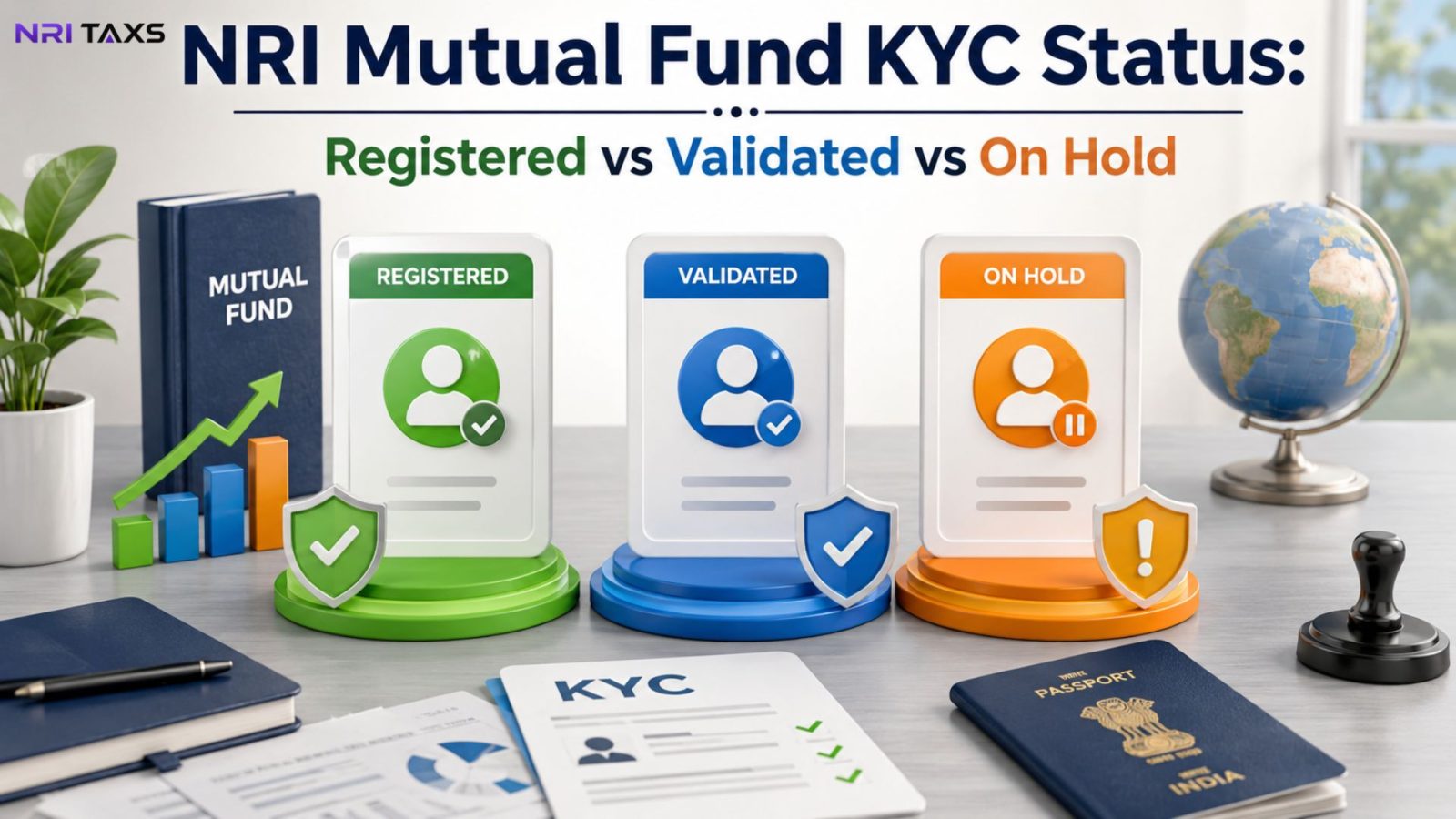
If you have invested in Indian mutual funds as an NRI, you may see different KYC statuses such as Registered, Validated, On Hold, or Rejected when you check your records. These statuses can affect whether you can make a new investment, continue your SIP, or need to update your KYC details. Seeing an On Hold or Registered status does not necessarily mean there is a problem with your mutual fund account. The action you need to take depends on the status shown in your KYC record and the reason behind it. In this guide, we explain what each NRI Mutual Fund KYC status means, whether you can invest with that status, why your KYC may be On Hold, how to check your status online, and what steps you can take to resolve the issue.
Key Takeaways
- ✔ NRI Mutual Fund KYC status can appear as Registered, Validated, On Hold, Rejected, or Under Process, and each status determines whether you can invest or need to take further action.
- ✔ A Validated KYC offers the smoothest investment experience, while an On Hold status can block new purchases, SIPs, and, in some cases, redemptions until the issue is resolved.
- ✔ Common reasons for an On Hold status include PAN or document mismatches, expired passports, pending FATCA declarations, outdated residential status, and incomplete KYC verification.
- ✔ You can check your KYC status online through MF Central or your respective KRA portal using only your PAN number, making it easy to identify and resolve issues.
- ✔ Keeping your passport, overseas address, FATCA details, PAN information, and Resident-to-NRI KYC records up to date helps prevent delays in mutual fund transactions.
- ✔ Regularly reviewing your KYC status and updating any incorrect information helps ensure uninterrupted mutual fund investments and compliance with SEBI’s latest KYC requirements.
What Is Mutual Fund KYC for NRIs?
Mutual Fund KYC is the identity and address verification process required before investing in Indian mutual funds. For NRIs, the process may involve documents such as a PAN card, passport, overseas address proof, and FATCA/CRS declaration, depending on the applicable KYC requirements. Once your KYC details are recorded with a KYC Registration Agency (KRA), your KYC record can generally be used when investing through participating mutual fund institutions, subject to applicable validation and update requirements.
This is why checking your KYC status is important. A status such as Registered, Validated, On Hold, or Rejected tells you whether your KYC requires any further action before you make a mutual fund transaction. If you’re new to investing, our detailed guide on Mutual Fund KYC for NRIs explains the complete KYC process, required documents, and verification methods before you begin investing.
What Do KYC Statuses Mean?
Every mutual fund investor’s KYC record, whether resident or NRI, sits in one of five buckets. Understanding which one you’re in tells you exactly what you can do right now.
Registered
Your basic identity details have been checked, but they haven’t been independently verified against an official database like Aadhar or your bank. For NRIs, this is the most common status because most don’t have an Aadhaar-based OVD to begin with.
Validated
This is the highest tier. Your PAN, address, email, and mobile number have all been cross-checked and confirmed against official records. A Validated KYC lets you invest with any AMC in India without submitting fresh documents.
On Hold
Something in your record failed verification usually a PAN-Aadhaar mismatch, an unvalidated email or mobile number, or missing documents. With this status, you cannot invest, and in many cases you can’t even redeem from your existing folios until it’s resolved.
Rejected
Your KYC application itself was declined, typically because a submitted document didn’t meet SEBI’s Officially Valid Document (OVD) standard, or the details didn’t match across documents. You’ll need to reapply with corrected paperwork.
Under Process
Your application is sitting with the KRA and hasn’t been fully checked yet. This is a temporary state most NRI applications clear this stage in 7 to 10 working days if the paperwork is in order.
NRI Mutual Fund KYC Status: Registered vs Validated vs On Hold
| Status | Meaning | Can You Invest? | Action Required |
| Registered | Details captured but not independently verified against Aadhaar or another OVD database | Yes, in most cases — SEBI has given NRIs a relaxation window for this status | Upgrade to Validated when possible using Aadhaar or a fresh OVD-based KYC |
| Validated | PAN, address, email, and mobile fully verified against official databases | Yes, across any AMC without extra paperwork | None — keep contact details updated if you move house or change your number |
| On Hold | Verification failed on one or more attributes (PAN-Aadhaar link, email/mobile, document type) | No — new purchases and often redemptions are blocked | Identify the exact reason via your KRA and resubmit or correct the flagged item |
| Rejected | Application declined due to invalid or mismatched documents | No | Reapply with corrected, properly attested documents |
How to Check Your Mutual Fund KYC Status?
You only need one thing to check your status: your PAN number. Here’s how to do it step by step.
- Go to MF Central (mfcentral.com) this is the unified portal that pulls your KYC record regardless of which KRA holds it. Enter your PAN and registered mobile/email to view your status.
- Check on CAMS (camsonline.com) if most of your folios were opened through CAMS-serviced AMCs. Use their KYC status search page.
- Check on KFintech (kfintech.com) if your investments were routed through Karvy or KFin-serviced fund houses.
- Check via CVL KRA (cvlkra.com) one of the largest KRAs and often the first place NRI KYC records land.
- Check via NDML KRA (ndml.in) if your record was created through an NSDL-linked intermediary.
- Check via CAMS KRA separately from the regular CAMS portal, since the KRA database and the transaction portal are technically different systems.
You don’t need to check all five just enter your PAN on MF Central first, and it will usually tell you which KRA is holding your active record.
Why Is Your KYC Showing “On Hold”?
On Hold is the status that causes the most panic, but it almost always comes down to one of these reasons:
- PAN mismatch: Your PAN details (name, date of birth) don’t exactly match what’s on your submitted documents.
- Aadhaar mismatch (for residents who later became NRIs): Your PAN isn’t linked to Aadhaar, or the linkage failed.
- Passport expired: KRAs periodically re-verify ID documents, and an expired passport on file triggers a hold.
- Overseas address mismatch: Your current country of residence doesn’t match the address on record with the AMC or KRA.
- FATCA declaration pending: If you haven’t submitted or updated your FATCA/CRS self-certification, several AMCs will freeze transactions until you do.
- CKYC mismatch: Your Central KYC Registry record doesn’t align with your mutual fund KRA record.
- Missing In-Person Verification (IPV): Some NRI applications get flagged when IPV wasn’t completed through an approved channel.
- Bank verification issue: Your NRE or NRO account details don’t match the cancelled cheque or bank proof submitted.
If you’ve recently moved abroad, make sure you’ve updated your KYC from Resident to NRI, as outdated residency information is one of the most common reasons for KYC verification issues.
How NRIs Can Change KYC Status from “On Hold” to “Validated”
- Identify the exact reason for the hold by checking the email from your KRA or logging into MF Central for a status breakdown.
- Fix PAN-Aadhaar linking on the Income Tax e-filing portal if that’s the trigger this alone resolves a large share of NRI holds.
- Update and validate your email and mobile number directly with your KRA. Note that overseas mobile numbers sometimes fail auto-validation, so use email as your primary validated channel.
- Submit fresh KYC documents — passport, visa/OCI, PAN, and overseas address proof — if your existing record used an outdated or unsupported document type.
- Complete In-Person Verification (IPV) through the Indian Embassy, a notary in your country of residence, or an overseas branch of an Indian bank.
- Submit or refresh your FATCA/CRS declaration through your AMC’s online portal or the KFintech FATCA page.
- Request revalidation through the KRA portal once every flagged item is corrected this isn’t automatic, you usually have to trigger it.
- Track the status on MF Central every few days until it moves to Validated.
Documents Required
| Document | Why It’s Needed |
| Passport | Primary identity proof for all NRI KYC applications |
| Visa | Confirms your current residency status abroad |
| OCI Card | Required if you hold Overseas Citizen of India status instead of an Indian passport |
| PIO Card | Accepted for older Person of Indian Origin cardholders where applicable |
| PAN Card | Mandatory — links your KYC record across every AMC and intermediary |
| NRE/NRO Account Proof | Confirms the bank account through which you’ll invest and redeem |
| Overseas Address Proof | Utility bill, bank statement, or driving licence showing your current country address |
| Photograph | Passport-size photo required for the physical or digital KYC form |
How Long Does KYC Validation Take?
| Method | Typical Timeline |
| Aadhaar-based e-KYC (if you have an active Aadhaar linked to an Indian number) | Instant to 48 hours |
| Non-Aadhaar OVD-based KYC (passport, overseas address proof) | 7–10 working days |
| Resolving an On Hold status after correction | 3–7 working days once the flagged issue is fixed |
| Physical/courier-based KYC submission | 10–15 working days, depending on courier and IPV scheduling |
Can You Invest If Your Status Is “Registered”?
This is one of the most searched questions among NRI investors, and the honest answer is: it depends on timing. SEBI gave NRIs a relaxation allowing them to continue investing including with a new fund house while holding “Registered” status, treating it as equivalent to Validated for portability purposes. That relaxation window was extended in stages and was last set to run through April 30, 2026.
Since that date has now passed, don’t assume the old relaxation still applies automatically. Check your live status on MF Central before placing a fresh purchase, and if you’re still on Registered, it’s worth completing Aadhaar-based validation now rather than waiting for another possible extension. If you already have an active folio and your status is Registered, existing SIPs and redemptions in that specific fund house usually continue to work; the friction shows up mainly when you try to invest with a new AMC.
Can You Invest If Your Status Is “On Hold”?
No. On Hold effectively freezes you out of new purchases, and in most cases redemptions and SIP instalments in existing folios get blocked too, until the underlying issue is resolved. This is different from Registered status, which usually still lets you transact. Don’t wait for the AMC to reach out the fix is almost always faster when you initiate the correction yourself through the KRA portal.
Best Ways to Fix KYC Issues Quickly
- Start with MF Central it shows a single consolidated view instead of chasing multiple KRA sites.
- Link PAN with Aadhaar first if you have one; this resolves the single biggest cause of On Hold status.
- Use email validation as your primary channel since overseas mobile numbers can fail auto-verification.
- Keep your residential status updated with your AMC the moment you move from resident to NRI, since a stale status often triggers a fresh KYC hold later.
- Get documents attested through the Indian Embassy or a notary in your country of residence rather than self-attesting, which several AMCs no longer accept for NRIs.
- Submit your FATCA/CRS declaration proactively, don’t wait for a transaction to fail first.
- Re-check your status every few days after submitting a correction KRAs don’t always send a confirmation email once it’s resolved.
Conclusion
Your KYC status decides whether your investment goes through or bounces back so it’s worth five minutes to check it before you place your next SIP or lump-sum purchase. If you’re sitting on Registered, don’t wait for another SEBI extension; move to Validated now so a policy change never catches you off guard. If you’re On Hold, the fix is usually faster than it looks. Most cases come down to one document or one unlinked PAN-Aadhaar record.
Not sure where your KYC stands or which document is causing the block? Talk to our NRI tax and compliance team at NRITaxs.com we’ll help you check your status, identify the exact issue, and get it resolved without the back-and-forth.
Disclaimer
The content published on NriTaxs is intended for informational purposes only and does not constitute legal, tax, or financial advice. Readers are encouraged to consult qualified professionals before making any decisions based on the information provided.




Related Articles