
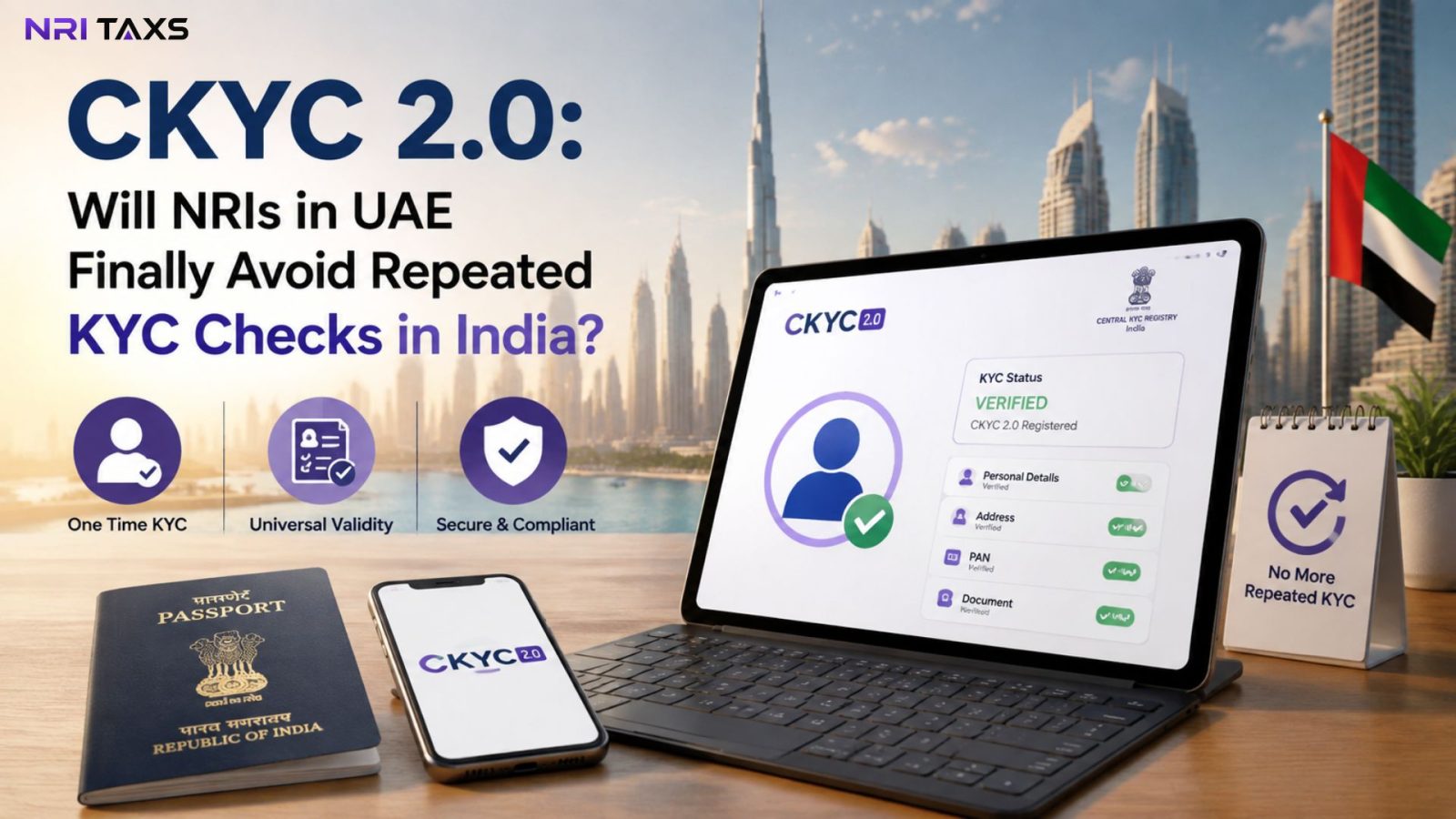
If you’re an NRI in the UAE, you’ve probably uploaded the same KYC documents more than once, your passport to open an NRE account, the same passport again for mutual funds, another copy for insurance, and yet another when your bank asks you to re-verify your details a few years later. For many NRIs, repeated KYC has become one of the biggest frustrations when managing financial relationships in India.
That may soon begin to change. India is rolling out CKYC 2.0, an upgraded Central Know Your Customer (CKYC) system designed to reduce duplicate KYC submissions by allowing participating financial institutions to access a customer’s verified KYC record with their consent. Recent reports suggest the new framework could significantly simplify onboarding and compliance for NRIs, including those living in the UAE, as banks and other financial institutions gradually adopt the upgraded system.
In this guide, we’ll explain what CKYC 2.0 is, why it has been introduced, how it works, which financial institutions are expected to use it, whether it will really reduce repeated KYC checks for NRIs, and what you should do before the new system is fully rolled out.
Quick Answer
CKYC 2.0 is India’s upgraded Central KYC Records Registry, expected to roll out from August 2026, starting with banks and insurance companies. It allows NRIs to complete KYC once and lets participating financial institutions retrieve the verified record with the customer’s consent, reducing the need to submit the same documents repeatedly. However, KYC requirements won’t disappear completely—institutions may still request updated documents if your information is outdated, incomplete, or your risk profile requires additional verification. The rollout will be phased across banks, insurers, mutual funds, and brokers.
What Is CKYC 2.0?
CKYC 2.0, officially the upgraded Central KYC Records Registry (CKYCRR 2.0), is a government-backed upgrade to India’s centralised KYC system operated by CERSAI. The upgraded framework is designed to make KYC data sharing faster and more standardised through digital, API-based processes. With the customer’s consent, participating banks, insurers, mutual funds and other regulated entities can retrieve an existing verified KYC record instead of asking the customer to submit the same information from scratch.
Why Has CKYC 2.0 Been Introduced?
India’s original CKYC registry already holds over a billion customer records, but duplicate entries, missing data, and inconsistent quality have limited how useful it really is in practice. CKYC 2.0 was introduced to fix that, with a few clear goals:
- Ending repeated KYC: customers shouldn’t have to re-submit the same documents to every new institution.
- Digital verification: real-time API checks, AI-based face matching, and DigiLocker integration replace slow manual PDF reviews.
- Faster onboarding: account opening that used to take days can now happen in minutes for repeat customers.
- Better customer experience: a self-service portal lets customers see who has accessed their KYC data and request corrections.
- Consent-based KYC sharing: no institution can pull your record without an OTP-based consent step first.
CKYC 2.0 to Help NRIs
This is the part that matters most if you’re reading this from Dubai, Abu Dhabi, or Sharjah. NRIs typically juggle more financial relationships in India than resident Indians do an NRE account, an NRO account, fixed deposits, insurance policies, mutual funds, and sometimes a demat account too. Each one has historically demanded its own round of KYC paperwork, even when another regulated institution already verified the exact same documents.
CKYC 2.0 is designed to change that pattern for NRIs in a few concrete ways:
- One-time KYC: complete verification once, and let participating institutions retrieve it with your consent.
- Less paperwork: fewer repeated passport copies, address proofs, and photographs across providers.
- Faster account opening: new NRE/NRO accounts or FDs can be opened faster once your verified record exists.
- Better banking experience: less back-and-forth over courier-scanned documents from overseas.
- Easier financial onboarding: new mutual fund or insurance purchases can lean on your existing verified KYC instead of starting from scratch.
How Does CKYC 2.0 Work?
At a basic level, the CKYC 2.0 process follows a simple flow:
In practice, this means when you approach a new bank or investment platform, you give consent through an OTP, the institution pulls your existing verified record from the CKYC registry instead of asking you to re-upload documents, and your account moves forward from there unless something in your profile has changed or needs updating.
Will NRIs in UAE No Longer Need Repeated KYC?
This is the real question behind the Gulf News headline, and the honest answer is: not immediately, and not completely. Here’s the nuance that’s easy to miss:
- Not immediately: CKYC 2.0 is being rolled out in phases, so NRIs may not see the same KYC experience across every financial institution at the same time.
- Depends on the institution: Your NRE/NRO bank may adopt the upgraded CKYC system before your mutual fund house, insurer or broker.
- Phased adoption: Different categories of regulated financial institutions may come under the upgraded framework at different stages.
- Fresh documents may still be required: CKYC 2.0 does not remove KYC obligations. A bank or financial institution can still request updated documents if your passport, address, contact details or other KYC information has changed, your record is incomplete, or additional due diligence is required.
- Periodic KYC requirements remain: Customers may still need to complete periodic KYC updates based on applicable regulatory requirements and their risk category. CKYC 2.0 is intended to make this process more efficient, not eliminate the requirement itself.
So while CKYC 2.0 is a genuine step toward reducing repeated KYC checks for NRIs, it’s an improvement in efficiency, not a promise that you’ll never be asked for a document again.
Contact Us
Which Financial Institutions Will Use CKYC 2.0?
| Financial Institution | CKYC 2.0 Status |
|---|---|
| Banks | Being rolled out from August 2026 |
| Insurance Companies | Being rolled out from August 2026 |
| Mutual Funds | Phased adoption |
| Stock Brokers | Phased adoption |
Which Services Will CKYC 2.0 Cover?
Once fully rolled out, CKYC 2.0 is intended to cover most of the financial products NRIs typically hold in India:
- Savings Accounts
- NRE Accounts
- NRO Accounts
- Fixed Deposits
- Insurance
- Mutual Funds
- Demat Accounts
- Stock Trading
This is the part many competitor articles skip entirel, most coverage stops at “banks and insurers,” without spelling out that NRE/NRO accounts, demat holdings, and stock trading accounts all sit inside the same CKYC 2.0 framework once the rollout reaches those institutions.
Has CKYC 2.0 Launched in India?
CKYC 2.0 is being introduced through a phased rollout from August 2026, rather than becoming available across every financial institution at once. Banks and insurance companies are among the institutions involved in the initial phase, while other financial institutions are expected to adopt the upgraded framework progressively.
For NRIs, this means you may not immediately notice a change when dealing with every bank, mutual fund, insurer or broker in India. The practical benefit will increase as more participating institutions connect to the upgraded CKYC framework and begin retrieving verified KYC information with customer consent.
So, if your bank still asks you to provide KYC documents after the August 2026 rollout, it does not necessarily mean CKYC 2.0 has failed. Adoption is phased, and institutions may still request documents when updated or additional verification is required.
Is CKYC 2.0 Better Than CKYC 1.0?
| CKYC 1.0 | CKYC 2.0 |
| Static PDF uploads | Real-time, API-based data sharing |
| No consumer-facing portal | Self-service portal to view access and raise disputes |
| Limited Aadhaar integration | Full India Stack integration — Aadhaar, DigiLocker, PAN validation |
| High duplicate and data-quality issues | AI-based duplicate detection and confidence scoring |
| No standard consent mechanism | OTP-based consent required before any institution accesses your record |
| Onboarding often took days | Onboarding can complete in minutes for verified repeat customers |
What Should NRIs Do Before CKYC 2.0 Is Fully Rolled Out?
You don’t need to take any emergency action the moment CKYC 2.0 launches, but getting your existing records accurate now will save you friction later. Before the rollout reaches your institutions, work through this checklist:
✔ Update PAN with your current details. For updating PAN details, read our guide on How to Update Citizenship Status in PAN Card for NRIs.
✔ Update Passport information on file with your bank.
✔ Update Overseas Address to your current UAE residence.
✔ Update Mobile Number linked to your accounts.
✔ Update Resident → NRI KYC status if you haven’t already.
✔ Complete FATCA/CRS Declaration if pending.
✔ Keep CKYC Details Consistent across every bank, insurer, and fund house you use.
✔ Check your CKYC Identifier (KIN): If your bank has already generated a CKYC Identifier for you, keep the number available. It can help participating financial institutions locate your existing KYC record when required.
Quick Tip
If your Indian bank has generated a CKYC Identifier (KIN) for you, ask them to share it. Keeping your CKYC number handy can make future KYC updates and account opening processes quicker, as participating financial institutions can retrieve your verified KYC record with your consent.
Will UAE Introduce a Similar KYC System?
This part is worth being precise about, since it’s easy to overstate. Here’s what’s actually confirmed, without speculating beyond it:
- The UAE has its own KYC framework, and the UAE Central Bank has separately been developing a nationwide unified eKYC platform through a technical partnership with Norbloc AB.
- This announcement CKYC 2.0 is specifically about India’s Central KYC registry, not a joint India-UAE initiative.
- Future interoperability between India’s CKYC system and any UAE eKYC platform has not been announced. Industry commentary has suggested India’s model could serve as a reference point for the UAE, but that is not the same as a confirmed integration.
Conclusion
CKYC 2.0 is a government-backed upgrade now being rolled out in phases in India in 2026. For NRIs in the UAE juggling NRE accounts, FDs, insurance, and mutual funds back home, it genuinely points toward fewer repeated KYC checks over time. But the rollout is phased, institution-dependent, and won’t eliminate documentation requests overnight. The smartest move right now is to make sure your PAN, passport, address, and NRI KYC status are all current, so that whenever CKYC 2.0 reaches your bank or fund house, you’re ready to benefit from it immediately.
Disclaimer
The content published on NriTaxs is intended for informational purposes only and does not constitute legal, tax, or financial advice. Readers are encouraged to consult qualified professionals before making any decisions based on the information provided.







Related Articles