

Many NRIs continue investing in Indian stocks using their old resident demat account without realizing that it may no longer comply with FEMA regulations. If you live outside India and want to invest in Indian shares, mutual funds, ETFs, or bonds, opening the right NRI Demat Account is the first step toward investing legally and managing your portfolio without regulatory issues.
The good news is that you don’t need to travel back to India to open one. Today, most leading banks and stockbrokers allow NRIs to complete the entire account opening process online from document submission and Video KYC to account activation whether you’re living in the USA, UK, Canada, UAE, Australia, or any other country.
In this guide, we’ll walk you through everything: what an NRI demat account is, the documents you’ll need, How to Open NRI Demat Account in India, charges to expect, and the mistakes most NRIs make so you can avoid them.
What Is an NRI Demat Account?
A demat (dematerialized) account holds your shares, mutual funds, and bonds in electronic form, just like a bank account holds your money digitally instead of cash. An NRI demat account is the same concept, but specifically meant for Non-Resident Indians, and it must be linked to an NRI bank account not a regular resident savings account.
The key difference is regulatory. Your NRI demat account operates under FEMA (Foreign Exchange Management Act) guidelines, which decide how much you can invest, what you can invest in, and how much you can send back abroad.
In India, your broker doesn’t hold your shares directly; they act as a Depository Participant (DP) connected to either CDSL or NSDL, the two depositories that maintain the actual electronic records.
How Nri Demat Account Differs from Resident Demat Accounts?
- Different Bank Accounts:- An NRI Demat account must be linked to an NRI bank account (NRE or NRO), not a regular resident savings account.
- FEMA Regulations:- NRI accounts must strictly comply with FEMA guidelines, which govern how much money you can invest and move back abroad (repatriation).
- Strict Investment Caps:- NRIs face individual holding limits. You cannot own more than 5% of a company’s paid-up capital individually, and all NRIs combined cannot hold more than 10% (unless the company approves up to 24%).
- No Intraday Trading:-NRIs are strictly barred from intraday trading and short-selling. You can only do delivery-based (buy and hold) investing.
- Automated TDS:- Brokers automatically deduct TDS on capital gains every time an NRI sells a stock. Resident investors do not face TDS and pay tax during annual ITR filing.
Who Can Open an NRI Demat Account?
Your eligibility depends on your residential status and investment category. Here’s who can open an NRI Demat Account in India:
| Applicant Type | Eligible? | Notes |
| NRI | ✅ Yes | Must have a valid PAN and NRE/NRO bank account. |
| OCI Cardholder | ✅ Yes | Most brokers allow OCI holders to open NRI Demat Accounts. |
| PIO (where applicable) | ✅ Yes | Subject to current RBI/FEMA rules and broker policies. |
| Resident Indian | ❌ No | A regular resident Demat Account is required instead. |
A quick note on joint accounts: an NRI can hold a joint demat account with a resident Indian, but only as a non-repatriable NRO account, with the NRI as the primary holder. Two NRIs together can open either an NRE or NRO account.
What Happens to Your Existing Demat Account When You Become an NRI?
If you already hold a demat account before moving abroad, you cannot legally continue using it as a resident. Under FEMA regulations, it is mandatory to either change the status of your account or close it once your residency changes to an NRI.
You have two main paths to handle this:
Option 1: Convert to an NRO Demat Account
Most Indian brokers allow you to transition your existing resident demat account into a Non-Resident Ordinary (NRO) account. This path allows you to retain your current stock holdings without selling them. To do this, you must submit updated NRI KYC documents, including your foreign passport/visa, overseas address proof, and your linked NRO bank account details.
Option 2: Open a New NRE Demat Account
If your goal is full repatriability (the ability to easily move all your investment proceeds back abroad), you will need to open a brand-new NRE demat account. You can then transfer eligible securities from your old account, though this may trigger specific tax implications depending on how the transfer is structured.
The Standard Conversion Process
While the exact procedure depends on your broker, the standard steps generally involve:
- Downloading the Change of Status / NRI Conversion Form from your broker’s portal.
- Filling in your updated overseas details and your new NRO bank account info.
- Providing self-attested copies of your passport, visa/work permit, overseas address proof, and NRO bank statement.
- Submitting a signed FEMA declaration confirming your non-resident status. Processing usually takes between 7 to 15 business days.
Stop trading on your resident account the moment your residency status changes to an NRI. Continuing to execute trades on a standard resident account while living abroad is a direct violation of FEMA guidelines and can attract penalties.
NRE vs NRO Demat Account: Which One Should You Choose?
This is usually the first real decision you’ll make, and it depends entirely on where your investment money is coming from.
| Feature | NRE Demat Account | NRO Demat Account |
| Linked Bank Account | NRE bank account | NRO bank account |
| Best For | Investing foreign earnings | Investing Indian-sourced income (rent, pension, etc.) |
| Repatriation | Fully repatriable (No upper limit) | Limited up to USD 1 million/financial year (after taxes) |
| RBI Registration Needed | PIS (Portfolio Investment Scheme) | Not required (Can trade via Non-PIS route) |
| Intraday Trading | Not allowed | Restricted/limited (Broker-dependent) |
| Tax on Dividends/Capital Gains | Taxable in India | Taxable in India |
A simple way to decide: if the money you want to invest comes from your salary or savings abroad and you may want to take it all back someday, go with NRE. If you’re investing money you already earned in India like rent or freelance income an NRO account makes more sense.
You can also hold both accounts at the same time if you have both types of income, though you’ll pay maintenance charges on each.
Documents Required to Open an NRI Demat Account
Keep these ready as clear, high-resolution scans before you start the application:
- PAN card — mandatory, no exceptions
- Passport — first page, last page, and any visa/immigration stamp page
- Visa or residence permit proving your overseas status
- Overseas address proof — utility bill or bank statement, not older than 3 months
- Indian address proof — Aadhaar, voter ID, or driving license
- Two recent passport-size photographs
- Cancelled cheque or bank statement of your NRE/NRO account
- Form 10F + Tax Residency Certificate — only if you want to claim a lower TDS rate under DTAA
Most brokers now accept self-attested copies, so notarization usually isn’t required unless your specific broker insists on it.
How to Open NRI Demat Account: Step-by-Step Process
Here are the key steps to open NRI Demat Account.
Step 1: Decide Between NRE and NRO
First step to open NRI Demat account is to choose between NRE or NRO. Based on your fund source, lock in your account type first this decides which bank account you’ll need to set up alongside it.
Step 2: Choose a Broker or Bank
Compare a few options on charges, app usability from your country of residence, and NRI-specific support. Don’t assume every broker supports NRE accounts many discount brokers only offer NRO.
Step 3: Open Your NRI Bank Account (If You Don’t Have One)
Your demat account must link to an NRE or NRO account, so this needs to be ready first or in parallel.
Step 4: Fill the Online Application
Most brokers have a dedicated NRI account-opening section. Enter your personal, contact, and banking details carefully your PAN and email especially, since OTPs and all communication go through these.
Step 5: Upload Documents
Submit scanned copies of everything listed above through the broker’s portal. Naming files clearly reduces back-and-forth.
Step 6: Complete Video KYC
A short video call (usually 10–15 minutes) verifies your identity against your original documents. Make sure you’re in good lighting with a stable internet connection.
Step 7: Sign the Agreement
E-sign your client agreement, usually via Aadhaar-based authentication or a simple digital signature link.
Step 8: Account Activation
Once verified, you’ll receive your demat account number (typically 16 digits, starting with “IN”) and trading login credentials, usually within 2–7 working days.
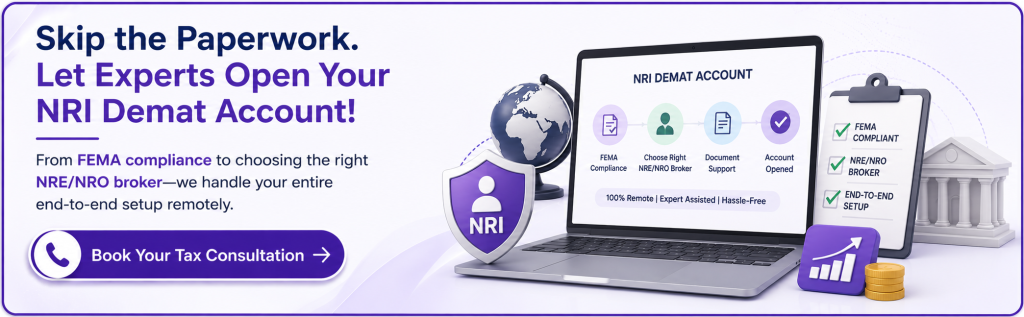
Total timeline: Most accounts get fully activated within 7–15 working days. Some digital-first brokers can do it in as little as 24–48 hours if your documents are in order. For durther support you can take help from savetax.
What If You Already Had a Demat Account Before Becoming an NRI?
You cannot continue using your old resident demat account once you become an NRI this is a FEMA requirement, not optional. You have two paths:
- Convert it to an NRO account — keeps your existing holdings intact
- Open a fresh NRE account — if you want full repatriation flexibility, then transfer eligible holdings after paying applicable taxes
Stop trading on your resident account the moment your NRI status kicks in, even before conversion is complete.
What Are the Charges Involved?
Costs vary quite a bit depending on whether you go with a full-service broker or a discount broker:
- Account opening fee: Roughly Rs 0–1,000 (discount brokers are usually cheaper or free)
- Annual Maintenance Charge (AMC): Rs 0–750 per year
- Brokerage: Flat Rs 10–20 per trade (discount) vs 0.25–0.50% of trade value (full-service)
- DP charges: Rs 5–20 per scrip, charged only when you sell
Always check the fine print some brokers offset “zero AMC” offers with higher brokerage elsewhere.
Trading Restrictions Every NRI Should Know
- No intraday trading through NRE/PINS accounts only delivery-based trades are allowed
- F&O trading is heavily restricted and unavailable with most brokers for NRI accounts
- No currency derivatives trading
- Commodity trading on MCX/NCDEX is generally not permitted
- Delivery-based equity, ETFs, bonds, and mutual funds remain fully accessible
If your goal is long-term wealth building rather than active trading, none of this should really affect you.
Tax Implications You Shouldn’t Ignore
- TDS on capital gains for NRIs is typically around 20% (plus surcharge/cess) if PAN is submitted; without PAN, it jumps to 30%
- LTCG (holding period over 12 months) on equity is taxed at 12.5% above the exempt threshold
- STCG (under 12 months) on equity is taxed at 20% for NRIs
- A Tax Residency Certificate (TRC) and Form 10F can help you claim a lower TDS rate under DTAA if your country has a tax treaty with India
Since TDS is often deducted at a flat higher rate, many NRIs end up overpaying and are eligible for a refund but only if they file an Indian income tax return.
How to Choose the Best NRI Demat Account
Key Factors to consider when choosing an NRI Demat Account.
- Brokerage and Associated Costs: Compare all charges, including brokerage rates, account opening fees, and annual maintenance charges (AMC). Even small differences in fees accumulate over time.
- Bank Account Integration (3-in-1): An integrated account (Demat, Trading, and NRE/NRO Bank Account) streamlines transactions, fund transfers, and regulatory reporting, making it more convenient to manage.
- PIS vs. Non-PIS Handling: Check the broker’s process for obtaining the PIS (Portfolio Investment Scheme) letter from the RBI, which is required for trading on a repatriable basis. Non-PIS accounts are simpler but are for non-repatriable investments.
- Trading Platform and Technology: Ensure the platform is reliable, user-friendly, and easily accessible from your country of residence. Look for features like advanced charting and quick order execution.
- NRI Customer Support: Effective and timely customer service is crucial. Confirm if the broker offers dedicated support for NRIs, including assistance across different time zones.
- Ease of Repatriation: Understand the broker’s process for repatriating funds (both capital and gains) back to your overseas account to ensure it is straightforward and compliant with FEMA guidelines.

Common Mistakes NRIs Make While Opening a Demat Account
- Picking NRO when they should’ve picked NRE (or vice versa) and realizing the repatriation mismatch too late
- Submitting blurry or expired documents, which is the single biggest cause of delays
- Trying to link a regular resident bank account this simply won’t work
- Ignoring DTAA benefits, ending up with avoidable TDS deductions
- Choosing a broker on brand name alone without comparing AMC, brokerage, and hidden charges
Final Thoughts
Opening an NRI demat account is far simpler today than it was even a few years ago most of it can be done online without ever stepping into a bank branch in India. The part that actually matters is getting your account type right (NRE vs NRO) based on where your money is coming from, and being thorough with your documentation upfront.
Tax planning is the piece most NRIs underestimate. Getting your DTAA paperwork right from day one can save you a meaningful amount in TDS every year.
Not sure whether to set up NRE or NRO, or how to structure your investments tax-efficiently? Talk to our NRI tax expert for a personalised consultation, and let us help you set this up the right way from the start.
Disclaimer
The content published on NriTaxs is intended for informational purposes only and does not constitute legal, tax, or financial advice. Readers are encouraged to consult qualified professionals before making any decisions based on the information provided.





Related Articles