
Filing LLC taxes for the first time can be more complicated than starting the business itself. You need to know which tax forms apply to your LLC, what expenses you can deduct, and when your tax return and payments are due. Getting these details wrong could lead to unexpected tax bills, penalties, or missed deductions.
In this guide, you’ll learn how to file LLC taxes for the first time, understand the tax rules for single-member and multi-member LLCs, prepare the required documents, and meet the key 2027 filing deadlines. Whether you’ve recently started an LLC or are preparing for your first tax season, this step-by-step guide will help you navigate the filing process with greater clarity and confidence.
Key Takeaways
- ✔ Your LLC is not taxed as its own type by default. The IRS taxes it as a disregarded entity, a partnership, an S-corp or a C-corp, based on its owners and elections.
- ✔ Your tax classification decides which form you file: Schedule C with Form 1040, Form 1065, Form 1120-S or Form 1120.
- ✔ For tax year 2026, partnerships and S-corps file by March 15, 2027. Single-member LLCs and C-corps file by April 15, 2027.
- ✔ Extensions give you more time to file, not more time to pay.
- ✔ LLC owners usually pay estimated taxes four times a year, and self-employment tax of 15.3% applies to most single-member LLC owners and partners.
- ✔ Since 2026 payments, you file Form 1099-NEC only for contractors paid $2,000 or more, and the 2027 deadline is February 1.
- ✔ Keep business and personal money separate, and keep clean records for every deduction.
Understanding How LLCs Are Taxed
An LLC is a legal structure, not a tax class. The IRS taxes it as one of four types, based on its owners and any election it makes. Your type decides which form you file and how your profit is taxed.
Single-Member LLC
A single-member LLC has one owner and is taxed as a disregarded entity by default. It does not file its own federal income tax return. You report profit or loss on Schedule C of your personal Form 1040, and you pay income tax plus self-employment tax on the net profit.
Multi-Member LLC
A multi-member LLC has two or more owners and is taxed as a partnership by default. The LLC files Form 1065 to report income and expenses, then gives each member a Schedule K-1. Each member reports their share on a personal return and pays tax on that share.
LLC Electing S-Corp Status
An LLC can elect S-corp status by filing Form 2553. The LLC then files Form 1120-S, and profits pass through to the owners. Owners who work in the business must take a reasonable salary through payroll. The remaining profit is not subject to self-employment tax, which can lower the bill.
LLC Electing C-Corp Status
An LLC can elect C-corp status by filing Form 8832. The LLC then files Form 1120 and pays the 21% federal corporate tax on its profit. Owners pay tax again on any dividends they receive. This double taxation is why the option is less common for small businesses.
What Do You Need Before Filing?
- An EIN from the IRS. The Employer Identification Number is free and works like a Social Security number for your LLC. You need it to open a bank account, file returns, and hire staff.
- Formation documents. Keep your Articles of Organization and operating agreement ready. They show who owns the LLC and in what percentage, which decides how profit is split and which tax form applies.
- A separate business bank account. Use one account and card only for business. This keeps income and expenses clear, makes bookkeeping simple, and helps protect the limited liability your LLC provides.
- Income and expense records. Collect invoices, sales reports, receipts, bank statements, and payroll records for the full year. Also gather any Forms 1099 that clients or payment platforms sent to you.
- State tax details. Check your state’s rules for income tax, franchise tax, annual reports, and sales tax registration. Some states charge a fee even when your LLC earns no profit, so confirm this early.
How to File Your First LLC Tax Return
Step 1: Confirm Your LLC’s Tax Classification
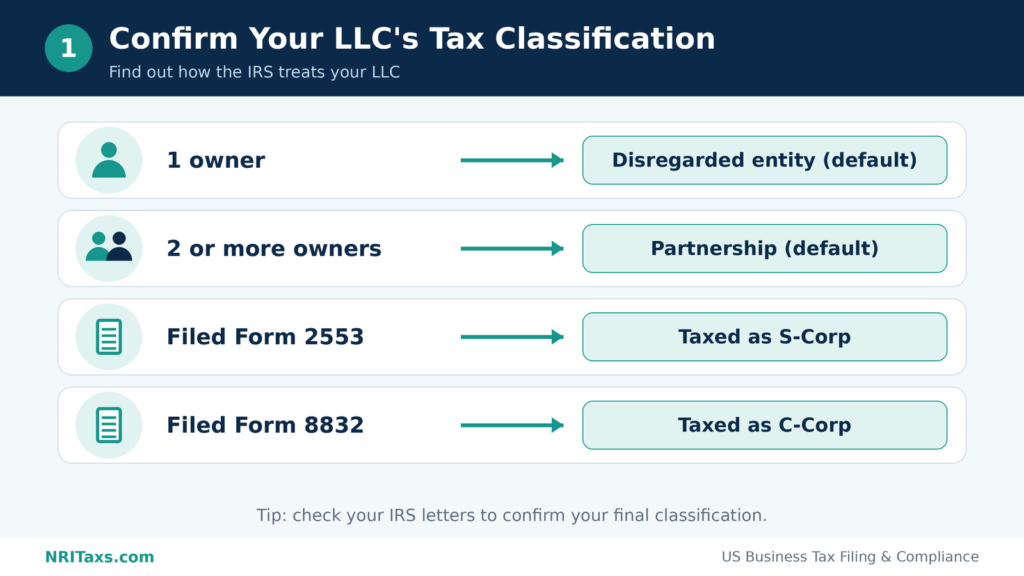
Check how the IRS treats your LLC. One owner means a disregarded entity by default, and two or more owners means a partnership. If you filed Form 2553 or Form 8832, you are taxed as an S-corp or C-corp. Review your IRS letters carefully, because your classification decides every form you file.
Step 2: Gather Your Financial Records
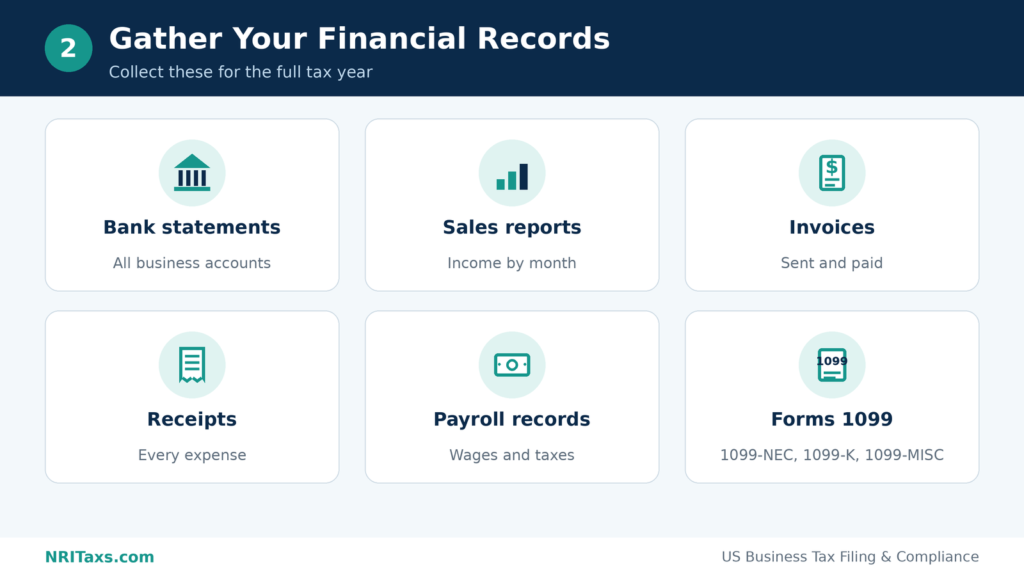
Collect all income and expense records for the full year. This includes bank statements, sales reports, invoices, receipts, payroll records, and any Forms 1099-NEC, 1099-K, or 1099-MISC you received. Reconcile your books so income matches your bank deposits. Clean records make filing faster and protect you if the IRS asks questions.
Step 3: Understand Your Deadlines
| LLC Tax Type | Main Form | Due Date (Tax Year 2026) | Extension Form and New Due Date |
| Single-member LLC | Schedule C with Form 1040 | April 15, 2027 | Form 4868 · October 15, 2027 |
| Multi-member LLC (partnership) | Form 1065 | March 15, 2027 | Form 7004 · September 15, 2027 |
| LLC taxed as S-corp | Form 1120-S | March 15, 2027 | Form 7004 · September 15, 2027 |
| LLC taxed as C-corp | Form 1120 | April 15, 2027 | Form 7004 · October 15, 2027 |
| Forms W-2 and 1099-NEC | Copies to workers and the IRS | February 1, 2027 | No automatic extension |
| Estimated taxes | Form 1040-ES | April 15, June 15, September 15, January 15 | Not applicable |
Extensions give you more time to file, not more time to pay. For a wider view of US due dates, forms, and filing tips, read our US tax filing guide.
2027 update: January 31, 2027 falls on a Sunday, so Forms W-2 and 1099-NEC are due on Monday, February 1, 2027. Also, the 1099-NEC and 1099-MISC reporting threshold is now $2,000 for payments made in 2026, up from $600.
Step 4: Calculate Your Deduction
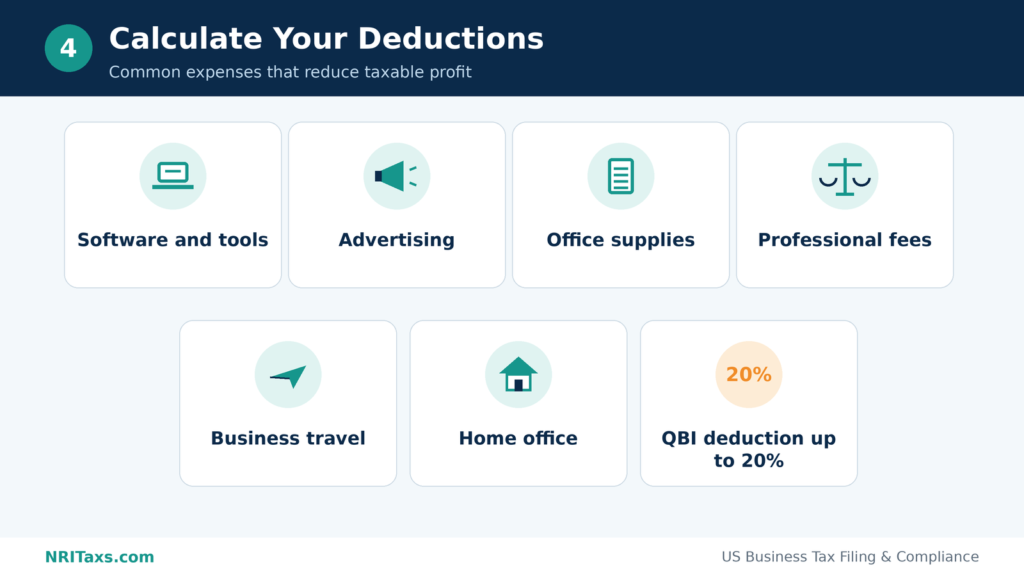
Lower your taxable profit by claiming ordinary and necessary business expenses. Common deductions include software, advertising, office supplies, professional fees, business travel, and a home office. Pass-through owners may also qualify for the qualified business income (QBI) deduction of up to 20%. Keep receipts and short notes for every claim you make.
Step 5: File the Correct Forms
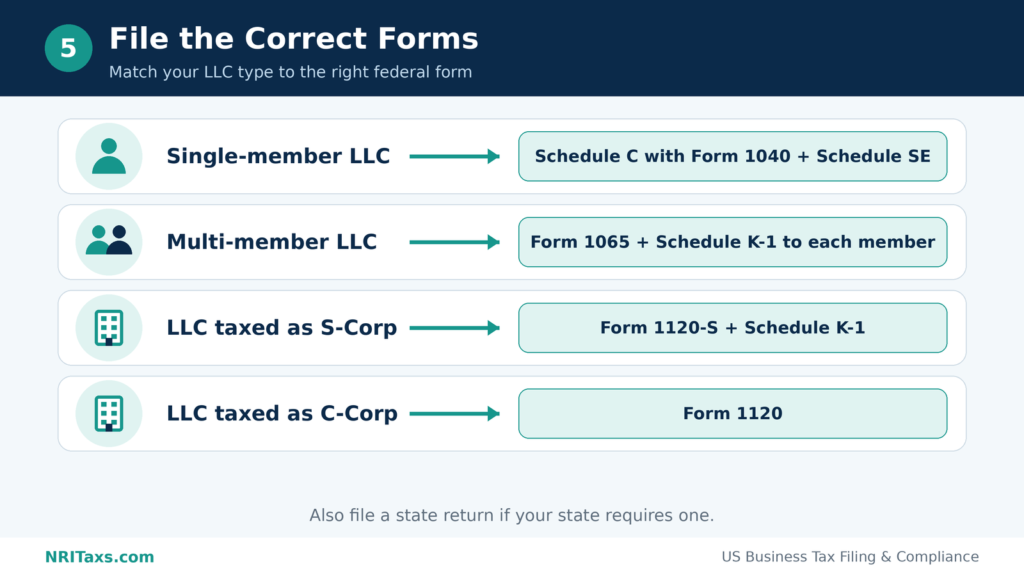
Use the form that matches your classification. Single-member LLCs file Schedule C with Form 1040. Multi-member LLCs file Form 1065 and issue Schedule K-1s. S-corps file Form 1120-S, and C-corps file Form 1120. Sole owners and partners add Schedule SE for self-employment tax. Also file any state return that your state requires.
Step 6: Set Up Estimated Tax Payments
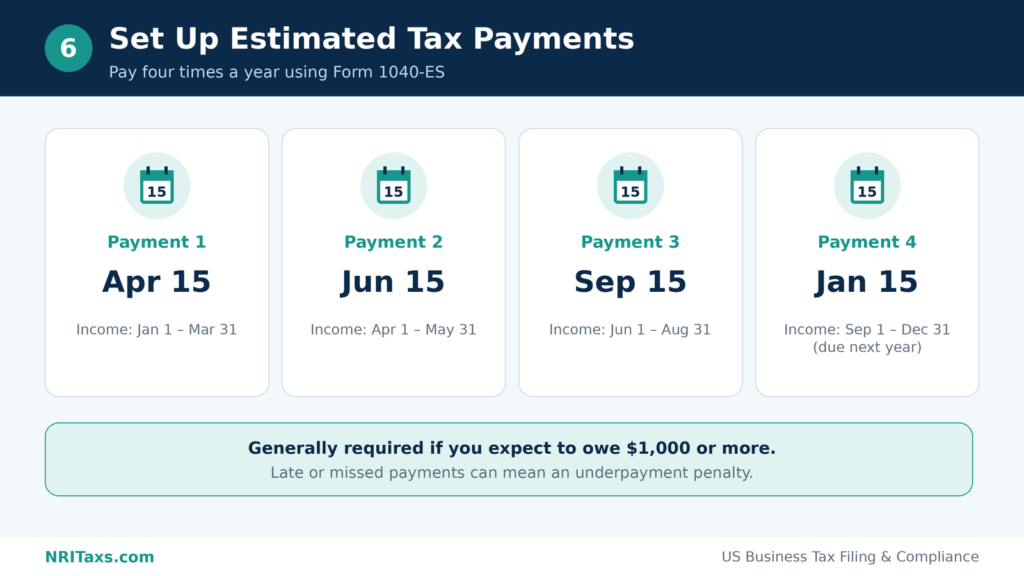
LLC owners usually have no tax withheld, so you must pay as you earn. Pay estimated taxes four times a year using Form 1040-ES, generally if you expect to owe $1,000 or more. Missing these payments can trigger an underpayment penalty, even if you pay the full balance later when you file.
Does an LLC Need to File Taxes If It Makes No Money?
Yes, in many cases. An LLC with no income may still need to file, depending on how it is taxed. A single-member LLC with no income and no expenses may have nothing to report. A multi-member LLC with any expenses must file Form 1065, and an LLC taxed as an S-corp or C-corp must file every year. Skipping a required return can lead to penalties. Read our guide on whether an LLC needs to file taxes with no income for the exact rules by LLC type.
First-Year LLC Tax Filing Mistakes to Avoid
Mistake 1: Mixing Personal and Business Expenses
Using one account for personal and business spending makes your books messy and hard to defend. It can also weaken the liability protection your LLC gives you. Open a separate business account and card from day one, and pay yourself only through owner draws or payroll.
Mistake 2: Missing the S-Corp Election Deadline
To be taxed as an S-corp for the full year, Form 2553 is generally due within two months and 15 days after the tax year begins. Missing this date can delay the election by a full year or force you to request late-election relief from the IRS.
Mistake 3: Forgetting Self-Employment Tax
Single-member LLC owners and partners usually owe self-employment tax of 15.3% on net earnings, which covers Social Security and Medicare. Many first-timers budget only for income tax and get surprised later. Set aside part of every payment to cover both taxes.
Mistake 4: Failing to Issue 1099s or W-2s Correctly
If you pay a contractor $2,000 or more in 2026, you generally must send Form 1099-NEC. Employees receive Form W-2. Both are due February 1, 2027. Collect a Form W-9 before the first payment, and classify every worker correctly to avoid penalties.
Mistake 5: Not Keeping Organized Records for Deductions
Deductions without proof can be denied in an audit. Save receipts, invoices, mileage logs, and bank statements for at least three years. Use accounting software and update it monthly, so you are never rebuilding the whole year at tax time.
When Your LLC Needs Professional Help
- You have partners or changing ownership. Profit splits, Schedule K-1s, and capital accounts get complicated quickly, and one mistake can affect every single member.
- You are thinking about an S-corp election. A professional can estimate the savings, set a reasonable salary, and file the election correctly and on time.
- You have employees or contractors. Payroll taxes, W-2s, 1099s, and worker classification follow strict rules, and errors often lead to costly penalties.
- You sell in several states, have foreign owners, or received an IRS notice. These cases add extra forms, deadlines, and a higher risk of costly mistakes.
How NRITaxs Helps LLC Owners Prepare for Tax Season
LLC Tax Filing Assistance
Our experts prepare and file your federal and state LLC returns, including Schedule C, Form 1065, Form 1120-S, and Form 1120. We confirm your classification and check every form carefully before your deadline.
Simplified Bookkeeping Support
We organize your income, expenses, and bank records so your books are clean and ready at tax time. Accurate monthly bookkeeping saves hours at filing and helps you find deductions you might otherwise miss.
Tax Planning to Help Minimize Tax Liability
We review your income and structure through the year to find legal ways to lower your tax bill, from deductions and retirement contributions to deciding whether an S-corp election makes sense for you.
Updates on Important Tax Law Changes
Tax rules change often. We keep you informed about new thresholds, deadlines, and forms, such as the higher $2,000 Form 1099 limit, so you never miss a change that affects your LLC.
Comprehensive Tax Guidance and Advisory Services
From choosing the right structure to handling IRS notices, our team guides you at every stage. You get clear advice for your situation, including help for LLC owners with both US and India tax questions.

Conclusion
File LLC taxes for the first time becomes simple once you know your tax classification. Confirm how your LLC is taxed, keep clean records, claim every valid deduction, file the right forms on time, and pay estimated taxes during the year. Avoid the common first-year mistakes, such as mixing personal and business finances or missing the S-corp deadline. Planning early saves you stress, penalties, and money, and it makes every following tax season easier to handle with confidence. If your situation feels complex, get expert help before the deadline, not after it.
Disclaimer
The content published on NriTaxs is intended for informational purposes only and does not constitute legal, tax, or financial advice. Readers are encouraged to consult qualified professionals before making any decisions based on the information provided.






Related Articles